Home Office Deduction for Side Business: 2026 Guide

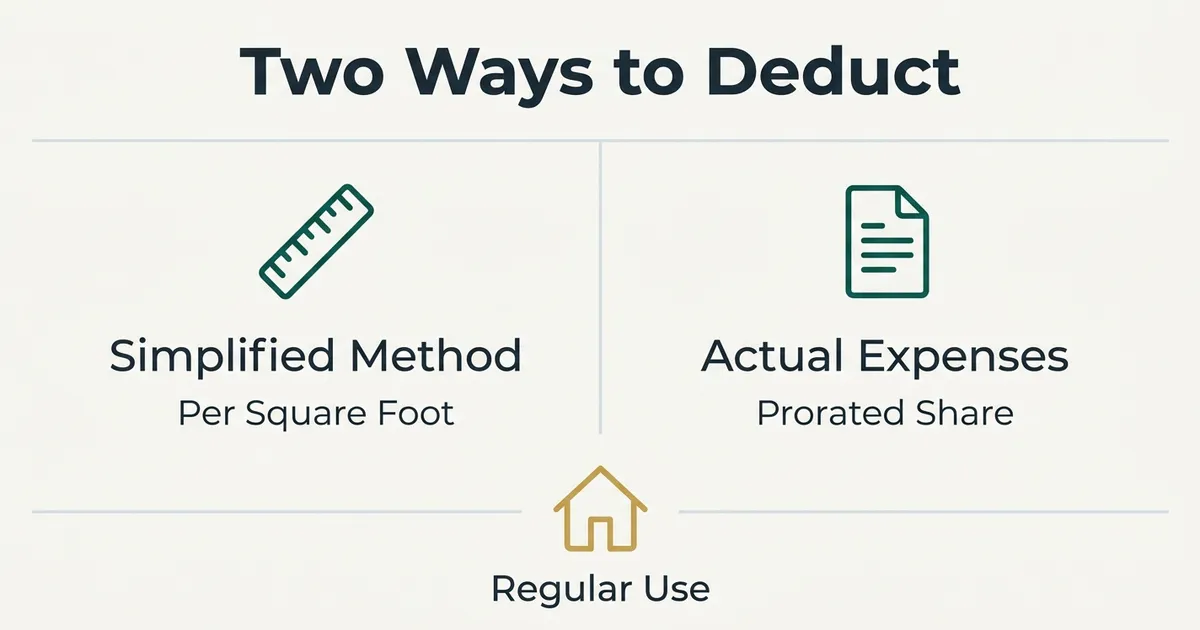
The home office deduction for a side business lets you write off $5 per square foot of dedicated office space (up to 300 square feet, a $1,500 cap) or a prorated share of your actual housing costs, as long as you use the space regularly and exclusively for that business.
Most parents running a side hustle from a spare bedroom, garage, or converted closet qualify for one of these two methods without realizing it. According to the IRS Statistics of Income Division (2025), more than 28 million individual returns reported nonfarm sole proprietorship income, and a large share of those filers never claim the home office deduction because they assume it applies only to full-time freelancers with a separate office suite.
That assumption costs real money. A parent who nets $8,000 a year selling handmade goods on Etsy or doing weekend bookkeeping for neighbors, and who never claims a legitimate home-office deduction, is paying income tax and self-employment tax on profit that federal law explicitly lets them shelter.
What Qualifies as a Home Office for a Side Business?
Your space qualifies if you use it regularly and exclusively for business, and it's either your principal place of business or where you regularly meet clients, per Internal Revenue Code Section 280A(c)(1). "Exclusive use" means no personal activity happens there — a spare room doubling as a guest bedroom or the kids' homework station fails the test even if you work there 20 hours a week.
The mechanism behind this rule is that Congress wanted to prevent taxpayers from converting personal living space into a tax deduction by simply doing paperwork at the kitchen table. According to IRS Publication 587 (2025), Business Use of Your Home, you can still qualify under the "principal place of business" test even if you meet clients elsewhere, as long as you use the home office for administrative or management activities — invoicing, bookkeeping, ordering supplies — and have no other fixed location where you regularly conduct those tasks.
One exception matters directly for this audience: parents who run a licensed home daycare. Under IRC Section 280A(c)(4), a family daycare provider can claim a home office deduction on space used for both business and personal purposes, because the exclusive-use test is waived for daycare operations that use state-licensed facilities such as a playroom or kitchen shared with the family. The deduction is instead prorated by hours of business use versus total hours in the day, not just square footage.
The most common disqualifying mistake is claiming a multi-purpose room. If your "office" is also where the family watches television most evenings, the IRS can deny the entire deduction on audit, not just reduce it, because exclusive use is an all-or-nothing test under Section 280A.
How Much Can You Deduct: Simplified vs. Actual Expense Method?
The simplified method deducts $5 per square foot of home office space, capped at 300 square feet for a maximum $1,500 deduction, per IRS Revenue Procedure 2013-13 (2013), which remains unchanged for the current tax year. The actual expense method instead applies your business-use percentage — office square footage divided by total home square footage — to your real costs: mortgage interest, rent, utilities, homeowners insurance, repairs, and depreciation, reported on IRS Form 8829, Expenses for Business Use of Your Home (2025).
Here's how the two compare with real numbers. A parent with a 2,000-square-foot home and a 200-square-foot converted garage office uses 10% of the home for business. If total annual housing costs — mortgage interest, utilities, insurance, and repairs — run $24,000, the actual expense method yields roughly $2,400 (10% of $24,000). The simplified method caps out at $1,000 (200 square feet × $5) in this case, so the actual method wins by $1,400.
Choose the simplified method if you rent a modest apartment, have low utility costs, or want to skip depreciation recordkeeping — it takes minutes to calculate and carries no depreciation-recapture exposure when you sell your home. Choose the actual expense method if you own a higher-cost home, especially in a high-property-tax state like California, and are willing to track receipts, because the deduction typically runs two to three times higher than the $1,500 simplified cap.
The trade-off with the actual method is depreciation recapture: the business-use portion of home depreciation you claim must be recaptured as unrecaptured Section 1250 gain, taxed at up to 25%, when you sell the home, according to IRS Publication 523 (2025), Selling Your Home. Renters never face this issue since there's no home depreciation to recapture.
What Is the $2,500 Expense Rule for Business Equipment?
The $2,500 rule is the de minimis safe harbor election, which lets you deduct the full cost of any business equipment or supply item costing $2,500 or less per invoice or item in the year you buy it, instead of depreciating it over several years. This threshold comes from Treasury Regulation Section 1.263(a)-1(f), raised from $500 to $2,500 by IRS Notice 2015-82 (2015) for taxpayers without an applicable financial statement — which covers nearly every side-business owner filing a Schedule C.
The mechanism matters because normal tax law would otherwise force you to depreciate a $1,200 laptop over five years or office furniture over seven years under the Modified Accelerated Cost Recovery System. The safe harbor election skips that entirely: buy a $2,200 standing desk on one invoice and a $650 monitor on a separate invoice, and both amounts are fully deductible in the purchase year rather than spread out. The election applies per item or per invoice, not to your total annual spending, so multiple qualifying purchases in the same year don't get combined and disqualified.
For equipment above $2,500 per item — a $4,000 commercial embroidery machine, for example — Section 179 expensing may let you deduct the full cost immediately instead, subject to an annual dollar cap the IRS adjusts for inflation each year. For tax years beginning in 2026 that cap is $2,560,000, reduced dollar-for-dollar once Section 179 property placed in service exceeds $4,090,000, per IRS Revenue Procedure 2025-32 (2026). Those ceilings sit far above what a typical side hustle spends, so the practical limit for most parents is the separate rule that Section 179 cannot create or increase a business loss: per IRS Publication 946 (2025), How To Depreciate Property, the deduction is capped at your taxable income from actively conducted trades or businesses, and any cost disallowed by that cap carries forward to the next year rather than being lost. The de minimis safe harbor and Section 179 can both apply in the same year to different purchases, so track receipts by item cost to route each one to the right deduction.
How Does Self-Employment Tax Interact With the $400 Rule?
If your side business nets $400 or more in profit for the year, you must file Schedule SE and pay self-employment tax, currently 15.3% (12.4% for Social Security plus 2.9% for Medicare), according to the IRS Schedule SE Instructions (2025) and IRS Tax Topic 554, Self-Employment Tax. This threshold hasn't changed in decades and applies regardless of whether you also have a W-2 job.
The mechanism: self-employment tax is calculated on 92.35% of your net profit, not the full amount, because that 7.65% haircut mirrors the employer-paid half of payroll tax that a traditional employee's boss would otherwise cover. A side hustle that nets $3,000 after expenses generates self-employment tax of about $424 ($3,000 × 92.35% × 15.3%), and half of that amount — roughly $212 — is deductible above the line on Schedule 1, per IRC Section 164(f).
This is why stacking your home office deduction and the $2,500 de minimis election matters more than it looks. Every dollar of deduction that reduces your Schedule C net profit lowers both your income tax and your self-employment tax simultaneously — a $1,500 home office deduction at a 22% federal bracket plus 15.3% self-employment tax saves roughly $560 in combined federal tax, before any state tax savings, though once profit grows well past what deductions alone can shelter, it's worth comparing whether LLC or S-Corp? When a Family Side Business Should Elect S-Corporation Status cuts the self-employment tax bill further.
Can You Deduct a Home Office for Two Side Businesses?
Yes, but you must allocate the space between businesses, and the simplified method's 300-square-foot cap applies across all businesses combined, not per business. According to IRS guidance on the Simplified Option for Home Office Deduction (IRS.gov, 2025), a taxpayer with more than one qualified business use of the same home must divide the actual square footage among each business using a reasonable method.
A common scenario for this audience: one parent sells handmade goods through an Etsy shop and also does freelance bookkeeping from the same converted garage. If the space totals 250 square feet and each business uses it roughly half the time, allocate 125 square feet to each Schedule C and apply the simplified method separately, keeping the combined total under the 300-square-foot ceiling. If the businesses use the space at different times of day rather than splitting square footage, allocate by a documented time log instead, since IRS Publication 587 (2025) requires a reasonable, consistently applied allocation method.
Don't try to claim 300 square feet for each business by treating them as unrelated — the cap is per home, not per Schedule C, and claiming it twice is a straightforward double-dip an IRS matching program can catch by cross-referencing two Schedule Cs filed under the same address.
What Mistakes Trigger an IRS Notice or Denial?
The most common denial trigger is claiming a room that fails the exclusive-use test — a converted dining room still used for family meals, or a bedroom that also stores personal items, gets the entire deduction disallowed on audit rather than just reduced. A second frequent error is claiming a home office deduction against W-2 wage income with no accompanying Schedule C, since the deduction only attaches to self-employment or business income reported on Schedule C, per IRS Publication 587 (2025).
A third mistake is mixing methods: claiming the simplified $5-per-square-foot rate while also depreciating the same office space on Form 8829 in the same tax year. The IRS requires you to pick one method per business per year; you can switch methods year to year, but not blend them within a single return.
Keep supporting records — a floor plan or photo showing the office boundaries, utility bills, and a log of business use — for at least three years from your filing date, the standard IRS statute of limitations under IRS Tax Topic 305, Recordkeeping (2025), or six years if you underreported gross income by more than 25%.
How Do You Claim the Home Office Deduction on Your Tax Return?
- Confirm eligibility. Verify the space passes the regular-and-exclusive-use test and either the principal-place-of-business or client-meeting test under IRC Section 280A.
- Measure the office. Record the exact square footage of the dedicated business space and your home's total square footage.
- Choose your method. Compare the simplified $5-per-square-foot calculation against a rough actual-expense estimate before committing, since you can pick whichever yields a bigger deduction.
- Gather actual costs if using the actual method: mortgage interest or rent, utilities, homeowners or renters insurance, repairs, and depreciation documentation.
- Calculate your business-use percentage by dividing office square footage by total home square footage.
- Complete the right form — Form 8829 for the actual expense method, or the Simplified Method Worksheet in the Schedule C instructions for the simplified option, per the IRS Instructions for Form 8829 (2025).
- Transfer the deduction to Line 30 of IRS Schedule C, Profit or Loss From Business (2025), which flows into your net profit before Schedule SE calculates self-employment tax.
- File supporting documentation in your own records — not with the return — including photos, floor plans, and utility statements, in case of an IRS inquiry.
Where Should the Tax Savings Go for Your Kids?
The combined income-tax and self-employment-tax savings from a properly claimed home office deduction — often $500 to $600 a year on a $1,500 to $2,400 deduction — is money you can redirect into a custodial Roth IRA for a child with earned income, rather than letting it disappear into general spending. If it is earmarked for a nearer-term goal instead, park it somewhere that actually pays — high-yield savings, money market accounts and CDs compared covers how to match the account to the timeline, and a money market account is the usual home for a quarterly estimated-tax reserve you need to write checks against. Custodial Roth IRA contributions are capped at the child's earned income or the annual IRA limit, whichever is lower, per IRS guidance on IRA contribution limits (2025); compare providers on the best custodial Roth IRA providers to find low-minimum options that fit a teen's part-time earnings from helping with the family business. Generating that earned income in the first place is its own set of payroll rules — how to hire your kids and pay them tax-free covers the W-2 paperwork and the FICA exemption that make the wage deductible. If the savings are better parked toward your own retirement instead of a child's account, Solo 401k 2026: How Self-Employed Parents Cut Taxes covers the two-part contribution limits and how the 2026 Roth catch-up rule applies — and, for most sole proprietors, does not apply — once the same Schedule C profit funds a retirement plan. The same business can also reimburse the family's medical costs pre-tax; writing off family health expenses through an HRA or HSA is the companion deduction.
Home office savings compound with other family tax moves covered under the broader tax-saving strategies for families pillar. The Child Tax Credit, worth up to $2,200 per qualifying child for the current tax year under the One Big Beautiful Bill Act (July 2025), stacks independently of your home office deduction — see Child Tax Credit maximization strategies for phase-out thresholds by income, and if childcare costs are what's funding the side hustle in the first place, Childcare Tax Credit vs. Dependent Care FSA in 2026 walks through which one to claim. If your home office runs on solar power or you're weighing an efficiency upgrade that also lowers the utility costs feeding into your actual-expense calculation, the solar tax credits and utility savings guide covers the federal credit percentage and how it interacts with a home-based business.
Disclaimer: This article explains general federal tax rules current as of July 2026 and is not personalized tax, legal, or financial advice. Confirm current-year figures with the IRS or a licensed tax professional before filing, since dollar thresholds and phase-out ranges adjust annually.
Frequently asked questions
How does the new $6,000 deduction work?
The $6,000 deduction is not part of the home office deduction — it's a new additional deduction for taxpayers age 65 and older created by the One Big Beautiful Bill Act (July 2025), available for tax years 2025 through 2028. It provides up to $6,000 per qualifying senior ($12,000 for a married couple filing jointly if both spouses are 65 or older), phasing out for higher earners, and applies regardless of whether the taxpayer itemizes.
What is the $2,500 expense rule?
The $2,500 expense rule is the de minimis safe harbor election under Treasury Regulation Section 1.263(a)-1(f), which lets a side-business owner deduct the full cost of any equipment or supply item costing $2,500 or less per invoice immediately, instead of depreciating it over several years. IRS Notice 2015-82 (2015) raised this threshold from $500 to $2,500 for taxpayers without an applicable financial statement, which covers the vast majority of Schedule C filers.
What is the $400 rule for self-employed people?
The $400 rule means that once your net self-employment earnings reach $400 or more in a year, you must file Schedule SE and pay self-employment tax, currently 15.3%, per IRS Tax Topic 554, Self-Employment Tax (2025). This applies even if your only income source is a small side hustle and even if you already have taxes withheld from a separate W-2 job.
Can I write off my home office as a business expense?
Yes, if you're self-employed and use part of your home regularly and exclusively for that business, either as your principal place of business or where you regularly meet clients, under IRC Section 280A(c)(1). W-2 employees generally cannot claim this deduction on their federal return because the Tax Cuts and Jobs Act suspended unreimbursed employee business expense deductions, though states like California may still allow it at the state level, according to the California Franchise Tax Board (2025).
Can I deduct home office for two businesses?
Yes, but you must allocate the space between the two businesses using a reasonable, documented method, and the simplified method's 300-square-foot cap applies across all businesses in the home combined, not separately for each one, according to IRS guidance on the Simplified Option (2025). If the businesses use the same physical space at different times, allocate by a time log instead of splitting square footage.
Can I deduct my office if I work from home?
You can deduct a home office only if you're self-employed and file a Schedule C for that income; working from home as a W-2 employee does not qualify for the federal home office deduction under current law, per IRS Publication 587 (2025). If you run a side business from home in addition to a W-2 job, the deduction applies only against the self-employment income, calculated using the simplified or actual expense method described above.