
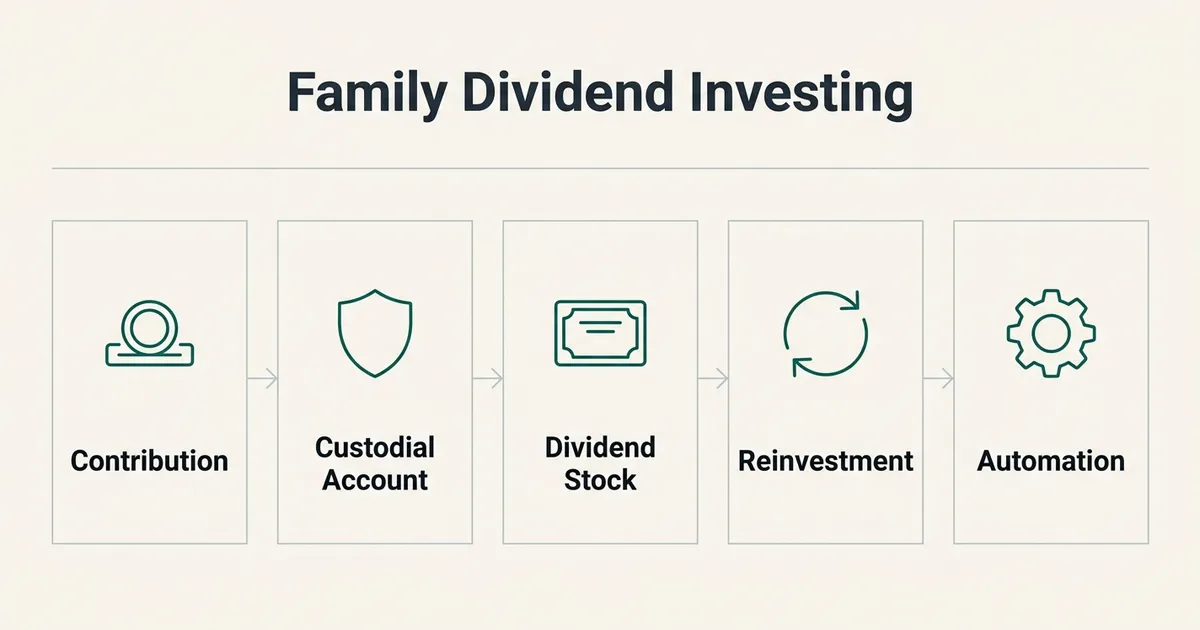
Parents saving $50 to $500 a month for a young child increasingly look past traditional savings accounts toward custodial brokerage accounts that hold dividend-paying stocks and funds. The appeal is straightforward: dividends can be reinvested automatically for years before a child ever touches the money, compounding quietly in the background while the account also teaches long-term ownership habits. But "family dividend investing" sits at the intersection of several technical systems — custodial account law, federal and state tax rules, and portfolio construction — that don't always point in the same direction. This hub orients parents to that landscape before they open an account or place a first trade, and the linked guides below go deeper on each individual decision.
What Is Family Dividend Investing?
Family dividend investing, in the scope of this hub, means using a custodial brokerage account — most commonly a UTMA or UGMA account — to hold dividend-paying stocks, ETFs, or mutual funds on behalf of a minor, with the goal of generating recurring, reinvestable income rather than relying solely on price appreciation. It differs from general retirement or FIRE investing because the account belongs irrevocably to the child once funded, and it differs from a 529 plan because the money is not restricted to education expenses and the tax treatment follows a different set of federal rules known as the "kiddie tax."
Parents typically arrive at this strategy for one of two reasons: funding recurring extracurricular costs (music lessons, sports fees, camp) from years of accumulated dividend cash flow, or building a long-horizon wealth transfer that compounds for one to two decades before the child gains control of the account.
Because the underlying assets are ordinary brokerage securities, the mechanics of dividend investing itself — dividend yield, payout frequency, ex-dividend dates, qualified versus ordinary dividend tax treatment — work the same way inside a custodial account as they would in an adult's taxable account. What changes is who owns the account, how it's taxed, and when the child gains control of it.
Why Use a Custodial Account for Dividend Income Specifically?
A custodial account is not the only vehicle available to parents wanting to invest for a child, but it is the one best suited to dividend-focused, non-education-restricted investing. Its core advantage is flexibility: unlike a 529 plan, funds are not limited to qualified education expenses, and unlike a trust, no attorney-drafted document is required to open one — most major brokerages allow a parent to open a UTMA or UGMA account online in the same way they'd open a personal brokerage account.
The tradeoff is control, and it is permanent. According to the Uniform Law Commission (1986), which drafted the Uniform Transfers to Minors Act, assets transferred into a custodial account become the irrevocable property of the minor, held by the custodian only until the statutory termination age is reached; the custodian's authority is limited to managing the property for the minor's benefit, never the custodian's own. A parent cannot later reclaim contributed funds, even in a financial emergency.
This irrevocability matters more for dividend investing than it might for a simple buy-and-hold index strategy, because dividend income generated inside the account is taxable income belonging to the child each year it's received — whether or not it's ever withdrawn. That single fact drives much of the tax planning covered later on this hub and in the linked guides.
UTMA or UGMA: Which Custodial Account Fits Dividend Investing?
Parents opening a custodial account for dividend investing will almost always choose between a Uniform Transfers to Minors Act (UTMA) account and the older Uniform Gifts to Minors Act (UGMA) account. According to Charles Schwab (2023), the practical difference for most investors is narrow: UGMA accounts, based on the original 1956 model act, are generally restricted to financial assets like cash, stocks, and mutual funds, while UTMA accounts, drafted in 1986, can also hold real estate, royalties, and other property types. For a parent whose plan is limited to dividend-paying stocks and funds, the two accounts function almost identically.
In practice, geography decides the question. According to the Uniform Law Commission (2024), every US state except South Carolina and Vermont has adopted UTMA — those two states still operate under UGMA statutes, so new custodial accounts there are UGMA accounts, generally terminating at age 18. Everywhere else, a new custodial brokerage account is a UTMA account by default.
Where states diverge meaningfully is termination age. According to Finaid's state-by-state age-of-majority tables (2024), most states set UTMA termination at 18 or 21, and a number of states let the person making the gift specify a later age within a statutory cap — Nevada, for example, permits the transferor to designate an age up to 25 at the time of the gift.
Because this hub uses California as its primary reference state, the California rule is worth stating precisely, since it is narrower than often assumed. According to California Probate Code § 3920.5 (2024), a custodianship created by an outright lifetime gift — the way a parent funding a brokerage account transfers money — ends at 18 by default, and the transferor may specify any age up to 21 in the transfer instrument. Delaying transfer to age 25 is available only for custodial property transferred from a will, a trust, or by a trustee, not for a parent's direct deposits. The election is made once, at the time of the transfer, and is difficult to change later. Parents in other states should confirm their own state's default and maximum ages with their brokerage, since the Uniform Act has not been adopted identically everywhere.
How Does the Kiddie Tax Apply to a Child's Dividend Income?
The single most important tax mechanism for family dividend investing is the federal "kiddie tax," which governs how a child's unearned income — including dividends — is taxed each year regardless of the custodial account's home state. According to the Internal Revenue Service (2025), in Revenue Procedure 2025-32 setting inflation-adjusted amounts for the 2026 tax year, the structure works in three bands:
| Child's unearned income (2026 tax year) | How it's taxed |
|---|---|
| First $1,350 | Not taxed (standard deduction for unearned income) |
| Next $1,350 (up to $2,700 total) | Child's own rate — typically 10% |
| Above $2,700 | Parent's marginal rate |
This structure exists specifically to prevent parents from shifting large investment portfolios into a child's name purely to access lower tax brackets, and it directly caps how much dividend income a family can generate before the tax advantage of a custodial account starts to erode. The thresholds are inflation-adjusted annually, so verify the current year's figures in the IRS's annual revenue procedure before filing.
For a portfolio funded at $50–$500 a month, actual annual dividend income in the early years typically sits well under the $2,700 threshold, meaning many families in this hub's target range will owe little or no federal tax on custodial dividends for several years. According to the IRS (2025) instructions for Form 8615, once a child's unearned income exceeds the threshold, the parent generally must either report it on the parent's own return (if eligible, via Form 8814) or file Form 8615 with the child's return calculating tax at the parent's rate — an administrative step families should anticipate before a dividend portfolio grows large, since failure to file when required carries the same late-filing consequences as any other required return.
State tax adds a layer that varies by state. California, this hub's reference state, taxes a resident child's income under its own rules and — unlike the federal system — offers no preferential rate for qualified dividends, a point covered in the next section. Families should verify their own state's filing thresholds with their state revenue department rather than assume full federal conformity.
Qualified vs. Ordinary Dividends: Why the Distinction Matters More in a Kiddie-Tax Account
Not all dividends are taxed the same way, and the qualified/ordinary distinction becomes more consequential inside a custodial account because it interacts with the kiddie tax's parent-rate provision. According to the IRS (2025), qualified dividends — generally those paid by US corporations and certain foreign corporations on stock held for a minimum holding period — are taxed at long-term capital gains rates of 0%, 15%, or 20% depending on income, while non-qualified (ordinary) dividends are taxed at regular income rates.
Because income above the kiddie-tax threshold is taxed at the parent's marginal rate, a custodial portfolio weighted toward ordinary-dividend payers — such as certain REITs or high-yield bond funds — can generate a meaningfully higher tax bill at the parent's rate than an equivalent portfolio weighted toward qualified-dividend-paying blue-chip stocks or broad equity ETFs. According to the Securities and Exchange Commission (2023), REIT dividends are frequently taxed as ordinary income specifically because REITs are structured to avoid corporate-level tax, passing that liability through to shareholders.
State treatment can erase the distinction entirely: according to the California Franchise Tax Board (2024), California taxes all dividend income — qualified or not — as ordinary income, with no preferential state rate. Families building a custodial dividend strategy for tax efficiency generally weigh both layers when choosing between individual dividend stocks, dividend-focused ETFs, and higher-yield alternatives like REIT funds.
Building a Dividend Portfolio for a Child's Account
Portfolio construction inside a custodial account follows the same investment principles that apply to any long-horizon dividend strategy, adjusted for the fact that the time horizon (often 10–20+ years until the child needs the funds) is unusually long and predictable for a retail account.
Broad-market funds alone won't produce much current income: according to S&P Dow Jones Indices data compiled by Multpl (July 2026), the S&P 500's dividend yield stood near 1.1%, well below its long-run historical median, meaning a portfolio built purely from broad-market index funds will produce comparatively modest dividends relative to price growth — a tradeoff many families accept in exchange for diversification and lower volatility. Parents seeking higher current income typically look to dedicated dividend-growth or high-yield equity funds, individual dividend-paying blue-chip stocks, or a blend. Cost matters at this scale: according to Vanguard (2024), the Vanguard High Dividend Yield ETF (VYM) charges a 0.06% expense ratio — about $6 a year per $10,000 invested — which is why broad, low-cost dividend index funds remain a common building block for smaller monthly contribution amounts rather than concentrated individual-stock picking.
For families contributing $50–$500 a month, fractional-share investing has become a practical enabler of diversification. According to FINRA (2023), fractional-share trading is now widely offered at major US brokerages, making it possible for small, recurring contributions to be spread across multiple dividend-paying holdings rather than concentrated in a single stock purely because of its share price.
Diversification across sectors also matters more in a dividend-focused account than in a pure growth account, because dividend cuts tend to cluster by sector during economic stress. According to the Federal Reserve's Survey of Consumer Finances (2023), 58% of US families held stock directly or indirectly, but household equity wealth remains heavily concentrated in a small number of large-cap names — a concentration risk a dividend-focused custodial portfolio inherits if it isn't deliberately diversified across industries rather than simply across ticker count.
What Does $200 a Month Actually Produce? A Worked Example
Parents evaluating whether this strategy is worth years of monthly contributions usually want a sense of scale. The following is an illustration using round numbers and historical averages, not a projection or a promised outcome — any real decade can land well above or below it.
Take a family contributing $200 a month ($2,400 a year) into a diversified dividend-oriented ETF portfolio yielding 2.5%. In year one, dividends are trivial: the average invested balance is only about $1,200, so the account throws off roughly $30 — far below any tax threshold. The engine is time. According to S&P Dow Jones Indices (2024), the S&P 500's long-run total return (price appreciation plus reinvested dividends) has averaged roughly 10% annually over multi-decade periods; at a more conservative illustrative 7%, fifteen years of $200 monthly contributions compound to roughly $63,000, of which $36,000 is contributions and the rest growth. At a 2.5% yield, that balance generates about $1,575 a year in dividends — still under the kiddie-tax parent-rate threshold ($2,700 for 2026, per the IRS), but close enough that the family should be watching it.
The same arithmetic locates the tax planning milestone: at a 2.5% yield, dividend income crosses $2,700 once the balance passes roughly $108,000. A family contributing $200 a month reaches that zone only after many years or strong markets; a family contributing $500 a month, or one that front-loads a windfall, reaches it much sooner. Dollar-cost averaging — investing the fixed amount on schedule regardless of market level — removes the need to time any of these purchases, which is exactly what the automation below is for. It does not eliminate risk or guarantee a profit in any period, a point to weigh against any online calculator that presents a single projected ending balance as a certainty.
Automating Contributions and Dividend Reinvestment
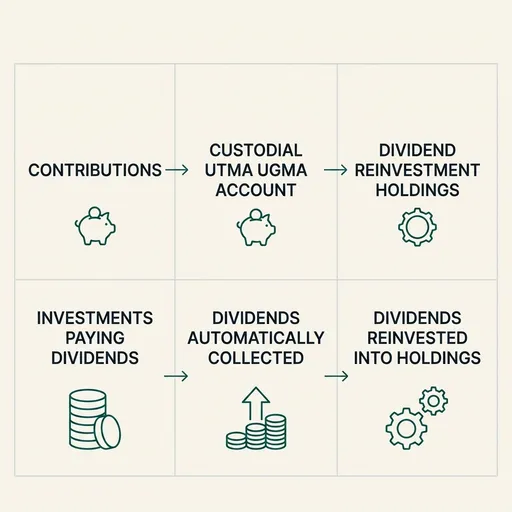
Automation is central to making a $50–$500/month custodial dividend strategy sustainable over a decade or more, because manual monthly trading decisions are the most common point of abandonment for small recurring investment plans.
Two layers apply. First, automatic recurring contributions — scheduled transfers from a parent's bank account into the custodial brokerage account — remove the need to remember a monthly transfer and the temptation to skip one. Major brokerages support scheduling these on custodial accounts at no cost.
Second, a Dividend Reinvestment Plan (DRIP) automatically uses cash dividends to purchase additional shares (or fractional shares) of the paying security, rather than letting the dividend sit as uninvested cash. According to the U.S. Securities and Exchange Commission (2023), dividend reinvestment plans let investors compound returns by continuously increasing share count without manual reinvestment decisions, and most major US brokerages offer DRIP enrollment at no additional cost on custodial accounts. For a family investing small monthly amounts, DRIP is what allows a $30 quarterly dividend on a $200 position to actually contribute to compounding rather than sitting idle.
One tax-reporting note: reinvested dividends are still taxable income in the year received, even though no cash left the account. A fully automated DRIP portfolio can cross the kiddie-tax threshold without any active trading decision by the parent — which is why the worked example above tracks the balance at which that happens.
Custodial Accounts vs. 529 Plans: Two Different Tools
Because custodial accounts and 529 college savings plans are the two vehicles parents most often compare, the differences are worth laying side by side, even though 529 mechanics belong to a sibling topic area rather than this hub.
| Factor | UTMA/UGMA custodial account | 529 plan |
|---|---|---|
| Use of funds | Any purpose benefiting the child | Qualified education expenses to keep tax benefits (Saving For College, 2024) |
| Who controls it long-term | Child, irrevocably, at state termination age | Account owner (typically the parent), indefinitely in most states |
| Federal tax on growth | Dividends/gains taxed annually under kiddie-tax bands | Tax-deferred; tax-free for qualified withdrawals |
| Investment choices | Any brokerage security, incl. dividend stocks/ETFs | Plan's menu, typically mutual-fund portfolios |
| FAFSA treatment | Student asset — assessed at up to 20% (Federal Student Aid, 2024) | Parent asset — assessed at up to 5.64% |
| Contribution limits | None (gift-tax rules apply) | State-set aggregate limits |
The FAFSA row deserves emphasis: according to Federal Student Aid (2024), student-owned assets — which is what custodial accounts are — are assessed at up to 20% in the federal aid formula, versus a maximum of 5.64% for parent-owned assets including 529 plans. A large custodial balance can therefore reduce need-based aid eligibility materially more than the same dollars in a 529.
This difference in restriction, control, and aid treatment is why many families this hub addresses use both vehicles for different purposes rather than choosing one exclusively: a 529 plan for anticipated education costs, and a custodial dividend account for extracurricular funding, a general wealth head-start, or goals beyond education.
What Happens When the Child Reaches the Age of Majority?
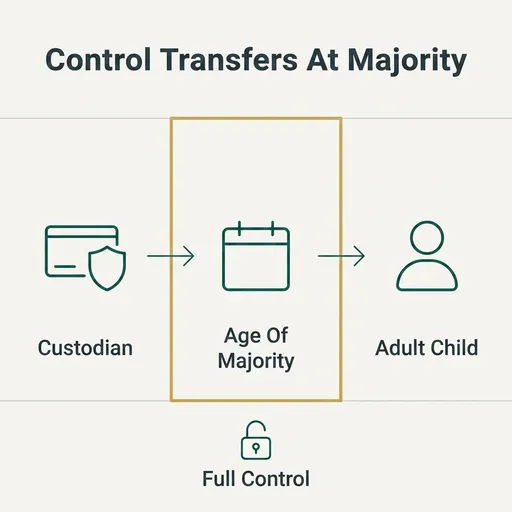
Every custodial dividend account has a built-in end date: the age at which state law transfers full control of the account — including the right to liquidate the entire portfolio — from the custodian to the now-adult child. This is arguably the single most consequential structural feature separating custodial dividend investing from other family investing strategies, and it is not modifiable after the fact.
Under the California framework used as this hub's reference example, that means a parent's directly gifted account transfers at 18 unless the paperwork specified an age up to 21, with 25 reachable only via will or trust transfers as covered in the account-selection section above. The planning implication is behavioral, not legal: a decade-plus of compounded dividends becomes an 18-to-21-year-old's unrestricted property at exactly the moment many families would prefer more guidance still applied. Some parents planning a large intended balance route the portion they'd rather protect through a different structure altogether (such as a trust), reserving the custodial account for money they're genuinely comfortable handing over at the statutory age. That structural decision sits partly outside this hub's investing-and-tax focus, but it belongs in the conversation before funding, not after.
Common Structural Mistakes Families Make
Several recurring errors show up across custodial dividend accounts, largely because the strategy blends investment decisions with tax and legal ones many parents haven't encountered before.
The first is treating the account like a personal brokerage account — planning as though contributed funds could be pulled back for the parent's own use later. As covered above, the governing Uniform Act makes the transfer irrevocable and limits the custodian to acting for the minor's benefit; money a family may need for itself doesn't belong in this account.
The second is under-anticipating the kiddie-tax filing obligation once dividend income crosses the federal threshold, leading to a surprise Form 8615 requirement in a year the family didn't expect one — the automated-DRIP scenario flagged in the automation section.
The third is over-concentrating a small monthly contribution in a single high-yield stock or narrow sector fund chasing current income. According to FINRA (2023), diversification remains one of the most consistently emphasized principles in retail investor education because concentrated positions carry outsized single-company and single-sector risk — and in a dividend strategy, a single cut can disrupt the account's entire income stream.
The fourth is choosing the wrong termination age for the family's actual goals — defaulting to 18 in a state that permits specifying 21 (or more, depending on the state and transfer type), without realizing the election generally cannot be revisited once the transfer is made.
How to Use the Guides Below This Hub
This overview intentionally stays at the landscape level; the specific mechanics of each decision are covered in the linked guides beneath this hub. A parent just starting out typically benefits from reading in roughly this order: first, the account-selection guide comparing UTMA, UGMA, and other custodial structures against the family's home-state rules; second, the kiddie-tax deep dive that walks through current-year thresholds, Form 8615 mechanics, and parent-rate calculations in more numeric detail than this overview provides; third, the portfolio-construction guide that compares individual dividend stocks, dividend ETFs, and diversification approaches suited to $50–$500 monthly contribution sizes; and finally, the automation and DRIP setup guide that walks through configuring recurring contributions and dividend reinvestment at the account level.
Families further along — those whose custodial dividend income is already approaching the kiddie-tax threshold, or whose child is nearing their state's termination age — will find more direct value starting with the tax and age-of-majority guides. Because state rules and IRS thresholds change annually, every guide in this cluster should be checked against current-year figures and the family's own state statute before finalizing an account structure, and no single article — including this one — substitutes for state-specific legal or tax advice on an unusually large or complex custodial account.
Guides in this cluster
- Dividend ETFs vs Stocks 2026: Best for Kids' Accounts?
- Custodial Account vs. 529 Plan: Which Wins in 2026?
- Best Dividend Stocks for Kids in 2026: ETFs vs Stocks
- Dividend Reinvestment Plan Setup for Kids in 2026
- Kiddie Tax Explained: 2026 Rules for Custodial Accounts
- UTMA vs UGMA Differences: Which Fits Your Child in 2026
- Monthly Dividend Portfolio for Kids: 2026 Guide
- 529 Plan Uses Beyond College in 2026: What Qualifies
- Dividend Income: How Much to Invest (2026 Guide)
- Brokerage Account for Kids: Custodial Guide (2026)