Monthly Dividend Portfolio for Kids: 2026 Guide

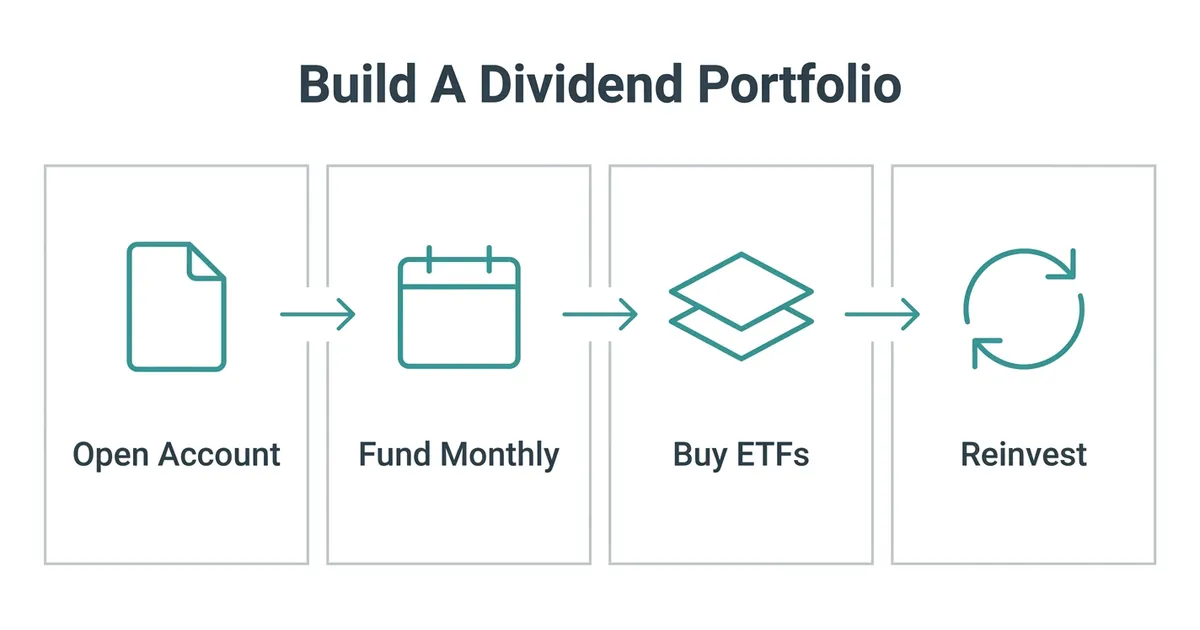
A monthly dividend portfolio for kids is a custodial brokerage account funded with $50–$500 a month and invested in dividend ETFs so payouts compound automatically. Most parents open a UTMA account, hold two or three low-cost ETFs, and turn on automatic dividend reinvestment (DRIP) so the account grows even when they forget to log in.
The appeal isn't retiring your eight-year-old — it's building a habit and a head start. A child who starts at age 3 has roughly 15 more years of compounding than one who starts at 18, and that time horizon matters more than the dollar amount you contribute in any single month. According to the SEC's Investor.gov (2026), custodial brokerage accounts opened under the Uniform Transfers to Minors Act (UTMA) let an adult custodian manage investments on a minor's behalf until the child reaches the state's age of majority, at which point control transfers irrevocably.
That irrevocability is the trade-off every parent needs to understand before funding one of these accounts: money you deposit is a completed gift to your child, not a family fund you can redirect later. Once you're clear on that, the mechanics — which account, which holdings, how the IRS taxes the dividends, and how to automate the whole thing — are straightforward enough to set up in one weekend.
How Much Do You Need to Start a Monthly Dividend Portfolio for Kids?
You can start with as little as $1, since most major brokers now support fractional shares and have eliminated account minimums for custodial accounts. According to FINRA (2026), federal rules do not set a minimum deposit for opening a brokerage account; the broker sets its own policy, and most large custodial-account providers require $0 to open.
The amount that actually matters is your monthly contribution, because dividend income scales with money invested, not with account age. A $100/month contribution invested in a fund yielding 3% produces about $36 a year in dividends after 12 months — small, but it compounds as those dividends buy more shares automatically. Contributing $50/month gets a child to roughly $7,200 invested by age 16 (assuming a start at age 4), before any market growth or reinvested dividends are counted; $300/month over the same 12 years puts in $43,200. The gap between $50 and $300 a month is the single biggest lever you control — bigger than fund selection or yield chasing.
Which Custodial Account Should You Open First?
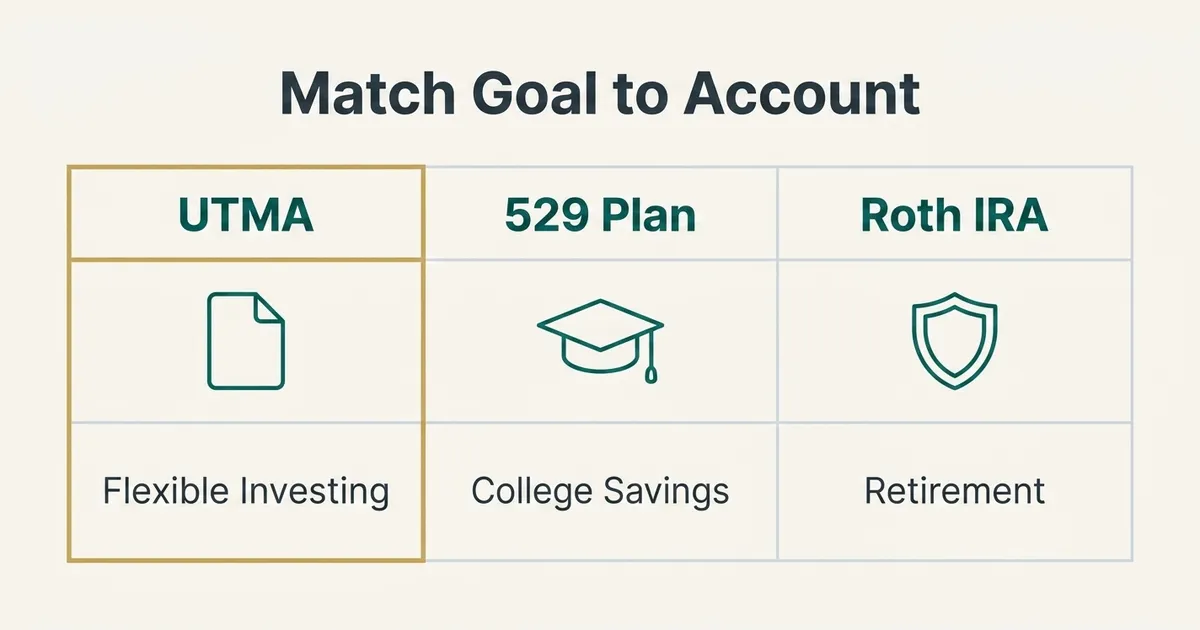
Open a UTMA custodial brokerage account if your goal is flexible, general-purpose dividend investing; open a 529 plan instead if the money is earmarked specifically for college. The two accounts are taxed differently, controlled differently, and released to your child on different timelines, so picking the wrong one is hard to undo later.
| Feature | UTMA/UGMA Custodial Brokerage | 529 College Savings Plan (e.g., California ScholarShare) | Custodial Roth IRA |
|---|---|---|---|
| Best for | General dividend investing, any future use | College or K-12 tuition specifically | Kids with earned income (babysitting, modeling, family business W-2) |
| Contribution limit | No cap, but gifts over $19,000/year (2026) may require a gift-tax return | Aggregate account cap around $529,000 in California, per the California ScholarShare Investment Board (2026) | Lesser of earned income or $7,500/year (IRS, 2026 limit) |
| Tax treatment of dividends | Taxed yearly under kiddie-tax rules (IRS Instructions for Form 8615, 2025) | Federal- and California-tax-free growth if used for qualified education expenses | Tax-free growth; no current tax on dividends at all |
| Who controls the money, and when | Child gains full legal control at the state age of majority — 18 in California, extendable to 21 for a parent's outright gift under California Probate Code Section 3920.5 (age 25 applies only to will- or trust-funded custodianships) | Parent (account owner) retains control indefinitely, even after the child turns 18 | Child's own Roth IRA once opened; custodian manages until majority |
| Typical fees | $0 commission, ETF expense ratios of 0.03%–0.06% | Asset-based fee of roughly 0.05%–0.20% depending on the underlying portfolio | $0 commission, ETF expense ratios of 0.03%–0.06% |
Choose the UTMA route if you want the child to be able to spend the money on anything at majority — a car, a business, extracurricular gear now via custodian withdrawals for the child's benefit — because a 529 plan penalizes non-education withdrawals with a 10% federal penalty on earnings. Choose a 529 if college costs are the priority and you want the money out of your child's direct control at 18. Compare the two side by side in more depth in our custodial account vs. 529 plan guide before you fund either one. If your child already earns income from modeling, content creation, or family-business work, a custodial Roth IRA usually beats both for pure long-term compounding, since qualified withdrawals in retirement are entirely tax-free.
How Does the Kiddie Tax Affect Your Child's Dividend Income?
The kiddie tax taxes a child's unearned income — dividends, interest, and capital gains — at the parent's marginal rate once it crosses a set threshold, instead of letting the child use their own lower bracket indefinitely. For 2026, per IRS Revenue Procedure 2025-32 and the IRS Instructions for Form 8615, the first $1,350 of a child's unearned income is tax-free, the next $1,350 is taxed at the child's own rate, and anything above $2,700 total is taxed at the parent's marginal rate. These dollar thresholds adjust annually for inflation, so reconfirm the current figures at IRS.gov before filing.
The mechanism exists because Congress didn't want wealthy parents shifting investment assets into a child's name purely to dodge their own tax bracket. In practice, for a monthly dividend portfolio funded with $50–$500 a month, most families never cross the second threshold: a $400/month contribution invested at a 3.5% yield generates roughly $168 in annual dividends in year one — well under the $1,350 tax-free floor. Once the account grows past roughly $38,500 at that same yield, though, dividend income starts exceeding the tax-free threshold and Form 8615 becomes relevant. According to the IRS Instructions for Form 8615 (2025), that form is required whenever a child's unearned income exceeds the annual threshold and the child meets the age and support conditions defining a "qualifying child" for kiddie-tax purposes.
Qualified dividends — the kind paid by most large U.S. companies and dividend ETFs — get preferential tax rates even before the kiddie tax applies. Per IRS Publication 550 (2025), qualified dividends are taxed at 0%, 15%, or 20% federal rates depending on total taxable income, versus ordinary income tax brackets for non-qualified dividends. That 0% bracket is why many families never owe federal tax on a child's dividend income at all in the account's early years.
What Should the Portfolio Actually Hold?
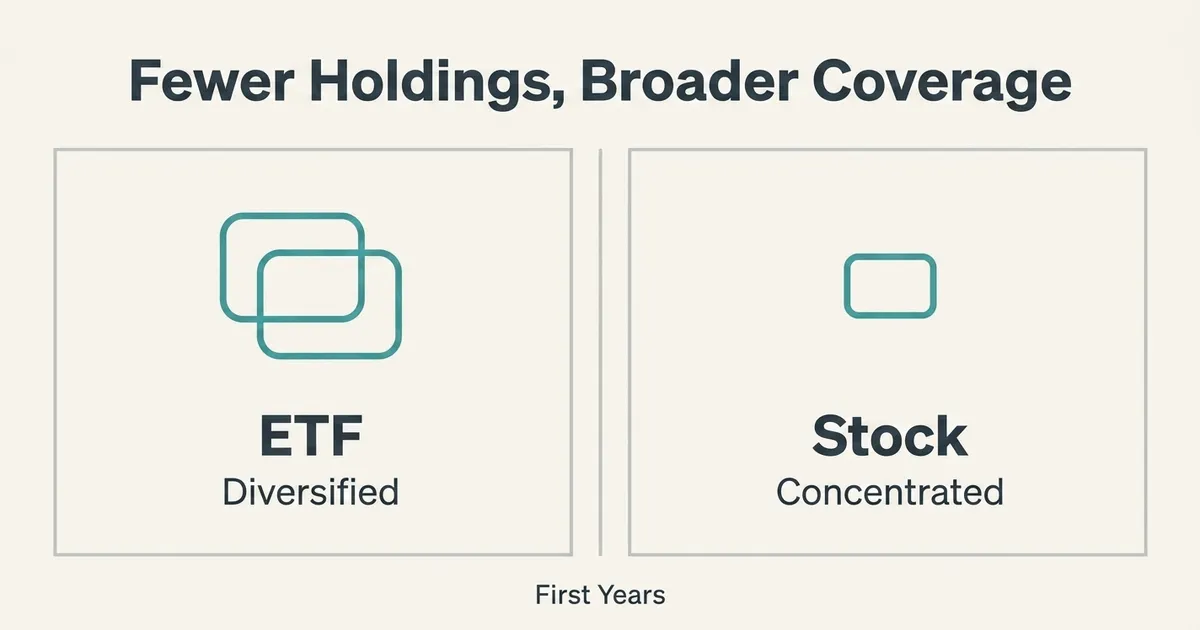
Hold one or two broad dividend ETFs rather than individual stocks for the first several years, because diversification matters more than yield-picking when you're contributing $50–$500 a month. A single ETF like Vanguard's VYM holds more than 500 underlying stocks, according to Vanguard (2026), with an expense ratio of 0.06% — meaning a $10,000 balance costs about $6 a year in fund fees.
Schwab's SCHD, a comparable dividend-growth ETF, also carries a 0.06% expense ratio, per Charles Schwab (2026), but screens for companies with a 10-year history of raising dividends rather than simply the highest current yield. That distinction matters: a fund chasing the highest yield often holds companies with financial stress signals, while a dividend-growth screen favors steadier, if lower-yielding, payers. For a kid's account with a decade-plus horizon, dividend growth compounds better than a high starting yield that later gets cut.
Decision rule: choose a single diversified ETF if you're contributing under $200/month, since fractional-share diversification across 500+ holdings is impossible to replicate manually at that size. Move to 3–5 individual dividend-paying stocks only once the account exceeds roughly $5,000–$10,000, when position sizes become meaningful and you have enough capital to diversify across sectors yourself. See a full breakdown of the ETF-versus-individual-stock trade-off, and specific holdings favored for custodial accounts.
How Do You Set Up a Monthly Dividend Portfolio for a Child? (5 Steps)
- Choose the account type. Open a UTMA custodial brokerage account for general-purpose investing, or a 529 plan if the money is strictly for education, using the comparison above.
- Fund it with a fixed monthly amount. Set an automatic transfer of $50–$500 on a recurring date — the day after your paycheck clears works well, since it removes the decision from your monthly budget.
- Buy one or two diversified dividend ETFs. Split contributions evenly, or dollar-cost-average into a single fund like VYM or SCHD, both carrying 0.06% expense ratios per Vanguard (2026) and Charles Schwab (2026).
- Turn on automatic dividend reinvestment (DRIP). Nearly every major broker offers this as a free account setting; enabling it means every dividend buys more fractional shares the same day it's paid, with no manual action required.
- Review once a year, not once a week. Check contribution amounts, rebalance if one holding has grown to dominate the portfolio, and confirm you're still under the kiddie-tax threshold — but resist adjusting holdings based on short-term price moves.
How Do You Automate Reinvestment So It Compounds Without You?
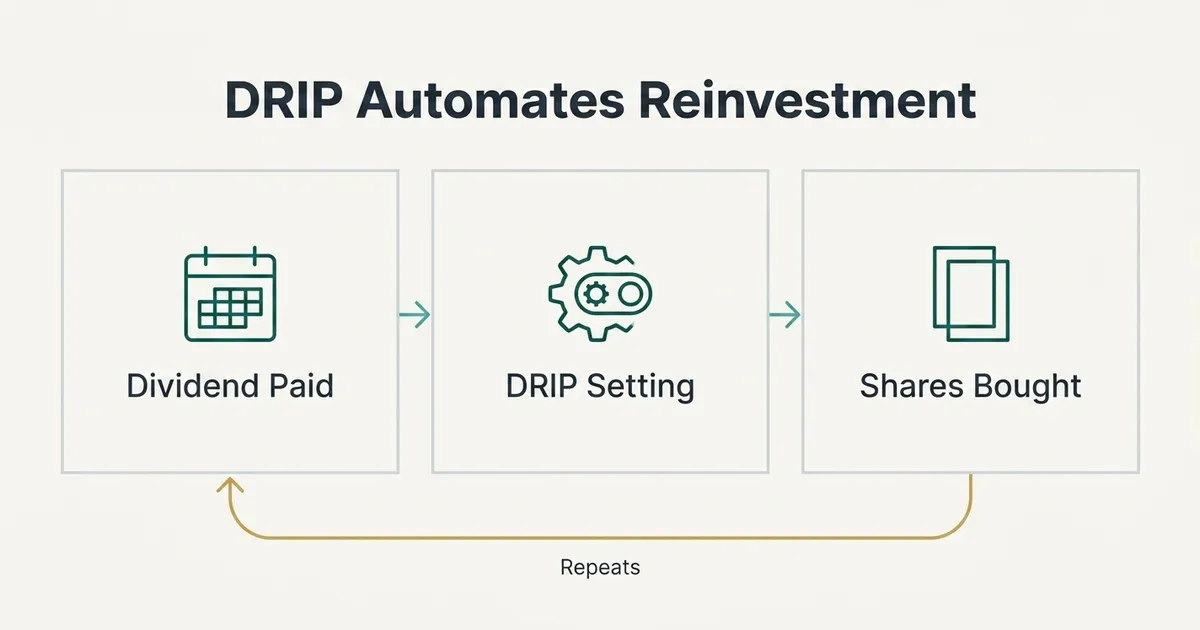
Turn on your broker's dividend reinvestment plan (DRIP) setting, which automatically uses each cash dividend to buy more shares — including fractional shares — on or near the payment date. According to the SEC's Investor.gov (2026), DRIP purchases typically incur no additional commission, and many brokers process them the same day the dividend posts, though settlement can take one to two business days depending on the fund.
The mechanism that makes this powerful over a decade is that reinvested dividends buy more shares, and those new shares generate their own dividends the next payment cycle — a compounding loop that runs entirely without you logging in. A fund paying quarterly distributions compounds four times a year; a monthly-distribution fund compounds twelve times a year, which is why some parents deliberately favor monthly-paying dividend ETFs for a kid's account even at a marginally lower yield, simply for the more frequent reinvestment cycle. Walk through the exact broker settings and common setup errors.
What Mistakes Do Parents Make With Kids' Dividend Portfolios?
The most common mistake is chasing the highest advertised yield instead of dividend reliability, because a fund yielding 9–10% often achieves that through option-writing strategies or leverage that erode the share price over time. A fund's total return — price change plus dividends — is what compounds a child's account, not the yield number alone; a high yield paired with a shrinking share price can leave a 10-year-old's portfolio worth less than what was contributed.
A second mistake is treating the UTMA account like a family emergency fund. Custodians can only spend the money for the direct benefit of the child, and under California Probate Code Section 3912, the custodian must observe the prudent-person standard of care and manage the assets solely in the minor's interest — using it for unrelated household expenses can create legal and tax exposure for the custodian. A third mistake is over-diversifying too early: buying eight or ten individual stocks with $50/month spreads each purchase so thin that fractional-share rounding and reinvestment become impractical to track. Stick to one or two ETFs until the account is large enough to diversify manually, and don't rebalance based on a single quarter's dividend news — a cut dividend at one company in a 500-holding fund barely moves the fund's total payout.
Parents who should NOT open a dedicated custodial dividend account yet: families still carrying high-interest debt above roughly 7–8% APR, since paying that down guarantees a better "return" than any dividend portfolio; and families without three to six months of emergency savings held somewhere safe and liquid, since UTMA contributions are irrevocable gifts you cannot pull back if a job loss hits next year. If that cushion isn't in place yet, start with how to open a high-yield savings account and build it before funding a custodial account.
How Much Could $200 a Month Grow Into by Age 18?
Illustratively, $200/month invested for 12 years (ages 6 to 18) at an assumed 7% average annual total return grows to roughly $44,900, of which about $28,800 is your contributions and $16,100 is investment growth — this is a hypothetical projection, not a promised outcome, since actual returns vary year to year and can be negative for extended periods. According to S&P Dow Jones Indices (2025), the S&P 500's long-run historical average annual total return has run close to 10% including dividends since 1926, though any single 12-year stretch can fall well below or above that average.
The mechanism behind the math: monthly contributions compound as an ordinary annuity, and reinvested dividends compound the account's own growth on top of new deposits, which is why the growth portion ($16,100) exceeds a third of the total even though contributions never increase. Doubling the monthly contribution to $400 over the same 12 years roughly doubles the ending balance to about $89,800 under the same assumptions — the relationship is close to linear because the growth rate, not the contribution size, drives compounding percentage-wise.
For the full framework this fits into — choosing an account, picking holdings, and handling the tax — start from our busy parent's guide to dividend investing.
Frequently asked questions
How much to make $1000 a month in dividends?
You need roughly $300,000 invested at a 4% average dividend yield, or $400,000 at a 3% yield, to generate $1,000 a month ($12,000 a year) in dividend income. The math is simply annual income target divided by yield: $12,000 ÷ 0.04 = $300,000. For a child's custodial account funded with $50–$500 a month, reaching this level typically takes decades of contributions and reinvested growth rather than a lump-sum deposit, so treat it as a long-term milestone rather than a near-term target.
How much money do I need to make $10,000 a month in dividends?
You need approximately $3 million invested at a 4% yield, or $4 million at a 3% yield, to produce $10,000 a month ($120,000 a year) in dividend income. This figure scales directly from the $1,000/month calculation — multiply the required principal by 10. For context, a custodial account for a child contributing even $500 a month would need several decades of consistent 7-10% average annual growth, per historical S&P 500 data from S&P Dow Jones Indices (2025), to approach this scale, making it a realistic goal only for adult retirement portfolios, not a child's extracurricular fund.
What is the 25% dividend rule?
The 25% dividend rule is an informal investing guideline — not a federal regulation — that caps any single dividend-paying stock or sector at roughly 25% of a portfolio's total dividend income, to limit concentration risk. If a child's account collects $40 a month in total dividends, the rule suggests no single holding should generate more than about $10 of that. Broad dividend ETFs satisfy this automatically: Vanguard's VYM spreads dividend income across more than 500 underlying companies, according to Vanguard (2026), so no single stock can realistically exceed the 25% threshold.
How much dividend stock do I need to make $3,000 a month?
You need roughly $900,000 invested at a 4% yield, or $1.2 million at a 3% yield, to generate $3,000 a month ($36,000 a year) in dividend income. Higher-yield funds near 6% would need only about $600,000, but yields that far above the broad market typically carry added risk from leverage, options overlays, or sector concentration. For a family building a monthly dividend portfolio for kids with $50–$500 monthly contributions, this income level is a decades-away milestone best reached by consistent contributions and dividend reinvestment rather than yield-chasing in the early years.