Best Dividend Stocks for Kids in 2026: ETFs vs Stocks

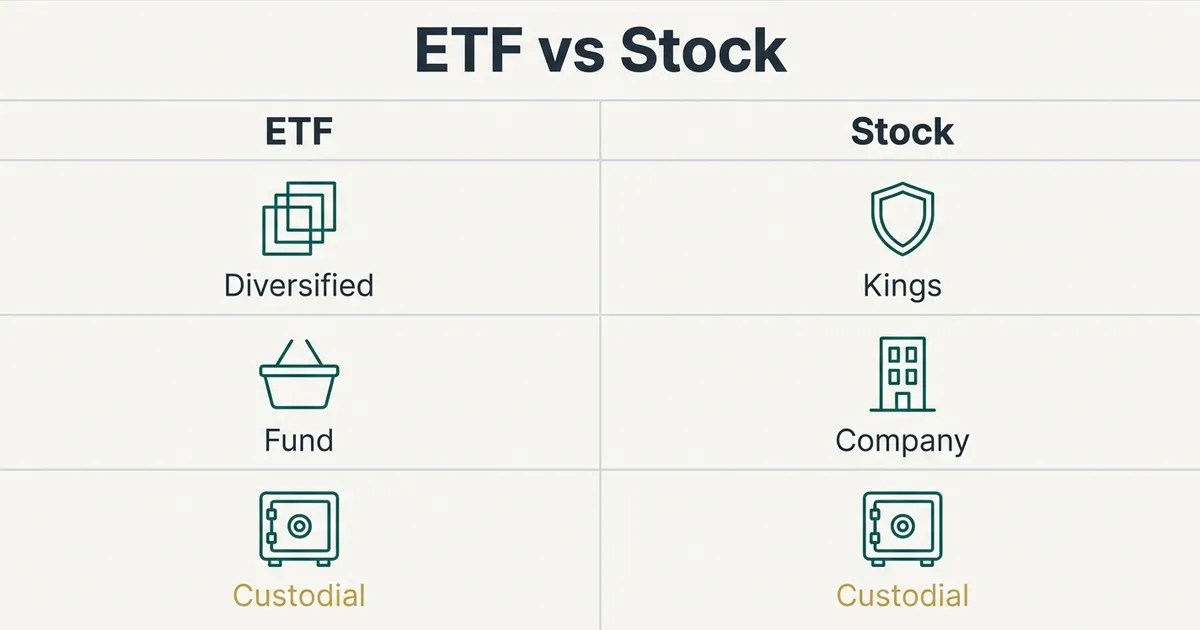
The best dividend stocks for kids in 2026 are low-cost, diversified picks like SCHD and Dividend Kings such as Johnson & Johnson and Coca-Cola. Hold them inside a custodial brokerage account, where reinvested dividends compound tax-efficiently below the kiddie tax's $2,700 unearned-income threshold for 2026.
Why Do Dividend Stocks Work Well in a Custodial Account?
Dividend stocks pay you to wait. Every quarter, the company sends cash to the account, and most brokers let you set that cash to buy more shares automatically through a dividend reinvestment plan (DRIP) — see Setting Up DRIP Auto-Compounding in a Kid's Custodial Account for the exact account settings to flip on — no manual trades required. Over a 10- to 15-year window, which is typical for a child born today reaching a UTMA/UGMA transfer age, that reinvested cash becomes a growing share count that itself throws off more dividends the following year.
The tax setup favors young accounts specifically. According to IRS Form 8615 Instructions (2025), a child's unearned income — dividends, interest, and capital gains inside a custodial account — is taxed under the "kiddie tax" rules, but the first slice is shielded by a standard deduction, meaning small annual dividend payouts from a starter portfolio often generate no federal tax bill at all. Custodial brokerage accounts also carry no age minimum and, per Charles Schwab (2024), no account minimum to open, so a parent can start with the first $50 or $100 deposit rather than waiting to accumulate a lump sum. For a full breakdown of how a custodial account works and which account type fits, see Brokerage Account for Kids: Custodial Guide (2026). For the fundamentals of setting up that first account before picking individual holdings, see this overview of dividend investing for kids.
Individual Dividend Stocks vs. Dividend ETFs: Which Should You Choose for a Child's Portfolio?
The honest answer is both play different roles, but the two paths diverge sharply on risk, fees, and how much homework you sign up for. A dividend ETF buys you instant diversification across dozens or hundreds of companies in one trade; an individual stock buys you concentration in one company's fortunes, for better or worse. For a full breakdown of how these two approaches perform over time, see this comparison of dividend ETFs vs. individual stocks.
| Pick | Type | Approx. Yield* | Expense Ratio | Dividend Track Record | Best For |
|---|---|---|---|---|---|
| Schwab U.S. Dividend Equity ETF (SCHD) | ETF | ~3.4% | 0.06% | Tracks ~100 quality dividend payers | Hands-off diversification |
| Vanguard Dividend Appreciation ETF (VIG) | ETF | ~1.8% | 0.05% | Holds companies with 10+ years of raises | Growth-over-yield, longer horizon |
| Vanguard High Dividend Yield ETF (VYM) | ETF | ~2.9% | 0.06% | Broad high-yield large-cap index | Income tilt with lower cost |
| Johnson & Johnson (JNJ) | Individual stock | ~3.2% | n/a | 62 consecutive years of increases | Teaching single-stock ownership |
| Coca-Cola (KO) | Individual stock | ~2.9% | n/a | 62 consecutive years of increases | Brand a young child recognizes |
| Procter & Gamble (PG) | Individual stock | ~2.4% | n/a | 68 consecutive years of increases | Household-name teaching tool |
*Yields are illustrative snapshots and move daily with share price; according to Nasdaq (January 2025) dividend yield data, always check the current figure before buying. Expense ratios per Charles Schwab Asset Management (2024) and Vanguard (2024) fund fact sheets. Dividend-increase streaks per the Dividend Kings list maintained by Sure Dividend (2024).
Choose ETFs if your monthly contribution is under $200 and you want one ticker that already spreads risk across sectors — a single bad earnings quarter at one company won't dent the account. Choose individual stocks if your goal is partly educational: buying one share of Coca-Cola or Johnson & Johnson gives a 6- or 8-year-old a company they recognize from the grocery store, which makes the "you own part of this" conversation concrete. Don't put more than 20-25% of a young child's portfolio into any single stock — according to S&P Dow Jones Indices (2024), even Dividend Aristocrats (companies with 25+ consecutive years of dividend increases) have had multi-year stretches of flat or falling share prices despite raising payouts.
Which Individual Dividend Stocks Are Best for a Kids' Portfolio?
Favor Dividend Kings — companies with 50+ consecutive years of dividend increases — over high-yield names, because the mechanism that matters for a child's account is reliability across decades, not this year's yield. Johnson & Johnson, Coca-Cola, and Procter & Gamble each appear on the Dividend Kings list tracked by Sure Dividend (2024), meaning each has raised its payout every year through multiple recessions, including 2008 and 2020. That consistency matters more than a 6% yield from an unfamiliar company, because a cut dividend also tends to come with a falling share price — a double loss for a young account.
Most major brokers now support fractional shares in custodial accounts, so you don't need $150+ to buy one whole share of a stock like Procter & Gamble. According to Fidelity (2024), the Fidelity Youth Account and standard custodial (UTMA/UGMA) accounts both allow fractional share purchases starting at $1, which lets a $50 monthly contribution buy slivers of three or four different Dividend Kings instead of a whole share of just one.
Which Dividend ETFs Are Best for a Custodial Account?
SCHD is the default answer for most parents because it combines a meaningfully higher yield than the broad market with a rock-bottom cost. According to S&P Dow Jones Indices (December 2024), the S&P 500's dividend yield sits near 1.3%, while SCHD's underlying index screens specifically for quality dividend payers, which is why its yield runs roughly two and a half times higher. At a 0.06% expense ratio per Charles Schwab Asset Management (2024), a $10,000 balance costs about $6 a year in fund fees — negligible against decades of compounding.
Pick VIG instead if you'd rather prioritize companies still growing their dividend fast, even at a lower current yield, because dividend growth (not just current yield) is what compounds a child's income stream fastest over an 18-year horizon. Pick VYM if you want maximum current income and can tolerate more exposure to slower-growing sectors like utilities and consumer staples. Don't hold more than one broad dividend ETF at a time in a starter account under $5,000 — the overlap in holdings across SCHD, VIG, and VYM means doubling up mostly duplicates the same 30-40 large companies rather than adding real diversification.
How Does the Kiddie Tax Affect Dividend Income in a Custodial Account?
For 2026, the first $1,350 of a child's unearned income is tax-free, the next $1,350 is taxed at the child's own (typically 10%) rate, and anything above $2,700 is taxed at the parent's marginal tax rate — a structure set annually under IRS Revenue Procedure 2025-32 (2025); see Kiddie Tax Explained: 2026 Rules for Custodial Accounts for the full breakdown of thresholds and filing requirements. This matters because a custodial account that generates, say, $600 a year in dividends from a $17,000 balance at a 3.5% yield sits entirely inside the tax-free band and triggers no federal return at all — see How Much Do You Need Invested to Cover One Bill With Dividends? for how to scale that same math to a specific recurring expense.
The mechanism kicks in once dividend income crosses that first threshold: a parent must then file IRS Form 8615 (2024 instructions) with the child's return, or elect to include the child's unearned income on the parent's own return via Form 8814, whichever produces a lower combined bill. Above $2,700 in a single year, additional dividend income is taxed as if it were the parent's own income — which is why very large custodial balances (typically well above $75,000-$100,000 at a 3% yield) start to lose some of their tax advantage compared with a 529 plan for education-specific savings. If you're deciding between the two vehicles, this comparison of a custodial account vs. a 529 plan breaks down which one fits which goal. And if the education-only restriction is your main hesitation about a 529, Beyond College Tuition: 4 Other Ways to Use a 529 Plan (Including the Roth IRA Rollover) covers how unused 529 funds can now be redirected, including a limited Roth IRA rollover.
Custodial accounts also carry an irrevocable-gift feature parents underestimate: once money goes in, it legally belongs to the child. In California, a UTMA custodianship transfers control to the child at 18 by default, though Probate Code Section 3920.5 (2024) lets the custodian specify an extended termination age up to 25 at the time the account is created — a choice you can't add retroactively. Other states set their own default ages and maximum extensions, so review UTMA vs. UGMA: The Differences Parents Need to Know before assuming the California timeline applies to your state.
How Should You Build a $100/Month Dividend Portfolio for Your Child?
Start with a core-and-teach split: put roughly 70-80% of each contribution into a broad dividend ETF like SCHD for diversification, and the remaining 20-30% into one or two Dividend King stocks the child can recognize and follow. At $100 a month, that's about $70-$80 into the ETF and $20-$30 toward fractional shares of something like Coca-Cola or Johnson & Johnson. If the goal is funding a specific recurring cost rather than general growth, see How to Build a Monthly Dividend Portfolio for Kids' Extracurriculars for a version of this same core-and-teach split sized to cover activity fees.
Here's the mechanism in numbers, shown purely as an illustrative model rather than a guaranteed outcome: $100 invested monthly for 10 years, assuming an average 8% combined return from reinvested dividends and share-price growth, compounds to approximately $18,300 — versus $12,000 in total contributions, meaning roughly $6,300 came from investment growth alone. That 8% figure blends historical long-run equity returns and is not a promise; real returns will be higher some years and negative in others.
Follow these steps to set it up:
- Open a custodial brokerage account at a broker with no minimum, such as Charles Schwab or Fidelity, per each firm's published 2024 account terms.
- Set a recurring auto-invest transfer timed to payday or a monthly budget date, so contributions happen without a manual decision each month.
- Turn on automatic dividend reinvestment (DRIP) in the account settings — this is usually off by default and must be switched on.
- Rebalance once a year, nudging the split back toward your target if one holding has grown to dominate the account.
Don't chase yield above roughly 5-6% from an unfamiliar single stock in a child's account — an unusually high yield is often a warning sign that the market expects a dividend cut, not a gift.
What Mistakes Do Parents Make When Picking Dividend Stocks for Kids?
The most common mistake is treating current yield as the only variable that matters. A stock yielding 7% that cuts its dividend in half erases both the income and typically a chunk of the share price at the same time — a worse outcome than a steady 3% yielder that raises its payout every year. Screen for dividend-growth history, not just today's number.
The second mistake is forgetting the account is an irrevocable gift once funded. Per the Uniform Transfers to Minors Act as adopted in California, Probate Code Section 3920 (2024), the money legally belongs to the child from the moment it's deposited — a parent cannot later redirect it to a sibling's account or reclaim it for a family expense. Only fund a custodial account with money you're fully prepared to give away.
The third mistake is ignoring the transfer-of-control date until it arrives. When the child reaches the account's termination age — 18 by default in California, or up to 25 if specified in writing at account opening per Probate Code Section 3920.5 (2024) — full control passes to them, with no legal requirement they spend it on college or anything else. If preserving parental influence over the money's use matters more than the tax benefits, a 529 plan (where the account owner, not the beneficiary, retains control) may fit better; see the custodial account vs. 529 plan comparison for the trade-offs. For a broader look at building a full family dividend strategy beyond the first account, start at the dividend investing pillar guide.
Disclaimer: This article is for general educational purposes and is not personalized financial, investment, or tax advice. Dividend yields, expense ratios, and tax thresholds change and should be verified against current issuer and IRS sources before you invest. Past dividend performance and dividend-growth streaks do not guarantee future payments or returns. Consult a licensed financial or tax professional about your family's specific situation.
Frequently asked questions
What is the best stock to invest in for kids?
There's no single best stock for every child, but Dividend Kings with 50+ years of consecutive dividend increases — such as Johnson & Johnson, Coca-Cola, and Procter & Gamble — are the most commonly recommended starting picks because of their multi-decade payout consistency, per the Dividend Kings list maintained by Sure Dividend (2024). For most parents with under $200/month to invest, a diversified ETF like SCHD is a stronger single choice than any one stock, since it removes single-company risk entirely.
How do I invest $1,000 for kids?
Split a $1,000 lump sum roughly 70/30 between a broad dividend ETF and one or two individual Dividend King stocks, using a custodial brokerage account that supports fractional shares. According to Fidelity (2024), fractional-share purchases start at $1, so $700 into SCHD and $300 split across two stocks like Coca-Cola and Johnson & Johnson is achievable in a single session without leftover cash sitting uninvested.
What are the top 3 dividend-paying stocks?
Among widely tracked Dividend Kings, Procter & Gamble, Johnson & Johnson, and Coca-Cola are the three most commonly cited for long-term reliability, with dividend-increase streaks of 68, 62, and 62 consecutive years respectively, according to the Dividend Kings list from Sure Dividend (2024). "Top" here means longest proven consistency, not highest current yield — several smaller companies post higher yields but with far shorter track records.
How much money do I need to invest to make $3,000 a month?
At a 3-4% average dividend yield, generating $3,000 a month ($36,000 a year) in dividend income alone would require an illustrative portfolio of roughly $900,000 to $1.2 million, since dividend income scales directly with both yield and total invested balance. This is a math exercise, not a target for a child's account — the realistic goal for a $50-$500/month custodial account is decades of compounding growth, not a specific monthly income figure.
What are good dividend stocks for kids?
Good picks combine a long, uninterrupted dividend-increase history with a business a child can recognize, which is why Dividend Kings like Coca-Cola, Johnson & Johnson, and Procter & Gamble are frequently used as starter individual stocks, per Sure Dividend's Dividend Kings tracking (2024). Pair one or two of these with a low-cost ETF like SCHD, which per Charles Schwab Asset Management (2024) charges a 0.06% expense ratio, so a single stock's stumble doesn't sink the whole account.
What are high dividend stocks for kids?
Higher-yield options like the Vanguard High Dividend Yield ETF (VYM), yielding roughly 2.9% versus the S&P 500's approximately 1.3% per S&P Dow Jones Indices (December 2024), give more current income without the concentration risk of a single high-yield stock. Avoid individual stocks yielding above roughly 6-7% in a child's account without checking the payout ratio first — an unusually high yield frequently signals the market's doubt about whether the dividend will hold, not a bargain.