Custodial Account vs. 529 Plan: Which Wins in 2026?

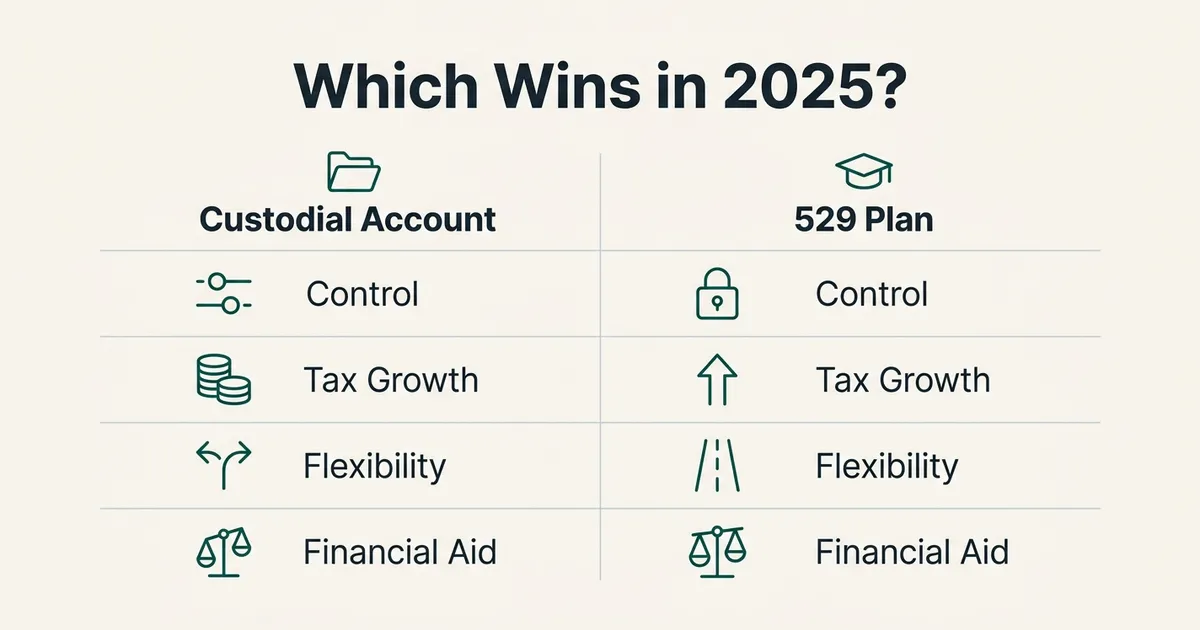
A custodial account wins on flexibility and investing control, while a 529 plan wins on tax-free growth for education costs and better financial-aid treatment. Custodial accounts (UGMA/UTMA) let a child own dividend stocks and ETFs directly, but earnings face the kiddie tax each year, per IRS Form 8615 Instructions (2025). A 529 plan's earnings escape federal tax entirely when spent on qualified education expenses, per IRC Section 529.
Disclaimer: This article is for educational purposes only and does not constitute personalized financial, tax, or legal advice. Consult a licensed financial advisor or tax professional before opening or funding a custodial brokerage account or 529 plan.
What Is a Custodial Account, and How Is It Different From a 529 Plan?
A custodial account is a taxable brokerage account a parent opens and manages ("custodies") for a child under the Uniform Transfers to Minors Act (UTMA) or the older Uniform Gifts to Minors Act (UGMA), until the child legally takes control at the state's age of majority. A 529 plan is a state-sponsored investment account earmarked for education, where the parent (not the child) stays the legal account owner indefinitely.
The core difference is legal ownership. Once you deposit money into a custodial account, it becomes the child's irrevocable property under the state's UTMA statute — you can't take it back, and the child gains full control at majority, which is age 18 in most states but as late as 21 to 25 in a handful, so verify your state's exact statute before funding one. A 529 plan never transfers ownership to the child; the parent can change the beneficiary to a sibling, or even roll leftover funds into a Roth IRA for the original beneficiary, per the SECURE 2.0 Act of 2022.
That ownership distinction drives everything downstream: which investments you can hold, how the IRS taxes the growth, and how colleges treat the balance on a financial aid application.
One wrinkle: a 529 plan can itself be titled as a custodial account, usually because an existing UTMA/UGMA custodial account got converted into one — the child keeps legal ownership of the money, exactly as under the original UTMA, but the account is now a 529. Despite that student ownership, federal law still reports a custodial 529 owned by a dependent student as a parent asset on the FAFSA rather than a student asset, per 20 U.S.C. § 1087vv(f)(3) — so it keeps the favorable ~5.64% assessment rate covered below instead of the 20% rate that applies to a raw UTMA/UGMA brokerage account. That's why converting an existing custodial account into a custodial 529 is a common way to cut the financial-aid penalty without giving up the child's irrevocable ownership of the funds.
How Does a Custodial Account Work for Dividend Investing?
A custodial account works like any standard brokerage account — you buy dividend-paying stocks, ETFs, or mutual funds in the child's name, and dividends either pay out as cash or reinvest automatically through a DRIP (dividend reinvestment plan). The custodian (usually a parent) places every trade and manages the account until the child reaches the age of majority defined by that state's UTMA statute.
Because the account is taxable every year — unlike a 529 or a retirement account — dividends and any realized capital gains generate a 1099-DIV or 1099-B each January, reportable on the child's own tax return or the parent's, depending on the amount. This is the mechanism that makes custodial accounts a genuine teaching tool: the child sees real tax documents tied to real ownership, which a 529 plan never generates until a withdrawal happens.
Most major brokerages — Fidelity, Charles Schwab, and Vanguard among them — offer UTMA/UGMA accounts with no minimum opening deposit and no account maintenance fee, according to each firm's published custodial account disclosures (2024). That makes the account itself essentially free to open; your only ongoing cost is the expense ratio on whatever fund you hold inside it, typically 0.03%–0.06% for a broad dividend ETF like Schwab U.S. Dividend Equity ETF (SCHD) or Vanguard High Dividend Yield ETF (VYM), per each fund's most recent prospectus.
Which Wins for Your Goal: Custodial Account or 529 Plan?
Choose a custodial account if you want the money available for anything — a first car, a gap-year trip, seed capital for a business — not just education, and you're comfortable losing control once the child reaches majority. Choose a 529 plan if the money is earmarked specifically for school, because the tax and financial-aid math favor it heavily for that one purpose.
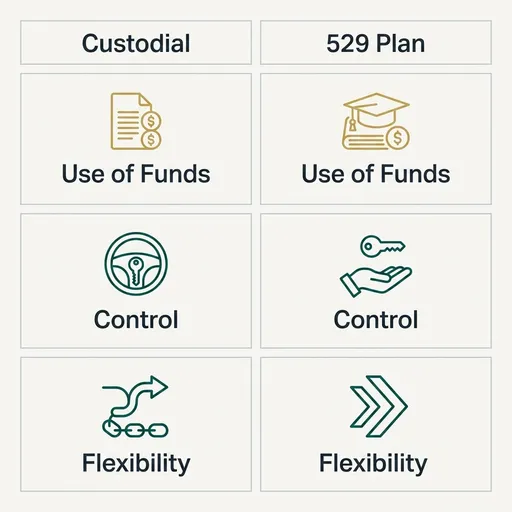
| Feature | Custodial Account (UGMA/UTMA) | 529 Plan |
|---|---|---|
| Who controls the money | Custodian, until age of majority (18–21+, set by state statute) | Parent (account owner), indefinitely — can change beneficiary |
| Tax on growth | Taxable annually; kiddie tax applies via IRS Form 8615 | Tax-free federally if spent on qualified education expenses, per IRC §529 |
| Financial aid impact | Child's asset, assessed up to 20% under the federal aid formula, per Federal Student Aid, U.S. Dept. of Education (2024) | Parent's asset, assessed at a maximum 5.64%, per Federal Student Aid, U.S. Dept. of Education (2024) |
| Annual gift-tax-free contribution | $19,000 per donor in 2026, per IRS Revenue Procedure 2025-32 | Same $19,000 per donor; a 5-year "superfunding" election allows up to $95,000 in one year, per IRS Revenue Procedure 2025-32 |
| Use of funds | Anything, once the child reaches majority | Qualified education expenses; nonqualified withdrawals owe income tax plus a 10% penalty on earnings; up to $35,000 lifetime can roll to a Roth IRA for the beneficiary, per the SECURE 2.0 Act (2022) |
| Investment menu | Any stock, ETF, or fund the brokerage offers | A fixed set of state-selected portfolios, usually 10–30 options |
The 5.64% parent-asset rate above applies to a 529 plan whether it's owned by the parent or titled as a custodial 529 owned by the student — the FAFSA treats both the same way, per 20 U.S.C. § 1087vv(f)(3). A private college using the CSS Profile applies different rules and may treat a custodial 529 less favorably, so check that school's specific instructions.
Read the table as a trade-off between flexibility and efficiency. A custodial account is the more flexible, more heavily-taxed, and more aid-penalized vehicle; a 529 plan is the narrower, tax-advantaged, aid-friendly vehicle. If you're already maxing out a 529 for tuition and want a side account for teaching investing or funding non-education goals, a custodial account fills that gap — it isn't an either/or for most families with two incomes and steady saving capacity.
Do You Pay Taxes on a Custodial Account?
Yes — a custodial account is fully taxable, and the "kiddie tax" rule determines whose tax rate applies to the child's investment income. For 2026, the first $1,350 of a child's unearned income (dividends, interest, capital gains) is tax-free, the next $1,350 is taxed at the child's own rate, and anything above $2,700 is taxed at the parent's marginal rate, per IRS Revenue Procedure 2025-32 and IRS Form 8615 Instructions (2025).
The mechanism exists to stop parents from shifting large investment portfolios into a child's name purely to dodge their own tax bracket. Here's a worked example: if a custodial account holding $60,000 in SCHD (yielding roughly 3.5% annually) generates about $2,100 in qualified dividends in a year, the first $1,350 is untaxed, the next $750 is taxed at the child's rate (often 10%, or 0% if it's qualified dividends and the child's total income stays low), and none of it crosses the $2,700 threshold into the parent's bracket. This is illustrative — actual qualified-dividend tax treatment depends on the child's total taxable income and current IRS brackets for the filing year.
Above the kiddie tax threshold, parents can elect to report a child's unearned income directly on their own return using Form 8814, instead of filing a separate return for the child, when the child's income consists only of interest and dividends under a set ceiling defined in IRS Form 8814 Instructions (2025). This saves paperwork but usually costs slightly more in tax, since it stacks the child's income onto the parent's return at the parent's marginal rate for any amount above the two-tier thresholds.
Is a 529 Plan Better Than a Custodial Account for College Savings?
For college costs specifically, a 529 plan is better in almost every case, because its earnings avoid federal tax entirely when spent on qualified expenses and its balance barely affects financial aid eligibility. A custodial account's balance, by contrast, is assessed at up to 20% under the federal methodology used on the FAFSA, compared with a maximum 5.64% for parent-owned assets like a 529 plan, per Federal Student Aid, U.S. Department of Education (2024).
Run the numbers on a $50,000 balance: as a custodial (child) asset, the federal aid formula could reduce eligible aid by up to $10,000 in a given year; as a parent-owned 529 asset, that same balance reduces eligibility by at most roughly $2,820. That gap alone often decides the choice for families expecting to qualify for need-based aid.
The exception: if you're highly confident the child won't attend a traditional four-year college, or you want money available for non-education goals, the 529's flexibility narrows. Since the SECURE 2.0 Act (2022) took effect, up to $35,000 in leftover 529 funds can roll into the beneficiary's Roth IRA over time, subject to that year's annual Roth contribution limit and a requirement that the 529 account has been open at least 15 years — which softens the old "what if they don't go to college" objection but doesn't eliminate it entirely, since the rollover is capped and rule-bound.
Don't choose a 529 if you want the money for anything other than education or retirement seeding via the Roth rollover — a custodial account or a standard taxable brokerage account in the parent's name serves that broader goal better.
How Should You Invest $1,000 in a Custodial Account for a Child?
Put $1,000 into a single low-cost, broad-market or dividend-focused ETF inside the custodial account rather than splitting it across several funds, because at this size, diversification within one fund (holding 100+ underlying stocks) already does the diversifying work. A total-market fund like Vanguard Total Stock Market ETF (VTI) or a dividend-focused fund like Schwab U.S. Dividend Equity ETF (SCHD) both carry expense ratios near 0.03%–0.06%, per each fund's current prospectus, meaning fees cost roughly 30–60 cents a year on a $1,000 balance.

Turn on automatic dividend reinvestment (DRIP) at account opening — this is the single highest-leverage setting for a long time horizon, because it compounds each payout back into more shares without you needing to place a trade. As an illustration only, not a projection: $1,000 growing at a hypothetical 7% average annual total return, with no further contributions, would reach roughly $1,970 in 10 years and roughly $3,870 in 20 years — actual returns will vary and can be negative in any given year.
Skip individual stock picks at this dollar amount. A single $1,000 position in one company carries concentration risk a fund avoids, and most custodial brokerages let you buy fractional shares of an ETF anyway, so there's no minimum-size reason to go single-stock. Add small, regular contributions — even $50 a month — rather than treating the $1,000 as a one-time deposit; consistent contributions matter more to the ending balance than which specific fund you pick, provided the fund is broadly diversified and low-cost. For a step-by-step approach to sizing and automating those monthly contributions, see our guide to building a monthly dividend portfolio for kids. Once the balance grows and you want to add individual names, our shortlist of the best dividend stocks for a custodial account covers vetted, long-horizon picks.
What Are the Risks and Failure Modes of Custodial Accounts?
The single biggest risk is irrevocability: once you deposit money into a custodial account, it legally belongs to the child, and you cannot move it back to yourself or repurpose it for a sibling, unlike a 529 plan's beneficiary-change feature. A second risk is loss of control at the age of majority — the child can spend the entire balance however they choose the day they legally take control, and the custodian has no legal recourse to stop them.
The financial-aid penalty is a failure mode families discover too late: a custodial account funded aggressively in a child's early years can quietly shrink a college financial aid offer years later, since it's assessed at up to 20% under the federal aid formula versus a parent asset's maximum 5.64%, per Federal Student Aid, U.S. Department of Education (2024). Families planning to apply for need-based aid should generally favor a 529 plan or a parent-owned taxable account over a heavily funded custodial account for this reason alone.
A third failure mode is over-concentration from well-meaning gifts: grandparents and relatives who each gift appreciated stock into the same custodial account, without coordinating, can leave a portfolio dangerously concentrated in one or two names. Rebalance a custodial account at least annually toward a diversified target — a broad index fund core plus, if desired, a dividend-focused satellite — the same discipline used across dividend ETFs vs. individual stocks.
Frequently asked questions
Is a custodial account a good idea?
A custodial account is a good idea for parents who want to teach investing with real ownership and want the money available for goals beyond college, but it's a weaker idea for families expecting significant need-based financial aid. The balance is assessed at up to 20% under the federal aid formula, per Federal Student Aid, U.S. Department of Education (2024), versus a maximum 5.64% for a parent-owned 529 plan — run that comparison before funding one heavily.
Do I pay taxes on a custodial account?
Yes — dividends, interest, and realized gains inside a custodial account are taxable every year under the kiddie tax rules. For 2026, the first $1,350 of a child's unearned income is tax-free, the next $1,350 is taxed at the child's rate, and amounts above $2,700 are taxed at the parent's marginal rate, per IRS Revenue Procedure 2025-32.
What is the best way to invest $1,000 for a child?
The best way to invest $1,000 for a child is a single low-cost, broad-market or dividend-focused ETF with automatic dividend reinvestment turned on, inside either a custodial account or a 529 plan depending on the goal. A fund like VTI or SCHD carries an expense ratio near 0.03%–0.06%, per each fund's current prospectus, so fees cost only pennies to a few dollars a year on a $1,000 balance.
Which is better, 529 or custodial account?
A 529 plan is better specifically for college costs, because its earnings grow tax-free for qualified education expenses under IRC Section 529 and it's assessed at a maximum 5.64% on financial aid applications, versus up to 20% for a custodial account, per Federal Student Aid, U.S. Department of Education (2024). A custodial account is better when you want the money available for non-education goals or want the child to hold real, taxable ownership earlier.
What is a custodial account for a minor?
A custodial account for a minor is a brokerage account opened under a state's UGMA or UTMA statute, where an adult custodian manages investments on the child's behalf until the child reaches the state-defined age of majority — commonly 18, but as late as 21 to 25 in some states. At that age, control transfers entirely to the child, who can withdraw or spend the full balance regardless of the custodian's original intent.
What's the difference between UGMA and UTMA custodial accounts?
UGMA (Uniform Gifts to Minors Act) accounts can hold only financial assets like cash, stocks, and bonds, while UTMA (Uniform Transfers to Minors Act) accounts, adopted later in most states, can also hold real estate, royalties, and other property types. Nearly every state now uses the broader UTMA statute, but a handful of older UGMA-only accounts still exist, and the exact age of majority and permitted asset types vary by state — verify your state's specific statute before opening one.
Is a custodial 529 plan assessed as a parent asset or a student asset on the FAFSA?
A custodial 529 plan owned by a dependent student is assessed as a parent asset on the FAFSA, at the same favorable maximum 5.64% rate as a parent-owned 529, per 20 U.S.C. § 1087vv(f)(3) — not as a student asset at up to 20%, the way a raw UTMA/UGMA brokerage account is treated. The CSS Profile, used by many private colleges, applies different rules and requires reporting all 529 accounts that list the student as beneficiary regardless of who owns them, so check a specific school's own instructions if it requires the CSS Profile.