HYSA vs Money Market Account: Which Wins in 2026?

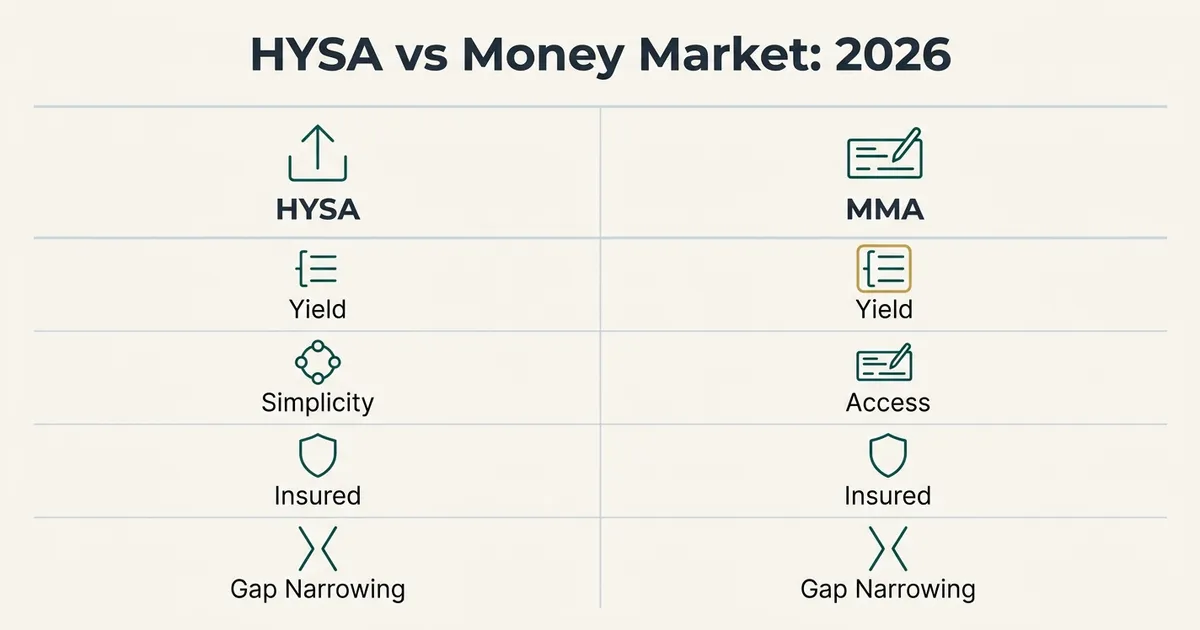
A HYSA usually pays a higher APY with a simple, online-only structure, while a money market account (MMA) pays a close but often slightly lower rate and adds check-writing or debit-card access. According to Bankrate (August 2026), top nationally available HYSAs pay around 4.30% APY versus roughly 3.90%–4.10% APY for the best money market accounts.
Both products hold cash, both are typically FDIC- or NCUA-insured, and both pay variable rates that move with the Federal Reserve's benchmark rate. The real decision isn't about safety — it's about whether you need the extra access an MMA provides badly enough to give up a little yield.
What Is the Difference Between a HYSA and a Money Market Account?
A HYSA is a deposit account, usually at an online bank or credit union, built purely for saving — no checks, limited or no debit-card access, and a rate that adjusts as the bank chases deposits. A money market account is also a deposit account, but banks bundle in check-writing privileges and sometimes a debit card, funding those extra features with a slightly lower average rate. According to the FDIC (2026), both account types are insured up to $250,000 per depositor, per insured bank, per ownership category, so the safety profile is identical even though the features differ.
The naming gets confusing because "money market account" also describes a money market mutual fund, a completely different product sold through brokerages. According to the SEC (2026), money market mutual funds are registered investment products regulated under Rule 2a-7 of the Investment Company Act of 1940, and they are not FDIC insured — you're buying shares in a fund that holds short-term debt, not making a bank deposit. If your brokerage's "money market" is actually a mutual fund (common at firms like Vanguard and Fidelity), your cash carries fund-level risk, however small, instead of federal deposit insurance.
How Do HYSAs and Money Market Accounts Compare on Rates, Fees, and Access?
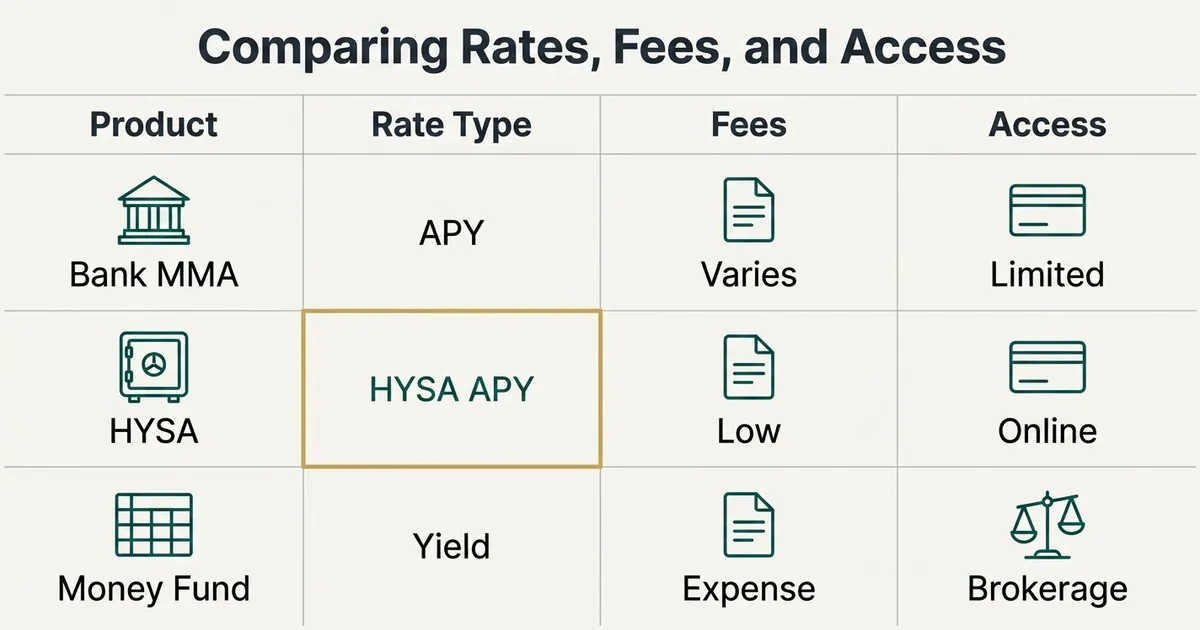
The table below lines up the three products readers usually mean when they search "money market account" — a bank/credit union MMA, a HYSA, and a brokerage money market mutual fund — on the factors that actually change your outcome.
| Feature | HYSA (online bank) | Money market account (bank/credit union) | Money market mutual fund (brokerage) |
|---|---|---|---|
| Typical APY, August 2026 | ~4.30% | ~3.90%–4.10% | ~4.00%–4.20% |
| FDIC/NCUA insured | Yes, to $250,000 | Yes, to $250,000 | No — SEC-regulated, not deposit insurance |
| Check-writing / debit card | Rare, usually none | Common — checks and/or debit card | Rare, via linked brokerage account |
| Minimum balance for top rate | $0 at most online banks | $0–$2,500 | $0–$3,000 |
| Fee if balance falls below minimum | None at most online banks | $0–$15/month | Expense ratio ~0.10%–0.30% annually |
| Withdrawal limits | Bank-set, often 6/month | Bank-set, often 6/month | Trades settle T+1, no federal cap |
| Best for | Highest rate, simple saving | Emergency fund you may need to write a check against | Idle cash inside a brokerage account |
According to the Federal Reserve (April 2020), the six-withdrawal-per-month cap that once applied to savings and money market accounts under Regulation D was suspended, meaning any transaction limit you see today is set by the individual bank's account agreement, not federal law. Read that fine print before assuming your MMA behaves like a checking account — some banks still cap "convenient" transfers (online transfers, debit swipes, checks) at six per statement cycle and charge a fee past that.
For the highest guaranteed rate with the fewest strings, a HYSA wins on paper; for someone who wants one account that can both earn interest and occasionally write a check to a landlord or contractor, the MMA's slightly lower yield buys real convenience. If you're still deciding between a plain savings account and an MMA rather than a HYSA specifically, the MMA side of that trade-off is laid out in more detail in our guide to how money market accounts work.
Which Is Better: HYSA or Money Market Account?
Choose a HYSA if you won't need to write paper checks or swipe a debit card against these funds and you want the highest available rate with no minimum-balance games. Choose a money market account if you need occasional check-writing (rent to a landlord who won't take ACH, a large one-off payment) or want debit-card access to your cash cushion without a transfer delay.
The mechanism behind the rate gap is straightforward: banks pay for the checks, debit cards, and teller access an MMA offers by shaving a fraction of a percentage point off the yield, the same way a checking account with more services pays less interest than a savings account with fewer. According to DepositAccounts.com (August 2026), several online banks pay 4.25%–4.35% APY on HYSAs with zero minimum balance, while their MMA counterparts at the same institution pay 3.85%–4.05% APY for the added check-writing feature — a difference of roughly 0.30–0.40 percentage points for the convenience.
Don't choose an MMA purely out of habit if you've never actually used the checks. Every basis point matters on a large emergency fund, and most savers can route bill payments through ACH transfers from a HYSA just as easily as writing a check from an MMA.
How Much Will $10,000 Earn in a High-Yield Savings Account?
At a 4.30% APY compounded daily — the mechanism most HYSAs use, where interest accrues every day but posts to your balance once a month — $10,000 grows to roughly $10,439 after one year, or about $439 in interest. That's the compounding formula A = P(1 + r/n)^(nt) with n = 365, applied to a rate Bankrate (August 2026) reports as representative of top nationally available HYSAs.
Compare that to parking the same $10,000 in an account paying the national average. According to the FDIC's National Rates and Rate Caps report (effective July 20, 2026), the average savings account APY across all FDIC-insured banks was just 0.38%, which would earn only about $38 over the same year — a gap of roughly $401 for doing nothing but choosing a different bank. That gap is why "which bank" matters more than "which product type" once you've decided on a HYSA; our step-by-step guide to opening a high-yield savings account covers how to compare institutions near the top of that range.
How Much Will $100,000 Earn in a Money Market Account?
At a 4.00% APY compounded daily, $100,000 in a money market account grows to approximately $104,081 after one year — about $4,081 in interest, using the same daily-compounding mechanism as a HYSA. That's before taxes: according to the IRS (2026), interest earned on savings, HYSA, and money market accounts is reported on Form 1099-INT and taxed as ordinary income in the year it's credited, not when you withdraw it.
At the FDIC's national average money market rate of 0.65% per the FDIC National Rates and Rate Caps report (effective July 20, 2026), that same $100,000 would earn only about $652 over a year — a difference of roughly $3,429 versus a top-yield account. On a six-figure balance, shopping for rate matters far more than the product label; a mediocre MMA at a legacy bank can cost you thousands of dollars a year compared with a competitive HYSA or MMA at an online bank.
How Are HYSAs and Money Market Accounts Insured?
Both are insured up to $250,000 per depositor, per insured institution, per ownership category, whether the account is labeled a savings account or a money market account. According to the FDIC (2026), a married couple can structure a joint account plus individual accounts at the same bank to insure up to $500,000 or more in combined coverage, because joint accounts are a separate ownership category from individual ones. According to the NCUA (2026), credit unions offer the same $250,000 standard coverage through the National Credit Union Share Insurance Fund, so a federally insured credit union's money market share account carries equivalent protection to a bank MMA.
Money market mutual funds sit outside this system entirely. According to the SEC (2026), these funds are not backed by deposit insurance of any kind; investors rely instead on the fund's compliance with Rule 2a-7's liquidity and credit-quality requirements, which is why a brokerage "money market" sweep account, however stable historically, carries a different risk category than a bank MMA or HYSA.
When Should You Choose a Money Market Account Over a HYSA?
Choose an MMA when you'll actually use the check-writing or debit-card feature — paying a contractor, a private landlord, or a school that doesn't accept ACH transfers. Choose an MMA over a brokerage sweep fund specifically when you want the $250,000 FDIC insurance ceiling rather than SEC-regulated fund risk; according to Bankrate (August 2026), many brokerage sweep programs pay 2.00%–2.50% APY, well below both dedicated HYSAs and MMAs, because sweep cash is optimized for the brokerage's convenience rather than your yield.
Skip the MMA if your only reason is "just in case" — a HYSA linked to a checking account can move money via ACH in one to three business days for free, which covers nearly every emergency-fund use case without sacrificing yield. Reserve the MMA for savers with a documented recurring need for paper checks or point-of-sale debit access tied to their cash reserve.
Is It Better to Put Money in a HYSA or the Stock Market?
Put money you'll need within three to five years — including your emergency fund — into a HYSA or MMA, and invest money you won't touch for five-plus years in the stock market, because the mechanism driving each decision is volatility versus liquidity, not just average return. According to S&P Dow Jones Indices (2026), the S&P 500 has returned an average of roughly 10% annually including dividends since 1957, but it also fell 18.1% in 2022 alone — a swing that would wipe out years of interest if you needed that cash during the downturn.
A HYSA or MMA guarantees your principal (up to FDIC/NCUA limits) and a known, if variable, rate; the stock market offers no principal guarantee over any specific short window. Size your emergency fund first — the common benchmark is three to six months of essential expenses — then direct additional savings toward investing once that cushion sits in a HYSA or MMA. For more on choosing where new cash should land first, see our saving money resource hub.
Frequently asked questions
Which is better, a high-yield savings or money market?
A high-yield savings account is better if you want the highest available APY and don't need check-writing or debit-card access to the funds. According to Bankrate (August 2026), top HYSAs pay around 4.30% APY versus roughly 3.90%–4.10% APY for comparable money market accounts, a gap banks create by funding the MMA's extra features. Choose the money market account instead only if you'll regularly use its checks or debit card; otherwise the rate difference favors the HYSA every time.
How much will $100,000 make in a money market account?
At a 4.00% APY compounded daily, $100,000 in a money market account earns approximately $4,081 over one year, growing to about $104,081. At the FDIC's reported national average money market rate of 0.65% per the FDIC National Rates and Rate Caps report (effective July 20, 2026), the same balance earns only about $652 in a year, illustrating why the specific bank matters more than the account label.
How much will $10,000 make in a high-yield savings?
At a 4.30% APY compounded daily, $10,000 in a high-yield savings account earns roughly $439 over one year, growing to about $10,439. According to the FDIC (effective July 20, 2026), the national average savings account rate was just 0.38% APY, which would earn only about $38 on the same $10,000 over a year — a roughly $400 difference driven entirely by which bank you choose.
Is it better to put money in the HYSA or stock market?
Money needed within three to five years, including an emergency fund, belongs in a HYSA because FDIC insurance up to $250,000 per depositor guarantees the principal, per the FDIC (2026). Money you won't need for five-plus years can reasonably go into the stock market, where S&P Dow Jones Indices (2026) reports an average annual return near 10% since 1957, but with real risk of double-digit losses in any single year, including an 18.1% drop in 2022.
HYSA vs money market account reddit — what do savers actually say?
Discussion threads comparing these accounts generally converge on the same two points confirmed by industry data: HYSAs usually pay a slightly higher rate, and MMAs earn their lower rate by adding check-writing or debit-card access. According to Bankrate (August 2026), the typical spread between top HYSAs and top MMAs is about 0.20–0.40 percentage points, which lines up with what savers report when comparing statements across both account types at the same bank.
HYSA or money market account — which should I open first?
Open a HYSA first if you're building a general-purpose emergency fund or short-term savings goal and have no immediate need for paper checks. According to the FDIC (2026), both account types carry identical $250,000 deposit insurance, so the decision comes down to features, not safety — add a money market account later only if a specific recurring need for checks or a debit card against your savings balance emerges.