
Real estate has a reputation as the asset class of 2 a.m. plumbing calls and Sunday-afternoon eviction paperwork. That reputation is only true for one ownership model — the one where you personally hold the deed, screen the tenant, and answer the phone. There are at least four other ways to collect rental-style cash flow from property without ever meeting a tenant, and they scale down to the kind of check size a working parent with $10,000 to $50,000 in savings can actually write. This hub sorts those paths — publicly traded REITs, fractional/crowdfunded platforms, turnkey rentals, property-manager-run rentals, and private syndications — by the four variables that matter most to someone with a full-time job and a school pickup schedule: minimum check size, all-in fee load, how fast the money comes back if plans change, and how many minutes a week the investment actually demands. The guides linked below this page go deep on each path; this page is where you figure out which one fits your household before you read further.
What Counts as "Low-Maintenance" Real Estate Exposure?
Every vehicle on this list transfers the operational burden of real estate — sourcing, financing, maintenance, tenant management — to someone else in exchange for a fee, a spread, or a promoted return. The differences are in who that someone else is and how much control (and upside) you give up to them.
- Publicly traded REITs hold portfolios of income property and distribute at least 90% of taxable income to shareholders to maintain their tax status under Internal Revenue Code Section 856. You buy shares like any stock; a fund manager and property-management staff do everything else.
- Fractional and crowdfunded platforms pool many investors' capital into a fund or single-asset LLC, usually registered under SEC Regulation A or Regulation Crowdfunding, and let you buy in with a few hundred dollars.
- Turnkey rentals are single-family or small multifamily properties sold already renovated and often already tenanted by a company that specializes in sourcing and rehabbing rental stock, typically bundled with a property-management contract from day one.
- Property-manager-run rentals describes any directly owned rental — turnkey or otherwise sourced — where a third-party management company handles leasing, rent collection, and maintenance dispatch for a recurring fee.
- Syndications are private partnerships, usually organized under SEC Regulation D, in which a sponsor raises capital from a group of passive limited partners to buy one specific larger asset — an apartment complex, a self-storage portfolio, a medical office building.
The first two are securities you can buy without ever touching a property title. The last three involve real property ownership (directly or through an LLC/LP interest) with a manager standing between you and the tenant. That distinction drives almost every other difference in this hub, including tax treatment, which matters here only insofar as it changes which vehicle suits a given goal, not as a standalone planning topic.
How Much Time and Money Does Each Vehicle Actually Require?
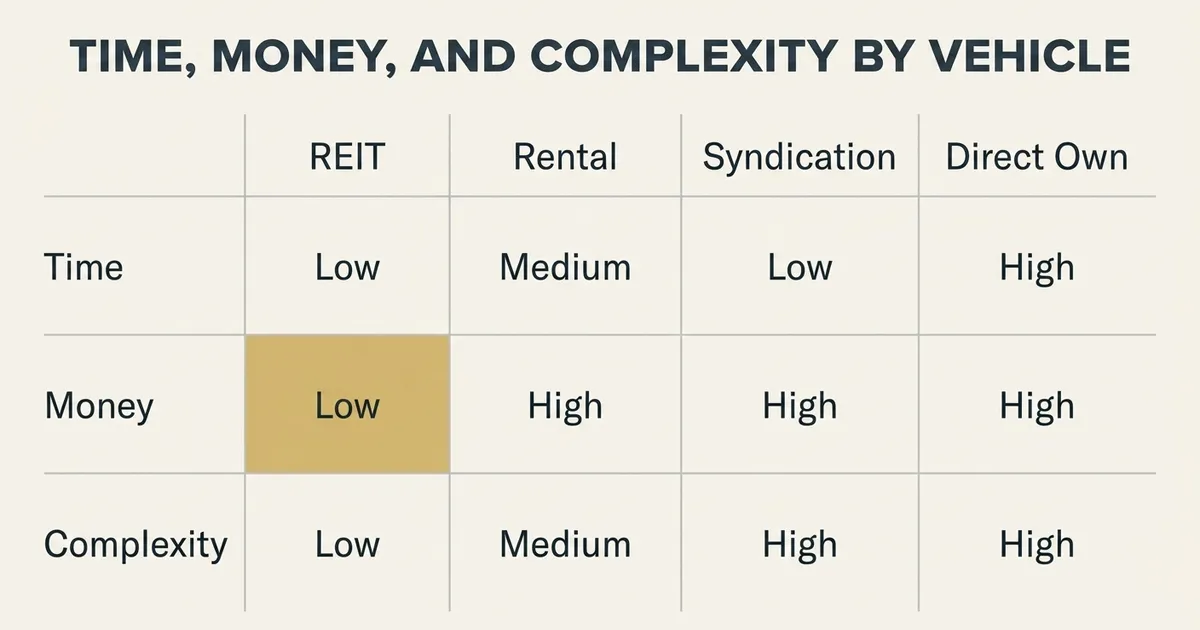
The honest answer varies by an order of magnitude on every axis. The table below uses typical ranges reported by the platforms, sponsors, and regulators governing each structure; actual figures for any specific offering can fall outside these bands, so treat this as an orientation, not a quote.
| Vehicle | Typical minimum check | Annual fee load | Liquidity | Weekly time commitment |
|---|---|---|---|---|
| Publicly traded REIT (via brokerage/ETF) | $1–$100 (one share or fractional share) | 0.1%–0.5% expense ratio for a REIT ETF | Daily; trades like a stock | Under 15 minutes a quarter |
| Fractional/crowdfunded platform (Reg A or Reg CF) | $10–$5,000 | ~1% of assets under management plus acquisition/disposition fees | Quarterly redemption windows, often gated in stressed markets | 15–30 minutes a quarter |
| Turnkey rental (bundled property management) | $30,000–$50,000 (down payment + reserves on a $150k–$200k property) | Property-management fee of 8%–10% of collected rent, plus a leasing fee equal to roughly one month's rent per new tenant | Months to sell; not liquid | 1–3 hours a month reviewing manager reports |
| Self-sourced rental + independent property manager | $30,000–$60,000 (down payment + reserves) | Same PM fee range, plus your own acquisition due-diligence time | Months to sell; not liquid | 2–4 hours a month, more at acquisition |
| Syndication (Reg D 506(b)/506(c)) | $25,000–$100,000 | 1%–2% asset-management fee, plus a sponsor "promote" of roughly 20%–30% of profit above a preferred return | Locked 3–7 years; no secondary market in most deals | Under 30 minutes a quarter (LP reporting review) |
Two patterns fall out of this table immediately. Liquidity and fee load move roughly inversely with weekly time commitment: the vehicles that ask the least of your calendar (REITs, syndications) sit at opposite ends of the liquidity spectrum, while the vehicles that give you the most control over the underlying asset (self-sourced rentals) also ask for the most hours. There is no vehicle here that offers stock-like liquidity, low fees, and direct property ownership simultaneously — pick two.
REITs: The Lowest-Effort, Most-Liquid Entry Point
A publicly traded REIT is, mechanically, a stock. It settles on the same T+1 cycle as any other equity, prices continuously during market hours, and requires no property inspection or loan application from the buyer. According to Nareit (2024), the FTSE Nareit All Equity REITs Index comprised roughly 140 publicly traded REITs with a combined equity market capitalization in the range of $1.3–$1.5 trillion, spanning apartments, warehouses, data centers, timberland, and healthcare facilities. That breadth means a single REIT ETF purchase can diversify a $10,000 stake across thousands of individual properties and dozens of metro markets — something no single-property crowdfunding deal or turnkey purchase can match at that check size.
The tax mechanics matter here because they separate REITs from every direct-ownership vehicle in this hub. REIT dividends are generally taxed as ordinary income rather than at qualified-dividend rates, because the REIT itself pays no corporate income tax on distributed earnings. To offset that, Congress built in a partial break: under IRC Section 199A(b)(1)(B), individual taxpayers may deduct 20% of qualified REIT dividends regardless of income level or business classification, a provision that — unlike the broader Section 199A pass-through deduction for other business income — does not carry the same sunset exposure tied to expiring individual provisions of the 2017 tax law. That 20% haircut on REIT dividend income is a real, checkable distinction from directly owned rental property, which instead shelters income through depreciation rather than a flat statutory deduction.
The tradeoff for that liquidity and diversification is that you own no specific building and have no say over which properties the REIT buys, sells, or refinances. Price also moves with broader interest-rate and equity-market sentiment, not just with local rental fundamentals — a REIT can drop 15% in a quarter because rates rose, even if every property in its portfolio is fully leased.
Fractional and Crowdfunded Platforms: Real Estate in $100 Increments
Crowdfunded and fractional-ownership platforms exist specifically to let small checks into deals that used to require six-figure minimums. Two SEC exemptions make this legal at retail scale. Under Regulation A (Tier 2), an issuer may raise up to $75 million in a 12-month period from both accredited and non-accredited investors, filing an offering circular (Form 1-A) instead of a full public registration — this is the framework most real-estate crowdfunding "eREITs" and single-property platforms use. Under Regulation Crowdfunding (Reg CF), issuers can raise a smaller amount and non-accredited investors face income- and net-worth-based caps; according to the SEC's 2024 inflation adjustment to Regulation Crowdfunding, an investor whose annual income or net worth is below $124,000 may invest the greater of $2,500 or 5% of the lesser of their income or net worth in a 12-month period across all Reg CF offerings.
This is the vehicle category built almost exactly for the $10,000–$50,000 saver: check sizes as low as $10–$500 buy exposure to a specific apartment building, a portfolio of single-family rentals, or a diversified non-traded fund, without a mortgage application or a landlord license.
The caveat that matters most here is liquidity, and it deserves stating plainly once: most Reg A and Reg CF real estate funds offer redemption only through periodic windows — often quarterly — and the sponsor typically reserves the right to suspend or limit redemptions if too many investors try to cash out at once, exactly the scenario that tends to occur during a real-estate downturn. The SEC has published investor bulletins warning that non-traded real estate funds "may not be freely traded" and that redemption plans "can be modified, suspended, or terminated" by the sponsor. Money placed here should be money you would not need on a fixed calendar date — it does not behave like a brokerage account you can sell into cash by Friday.
Concentration is the second risk worth naming: a single-property crowdfunding deal (one apartment building, one self-storage facility) carries the vacancy and refinancing risk of that one asset, unlike a REIT's thousand-property portfolio or a diversified eREIT fund. Reading whether a given platform offering is a diversified fund or a single asset is the first thing to check before comparing yields.
Turnkey Rentals and Property-Manager-Run Rentals: Owning the Deed Without Answering the Phone
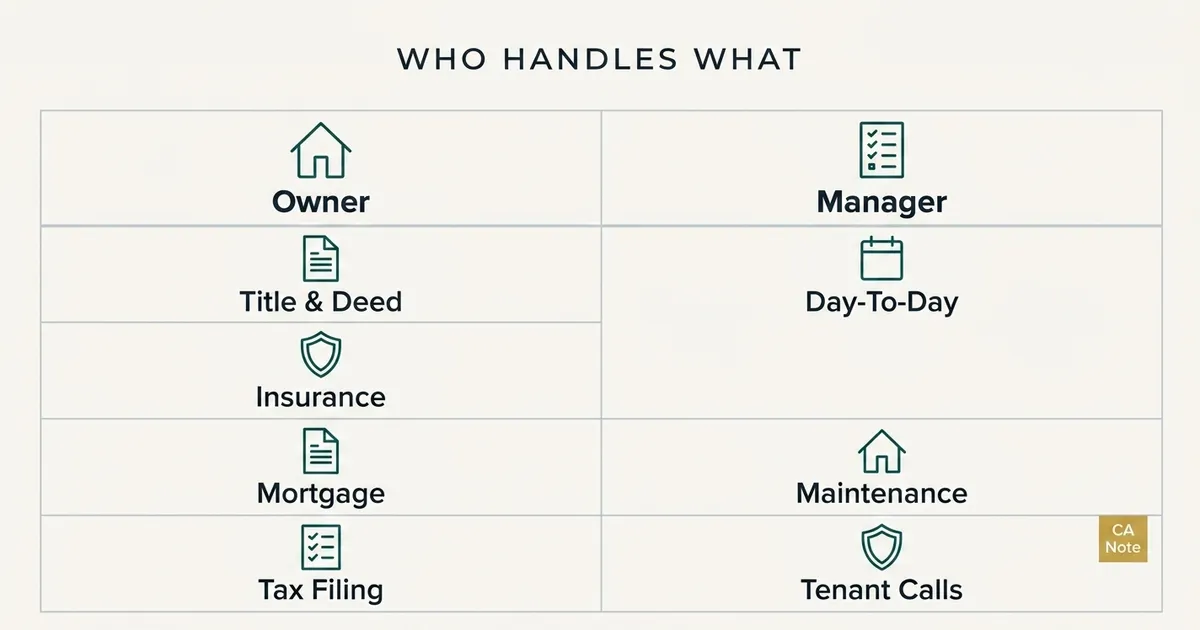
This is where the "low-maintenance" label gets tested most, because you own real property in your own name or LLC — with a mortgage, a title, property taxes, and insurance — and simply outsource the operations to a paid manager. Turnkey providers compress the acquisition side of that work: they buy distressed houses, renovate them, place a tenant, and sell the package to an out-of-state or out-of-time investor, usually with their in-house or affiliated property-management arm already in place. A self-sourced rental means you find the property yourself — through an agent, an off-market wholesaler, or an existing owner — and then hire an independent property manager once you close.
Illustrative example, not a projection of any specific property's performance. Suppose a parent has $40,000 in savings earmarked for real estate and buys a turnkey single-family rental priced at $160,000 in a secondary market, financing it with a conventional 25%-down investment-property loan. That's $40,000 down plus roughly $2,000–$4,000 in closing costs, leaving little cash reserve — a common reason turnkey buyers target markets where $150,000–$180,000 buys a fully rented three-bedroom house rather than trying to stretch that same down payment in a market where, according to the National Association of Realtors (2024), the national median existing single-family home price was approximately $412,000. At a monthly rent of $1,500, gross annual rent is $18,000. A property manager charging 9% of collected rent takes about $1,620 a year, plus a one-time leasing fee near one month's rent (roughly $1,500) whenever the unit turns over. After mortgage principal and interest (roughly $850/month on a $120,000 loan at a typical investment-property rate), property taxes, insurance, and a maintenance reserve of 5%–8% of rent, cash-on-cash returns on deals like this commonly land in the 4%–9% range depending on local taxes, insurance costs, and vacancy — a wide band that underscores why market selection, not just the "turnkey" label, drives the outcome.
The single biggest caveat with this vehicle: a property manager removes the maintenance call, not the maintenance cost or the ownership risk. You still fund the new roof, still carry the loan if the tenant stops paying, and still owe property tax whether or not the unit is occupied. Vacancy and a bad manager are the two failure modes that most often turn an advertised 8% cash-on-cash return into a loss; interviewing a property manager's tenant-screening process and average days-on-market before buying is not optional due diligence, it's the whole point of paying the fee.
On taxes — relevant here only because it's the feature that separates direct ownership from REITs and crowdfunded funds, not as a planning strategy in its own right — a directly owned rental generates depreciation deductions that can offset rental income and, within limits, other income. Under IRC Section 469(i), an investor who actively participates in managing the rental (even with a property manager handling day-to-day operations) may deduct up to $25,000 of passive rental losses against non-passive income such as wages, but that $25,000 allowance phases out for taxpayers with modified adjusted gross income between $100,000 and $150,000, and disappears entirely above $150,000. A dual-income household with two working parents often finds this allowance reduced or eliminated, which is a real reason some households prefer REIT or fund structures where no K-1 depreciation pass-through complicates the return.
Syndications: Bigger Checks, Longer Lockups, Sponsor-Dependent Outcomes
A real estate syndication is a private partnership: a sponsor identifies one asset — typically an apartment complex, self-storage portfolio, or industrial building — and raises the equity from a group of passive limited partners to buy and operate it, usually for a planned hold of three to seven years before a sale or refinance event.
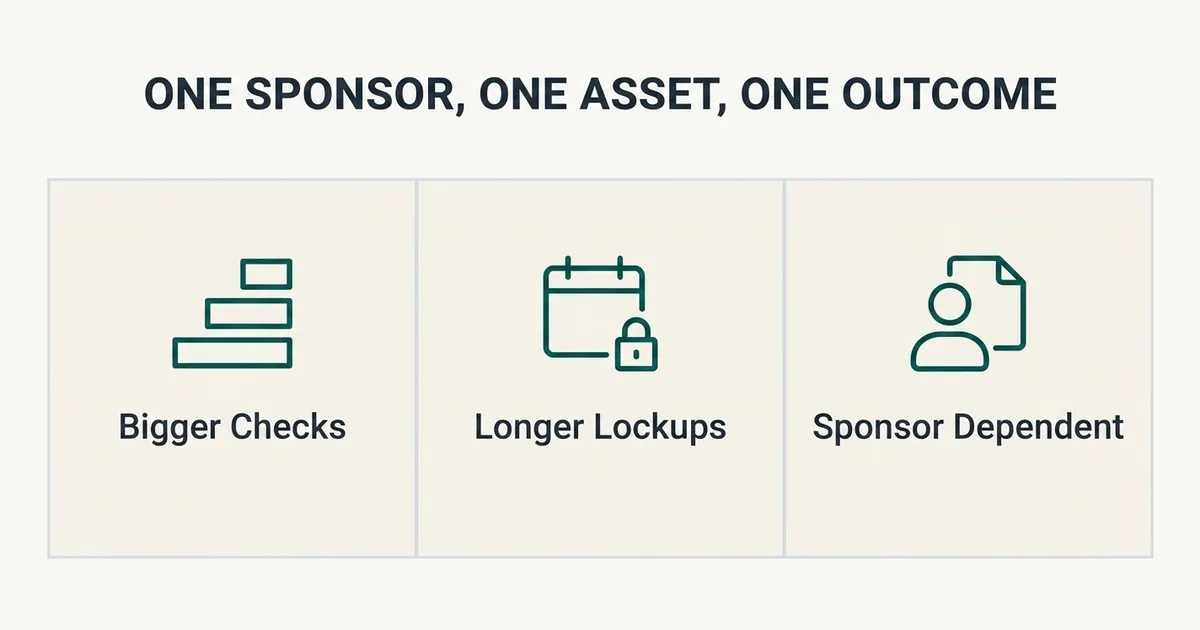
Access is the gating issue. A syndication marketed under SEC Rule 506(c) of Regulation D may use general solicitation but must verify that every investor is "accredited" — defined under 17 CFR 230.501 as an individual with net worth exceeding $1 million excluding a primary residence, or income exceeding $200,000 individually ($300,000 jointly) in each of the prior two years with a reasonable expectation of the same in the current year. Deals structured instead under Rule 506(b) can admit up to 35 non-accredited but "sophisticated" investors alongside accredited ones, but cannot be advertised publicly — a sponsor must have a pre-existing relationship with those investors. For a household with $10,000–$50,000 in savings and no existing net worth above $1 million, that generally means the accessible syndications are 506(b) deals reached through a sponsor's existing network, not the polished marketing sites that show up in a web search.
Fee structure compounds on top of the minimum-check hurdle: a typical acquisition fee of 1%–3% of purchase price is paid to the sponsor at closing, an ongoing asset-management fee of roughly 1%–2% of equity or revenue is paid annually, and — the largest line item — the sponsor keeps a "promote" or carried interest, commonly 20%–30% of profits above a preferred return to investors (often 6%–8% annually). That preferred return is a target, not a guarantee: if the property underperforms, the preferred return can go unpaid, and the sponsor's promote simply shrinks or disappears rather than the investor being made whole. There is no secondary market for most syndication LP interests; capital is effectively locked for the full hold period, which is why this vehicle is a poor fit for money earmarked for a house down payment or college costs on a known timeline three or four years out.
How Should a Parent With $10,000–$50,000 Actually Allocate Across These?
The decision tree starts with time-to-need, not expected return. Money you might need within two years — the emergency fund, a coming roof repair, next year's preschool tuition — has no place in any vehicle on this page; none of them offer same-week liquidity except a publicly traded REIT, and even that carries market-price risk that an emergency fund shouldn't bear. Once that near-term cash is set aside separately, three practical starting points emerge for the remaining balance:
- Want the closest thing to a "set it and forget it" real estate sleeve inside an existing brokerage or retirement account, with the ability to sell in a bad month if life demands it: a REIT index fund or ETF is the only vehicle here with that combination of features, and it can be funded with any amount from $50 up.
- Want direct exposure to a specific property type (say, workforce housing or self-storage) with a small check and no mortgage, and can tolerate a multi-quarter wait to get cash back: a Regulation A or Reg CF platform fits, with the redemption-gating caveat above kept firmly in mind.
- Have $30,000+ that will not be needed for at least five years, want the depreciation and leverage benefits of directly owned property, and are comfortable interviewing and firing a property manager if service slips: a turnkey or self-sourced PM-run rental is the vehicle built for that, understood as an illiquid, single-asset bet on one local market rather than a diversified holding.
- Have $25,000+ available for 3–7 years, meet or are close to the accredited-investor thresholds (or have a relationship with a sponsor running 506(b) deals), and want professional-grade asset management on a large commercial property without any landlord duties at all: a syndication fits, with the lockup and sponsor-dependency caveats above as the binding constraint.
Combining two or three of these is common and often prudent — a REIT allocation for liquidity and diversification, paired with a smaller crowdfunded or turnkey stake for direct-property exposure, spreads both the fee structures and the liquidity terms across the household's real estate sleeve rather than betting the whole $10,000–$50,000 on one structure's terms.
Which Mistakes Cost the Most?
The costliest error is a liquidity mismatch: putting money that will be needed on a known date — a home down payment in three years, a tuition bill next fall — into a syndication or non-traded fund with a multi-year lockup or a gated redemption window. The second-most expensive error is chasing an advertised yield without separating the sponsor's fee load from the underlying property's actual cash flow; a syndication's 8% "preferred return" and a turnkey provider's advertised "10% cap rate" are both projections built on assumptions about rent growth, vacancy, and exit price that the sponsor does not guarantee and, in a downturn, does not have to honor. The third is concentration: a single turnkey house or a single-asset crowdfunding deal ties the household's real estate return to one roof, one tenant, and one local job market, a risk a REIT or a multi-property fund diversifies away by design. Reading a Reg A offering circular's fee table, a syndication's private placement memorandum's promote structure, or a turnkey provider's actual (not pro forma) rent roll before wiring money addresses all three at once.
California and State-Specific Wrinkles
Federal securities rules — Regulation A, Regulation Crowdfunding, Regulation D — apply identically nationwide, so the REIT, crowdfunding, and syndication paths above work the same way whether an investor lives in California, Texas, or Ohio. Direct property ownership is where state and local law diverges sharply, and California is a useful illustration of how far that divergence can run.
California's statewide rent control and eviction framework, the Tenant Protection Act of 2019 (California Civil Code Section 1947.12), caps annual rent increases at 5% plus the local CPI (or 10%, whichever is lower) for most residential units older than 15 years, and requires "just cause" for eviction after a tenant has occupied a unit for 12 months — rules that directly shape the cash-flow assumptions behind a California turnkey or PM-run rental in a way that doesn't apply to an out-of-state purchase in a non-rent-controlled market. Short-term rentals add another layer: California has no single statewide short-term-rental licensing law, so regulation happens city-by-city — San Francisco, for instance, requires short-term rental hosts to register under Administrative Code Chapter 41A and generally limits unhosted rentals to a capped number of nights per year — meaning an investor evaluating a short-term rental strategy needs to check the specific municipal ordinance, not a statewide rule, before assuming a property can legally operate that way. Investors in other states should verify their own state's landlord-tenant statute and any municipal short-term-rental ordinance directly, since both vary widely and neither is standardized nationally.
Where to Go From Here
Every vehicle above trades check size, fees, liquidity, and weekly time against each other in a different pattern, and none of them is universally "best" — the right starting point depends on how soon the money might be needed and how many hours a week the household actually has to give to overseeing it. The guides below this page take each vehicle in turn: comparing specific REIT ETFs and their yields, walking through how to vet a crowdfunding platform's offering circular, pricing out a turnkey purchase market by market, evaluating a property-management contract line by line, and reading a syndication's private placement memorandum before wiring a five-figure check. Use this page to identify which one or two paths match the household's timeline and time budget, then use the linked guides to execute the specific comparison.
Guides in this cluster
- REIT Investing vs. Rentals: Which Wins in 2026?
- Fractional Real Estate Investing: Is It Worth It in 2026?
- Real Estate Crowdfunding Platforms Compared for 2026
- Property Management Companies: Outsource Rentals in 2026
- Turnkey Real Estate Investing: Worth It in 2026?
- Airbnb Management for Parents: 2026 Costs & Options
- Rental Property Income After Expenses: The Real Math (2026)
- Investment Property Loan Requirements, Explained (2026)
- Landlord Insurance: 2026 Costs, Coverage & Quotes