Property Management Companies: Outsource Rentals in 2026

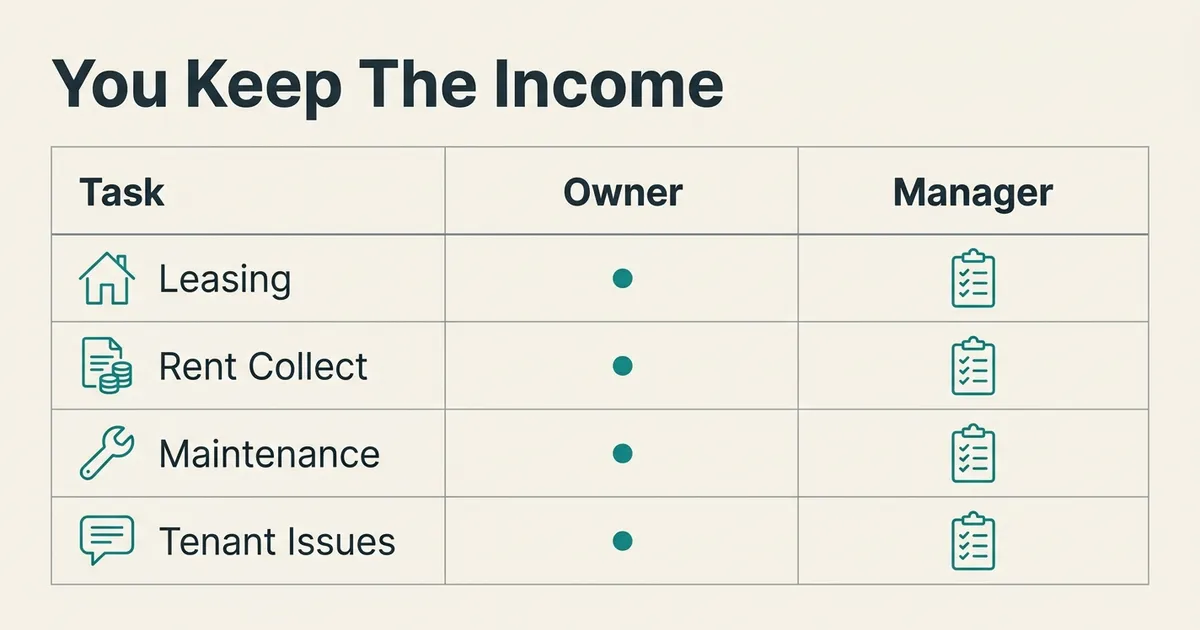
Property management companies take over leasing, rent collection, maintenance dispatch, and tenant issues for roughly 8-12% of monthly rent plus a leasing fee, so you keep the rental income without taking landlord calls yourself. You hire one by getting three local quotes, checking state licensing, and signing a management agreement that spells out fees, reserve funds, and termination terms.
If you're a working parent with $10,000-$50,000 to put toward real estate and no time for a 9 p.m. call about a broken water heater, self-managing a rental isn't a realistic second job. A property management company converts that time cost into a fixed, budgetable expense — the trade-off is a smaller net yield in exchange for zero hands-on hours per week.
What exactly do property management companies do?
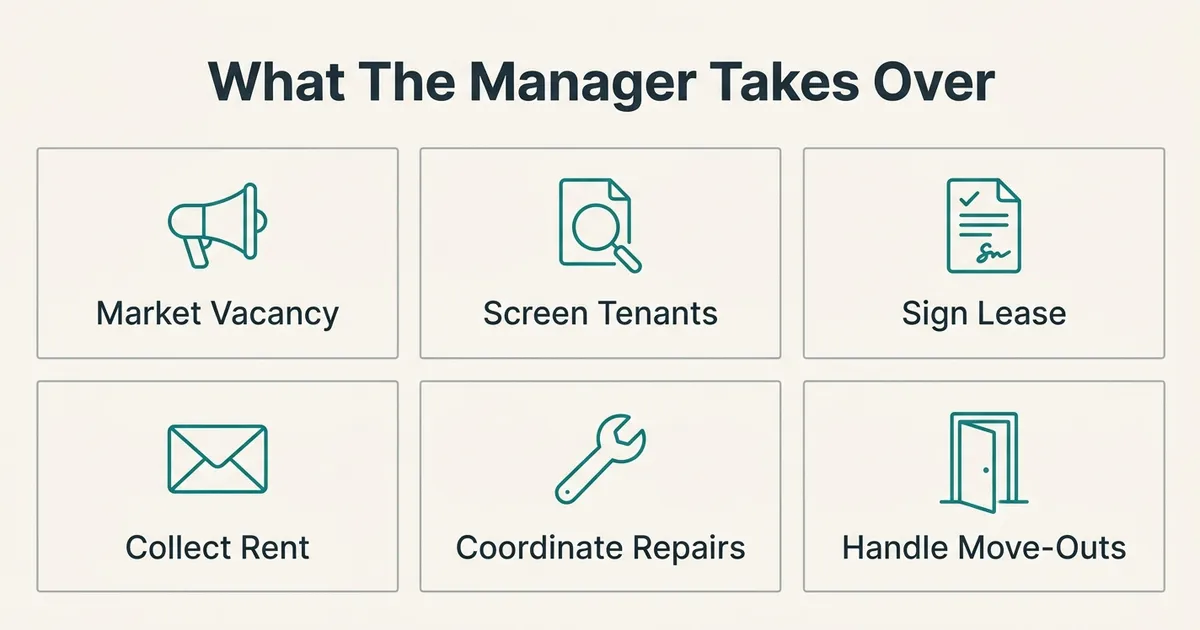
A property management company acts as your licensed agent for everything between "you own the property" and "a tenant pays rent on time." That includes marketing the vacancy, screening applicants, signing the lease, collecting rent, coordinating repairs, and handling move-outs and evictions if needed.
Screening is the mechanism that protects your cash flow most directly. Under the Fair Credit Reporting Act, enforced by the Federal Trade Commission (2025), any company pulling a credit or background report on an applicant must get written authorization and follow adverse-action notice rules — a property manager builds this compliance step into every application so you're not personally liable for a botched denial letter.
In most states, a company (or individual) that leases property for other people must hold a real estate broker's license, not just a "property manager" title. California requires this under Business and Professions Code §10131, administered by the California Department of Real Estate — a firm managing your rental without that license, or without a broker supervising its agents, is operating illegally in that state. Ask for the license number and verify it on your state real estate commission's public lookup before signing anything.
The fee you pay is also a federal tax deduction, not a wash against your return. Per IRS Publication 527 (2025), property management fees are deductible as an ordinary and necessary rental expense on Schedule E, which softens the net cost by your marginal tax rate — a $220/month fee at a 22% federal bracket effectively costs closer to $172/month after the deduction, before any state tax effect.
How much are monthly property management fees?
Most full-service companies charge 8-12% of collected monthly rent — the range that recurs across published fee schedules from national franchises and independent firms, including members of NARPM (the National Association of Residential Property Managers) — plus a one-time leasing or placement fee equal to 50-100% of the first month's rent. Expect additional charges for lease renewals ($150-$300), maintenance markups (10-15% on invoiced repair work), and sometimes a setup or onboarding fee ($100-$300).
Run the math on a real number before you sign. HUD's FY2026 Fair Market Rents put the national median two-bedroom at $1,241, with metro-level figures spanning under $500 to well over $4,000 — take a $2,000/month rental, above that median but unremarkable in a mid-sized metro: a 10% management fee is $200/month ($2,400/year), a 75%-of-first-month leasing fee is $1,500 in year one, and a $200 renewal fee applies if the tenant stays. That's roughly $3,900 in year-one management costs, or about $2,600/year in every subsequent year the tenant renews — the $2,400 in management fees plus the $200 renewal fee.
| Outsourcing option | Typical monthly fee | Leasing/placement fee | Best for | Weekly time commitment | Risk level |
|---|---|---|---|---|---|
| Local independent PM company | 8-10% of rent | 50-75% of 1st month | 1-3 nearby properties, hands-on owner oversight desired | ~15-30 min | Medium — quality varies firm to firm |
| National franchise PM (e.g., Real Property Management network) | 8-12% of rent | 75-100% of 1st month | Out-of-state owners wanting standardized systems | ~10-15 min | Low-medium — brand-level accountability |
| Tech-enabled/online PM (e.g., Mynd, Roofstock-affiliated managers) | 6-10% of rent | Flat fee, often $0-$500 | Turnkey single-family rentals bought sight-unseen | ~5-10 min | Medium — support is app/ticket-based, not local |
| Self-manage with software (Avail, TurboTenant) | $0-$40/month software | $0 | Owners within 20 minutes of the property, comfortable on-call | 3-5 hours | Higher — you are the maintenance contact |
Read the table by proximity and property count, not brand recognition. If you live more than a 30-minute drive from the property or own it out of state, a local independent or national franchise PM wins because someone has to physically inspect and dispatch vendors — software alone can't unclog a drain. If you bought a single turnkey rental through a platform and want the lowest possible fee with app-based reporting, a tech-enabled manager fits; skip it if the property needs heavy renovation, since these managers are built for stabilized units, not fixer-uppers.
How do you choose a property management company?
Get three written quotes before you decide, and compare the full fee schedule — not just the headline management percentage — because a low monthly rate often hides a high leasing or renewal fee. Published single-family leasing fees commonly run 50-100% of one month's rent, so a company advertising "6% management fee" can still cost more in year one than a "10%" competitor with no leasing fee.
Choose a full-service local company if you own the property out of state, don't want to vet contractors yourself, or hold more than one door — the fixed percentage buys you a single point of accountability. Choose a tech-enabled manager if your property is newly renovated, in a landlord-friendly market, and you're comfortable resolving disputes through an app rather than a phone call. Don't outsource at all if your monthly cash flow margin after mortgage, taxes, and insurance is under roughly $150 — a 10% fee on a $2,000 rent ($200/month) can erase that margin entirely, and you're better served by a REIT or fractional platform where the sponsor's management fee is already baked into the yield you're quoted.
Confirm three things before signing: state license status, proof of errors-and-omissions insurance, and how security deposits are held. Security deposit rules vary by state, and they change — since AB 12 took effect on July 1, 2024, California caps deposits at one month's rent whether the unit is furnished or not, where the old limit was two months (unfurnished) or three (furnished). A narrow exception lets a small landlord — a natural person owning no more than two residential properties totaling four or fewer units — collect up to two months, except from active-duty service members, who are capped at one month either way. California still requires an itemized accounting within 21 days of move-out, all under Civil Code §1950.5. The National Conference of State Legislatures' security deposit statutes resource shows how far limits and return deadlines diverge state to state, so verify your own state's statute directly rather than assuming California's rule applies.
Is outsourcing to a property manager worth it compared to other low-maintenance real estate?
Outsourcing wins on control and full ownership upside; REITs and fractional platforms win on lower minimum check size and true zero time commitment. A property manager still requires you to own the asset, sign the mortgage, and make the "sell or refinance" call — you've outsourced the labor, not the decision-making.
According to the 2021 Rental Housing Finance Survey published by HUD and the Census Bureau, only about 22% of small rental properties — those with one to four units — are professionally managed, against 84% of properties with 150 or more units. That leaves roughly four in five small rentals run by their owners, which is precisely the gap a management company is built to close for a working parent with no spare evenings. If your $10,000-$50,000 is better deployed as a down payment on a single rental than spread across shares, hiring a manager keeps you a landlord in name only. If you'd rather never touch a lease, compare the trade-offs in our guide to REITs vs. rental properties, which quantifies the yield and liquidity gap directly.
Fractional and crowdfunded platforms solve the same "no time" problem with a lower entry point but less control and less liquidity than a self-owned, professionally managed rental. Our breakdown of whether fractional real estate is worth it and our comparison of the best fractional real estate platforms cover minimums, fees, and redemption windows for that path — start there if $10,000-$15,000 is closer to your actual check size than $50,000, since that budget often can't cover a down payment plus reserves on a directly owned rental. For the full menu of low-maintenance options, the Low-Maintenance Real Estate pillar lays out how each vehicle ranks on time, minimum investment, and liquidity. Everything above assumes a long-term tenant on a standard lease; if you're weighing a short-term rental instead, both the service providers and the unit economics change — running a family Airbnb without full-time hosting covers co-hosts, turnover cleaning, and nightly-yield math.
What's the process to switch from self-managing to a property manager?
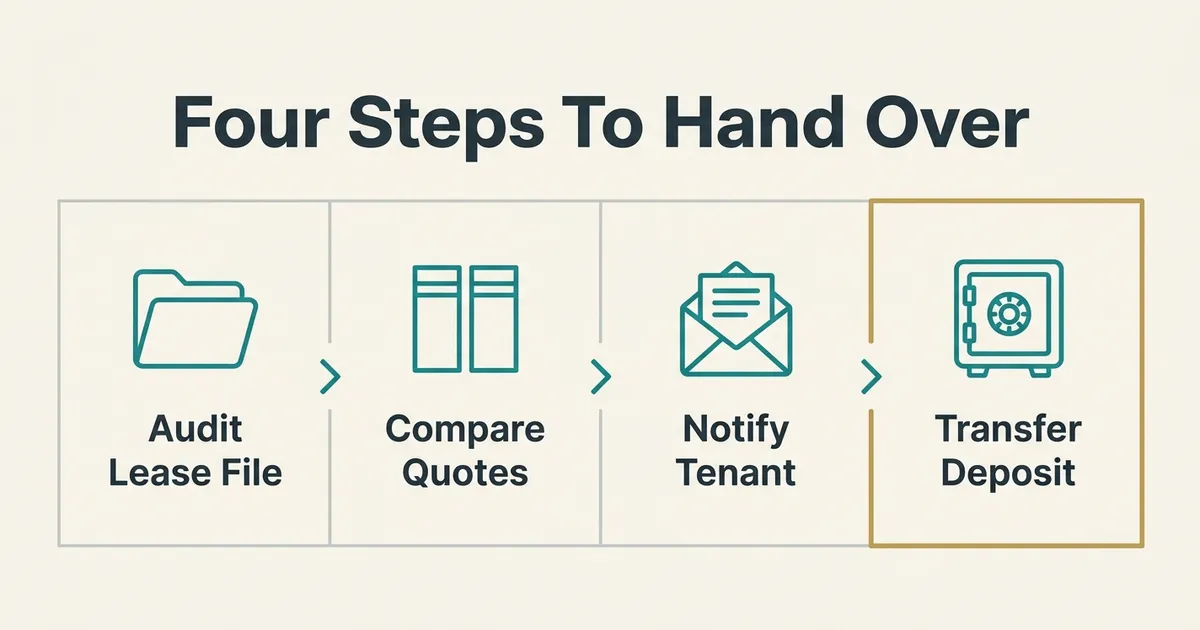
Start by auditing your current lease and tenant file — the incoming manager needs the signed lease, deposit ledger, and any pending maintenance requests before they can legally take over. Then request quotes from at least three companies and compare fee schedules using the table above, not just the headline percentage.
Notify your tenant in writing before the transition, since some states require formal notice of a change in who collects rent and handles repairs — California's Civil Code §1962 requires landlords to disclose the name and address of anyone authorized to manage the property. Transfer the security deposit to the new manager's trust account with a signed accounting showing the exact amount held, satisfying the itemization requirement under Civil Code §1950.5(g) in California, or your state's equivalent statute. Budget one to two weeks for the paperwork and account setup; most tech-enabled managers can activate an owner portal within 3-5 business days, while local independent firms may take one full billing cycle to fully take over rent collection.
Frequently asked questions
Who are the top 10 property management companies?
There's no single official ranking, but nationally recognized names that will actually manage a single rental for a private owner include Real Property Management (a franchise network), HomeRiver Group, Mynd (Roofstock-affiliated), Renters Warehouse, Vacasa (short-term rentals only), and thousands of independent NARPM-member firms operating locally. The biggest names in single-family rentals — Invitation Homes, American Homes 4 Rent, and Progress Residential — are not options for a private landlord: they own and lease their own portfolios, and where they manage for third parties it is for institutional portfolio owners, not a one-off rental. NARPM (National Association of Residential Property Managers) maintains a searchable directory of its member firms as of 2025, which is a more reliable starting point for a single rental than a "top 10" list built for institutional portfolios. Match the company type to your property: national franchises and tech-enabled managers suit out-of-state single-family owners, while local independents suit owners who want a single point of contact within driving distance.
What is the 2% rule for rental property?
The 2% rule says a rental's monthly rent should equal at least 2% of its purchase price for the deal to likely cash flow well after expenses — a $150,000 property would need $3,000/month in rent to pass. It originated as a quick screening heuristic among investors and is referenced in investor communities like BiggerPockets (2025), not a lender or regulatory standard. In most metro markets in 2026, achievable rents run closer to 0.5%-1% of purchase price, so the 2% rule mainly filters for distressed or rural markets rather than typical suburban rentals — use it as a first-pass screen, not a purchase requirement, and verify actual cash flow with a full expense worksheet including the property management fee.
What exactly do property management companies do?
A property management company handles marketing the vacancy, screening applicants under Fair Credit Reporting Act rules enforced by the Federal Trade Commission (2025), signing leases, collecting rent, coordinating maintenance, and managing move-outs or evictions on the owner's behalf. Most states, including California under Business and Professions Code §10131, require the company to hold a real estate broker's license to lease property for others legally. Beyond leasing, many companies also issue owners a monthly financial statement and, per IRS rules, must issue contractors a Form 1099-NEC for any single vendor paid $2,000 or more in a calendar year — a threshold the One Big Beautiful Bill Act raised from the long-standing $600 for payments made after December 31, 2025, with inflation indexing beginning in 2027.
How much are monthly property management fees?
Monthly property management fees typically run 8-12% of collected rent across published fee schedules from national franchises and independent firms alike, plus a separate leasing fee of 50-100% of one month's rent charged only when a new tenant signs. On a $1,800/month rental, a 9% fee costs $162/month, while the leasing fee on a 75%-of-first-month structure adds a one-time $1,350 when the unit turns over — budget for both, since owners who only account for the recurring percentage are routinely surprised by the leasing fee at turnover.
Property management companies in Tulsa — what should you check before hiring one?
In Tulsa, as in the rest of Oklahoma, anyone leasing property for an owner in exchange for a fee must hold a real estate license under the Oklahoma Real Estate License Code, Title 59 of the Oklahoma Statutes §858-301 et seq. — verify the company's license through the Oklahoma Real Estate Commission's public license lookup before signing. Because Tulsa's rental market includes both single-family and smaller multifamily stock, ask each candidate firm whether they're NARPM (2025) members, which requires adherence to a standardized code of ethics and continuing education, and request their specific vacancy-fill timeline for your property type rather than a citywide average.
How do you find property management companies near you?
Start with NARPM's member directory (2025) and your state real estate commission's license lookup, since both let you verify a company is actively licensed and disciplinary-history-free before you call. Request quotes from at least three local firms, confirm each carries errors-and-omissions insurance, and ask for two current owner-client references you can call directly — a firm unwilling to provide references managing similar properties in your ZIP code is a disqualifying red flag, not a minor gap.