Airbnb Management for Parents: 2026 Costs & Options

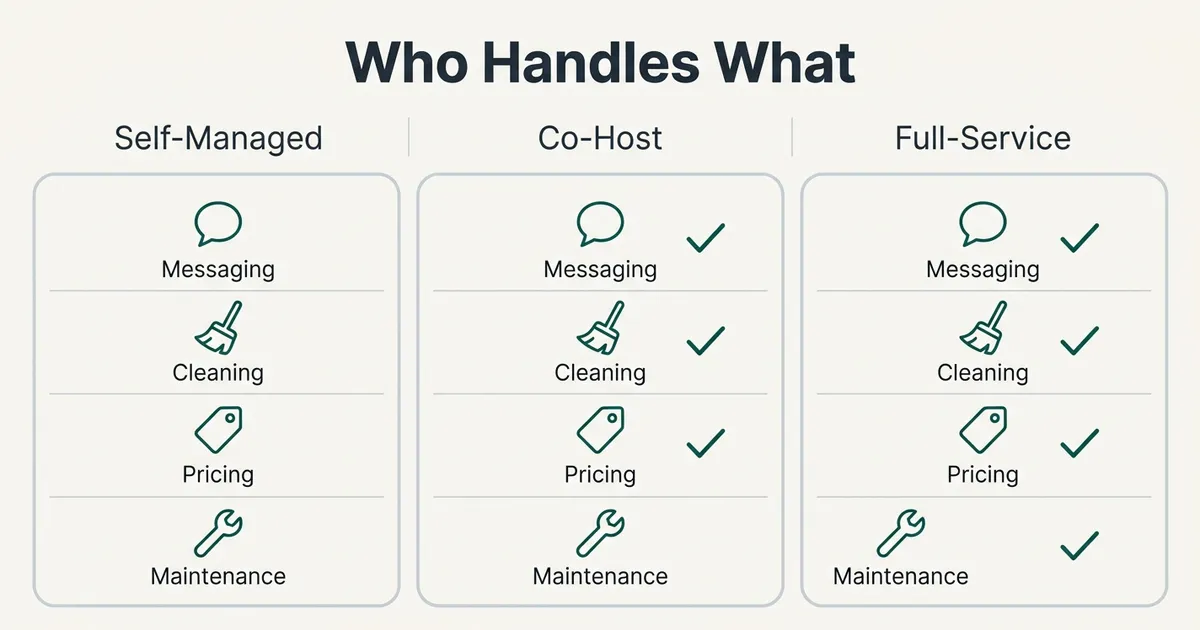
Airbnb management for parents means hiring a licensed co-host or management company to run guest messaging, cleaning, pricing, and maintenance for a monthly fee. According to AirDNA (2025), full-service co-hosting typically costs 15%-25% of gross booking revenue, so a $2,800-a-month listing can produce income without a single guest text at midnight.
That fee buys back the hours a self-managed short-term rental normally demands. A self-managed single-unit host commonly spends 5 to 15 hours a week on guest communication, turnover scheduling, and restocking — time a full-time employee with a pre-K or K-8 kid rarely has between drop-off, work, and bedtime. A management company or co-host absorbs that workload and reports back monthly, usually through a dashboard rather than a phone call.
The trade-off is margin, not risk elimination. You still own the asset, still carry the mortgage or HOA dues, and still owe income tax on the net rent, so "passive" describes your weekly time commitment, not your financial exposure. The rest of this guide breaks down exactly what you pay, what you get, and when the fee is worth it for a parent who cannot take a midnight maintenance call.
What Does Airbnb Management Cost in 2026?
Full-service Airbnb management costs 15%-25% of gross booking revenue for most U.S. markets, with some luxury or single-listing boutique operators charging up to 35%. According to AirDNA (2025), that percentage typically covers guest messaging, dynamic pricing, turnover coordination, and 24/7 guest support, but cleaning itself is usually billed separately and passed through to the guest as a cleaning fee. Individual co-hosts — often a local freelancer rather than a branded company — charge less, with commissions commonly quoted at 10%-20%, reflecting a leaner service that may skip revenue-management software and guest-screening tools.
Compare that to the traditional long-term rental world your parents' generation used. A conventional long-term rental property manager typically charges 8%-12% of monthly rent plus a leasing fee equal to 50%-100% of one month's rent when placing a new tenant — figures widely quoted across the industry, though no trade body publishes an audited national survey of what owners actually pay. Short-term rental management costs more per dollar of revenue because the workload repeats every 2-4 days instead of every 12 months — a fresh guest, a fresh cleaning, a fresh set of messages each stay.
| Option | Typical fee | Your weekly time | Best for | Main risk |
|---|---|---|---|---|
| Self-managed Airbnb | 0% (your time only) | 5-15 hrs | Parents living within 20 minutes of the property | Guest calls at any hour; burnout during peak season |
| Individual co-host | 10%-20% of revenue | Under 1 hr | One listing, want a local point person | Service quality varies host to host; no backup coverage |
| Full-service management company | 15%-25% of revenue (up to 35% for boutique/luxury) | Under 1 hr | 1-3 listings, want turnkey passive income | 12-month contract lock-in; fee compounds during slow months |
| Traditional long-term rental manager | 8%-12% of rent + leasing fee | Under 1 hr/month | Parents who want simpler cash flow, lower yield | Still carries landlord liability; lower gross yield than STR |
| REIT or fractional real estate (no physical property) | ~0.5%-2% expense ratio, platform-dependent | 0 hrs | Under $10k check size, zero desire to own a unit | Market and platform risk; no operational control |
Read the table by what you're actually trading. A full-service Airbnb manager costs roughly double a long-term rental manager as a percentage, but it also produces roughly double the gross yield in strong short-term rental markets — the fee and the upside scale together, unlike a REIT's flat, low expense ratio and flat, lower-volatility return. If your $10k-$50k stake is earmarked for a specific property you already own or plan to buy, a co-host or management company is the relevant comparison; if you have no property and no interest in owning one, the REIT/fractional row is the one to read against REITs vs. rental properties rather than this guide.
How Does the 80/20 Rule Apply to Airbnb Hosting?
The 80/20 rule, drawn from the Pareto principle, means a small share of your calendar and your tasks generates most of your revenue and most of your headaches. In short-term rental terms, that usually plays out as roughly 20% of the year — the peak-season weeks and holiday weekends — producing the majority of annual booking revenue, while the other 80% of nights fill in around it at lower rates. Dynamic-pricing tools are built around exactly this concentration, raising nightly rates sharply on the highest-demand dates and discounting the shoulder season to keep occupancy from collapsing.
The same ratio shows up in guest behavior: a small share of bookings — problem check-ins, same-day cancellations, maintenance emergencies — consumes a disproportionate share of a host's attention. A management company's value is concentrated in exactly that 20%: dynamic pricing that captures the peak-season premium, and 24/7 dispatch that absorbs the rare 2 a.m. lockout call. If you self-manage, budget your own time the same way — expect most weeks to be quiet and one week in five to demand real attention.
Is Hiring an Airbnb Manager Worth It for a Working Parent?
Hiring a manager is worth it once the dollar value of your reclaimed time exceeds the fee — and that calculation is close enough to be worth running properly. Take a two-bedroom condo generating $2,800 in average monthly gross booking revenue, and assume roughly $500 a month in supplies, restocking, and turnover costs that you carry in either scenario (guest-paid cleaning fees usually offset part of it). Self-managed, you net about $2,300 — but you spend roughly 30 hours a month on messaging, turnover coordination, and after-hours troubleshooting.
Hand the same unit to a full-service manager at a 20% fee and the manager takes $560 of the gross, leaving about $1,740 on the same $500 cost base — roughly $560 less per month — while your own time commitment drops to under an hour of reviewing a monthly statement. Divide that $560 by the roughly 30 hours you get back and self-managing is effectively paying you about $19 an hour before tax.
That is a real wage rather than a rounding error, which is why this call is genuinely close for a lot of families — be skeptical of any guide that treats it as obvious. Outsourcing wins when your own hourly rate at work comfortably exceeds that $19, when you cannot answer a guest message during business hours, or when the realistic alternative is not hosting at all. Self-managing wins when $560 a month is material to your budget and the hours are ones you would be at home for anyway.
Choose self-management if you live within 20 minutes of the property, have only one listing, and can realistically answer a guest message within an hour during work hours — a stay-at-home parent or a remote worker with flexible breaks fits this profile. Choose a full-service manager or co-host if you live more than an hour away, work a fixed 9-to-5 with young kids at pickup time, or own more than one listing, because the time cost of self-managing multiple properties compounds faster than the fee does.
What Do Airbnb Management Companies Actually Do?
A full-service Airbnb management company runs the entire guest lifecycle: listing optimization, dynamic pricing, guest screening, messaging, check-in coordination, cleaning-crew dispatch, restocking, and 24/7 emergency response. According to Airbnb (2025), the platform's own Co-Host Network vets independent co-hosts on responsiveness and review scores before connecting them with hosts, and most co-hosts in that network are paid a percentage of each payout rather than a flat monthly retainer. Larger franchise operators — names like Vacasa, AvantStay, and Awning are the most recognized in the U.S. market — bundle in professional photography, revenue-management software, and centralized guest-support call centers that a solo co-host typically cannot match.
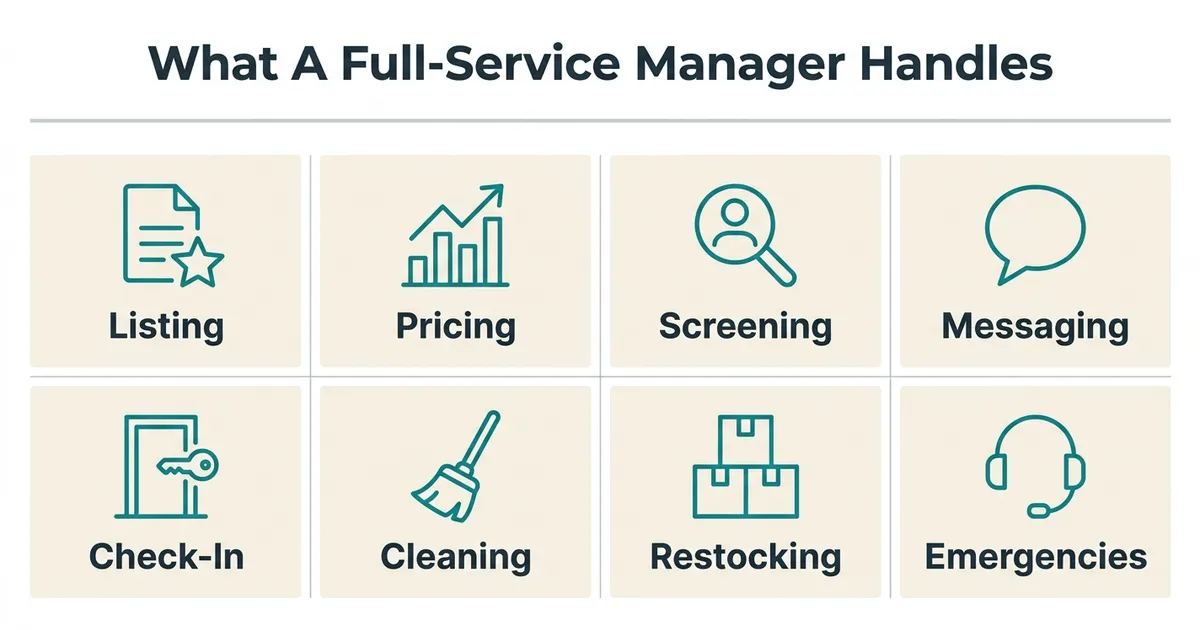
Tax and occupancy-fee compliance is a less visible but material task. Transient Occupancy Tax is levied and administered by cities and counties rather than by the state — the City of Los Angeles Office of Finance and the San Francisco Treasurer & Tax Collector each run their own TOT registration and filing, at rates that commonly land in the 8%-15% range depending on the municipality — and a management company usually handles that collection and filing as part of its fee. Verify what's actually included before signing: some contracts bill occupancy-tax remittance and photography as add-ons, which changes the effective 20% fee to closer to 25%-28% once those extras are added back in.
Co-Host or Full-Service Management Company: Which Should You Choose?
Choose an individual co-host if you have one listing, a fee budget under 15%, and you're comfortable with a single point of contact who may not have backup coverage during their own vacation. Choose a full-service management company if you own multiple units, want centralized reporting across properties, or need guaranteed 24/7 coverage — the higher 20%-25% fee buys redundancy an individual generally cannot offer. Franchise-affiliated managers are also more likely to carry their own liability coverage and standardized guest-agreement templates, which matters if you're managing a listing you'll rarely see in person — ask for a certificate of insurance rather than taking it on trust.
Read every management agreement for three terms before signing: the contract length (many run 12 months with an early-termination fee equal to one to three months of projected management fees), the cancellation notice period (30-90 days is standard), and whether the fee is calculated on gross booking revenue or on revenue net of Airbnb's own host service fee. That distinction has grown considerably: per Airbnb (2026), most hosts now pay a host-only service fee of 15.5% of the booking subtotal, and that structure is mandatory for hosts whose listings are connected to property management software — which includes essentially every listing run by a management company. The older split-fee model, under which the host paid about 3%, is being retired in waves through 2026. On $2,800 of gross bookings, a 20% management fee charged on gross costs $560, while a 22% fee charged after Airbnb's 15.5% cut costs about $521 — so the higher headline percentage is the cheaper deal. Always ask for the calculation base, not just the headline percentage.
How Do You Find an Airbnb Management Company Near You?
Start with Airbnb's own Co-Host Network, which lets you filter by city and see each co-host's review score and response rate before you contact them, per Airbnb (2025). Cross-check any local match against NARPM's online member directory, which lists property managers who carry professional certifications and agree to the association's Code of Ethics covering trust-account handling and fee disclosure — a useful screen against unlicensed operators who disappear after peak season.
Ask three questions before hiring anyone local: how many other listings they currently manage in your ZIP code (fewer than 15-20 per manager suggests more attention per property), what their average response time to guest messages is over the last 90 days, and whether they are licensed to operate in your city if local law requires it. Per the City of Los Angeles Home-Sharing Ordinance (2025), for example, any short-term rental operator in the city — including a hired manager — must hold a valid home-sharing registration number tied to the host's primary residence, and operating without one can result in fines and delisting. Confirm your manager either holds that registration or will help you obtain it before your first guest checks in.
What Can Go Wrong With Passive Airbnb Hosting?
The most common failure mode isn't a bad guest — it's a local law that makes the whole strategy illegal for your specific property. Per the San Francisco Office of Short-Term Rentals (2025), the city generally permits short-term rentals only in a host's permanent residence, effectively barring the absentee, manager-run model this article describes for most San Francisco units. Before you commission any manager, check your city's short-term-rental ordinance and your HOA's governing documents, since HOAs can and do ban rentals under 30 days even where city law allows them.
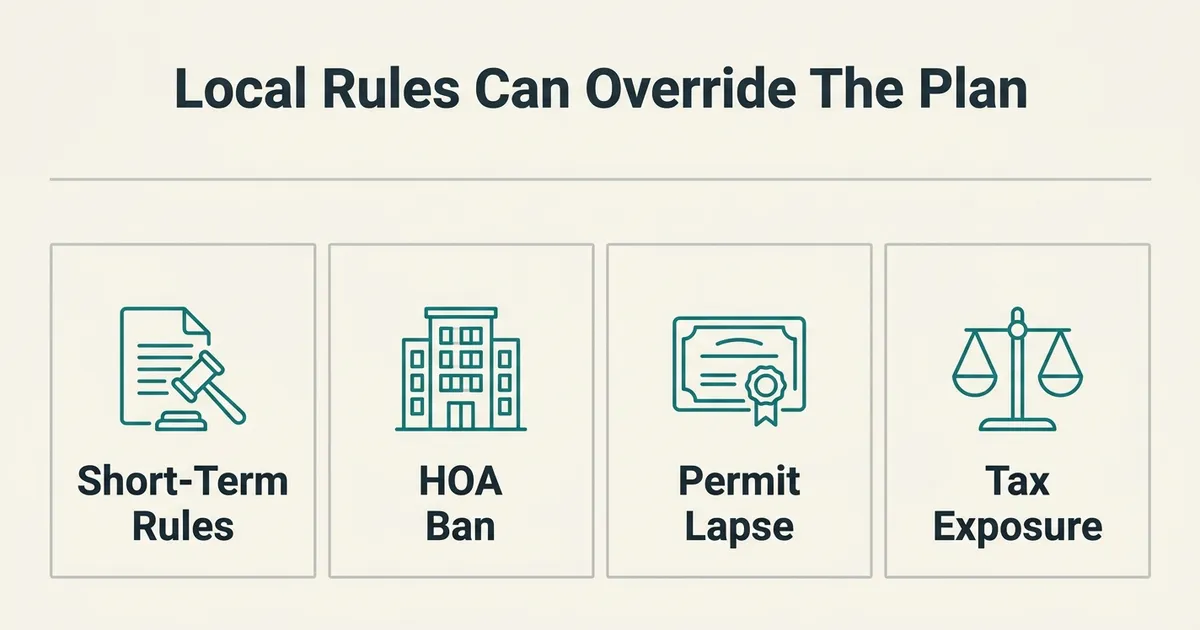
Contract lock-in is the second failure mode. A 12-month management agreement with a 60-day termination notice means a bad manager can cost you two months of subpar service even after you decide to leave — read the termination clause before the fee schedule. Insurance is the third: a standard homeowners policy generally excludes commercial short-term rental activity, so per the Insurance Information Institute (2025), hosts need either an Airbnb-specific endorsement or a dedicated short-term-rental policy, and a management company's coverage does not automatically extend to your own liability as the property owner. Finally, get the filing treatment right, because short-term rentals are the one rental category where it is genuinely ambiguous. Per IRS Publication 527, rental income and expenses normally go on Schedule E — but if you provide "substantial services" primarily for the guest's convenience, such as cleaning during a stay, linen changes, or maid service, the activity belongs on Schedule C and the net income becomes subject to self-employment tax. A full-service manager that layers hotel-style services onto your listing can push you across that line, so confirm which schedule applies with a tax professional before you budget the income. Either way it is a materially different filing than the Form 1099-DIV a REIT or fractional real estate platform issues, which matters if you're weighing this against is fractional real estate worth it as a lower-effort alternative.
If none of this fits your bandwidth — no property, no desire to research local ordinances, no appetite for a 12-month contract — a REIT, a fractional platform, or a professionally managed long-term rental is the better starting point. Compare the best fractional real estate platforms for check sizes under $10k, or read how to outsource rental property management if you already own a property but want the long-term-rental version of this same hands-off approach. For a broader map of every low-maintenance real estate option available at your savings level, start at the Low-Maintenance Real Estate pillar.
Disclaimer: This article is for general education, not personalized financial, tax, or legal advice. Short-term-rental laws vary by city and change frequently — verify current rules with your city's planning or short-term-rental office and consult a licensed tax professional before treating rental income as part of your household budget.
Frequently asked questions
How much does it cost to have someone manage my Airbnb?
Full-service Airbnb management typically costs 15%-25% of gross booking revenue, according to AirDNA (2025), while individual co-hosts often charge less, commonly in the 10%-20% range. On a listing generating $2,800 a month in gross bookings, that translates to roughly $280-$700 a month depending on the provider, with cleaning fees usually billed separately to the guest rather than deducted from that percentage.
What does the 80/20 rule mean for Airbnb?
The 80/20 rule, adapted from the Pareto principle, means roughly 20% of your calendar — peak-season weeks and holidays — generates the majority of your annual booking revenue, which is the pattern dynamic-pricing tools are built to capture by raising rates sharply on high-demand dates. The same ratio applies to guest issues: a small share of stays, such as same-day cancellations or lockouts, consumes most of a host's actual attention, which is why management fees concentrate their value in handling that narrow slice rather than the quiet 80%.
How difficult is managing an Airbnb?
Managing a single self-hosted Airbnb listing commonly takes 5-15 hours a week, with the upper end of that range typical in peak months of back-to-back turnovers. The difficulty isn't complexity — it's timing, since guest messages and lockouts arrive on the guest's schedule, not yours, which is the specific burden a management company or co-host is paid to absorb.
Can I hire someone to manage my Airbnb?
Yes — you can hire an individual co-host through Airbnb's own Co-Host Network, which vets candidates on responsiveness and review history according to Airbnb (2025), or a franchise management company such as Vacasa or AvantStay for a higher, more comprehensive fee. Before hiring, confirm the person or company is properly licensed for your city, since ordinances like the City of Los Angeles Home-Sharing Ordinance (2025) require a registration number tied to the property regardless of who physically manages it.
What is an Airbnb management company?
An Airbnb management company is a business that runs some or all of a short-term rental's operations — pricing, guest messaging, cleaning coordination, and maintenance dispatch — for a percentage-based fee, typically 15%-25% of gross booking revenue per AirDNA (2025). Larger companies add centralized call centers and revenue-management software, which individual co-hosts usually cannot match at their lower 10%-20% fee tier.
How do I find an Airbnb management company near me?
Search Airbnb's Co-Host Network by city to see local, vetted co-hosts along with their review scores and response rates, per Airbnb (2025), and cross-reference candidates against NARPM's online member directory for licensed, certified property managers in your ZIP code. Prioritize a manager who already handles fewer than 15-20 listings in your immediate area, since concentration beyond that range typically slows guest-message response times during peak booking periods.