QBI Deduction Explained: Cut Your 2026 Tax Bill

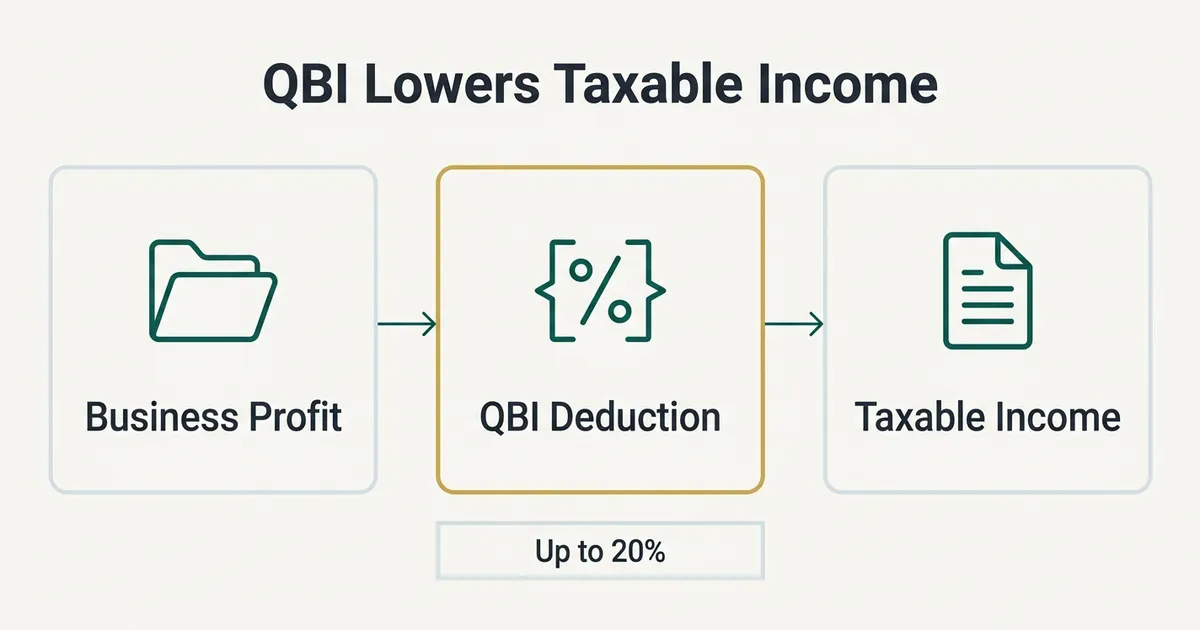
The Qualified Business Income (QBI) deduction lets eligible sole proprietors, LLC owners, and S-corp shareholders deduct up to 20% of their pass-through business profit before calculating federal income tax. For a parent netting $60,000 from a side hustle, that can mean a $12,000 deduction and roughly $2,640 in extra cash for a child's custodial Roth IRA.
Congress created this deduction under Internal Revenue Code Section 199A as part of the Tax Cuts and Jobs Act (2017), pairing it with the corporate rate cut from 35% to 21% so unincorporated businesses got a comparable break. The One Big Beautiful Bill Act (July 2025) made the 20% deduction permanent, erasing the original December 31, 2025 sunset date, which matters directly for anyone filing a 2026 return with side-hustle income.
What Is the QBI Deduction and How Does It Cut Your Tax Bill?
QBI reduces your taxable income, not your business's gross revenue — it's a below-the-line deduction taken after you compute net profit. Because the deduction lands on your Form 1040 rather than your Schedule C, it lowers the income tax bill without touching what you owe on self-employment (SE) tax or state returns that don't conform to it.
The mechanism matters for planning: since the deduction is 20% of the lesser of your qualified business income or your taxable income before QBI (minus net capital gains), a parent with a modest side hustle and a full-time W-2 job from a spouse usually gets the full 20% cut with zero extra paperwork. According to Revenue Procedure 2025-32 (October 2025), the One Big Beautiful Bill Act also added a permanent minimum QBI deduction of $400 for any taxpayer with at least $1,000 of qualified business income from a trade or business in which they materially participate, effective for tax years beginning in 2026 — a floor aimed at very small side businesses that previously saw a near-zero deduction after expenses.
Which Side Hustles and Family Businesses Qualify for QBI?
QBI covers net profit from a sole proprietorship (Schedule C), a single-member or multi-member LLC taxed as a disregarded entity or partnership, an S-corporation K-1, and certain REIT dividends and publicly traded partnership income — it never includes W-2 wages, even from a second job. Per Treasury Regulation 1.199A-5 (2019), the deduction also excludes "specified service trades or businesses" (SSTBs) once your income crosses the phase-out ceiling — a list that includes health, law, accounting, actuarial science, consulting, financial services, investing, athletics, and performing arts.
This split creates a clear decision rule for parents choosing how to structure a side hustle. Choose freelance graphic design, e-commerce (Etsy, Amazon FBA), rental real estate, or tutoring-as-a-business if you want QBI eligibility that survives high income, because none of these sit on the SSTB list. Skip counting on QBI if your side hustle is bookkeeping-as-a-CPA, legal consulting, or financial coaching once your household's taxable income exceeds the phase-out ceiling — the deduction phases to zero for SSTBs above that line regardless of how the business is legally structured.
An S-corp shareholder-employee must also take "reasonable compensation" as W-2 wages before QBI applies; per IRS guidance referenced in the Instructions for Form 8995-A (2025), that W-2 wage amount is excluded from QBI even though it came from the same business.
How Do You Calculate Your QBI Deduction?
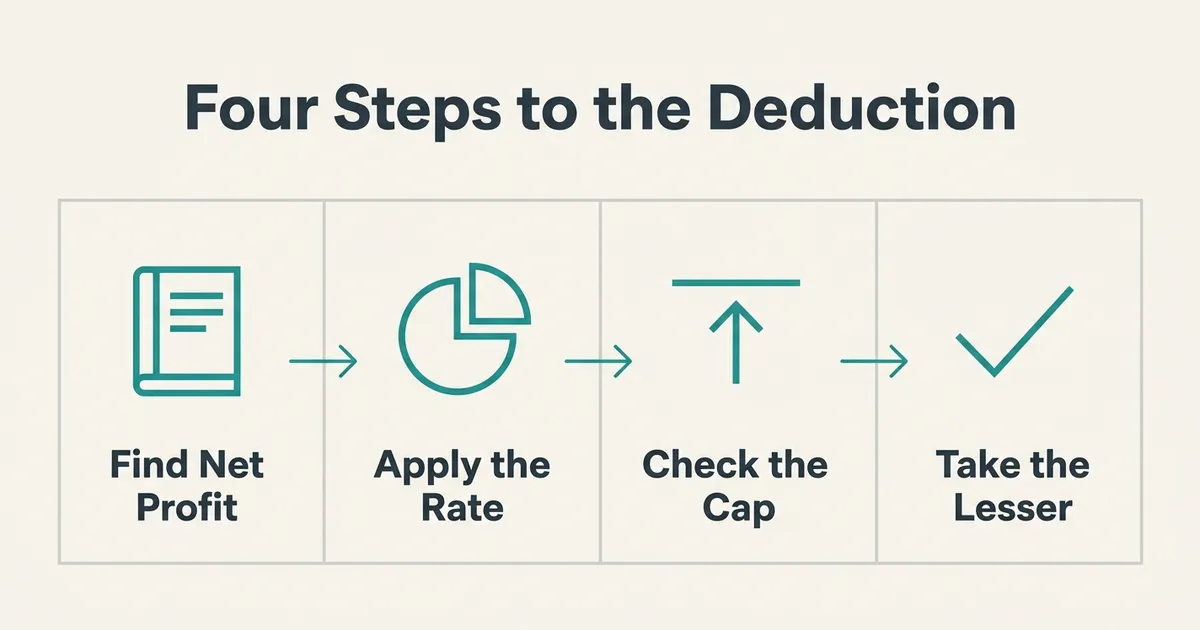
Follow these steps in order, using the same worksheet the IRS builds into Form 8995 (simplified) or Form 8995-A (full version with wage/property limits).
- Determine net QBI. Take your Schedule C or K-1 net profit and subtract the deductible portion of self-employment tax, self-employed health insurance, and SEP/Solo 401(k) contributions attributable to that business, per the Instructions for Form 8995-A (2025).
- Multiply net QBI by 20%. This is your tentative deduction from the business side.
- Multiply taxable income before QBI (minus net capital gains) by 20%. This is the overall ceiling — QBI can never exceed a fifth of your non-capital-gain taxable income.
- Take the lesser of steps 2 and 3. Below the phase-in threshold, that's your final deduction — no wage or property test applies.
- Above the phase-in ceiling, apply the greater of 50% of W-2 wages paid by the business, or 25% of W-2 wages plus 2.5% of unadjusted basis in qualified property (UBIA); SSTBs lose the deduction entirely once income clears the top of the phase-in range.
Worked example. Maria and Tom file married filing jointly. Maria's freelance graphic-design LLC nets $60,000 in 2026 after expenses; combined household taxable income before QBI is $145,000 — well under the 2026 phase-in floor for joint filers. Step 2 gives $60,000 × 20% = $12,000. Step 3 gives $145,000 × 20% = $29,000. The lesser figure, $12,000, is their deduction. That drops taxable income to $133,000, and at a 22% federal marginal bracket that's roughly $2,640 in federal tax saved — money that didn't exist as spendable cash until the return was filed.
What Are the 2026 QBI Income Thresholds, and How Do Phase-Outs Work?
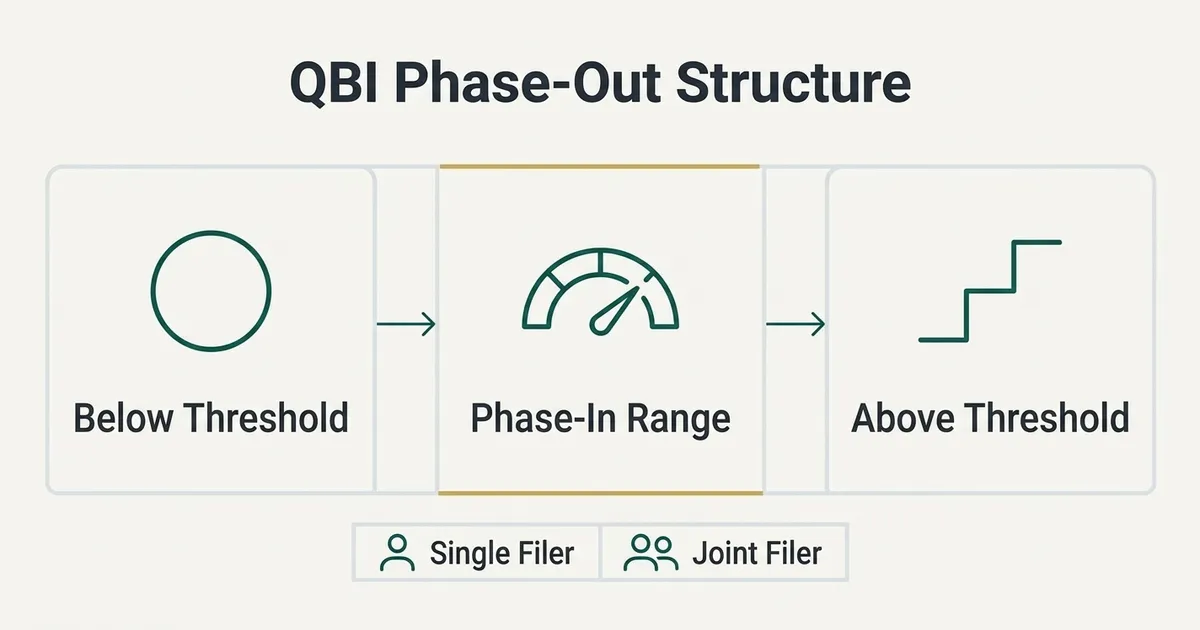
For tax year 2025, the IRS set the QBI phase-in threshold at $197,300 for single filers and $394,600 for married filing jointly, according to Revenue Procedure 2024-40 (October 2024). For 2026, the IRS adjusted these figures upward for inflation to $201,750 single and $403,500 married filing jointly, per Revenue Procedure 2025-32 (October 2025), so the phase-in range now runs up to $276,750 for single filers and $553,500 for joint filers. These amounts are re-indexed every year.
The phase-out exists because Congress didn't want business owners relabeling wage income as pass-through profit purely to dodge payroll taxes and grab an extra deduction. Below the threshold, everyone gets the full 20% regardless of business type or W-2 wages paid. Inside the phase-in range — the One Big Beautiful Bill Act (July 2025) widened this band to $75,000 for single filers and $150,000 for joint filers, up from the original $50,000/$100,000 — the wage/UBIA limitation phases in gradually for ordinary businesses and the SSTB exclusion phases in fully. Above the top of that range, ordinary businesses face the full wage/property test and SSTBs get zero deduction.
Does QBI Reduce Self-Employment Tax?
No — QBI only lowers federal income tax, and has zero effect on the 15.3% self-employment tax (12.4% Social Security plus 2.9% Medicare) computed on Schedule SE. The mechanism: SE tax is calculated on net earnings from self-employment before any Section 199A subtraction, because the deduction sits on Form 1040 as an income-tax item, not a Schedule SE adjustment, per the Instructions for Schedule SE (2025).
That distinction matters for the parent in the worked example above. Maria's $60,000 in net profit still generates SE tax on 92.35% of that amount (about $55,410), for roughly $8,478 in combined Social Security and Medicare tax — unchanged by her $12,000 QBI deduction. According to the Social Security Administration (October 2025), the 2026 Social Security wage base is $184,500, meaning the 12.4% portion applies only up to that ceiling per earner; the 2.9% Medicare portion applies to all self-employment income with no cap, and an additional 0.9% Medicare surtax kicks in above $250,000 of combined household earnings for joint filers, a threshold that has stayed fixed since it was set by the Affordable Care Act.
How Can Parents Redirect QBI Savings Into Kids' Custodial and Roth Accounts?
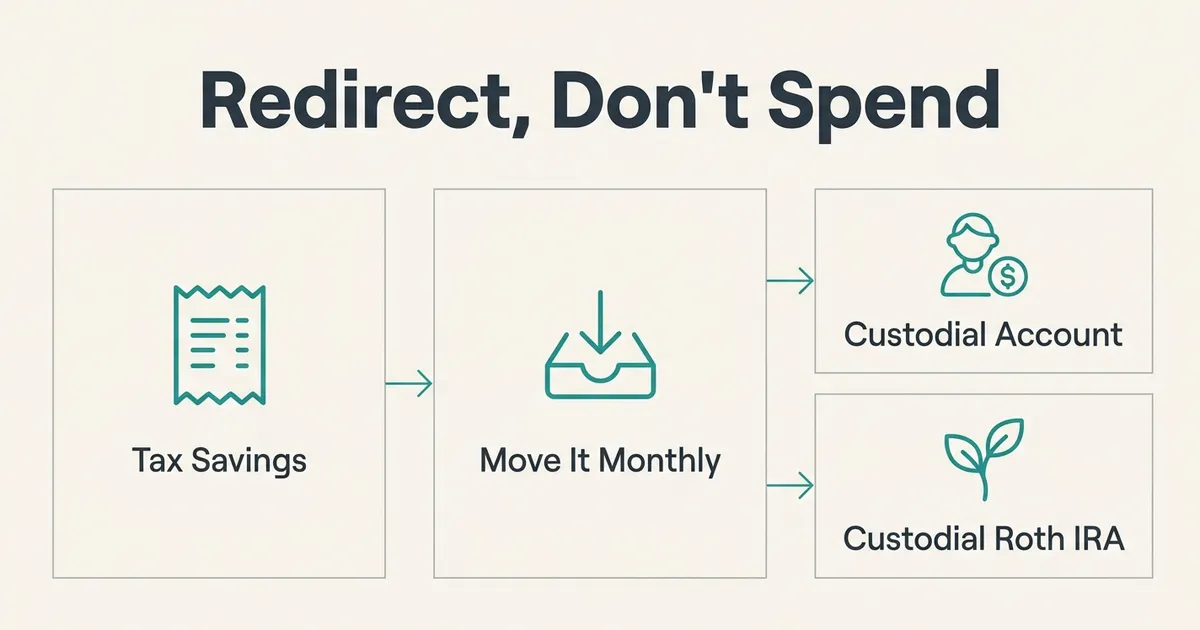
Route the dollar savings from your QBI deduction directly into a child's account rather than letting it disappear into general spending — the deduction only creates value if you capture it. Maria and Tom's $2,640 federal savings, for instance, covers about a third of the $7,500 IRA contribution limit for 2026 set by IRS Notice 2025-67 (2025) for a working teenager, assuming the child has matching earned income from the family business.
This is where family employment compounds the benefit. Per IRS Publication 15, Circular E (2025), wages a sole proprietor or a partnership of parents pays to their own child under age 18 are exempt from Social Security and Medicare withholding — a FICA exception that doesn't apply once the business is incorporated as an S-corp or C-corp. Pay your 12-year-old a reasonable wage for real work (organizing inventory, managing social media photos, data entry), and that wage becomes both a deductible business expense that trims your net QBI slightly and the earned income your child needs to legally fund a custodial Roth IRA — see the comparison of the best custodial Roth IRA providers for account minimums and fee structures.
Stack this with other levers inside the same family tax-reduction strategy: claiming legitimate home-office and side-hustle deductions lowers net profit (and therefore the QBI base) but usually cuts total taxable income by more than the 20% QBI haircut costs you, and a lower AGI can help preserve phase-out room for maximizing the Child Tax Credit if your household sits near the credit's income limits. Parents further from the SSTB list can also layer in residential solar tax credits the same tax year to compound total household tax drag reduction.
What Mistakes Cause Parents to Lose the QBI Deduction?
The most common error is forgetting to net out the deductible portion of SE tax, SE health insurance, and retirement contributions before applying the 20% rate — overstating QBI by including gross Schedule C profit inflates the deduction and invites an IRS correction notice, per the Instructions for Form 8995-A (2025). A second frequent mistake is misclassifying a borderline SSTB: a marketing consultant who also builds websites may have a mixed business, and only the consulting portion is subject to SSTB phase-out treatment.
Parents running rental property alongside a side hustle often skip the safe harbor entirely. According to Revenue Procedure 2019-38 (2019), rental real estate qualifies as a Section 199A trade or business under a safe harbor requiring at least 250 hours of rental services annually, documented contemporaneously — without that documentation, the IRS can disallow the rental's QBI treatment on audit. A final common failure: running two related businesses without filing the aggregation election under Treasury Regulation 1.199A-4, which can leave a profitable business's QBI needlessly capped by a separate, wage-light business's limitation.
Disclaimer: This article explains general federal tax rules for informational purposes and is not individualized tax advice. Confirm current-year thresholds on IRS.gov or with a licensed tax professional before filing, and note that California and other states with their own income tax may not conform to federal Section 199A treatment.
Frequently asked questions
What qualifies as QBI?
QBI is the net profit from a domestic trade or business you operate as a sole proprietorship, partnership, LLC, or S-corporation, reported on Schedule C or a K-1. It excludes W-2 wages (even reasonable compensation paid to an S-corp owner), guaranteed payments to partners, capital gains, dividends, and interest income unrelated to the business, per Treasury Regulation 1.199A-3 (2019). Specified service trades — law, health, accounting, financial services, consulting, and similar fields — qualify fully only below the phase-in income threshold and lose the deduction entirely above it.
How do I calculate my QBI deduction?
Multiply your net qualified business income by 20%, then compare that figure to 20% of your taxable income before QBI (excluding net capital gains), and take whichever number is smaller, per the worksheet in the Instructions for Form 8995 (2025). Below the 2026 phase-in threshold of $201,750 for single filers or $403,500 for joint filers (Revenue Procedure 2025-32, October 2025), no wage or property limitation applies, so most side-hustle parents can use the simplified Form 8995. Above that range, ordinary businesses add a wage/UBIA test, and specified service businesses phase the deduction down to zero.
What is the QBI income limit for 2026?
For 2026, the QBI phase-in threshold is $201,750 for single filers and $403,500 for married filing jointly, per Revenue Procedure 2025-32 (October 2025), an inflation adjustment from the 2025 figures of $197,300 and $394,600 set by Revenue Procedure 2024-40 (October 2024). The One Big Beautiful Bill Act (July 2025) widened the phase-in range itself to $75,000 above the threshold for single filers and $150,000 for joint filers, so for 2026 the range tops out at $276,750 and $553,500, and specified service businesses lose the deduction entirely once income clears it, while ordinary businesses instead face a wage/property limitation inside it.
Does QBI reduce self-employment tax?
No — the QBI deduction only reduces federal income tax and has no effect on the 15.3% self-employment tax computed on Schedule SE, because Section 199A applies after net self-employment earnings are already calculated, per the Instructions for Schedule SE (2025). A parent netting $60,000 from a side business still owes SE tax on roughly $55,410 of that amount (92.35% of net profit) regardless of any QBI deduction claimed on Form 1040. The Social Security portion of that tax applies only up to the annual wage base, which the Social Security Administration (October 2025) set at $184,500 for 2026.