Solar Tax Credit for Homeowners: What Changed in 2026

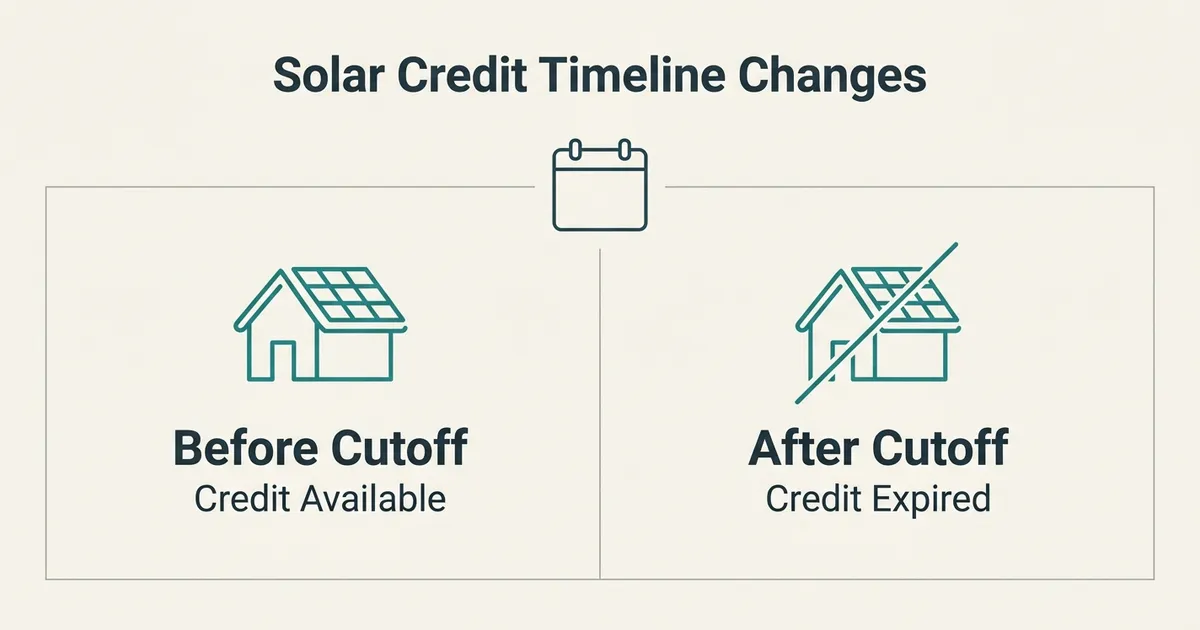
The 30% solar tax credit for homeowners no longer applies to systems placed in service after December 31, 2025, under the One Big Beautiful Bill Act signed July 4, 2025. If your panels or battery were operating by that date, claim the credit on your 2025 return; anything installed in 2026 or later gets no federal credit.
That repeal matters most to the parents this pillar is written for — households running a side business or family LLC (see LLC or S-corp for a family side business for how to choose) who were counting on the credit to free up cash for a kid's custodial Roth IRA or 529 plan. According to the Internal Revenue Service (2025), the credit formerly known as the Residential Clean Energy Credit under Internal Revenue Code Section 25D covered 30% of the cost of solar electric panels, solar water heaters, and qualifying battery storage, with no cap on the dollar amount claimed.
What Happened to the 30% Federal Solar Tax Credit for Homeowners?
Congress terminated Section 25D early through the One Big Beautiful Bill Act (H.R. 1), which President Trump signed into law on July 4, 2025. According to the Internal Revenue Service (2025), the statute originally scheduled the 30% rate to run through 2032 before stepping down to 26% in 2033 and 22% in 2034; the new law instead cuts it off entirely for expenditures made after December 31, 2025. The mechanism is simple: the statute keys off when the expenditure is treated as made, which per the IRS (2025) is when the original installation is completed — not when you signed the contract or paid a deposit. A system whose installation finished on December 20, 2025 qualifies; the same system finished on January 5, 2026 does not.
This repeal only touches Section 25D, the credit homeowners claim directly on their own return. It does not rewrite every clean-energy incentive in the tax code — separate commercial credits under Section 48E still exist for solar owned by a business, just on an accelerated phase-down schedule discussed below.
Can You Still Claim the Solar Tax Credit for a 2025 Installation?
Yes — if your system was placed in service on or before December 31, 2025, you claim the full 30% credit on the return you file for that year, even though you're filing it in 2026. You report it on IRS Form 5695, "Residential Energy Credits," and carry the result to Schedule 3 of Form 1040; per the IRS Instructions for Form 5695 (2025), the credit covers equipment, labor, wiring, and permitting fees tied to the installation, but not costs for a new roof unless the roofing material itself is integrated solar shingles.
Two documentation points trip up filers here. First, the cutoff turns on completed installation, not utility paperwork: per the IRS Frequently Asked Questions on the One, Big, Beautiful Bill (2025), an expenditure "is treated as made when the original installation of the item is completed." A system whose installation wrapped up in November 2025 therefore still qualifies even if the utility's permission to operate (PTO) didn't arrive until January 2026 — a distinction worth confirming with your installer in writing, since the reverse assumption costs a homeowner the entire credit on paper when they actually earned it.
Second, if the credit exceeds your tax liability for 2025, Section 25D lets you carry the unused portion forward to future tax years. Per the Congressional Research Service (2025), the One Big Beautiful Bill Act changed when the credit expires but left the carryforward rules untouched, and there is no expiration date on the carryforward itself. So a family with little or no federal tax owed in 2025 — because of large Child Tax Credit and dependent-care offsets, say — doesn't forfeit the credit; the unused amount rolls forward until there's liability to absorb it. Still worth modeling with a preparer, since the year you actually capture the benefit may be several returns away.
Is There an Income Limit for the Solar Tax Credit?
No — Section 25D has never had an income cap, unlike the now-repealed EV credit under Section 30D, which barred married joint filers with modified adjusted gross income above $300,000. According to the Internal Revenue Service (2025), the residential solar credit was a flat 30% of qualified costs regardless of the homeowner's income, and that design didn't change in the credit's final year before repeal. The practical effect for a self-employed parent: a strong side-hustle year that pushes household income up doesn't shrink or eliminate the credit the way it would with income-tested benefits like the Child Tax Credit eligibility rules for 2026 and its phase-out above $200,000 single/$400,000 joint MAGI, per the IRS (2025).
Do Landlords and Rental Properties Qualify for a Solar Tax Credit?
Generally no — Section 25D required the solar property to be installed on a home the taxpayer actually used as a residence, so a fully rented single-family property never qualified for the homeowner credit, even before repeal. Per the IRS Instructions for Form 5695 (2025), an owner who lived in one unit of a duplex and rented the other could only claim the credit on the percentage of square footage or costs allocable to the owner-occupied unit.
Landlords instead fall under the business energy credit in Section 48, now folded into Section 48E's Clean Electricity Investment Credit, which values solar based on the property being a depreciable business asset rather than a personal residence. That credit still exists after the One Big Beautiful Bill Act, but it's on a faster phase-down clock: per the Congressional Research Service (2025), solar and wind projects generally must begin construction within 12 months of the law's enactment — by July 4, 2026 — or be placed in service by the end of 2027 to retain full value, and new restrictions on components sourced from "prohibited foreign entities" phase in over 2026 and 2027. A landlord weighing solar on a rental unit should get a written cost-benefit projection from a CPA who models Section 48E depreciation and credit recapture rules before signing a contract, because the math is materially different from the now-defunct homeowner credit.
What Are Your Options for Solar Savings Now That the Federal Credit Is Gone?
With Section 25D repealed for 2026 installations, the decision is no longer "claim the credit or don't" — it's choosing among ownership structures that each carry a different cost, payback period, and risk profile. The table below compares the four paths available to a homeowner today.
| Path | Federal tax credit? | Typical upfront cost (6 kW system) | Who captures any tax benefit | Time to break even | Main risk |
|---|---|---|---|---|---|
| Cash purchase | None — Section 25D ended for property placed in service after 12/31/2025 | ~$18,000–$21,000 | You, but there's no federal credit to claim in 2026 | 9–14 years | You bear all equipment and performance risk |
| Solar loan | None | $0 down; financed at roughly 6%–9% APR | You (still no 25D credit) | 10–15 years including interest | Loan payment continues even if output underperforms |
| Solar lease or PPA (power purchase agreement) | Indirect — the third-party owner may claim the Section 48E commercial credit and pass some value through as a lower rate | $0 down | The leasing company, not you | Immediate bill reduction, no equity built | Rate escalators, complications transferring the lease at home sale |
| Wait for a state/utility rebate only | None federal | Full cost minus a local rebate | You | 12–18 years | Rebate funds are capped and can run out mid-year |
Cash purchase wins for a household with a specific, low-risk goal: it wants no ongoing payment obligation and plans to stay in the home more than 10 years. A solar loan makes sense for a family that wants ownership and the eventual home-value bump but needs to preserve cash for other goals, like funding a Roth IRA for a working teen. A lease or PPA fits homeowners who want a lower electric bill with zero capital outlay and don't mind never owning the equipment — but avoid it if you plan to sell within five years, since per the Solar Energy Industries Association (2025), unresolved lease transfers are among the most common reasons a home sale gets delayed once solar is on the roof. According to the U.S. Energy Information Administration's Short-Term Energy Outlook (May 2026), U.S. residential electricity prices average about 18.2 cents per kWh in 2026, up nearly 5% from 2025 — a trend that raises the value of every option in the table but doesn't change which one fits your cash-flow situation.
Check state and utility incentives before assuming the math above is your final number: DSIRE, the Database of State Incentives for Renewables & Efficiency (2026), tracks rebates, property-tax exemptions, and net-metering rules by state, and they vary enough that a system penciling out in one state can look very different in another. California is the clearest cautionary example: per the California Public Utilities Commission (December 2022), the state's NEM 3.0 net-billing tariff, effective April 15, 2023, cut the compensation utilities pay for exported solar power by roughly 75% compared with the prior NEM 2.0 rules, which is why California solar quotes now lean harder on self-consumption and battery storage than on selling power back to the grid.
How Should You Redirect Solar Savings Into Your Kids' Accounts?
Since the federal credit no longer subsidizes the purchase, the tax-hacking move for this pillar shifts from "claim the credit, then invest the refund" to "choose the cheapest ownership path, then invest the difference." A parent who picks a solar loan over a cash purchase frees up the cash they would have spent upfront and can route it into a child's Roth IRA if the child has W-2 or self-employment earned income from the family business — see how to pay your kids tax-free for the rules on structuring that pay — for 2026, the IRS (2025) caps Roth IRA contributions at $7,500 for savers under 50 or 100% of earned income, whichever is lower, and that limit adjusts annually for inflation, so confirm the current year's figure before contributing. A self-employed parent freeing up cash this way should also compare it against a Solo 401k 2026: How Self-Employed Parents Cut Taxes, which lets a business owner shelter far more of that freed-up cash each year than a Roth IRA alone allows.
For a younger child without earned income, the better vehicle is a custodial brokerage or 529 account funded with the cash saved by choosing a lease instead of a purchase; compare providers using our guide to the best custodial Roth IRA providers before opening an account, since fees and investment menus differ enough to matter over a decade of compounding. This slot-the-savings approach — cut a household expense, then automate the difference into a kid's account — is the same mechanic covered across our broader family tax hacking strategies for turning tax-code changes into funded custodial accounts rather than lost opportunity.
What Mistakes Do Homeowners Make With the Battery Storage Credit?
The most common mistake is assuming a standalone battery still qualifies in 2026 the same way solar once did — it doesn't, because battery storage was covered under the same now-repealed Section 25D, not a separate program. Under Internal Revenue Code Section 25D(d)(6), a battery needed at least 3 kilowatt-hours of capacity to qualify for the 30% credit through 2025, whether or not it was paired with solar panels; per the IRS (2025), that requirement and the credit itself both ended for property placed in service after December 31, 2025.
The second mistake is confusing this repeal with unrelated household tax-reduction moves that are still fully available, like the home office deduction for a side business, dependent care FSA vs. child tax credit planning, or a health reimbursement arrangement for family health expenses — those live in separate sections of the code and weren't touched by the One Big Beautiful Bill Act's energy provisions. Don't let the loss of the solar credit cause you to overlook the other household tax-reduction moves still on the table for this tax year.
Disclaimer: This article is for general information and isn't individualized tax advice. Confirm placed-in-service dates, carryforward eligibility, and Section 48E requirements with a licensed CPA or tax attorney before making a solar purchase or claiming a credit.
Frequently asked questions
Is there still a 30% solar tax credit in 2026?
No — the 30% federal solar tax credit for homeowners under Internal Revenue Code Section 25D ended for any system placed in service after December 31, 2025, per the One Big Beautiful Bill Act signed July 4, 2025. A system installed and generating power by that date still qualifies for 30% on the return covering that year; anything placed in service starting January 1, 2026 gets zero federal credit under this program, according to the IRS (2025).
Did Trump get rid of the solar tax credit?
Yes — President Trump signed the One Big Beautiful Bill Act (H.R. 1) into law on July 4, 2025, and that law repealed the Section 25D residential solar and battery storage credit for expenditures made after December 31, 2025. Per the Internal Revenue Service (2025), the credit had originally been scheduled to continue at 30% through 2032 before stepping down to 26% and then 22%; the 2025 law eliminated those later years entirely rather than letting the phase-down proceed as planned.
Is the 30% solar tax credit gone?
For homeowner-purchased systems, yes — it's gone for any solar or battery property placed in service after December 31, 2025, under the repeal in the One Big Beautiful Bill Act signed July 4, 2025. It isn't gone retroactively: per IRS Instructions for Form 5695 (2025), a system placed in service on or before that date still qualifies for the full 30% credit on the applicable year's return, and unused credit can carry forward if your tax liability that year was too low to absorb it all.
Is there an income limit for the solar tax credit?
No — Section 25D never included an income phase-out, so a homeowner's adjusted gross income didn't reduce or eliminate the 30% rate in any year the credit was in effect. That's a contrast with the now-repealed EV credit under Section 30D, which barred joint filers with modified AGI above $300,000, per the Internal Revenue Service (2025); the solar credit's flat rate applied the same way to a household earning $60,000 as one earning $600,000, as long as the system was placed in service by December 31, 2025.
What applies to landlords under the solar tax credit rules?
Landlords generally can't use the Section 25D homeowner credit at all, because that credit required the solar property to be installed on a home the taxpayer used as a residence, not a fully rented unit. Per IRS Instructions for Form 5695 (2025), an owner who lived in part of a multi-unit property could only claim the credit on the owner-occupied share; for wholly rented property, landlords instead look to the Section 48E commercial clean-electricity credit, which follows depreciation-based business rules and, per the Congressional Research Service (2025), now requires solar projects to begin construction by July 4, 2026, or be placed in service by the end of 2027 to retain full value under the One Big Beautiful Bill Act.
What was the 30% federal solar and battery tax credit for homeowners?
It was the Residential Clean Energy Credit under Internal Revenue Code Section 25D, which reimbursed 30% of the cost of solar electric panels, solar water heating equipment, and battery storage with at least 3 kilowatt-hours of capacity, claimed on IRS Form 5695. Per the Internal Revenue Service (2025), the credit had no dollar cap and no income limit, but the One Big Beautiful Bill Act signed July 4, 2025 ended it for any property placed in service after December 31, 2025, so it now only applies to installations completed on or before that date.