Health Reimbursement Arrangement: A 2026 Family Tax Guide

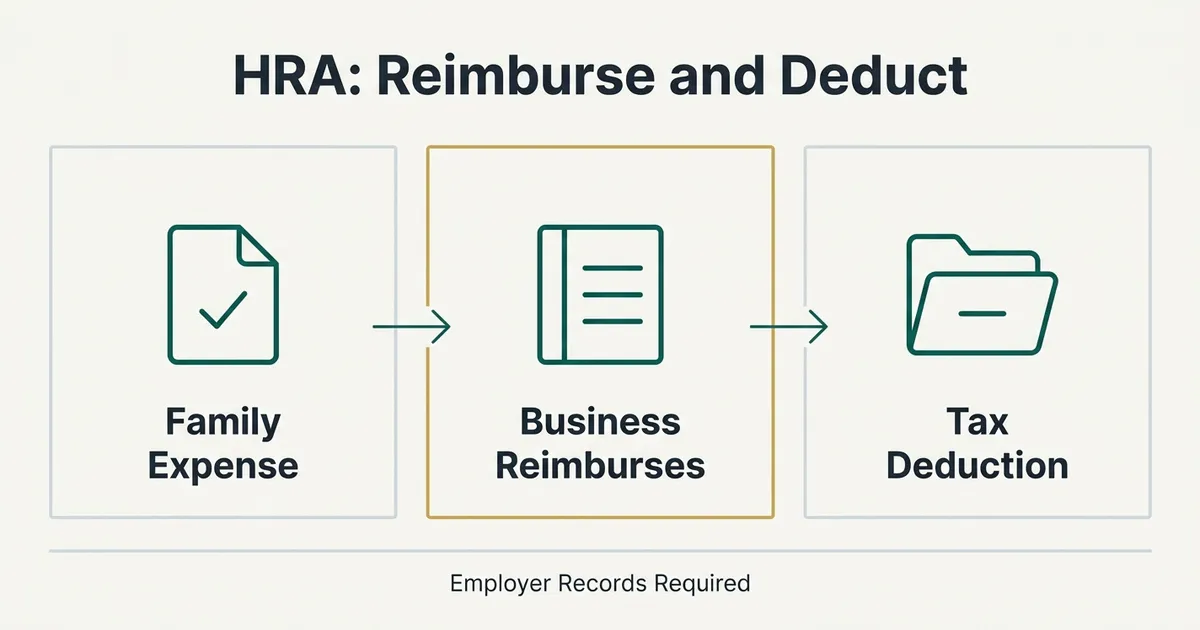
A health reimbursement arrangement (HRA) is an IRS-recognized benefit that lets a business reimburse an employee's family medical costs tax-free, then deduct the full amount as an ordinary business expense. For a self-employed parent, that usually means putting a spouse on payroll first, since owners generally can't reimburse their own medical bills this way. Done correctly, it beats itemizing.
What Is a Health Reimbursement Arrangement, and How Does It Work?
An HRA is an employer-funded account, not an employee-funded one — the business sets the terms, pays the claims, and takes the deduction. According to IRS Publication 969 (2026), reimbursements made through a properly documented HRA are excluded from the employee's taxable income under Internal Revenue Code Section 105(b), while the employer deducts the same dollars as a normal business expense.
That double benefit exists because Congress wanted employers to absorb medical risk without creating taxable compensation for workers. The mechanism matters for a family business: the money never shows up as income to your household, so it never touches your income tax bracket or your Adjusted Gross Income (AGI) — the number that determines eligibility for other credits, like the Child Tax Credit phase-out discussed in our Child Tax Credit maximization guide.
Not every HRA design works the same way, and not every business owner can participate in their own plan. According to IRS Publication 15-B (2026), a sole proprietor, partner, or more-than-2%-owner of an S corporation is not treated as an "employee" for fringe-benefit purposes — which is exactly why the spouse-employment workaround exists for family businesses, covered in detail below.
Which HRA Type Fits a Family Side Hustle — QSEHRA, ICHRA, or a One-Participant Plan?
Three HRA structures dominate the market, and each fits a different stage of a family business. A Qualified Small Employer HRA (QSEHRA) was created by the 21st Century Cures Act (2016) for employers with fewer than 50 full-time employees that don't offer a group health plan. An Individual Coverage HRA (ICHRA), authorized by a Treasury Department final rule (June 2019) effective for plan years starting January 1, 2020, works for employers of any size. A one-participant Section 105 plan — the "hire your spouse" structure — has no employee-count minimum at all because it's built around a single bona fide employee.
| Feature | One-Participant Section 105 HRA | QSEHRA | ICHRA |
|---|---|---|---|
| Who funds it | Business, 100% | Business, 100% | Business, 100% |
| 2026 reimbursement cap | No IRS dollar cap — must be a reasonable, substantiated business expense | $6,450 self-only / $13,100 family, per IRS Revenue Procedure 2025-32 (2026) | No IRS cap; employer sets the allowance |
| Owner participation | Owner covered only as spouse-employee's dependent | Owner generally excluded unless the business is a C corporation | Owner generally excluded under the same self-employment rule |
| Must pair with a specific plan? | No | Employee must have "minimum essential coverage" | Employee must buy individual-market coverage |
| Employee count needed | 1 (the hired spouse) | Up to 49 full-time employees | Any size |
| Best fit | Sole proprietor/single-member LLC with a working spouse and no other staff | Small business with unrelated employees, no group plan | Growing business moving employees off a group plan |
Read the table by employee count first, not by contribution limit. A family business with just one working parent and a spouse should look at the one-participant Section 105 plan because QSEHRA's dollar caps and ICHRA's individual-market requirement add compliance overhead that a single-employee household doesn't need.
How Does Hiring Your Spouse Unlock an HRA When You're Self-Employed?
A sole proprietor can't reimburse their own medical bills tax-free through an HRA because they aren't legally an employee of their own Schedule C business. According to IRS Publication 969 (2026), the workaround is to hire the spouse as a genuine W-2 employee, pay a reasonable wage for real work performed, then adopt a written Section 105 medical reimbursement plan that covers that employee and their tax dependents — which includes the business owner and the kids.
Consider Maria, who nets $45,000 a year from an Etsy-based side business structured as a sole proprietorship. She hires her husband Dave part-time for bookkeeping and order fulfillment at $12,000 a year, a wage that reflects the actual hours and market rate for that work. The business adopts a written Section 105 plan covering Dave and his dependents — Maria and their two kids — and reimburses their substantiated family medical costs: a $7,200 ACA marketplace premium, $1,400 in orthodontia, and $600 in copays and prescriptions, totaling $9,200.
That $9,200 is not wages — it's a tax-free fringe benefit, so no income tax withholding or FICA applies to it. FICA does apply to the $12,000 wage itself: according to IRS Publication 15 (Circular E) (2026), the combined Social Security and Medicare rate is 15.3%, split between employer and employee, which costs the business roughly $918 in employer-side payroll tax on that wage. Under Internal Revenue Code Section 3306(c)(5), wages paid to a spouse by a sole proprietor are exempt from the Federal Unemployment Tax Act (FUTA), which removes one layer of payroll cost the strategy would otherwise carry.
How Does an HRA Affect Your Taxes Compared With Itemizing Medical Expenses?
An HRA reimbursement is fully deductible from dollar one, while itemized medical expenses are not — that gap is the whole point of the strategy. According to IRS Publication 502 (2025), you can only itemize the portion of medical expenses that exceeds 7.5% of your AGI, and that surviving amount only helps if your total itemized deductions exceed the standard deduction.
Run Maria and Dave's numbers both ways. On a household AGI near $50,000, the 7.5% floor is $3,750, so only $5,450 of their $9,200 in medical costs would even be eligible for itemizing. According to IRS Revenue Procedure 2025-32 (2026), the 2026 standard deduction for married filing jointly is $32,200, and per the IRS Statistics of Income Bulletin (2023), roughly 87% of individual filers claim the standard deduction rather than itemizing — meaning that $5,450 medical deduction is usually worth $0 in practice unless mortgage interest, state and local taxes, or charitable giving already push the household past $32,200.
Route the same $9,200 through the business instead, and it reduces Schedule C net profit directly, no floor, no itemizing decision required. That deduction lowers both ordinary income tax and self-employment tax, since Social Security Administration (2025) rules base the 15.3% self-employment tax on net earnings from self-employment, not gross revenue. For a household in a 22% federal bracket, a $9,200 deduction that also escapes roughly 14% in effective SE tax works out to combined marginal savings in the mid-30% range — call it an illustrative $3,000–$3,400, not a promised figure, since your bracket and state taxes will move the number.
Is an HRA Better Than an HSA for a Family Business?
Neither wins outright — they solve different problems, and the right choice depends on whether you want the money to disappear into deductible expenses or grow toward your kids' accounts. Choose the HRA route if your family business already pays for real medical costs and you want those dollars fully deductible with no AGI floor. Choose (or add) an HSA if you want a portable, employee-owned account whose unused balance you can invest and eventually redirect into a custodial or Roth IRA strategy for your kids.
The ownership difference is the mechanism that matters most. An HRA balance belongs to the business — if you close the plan or the spouse-employee leaves, unused funds don't follow the family. An HSA belongs to the individual: according to IRS Revenue Procedure 2025-19 (2025), the 2026 contribution limits are $4,400 for self-only coverage and $8,750 for family coverage, and per the Employee Benefit Research Institute (2024), the average HSA balance reached $4,742 at year-end 2023, reflecting how many households let the account accumulate and invest rather than spending it down annually.
You don't have to pick just one. According to IRS Notice 2004-2 (2004), a "limited-purpose" or "post-deductible" HRA — one that only reimburses dental, vision, or post-deductible costs — can run alongside an HSA without disqualifying HSA eligibility, letting a family business deduct routine dental and vision bills through the HRA while still funding an investable HSA for larger medical costs and long-term growth.
What Are the Disadvantages and Failure Modes of an HRA?
The biggest disadvantage is that you don't own the money — the business does, and that changes your options if the spouse-employee's role ends or the business closes. A second failure mode is treating the wage as fake: the IRS expects a bona fide job with real hours, documented duties, and a wage that matches market rate for that work, not an inflated number invented to justify a bigger HRA.
Coordination with the Affordable Care Act (ACA) creates a third trap. According to IRS Notice 2013-54 (2013), a standalone HRA that reimburses individual insurance premiums generally violates ACA market reform rules unless it's structured as a compliant QSEHRA or ICHRA, so a one-participant Section 105 plan built around family coverage under a group or marketplace plan needs careful plan-document language to stay compliant. According to the U.S. Department of Labor (2020), Individual Coverage HRAs must also let covered employees opt out annually, since an "affordable" ICHRA offer can eliminate that employee's eligibility for a premium tax credit on the ACA marketplace.
Reporting adds a final layer of friction. According to the IRS (2025) Form W-2 instructions, employers must report QSEHRA benefit amounts in box 12 using code FF, and a one-participant plan still needs a signed plan document, a claims log, and retained receipts to survive an audit — skip the paperwork and the IRS can recharacterize the reimbursements as taxable wages.
How Do California and Other States Tax HRA and HSA Benefits?
Federal HRA and HSA rules apply nationwide, but state conformity to those rules varies, and California is the clearest example of a state that splits the two apart. According to the California Franchise Tax Board (2025), California generally conforms to the federal exclusion for employer-provided accident and health plan reimbursements under Internal Revenue Code Section 105, meaning your one-participant HRA reimbursement is not taxed at the state level either.
HSAs get different treatment. According to the California Franchise Tax Board (2025), California does not conform to the federal HSA deduction, so contributions remain taxable for California personal income tax purposes and any investment earnings inside the account are taxed annually as California income — New Jersey applies a similar rule. If you're combining an HRA with an HSA under the strategy above, run the state-tax side of the HSA contribution separately; other states generally follow the federal treatment, but verify against your own state's tax code before assuming full conformity.
How Do You Set Up a One-Participant HRA for Your Family Business?
Confirm your entity type first — this strategy fits sole proprietorships, single-member LLCs taxed as disregarded entities, and general partnerships without unrelated owner-employees, since S corporation and C corporation ownership triggers different rules under IRS Publication 15-B (2026). Hire your spouse for a real role with defined hours and a market-rate wage, run payroll correctly, and keep time and duty records in case of an audit.
Adopt a written Section 105 plan document naming the employee-spouse and covered dependents, then reimburse only substantiated medical expenses with receipts on file — improvised reimbursements without documentation are the single most common reason these plans fail on audit. Once the deduction lowers your Schedule C profit, redirect the freed-up cash toward the family's other tax-reduction and investing moves, including home-office and side-hustle deductions that stack with the HRA, Hiring Family Members: How to Pay Your Kids Tax-Free 2026 as another family-employment strategy that pairs with the spouse-employee structure above, residential solar tax credits if you're financing home upgrades, and the broader family tax-hacking strategies that free up dollars for your kids' custodial and Roth accounts. If childcare is another line in the budget, the Dependent Care FSA versus the childcare tax credit covers the other major pre-tax account a family can run alongside an HRA.
Disclaimer: This article explains general federal tax mechanics for informational purposes only and does not constitute personalized tax advice. Confirm current IRS Revenue Procedure figures, your state's conformity rules, and your plan's compliance with a licensed tax professional before implementing an HRA.
Frequently asked questions
What are the disadvantages of an HRA?
The main disadvantages of an HRA are lack of portability, payroll-tax cost, and audit risk from poor documentation. The business owns the funds, so an employee-spouse who leaves the role forgets the benefit entirely, and the IRS requires a genuine job with a market-rate wage — inflating that wage to justify a bigger reimbursement is the most common reason the IRS Publication 15-B (2026) framework treats these plans as taxable wages on audit.
Is an HRA better than an HSA?
An HRA is better when a family business wants to fully deduct real medical costs with no AGI floor, while an HSA is better when the goal is a portable, investable account the family controls directly. According to IRS Revenue Procedure 2025-19 (2025), the 2026 HSA contribution limits are $4,400 self-only and $8,750 family (up from $4,300 and $8,550 in 2025), and per IRS Notice 2004-2 (2004), a limited-purpose HRA can run alongside an HSA without breaking HSA eligibility, so many family businesses use both rather than choosing one.
What is HRA and how does it work?
A health reimbursement arrangement (HRA) is an employer-funded plan that reimburses an employee's substantiated medical expenses tax-free and lets the business deduct the same amount as an ordinary expense. According to IRS Publication 969 (2026), the exclusion comes from Internal Revenue Code Section 105(b), and for a self-employed parent, participation typically requires hiring a spouse as a bona fide W-2 employee first, since owners aren't employees of their own sole proprietorship.
How does an HRA affect my taxes?
An HRA lowers your business's net profit dollar-for-dollar by the amount reimbursed, which reduces both ordinary income tax and, for self-employed owners, self-employment tax on that profit. Unlike itemized medical deductions, which per IRS Publication 502 (2025) only count above a 7.5%-of-AGI floor and only help if you clear the standard deduction, HRA reimbursements are deductible from the first dollar with no floor and no itemizing requirement.
What is a health reimbursement arrangement (HRA), exactly?
A health reimbursement arrangement (HRA) is a written employer plan, not an insurance policy, that reimburses employees for qualified medical expenses using employer funds rather than payroll deductions. According to IRS Publication 15-B (2026), the three main structures are the Qualified Small Employer HRA (QSEHRA), created by the 21st Century Cures Act (2016) for businesses under 50 employees, the Individual Coverage HRA (ICHRA), available since a Treasury Department final rule (June 2019), and one-participant Section 105 plans built around a single bona fide employee.
What are the key health reimbursement arrangement rules to follow?
The core rules are: only bona fide employees can be reimbursed tax-free, the reimbursed expenses must be substantiated with receipts, and owners of sole proprietorships, partnerships, and more-than-2%-owned S corporations generally can't cover themselves directly. According to IRS Notice 2013-54 (2013), a standalone HRA that reimburses individual insurance premiums must be structured as a compliant QSEHRA or ICHRA to avoid violating ACA market reform rules, and per the IRS (2024), QSEHRA reimbursements are capped at $6,450 self-only and $13,100 family for 2026 per IRS Revenue Procedure 2025-32 (2026), up from $6,350 and $12,800 in 2025, with limits adjusting annually.