Childcare Tax Credit vs. Dependent Care FSA in 2026

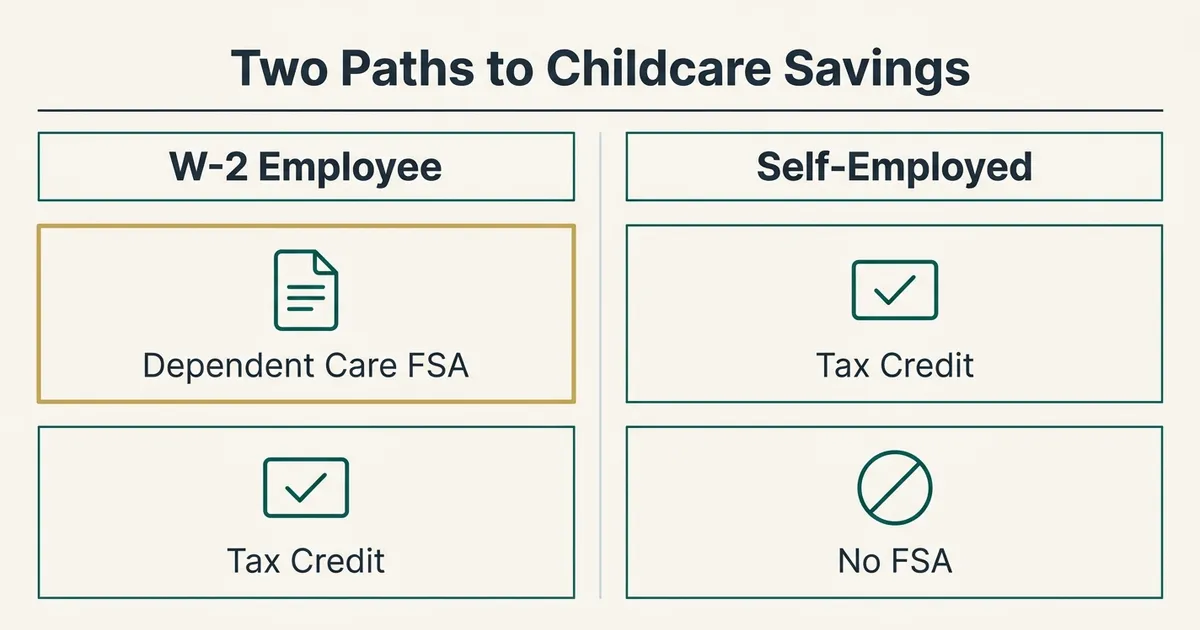
A Dependent Care FSA typically saves W-2 employees more than the childcare tax credit alone, while self-employed parents without an employer plan must rely on the credit. Both offset daycare, preschool, and after-school costs for kids under 13, and IRS coordination rules let many families combine the two for extra savings.
The confusion between these two benefits costs families real money every filing season, because the "childcare tax credit" people search for is actually the Child and Dependent Care Credit (CDCC) — a separate provision from the Child Tax Credit (CTC) that shows up on the same Form 1040. For 2026 the CDCC reimburses 20% to 50% of qualifying care expenses — the One Big Beautiful Bill Act (2025) raised the top rate from 35% to 50% starting this tax year — while the CTC is a flat per-child credit tied to having a dependent, not to what you spend on care. Getting the two mixed up leads parents to either double-count savings on their own spreadsheet or miss a deduction their employer already offers through payroll.
Is the "Childcare Tax Credit" the Same as the Child Tax Credit?
No — the childcare tax credit (formally the Child and Dependent Care Credit) and the Child Tax Credit are two different line items on the same return. The CDCC reimburses a percentage of what you actually paid for daycare, a nanny, or after-school care so you and your spouse could work or look for work. The CTC, by contrast, pays a flat $2,200 per qualifying child under 17 for the 2025 tax year regardless of whether you spend a dollar on childcare, according to the One Big Beautiful Bill Act (July 2025), which made this increase from the prior $2,000 permanent and indexed it for inflation going forward.
You can claim both in the same year if you qualify — they're not mutually exclusive. A family with two kids under 13 in paid daycare and no other childcare costs could claim the CDCC on the daycare bills and the full $2,200-per-child CTC on their dependents, assuming their adjusted gross income (AGI) falls below the CTC phase-out that begins at $400,000 for married-filing-jointly households, per the IRS (2026).
How Does the Child and Dependent Care Credit (CDCC) Work?
The CDCC refunds 20% to 50% of up to $3,000 in care expenses for one qualifying child or $6,000 for two or more, applied as a nonrefundable credit that reduces your tax bill dollar for dollar. The expense caps themselves were not changed by the One Big Beautiful Bill Act (2025); the applicable percentage was. The top 50% rate applies at AGI of $15,000 or below and steps down as income rises, settling at the unchanged 20% floor only at substantially higher incomes than the pre-2026 rules used. Check your own percentage against the current-year Form 2441 instructions before relying on a specific rate — the phase-down bands were rewritten for 2026.
The cap matters more than the rate for most families. A family with two kids in daycare and $12,000 in annual costs gets credit on only the first $6,000 of expenses, no matter how much they actually spend — so the credit is a fraction of $6,000, not of $12,000. Their exact percentage depends where their AGI falls in the 2026 phase-down.
To qualify at all, both spouses need earned income (or one must be a full-time student or disabled), and the child must be under age 13 or incapable of self-care, per IRS Publication 503 (2026). California generally follows the federal expense definitions but caps its own nonrefundable state credit to households with federal AGI at or below $100,000, according to the California Franchise Tax Board (2026) guidance for Form FTB 3506 — families above that threshold get zero state-level credit even though the federal CDCC still applies.
How Does a Dependent Care FSA Cut Your Taxes Differently?
A Dependent Care FSA (Flexible Spending Account) works by pulling money out of your paycheck before federal income tax, state income tax, and payroll (FICA) tax are calculated, capped at $7,500 per household per year ($3,750 if married filing separately) under Internal Revenue Code Section 129. The One Big Beautiful Bill Act (2025) raised that cap from $5,000 effective January 1, 2026 — the first permanent increase since the limit was set in 1986, apart from a temporary jump to $10,500 under the American Rescue Plan Act (2021) that expired after that year. Your employer's plan has to adopt the higher limit, so confirm your own plan's cap before electing.
The mechanism beats a simple deduction because it strips out payroll tax too. According to the Social Security Administration (2025), employees pay 7.65% in combined Social Security and Medicare tax on wages up to the $176,100 wage base — money you never see again on a standard deduction, but that a Dependent Care FSA dollar avoids entirely, on top of your federal and state income tax savings.
Unused Dependent Care FSA funds don't automatically carry over. Under IRS Notice 2005-42 (2005), employers can optionally offer a grace period of up to 2.5 extra months to spend down the account, but many plans don't — so estimating your annual care costs before electing an amount matters more than with a typical 401(k) contribution.
Can You Use Both the Dependent Care FSA and the Childcare Tax Credit in the Same Year?
Yes, but a coordination rule stops you from double-dipping on the same dollars. The $3,000/$6,000 CDCC expense cap is reduced dollar-for-dollar by whatever you ran through a Dependent Care FSA. This is where the 2026 increase bites: a full $7,500 FSA election now exceeds the $6,000 two-child cap outright, leaving nothing eligible for the credit — where a $5,000 election under the old limit still left $1,000 of room. Stacking both benefits now requires deliberately electing less than the cap, and whether that beats simply maxing the FSA depends on your CDCC percentage versus your marginal tax rate.
Here's what that looks like with real numbers. A California family in the 22% federal bracket with $12,000 in total daycare costs for two kids elects the full $7,500 Dependent Care FSA through one spouse's employer. Federal income tax at 22% plus 7.65% FICA is a 29.65% effective rate on money that never hits their return — about $2,224 saved. California does not fully conform to the federal FSA exclusion, so the state-tax share varies. But because $7,500 exceeds the $6,000 two-child CDCC cap, that election leaves $0 of expenses eligible for the credit. A family that wants both has to elect under $6,000 into the FSA and keep the difference for the credit — worth modelling both ways rather than assuming maxing the FSA always wins.
Compare that to skipping the FSA and claiming the CDCC alone on the full $6,000 cap at 20%: just $1,200. Running the FSA first and mopping up the remainder with the credit nets this family roughly $483 more — the FSA's payroll-tax-plus-income-tax combo beats the credit's flat percentage for almost every household above the 20% AGI phase-out floor.
Childcare Tax Credit vs. Dependent Care FSA: Which Saves More?
| Factor | Dependent Care FSA | Childcare Tax Credit (CDCC) |
|---|---|---|
| Tax mechanism | Pretax payroll deduction — reduces wages before tax | Nonrefundable credit — reduces tax owed dollar-for-dollar |
| Annual cap | $7,500 per household for 2026, up from $5,000 (IRC §129) | $3,000 (1 child) or $6,000 (2+), minus any FSA amount |
| Effective savings rate | Federal + state income tax + 7.65% FICA (often 30%-40% combined) | 20%-50% of eligible expenses for 2026, by AGI |
| Who can use it | Only employees whose employer offers a Section 125 cafeteria plan | Any taxpayer with earned income and a qualifying dependent |
| Self-employed sole proprietors | Generally cannot establish one for themselves, no employees | Fully available, no employer plan needed |
| Refundable if you owe no tax? | Not applicable — it's an exclusion, not a credit | No — unused CDCC is lost, unlike the ACTC portion of the CTC |
| Best fit | W-2 earners at 22%+ marginal rate with employer FSA access | Self-employed parents, lower-income filers at the 35% rate, or costs above the FSA cap |
Read the table by income and employment status, not by which benefit sounds bigger. W-2 employees in the 22% bracket or higher with an employer-sponsored FSA should max the FSA first and let the credit mop up any remaining eligible expenses, as the worked example above shows. Self-employed parents and lower-income households at the top 50% CDCC rate — AGI under $15,000, a less common but real case for a new side hustle with heavy startup losses — often do better leaning on the credit alone, since no FSA is available to them anyway.
When Should Self-Employed Parents Skip the FSA?
Skip the FSA entirely if you're a sole proprietor with no common-law employees — the IRS generally does not allow a self-employed individual with no employees to establish a Section 125 cafeteria plan for themselves, according to IRS guidance on cafeteria plans (2026). That rules out the Dependent Care FSA for a solo freelancer or single-member LLC owner with no staff, leaving the CDCC as the only childcare tax break available to that income stream.
The math still works in your favor because self-employment tax runs 15.3% under current IRS rules (2026), which the CDCC doesn't touch but which underscores why every other deduction — including the home-office and side-hustle write-offs covered in our guide to home-office and side-hustle deductions — carries more weight for this reader than it does for a standard W-2 employee. If your spouse has a W-2 job with employer FSA access, run the Dependent Care FSA through that spouse's plan and claim the CDCC on any remainder; that combination captures both the payroll-tax savings and the credit without triggering the self-employment restriction.
Budget the decision against real costs. According to Child Care Aware of America (2024), the national average annual price for center-based infant care exceeded $13,000 — well above both the $7,500 FSA cap and the $6,000 CDCC cap, meaning most families with an infant in full-time daycare should plan to use every dollar of both benefits rather than treating them as either/or.
How Do These Savings Fit Into a Bigger Family Tax Strategy?
Dependent care savings work best as one lever in a broader plan to cut household tax drag and redirect the difference into your kids' accounts, which is the core approach covered across our Family Tax Hacking coverage. The roughly $1,683 in combined FSA-plus-credit savings from the worked example above is real cash you can route into a child's custodial Roth IRA if they have earned income of their own, subject to the same $7,000 annual Roth contribution limit that applies to adults for 2025, according to the IRS (2026) — see our comparison of custodial Roth IRA providers for account-opening specifics. Families juggling both childcare and medical costs should also compare notes with our Health Reimbursement Arrangement: A 2026 Family Tax Guide, since HRA reimbursements run through the same pretax payroll mechanism that makes the Dependent Care FSA worth more than its face value.
Pair the childcare savings with a look at the Child Tax Credit maximization strategies for phase-out planning if your household AGI is approaching $400,000, and check whether your home already qualifies for the solar tax credits and utility savings available in your state — stacking several smaller, well-documented tax reductions produces a bigger investable surplus than chasing one large but uncertain deduction.
Frequently asked questions
Is there a federal tax credit for daycare?
Yes — the federal Child and Dependent Care Credit (CDCC) reimburses 20% to 50% of daycare, nanny, or after-school costs for a qualifying child under 13, up to $3,000 for one child or $6,000 for two or more. The One Big Beautiful Bill Act (2025) raised the top rate from 35% to 50% starting with the 2026 tax year. The percentage you get depends on your AGI: households at $15,000 or below get the full 50%, stepping down as income rises toward the unchanged 20% floor. Because the expense cap binds before the rate does, a two-child household claiming the full $6,000 receives between $1,200 and $3,000 depending where its AGI lands.
What is the $3,600 Child Tax Credit?
The $3,600-per-child Child Tax Credit was a temporary, fully refundable expansion under the American Rescue Plan Act (2021), which paid $3,600 for children under 6 and $3,000 for children ages 6-17, including monthly advance payments. That expansion expired after the 2021 tax year, and the credit reverted to its prior structure; for the 2025 tax year, the Child Tax Credit is $2,200 per qualifying child under the One Big Beautiful Bill Act (July 2025), with up to $1,700 of that potentially refundable through the Additional Child Tax Credit.
Do you get $2,000 per child on taxes in 2025?
No — for the 2025 tax year the Child Tax Credit is $2,200 per qualifying child, not $2,000, under the One Big Beautiful Bill Act (July 2025), which raised and made permanent the prior $2,000 TCJA-era amount starting with 2025 returns. The credit phases out for AGI above $200,000 (single/head of household) or $400,000 (married filing jointly), and up to $1,700 per child can be refundable through the Additional Child Tax Credit if your tax liability is lower than your credit amount.
Is it worth it to claim child care expenses on taxes?
Yes for almost every family with paid care costs, because the Child and Dependent Care Credit reduces your tax bill dollar-for-dollar with no out-of-pocket cost beyond keeping receipts and your provider's Tax ID, per IRS Publication 503 (2026). A two-child household at the 20% floor rate claiming the full $6,000 cap gets a $1,200 credit. Pairing it with a Dependent Care FSA needs care from 2026 on: the FSA cap rose to $7,500, which exceeds the $6,000 CDCC cap, so a maximum FSA election wipes out the credit entirely — see the coordination example above.
What's new with the childcare tax credit for 2026?
Quite a lot changed. For the 2026 tax year the Child and Dependent Care Credit's top rate rises from 35% to 50% under the One Big Beautiful Bill Act (2025), and the Dependent Care FSA cap rises from $5,000 to $7,500 — its first permanent increase since 1986. The $3,000/$6,000 expense caps are unchanged and remain non-indexed, so the credit's ceiling still comes from the caps rather than the rate. The Child Tax Credit, however, is indexed for inflation starting with the $2,200 base set by the One Big Beautiful Bill Act (July 2025), meaning the 2026 CTC amount will adjust slightly upward once the IRS publishes its 2026 inflation figures later this year.
What's the childcare tax credit worth for 2025 tax returns?
For 2025 returns filed in 2026, the Child and Dependent Care Credit is worth 20% to 35% of up to $6,000 in qualifying expenses for two or more children — the pre-OBBBA rate band, which still governs the 2025 tax year; the 50% top rate first applies to 2026 returns. The separate Child Tax Credit is worth $2,200 per qualifying child under the One Big Beautiful Bill Act (July 2025). A household claiming both — say, $6,000 in daycare costs at the 20% floor plus two kids' worth of CTC — could see roughly $1,200 from the CDCC and $4,400 from the CTC, before any phase-outs apply.