
Every household with a cash cushion eventually faces the same question: where should this money actually sit? Not in a mattress, and usually not in the checking account that also pays the mortgage — but exactly which type of deposit account, and how much to put in each, depends on how soon the money might be needed and how much yield a family is willing to trade for that certainty. This hub orients parents and household budget-holders to the three main places to park short-term cash — high-yield savings accounts, money market accounts, and certificates of deposit (CDs) — and how to weigh them against each other for an emergency fund, a house-down-payment stash, or any other money that needs to stay safe and largely liquid. The more detailed guides linked from this page go deep on each account type, on building a CD ladder, and on sizing an emergency fund for a specific household; this page is the map that tells you which of those guides applies to your situation.
How Much Emergency Cash Should a Family Actually Keep in Savings?
Before choosing an account type, it helps to know roughly how much cash is in scope, because the answer changes the strategy. A single-income household with a mortgage and young children generally needs a deeper cushion than a dual-income household with no dependents, because the former has less flexibility to cut spending or add income quickly if a paycheck stops. Financial educators commonly frame the target as a multiple of essential monthly expenses — rent or mortgage, utilities, groceries, insurance, minimum debt payments, and childcare — rather than a flat dollar figure, precisely because those expenses vary enormously by household.
The reason this matters for account selection is that emergency cash isn't one undifferentiated pile. Money that covers the first month of a job loss needs to be reachable within a day, with no penalty. Money that's a second-tier reserve — unlikely to be touched, but there in case the first tier runs out — can tolerate slightly less liquidity in exchange for a better rate. Treating the whole fund as identical either sacrifices yield unnecessarily (by keeping all of it in the most liquid, sometimes lowest-paying account) or creates a liquidity trap (by locking too much into CDs and paying an early-withdrawal penalty exactly when cash is tightest). According to the Federal Reserve's Report on the Economic Well-Being of U.S. Households (May 2024), 63% of adults said they could cover a $400 emergency expense using cash or its cash equivalent, meaning well over a third of households would need to borrow, sell something, or skip the expense — a gap that a properly structured, tiered savings account setup is designed to close.
High-Yield Savings, Money Market Accounts, and CDs: What's the Real Difference?
All three account types are deposit products offered by banks or credit unions, and all three are typically eligible for federal deposit insurance (covered in detail below). The differences that matter for a household deciding where to put cash are liquidity, rate stability, and minimum-balance rules.
A high-yield savings account (HYSA) is the most flexible of the three. Funds are available for transfer or withdrawal essentially any time, the rate is variable and can be lowered by the bank at its discretion, and most online-only banks impose no minimum balance and no monthly fee. Because the Federal Reserve Board amended Regulation D in April 2020 to remove the previous cap of six convenient transfers per statement cycle, banks are no longer required by federal rule to limit withdrawals from savings accounts — though many banks still impose their own transaction limits or fees as a matter of internal policy, so it's worth checking a specific account's terms.
A money market account (MMA) — not to be confused with a money market mutual fund, discussed below — is also a bank deposit product, usually paying a rate similar to or slightly above a comparable HYSA, sometimes with check-writing or debit-card access that a savings account lacks. MMAs more often carry minimum-balance requirements (commonly $1,000–$10,000 to earn the advertised rate or avoid a fee), and the trade for that check-writing convenience is sometimes a tiered rate structure that pays less on lower balances.
A CD is the least liquid of the three by design: the saver agrees to leave the money in place for a fixed term — commonly ranging from three months to five years — in exchange for a fixed rate that's locked for that term. Withdrawing early triggers a penalty, typically forfeiting a portion of the interest earned, and the exact penalty terms must be disclosed to the saver in writing under the Truth in Savings Act's implementing rule, Regulation DD, before the account is opened.
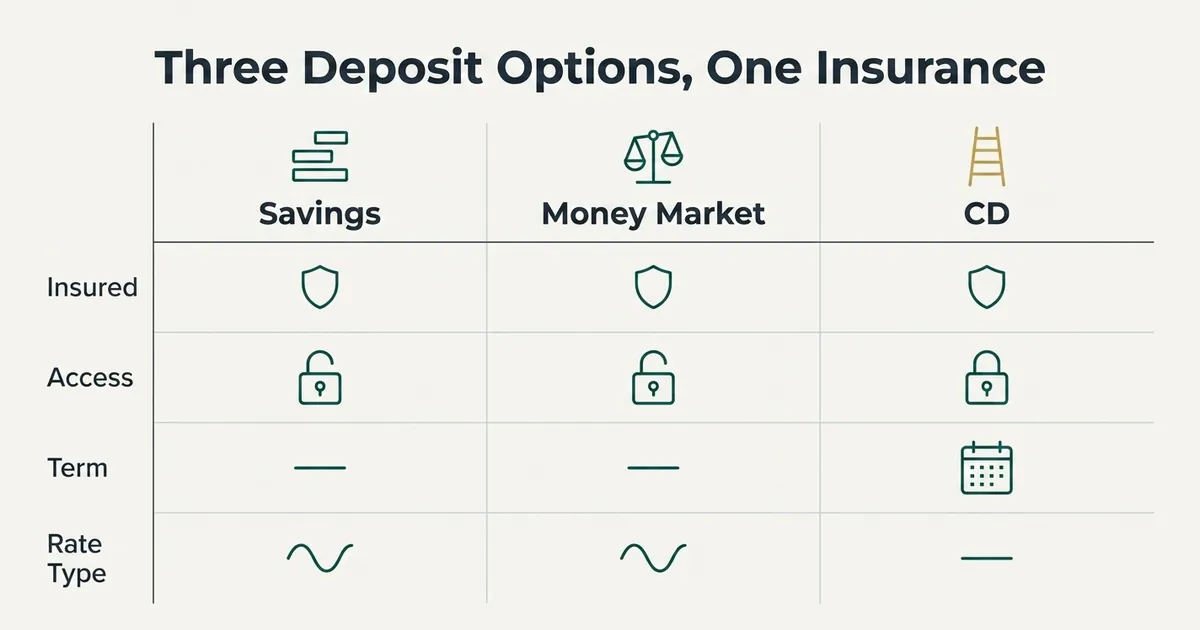
| Feature | High-Yield Savings Account | Money Market Account | Certificate of Deposit (CD) |
|---|---|---|---|
| Access to funds | Same-day or next-day transfer, no penalty | Same-day or next-day; may include checks/debit card | Locked for the term; early withdrawal usually forfeits interest |
| Rate type | Variable — bank can change it any time | Variable, often tiered by balance | Fixed for the full term |
| Typical minimum balance | Often $0 at online banks | Commonly $1,000–$10,000 to earn top rate | Often $500–$1,000 to open |
| Federal deposit insurance | Yes, up to $250,000 per depositor per bank per ownership category | Yes, same limit and structure | Yes, same limit and structure |
| Best used for | The "reach it tomorrow" layer of an emergency fund | Mid-tier reserve, or funds needing occasional check access | Money not needed before a known date, or a CD ladder |
| Main risk to the saver | Rate can drop with little notice | Missing the minimum balance can trigger fees or a lower rate | Early-withdrawal penalty if the money is needed before maturity |
Is Your Money Actually Safe? FDIC and NCUA Insurance, and a Crucial Distinction
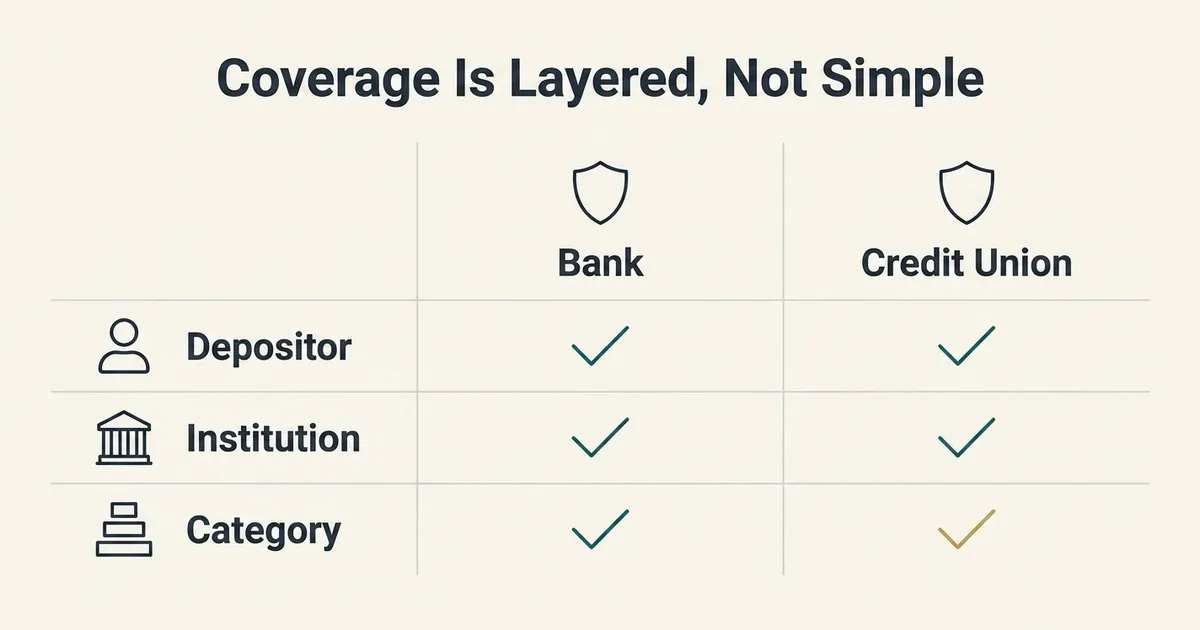
For deposits at a bank, the Federal Deposit Insurance Corporation insures up to $250,000 per depositor, per insured bank, per ownership category, under the framework set out in 12 CFR Part 330. For deposits at a federally insured credit union, the National Credit Union Administration provides equivalent share insurance up to $250,000 per member, per institution, per ownership category, under the Federal Credit Union Act. In practice this means a couple can often structure well over $250,000 in coverage at a single institution by using individual accounts, a joint account, and a payable-on-death beneficiary designation, since each ownership category is insured separately. The FDIC publishes a free online tool, the Electronic Deposit Insurance Estimator (EDIE), that lets a household enter its actual account structure at a given bank and see exactly how much of its balance is covered — a useful step before assuming a large balance is fully protected.
The distinction that trips up even careful savers is between a bank money market account and a money market mutual fund. The former is a deposit product covered by FDIC or NCUA insurance as described above. The latter is a security — a type of mutual fund that invests in short-term, high-quality debt — regulated by the Securities and Exchange Commission under Rule 2a-7 of the Investment Company Act, not by bank regulators, and it is not FDIC- or NCUA-insured. According to an SEC Investor Bulletin on money market funds, these funds aim to maintain a stable $1.00 share price but are not guaranteed to do so, and an investor can lose money in one, however rarely that has happened historically. A brokerage sweep account labeled "money market fund" is a different animal from a bank's "money market account," and a parent building an emergency fund who wants a federal insurance guarantee should confirm which one they're actually opening before committing meaningful cash to it.
How to Choose Based on When the Money Might Be Needed
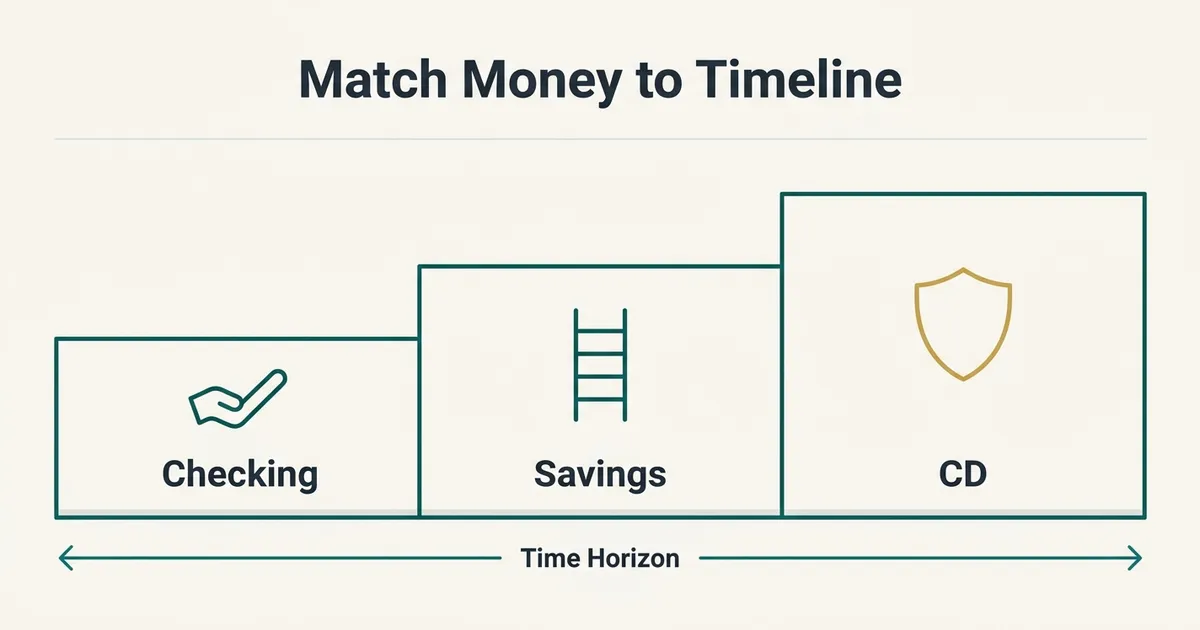
The practical decision for most households comes down to matching each portion of savings to its likely time horizon:
- Money that might be needed within days — the core of an emergency fund meant to cover a job loss, a medical bill, or a broken furnace — belongs in a high-yield savings account or an MMA with easy transfer access. The marginal extra yield a CD might offer isn't worth the risk of paying an early-withdrawal penalty during an actual emergency.
- Money that's a second-tier buffer, unlikely to be needed but not truly long-term savings, can tolerate a short-term CD (three to twelve months) or a CD ladder, discussed below, capturing a typically higher locked-in rate while keeping part of the balance rolling back to accessible in the near future.
- Money earmarked for a known future expense on a known date — a property tax bill due in eight months, a car that will need replacing next spring — is a strong candidate for a CD timed to mature just before the expense, since the rate is locked and the maturity date is already known and fixed.
The mistake this framework is meant to prevent is treating the entire fund as one lump sum and picking a single account type for all of it. A family that puts its whole emergency fund into a 12-month CD to chase a higher advertised rate has effectively bet that no emergency will happen in the next year; a family that leaves the whole fund in a low-rate account at a brick-and-mortar bank because it's familiar is leaving yield on the table for no safety benefit, since HYSAs carry the same federal insurance as a traditional savings account.
A Worked Example: Splitting a $15,000 Emergency Fund
The figures below are illustrative only, meant to show how the math works, not a forecast or promise of what any specific account will pay — actual rates change with Fed policy and vary by institution, so a reader should check current published rates before acting.
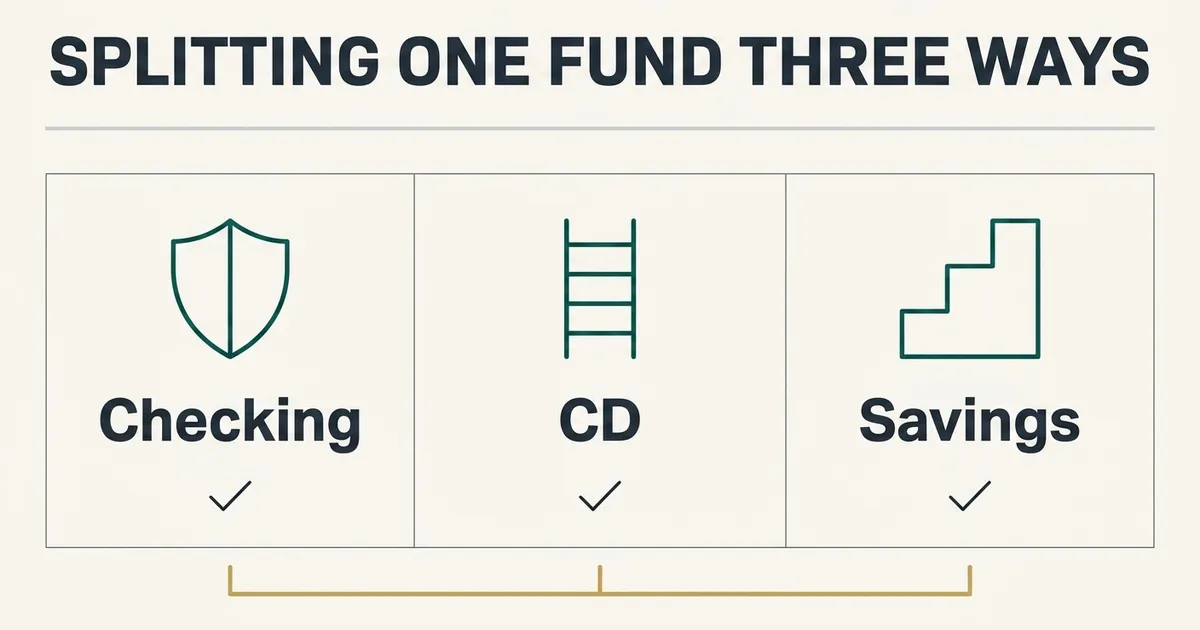
Say a household has built a $15,000 emergency fund and wants to split it between quick access and better yield. One reasonable structure:
- $7,500 in a high-yield savings account. If this portion earns an illustrative 4.0% APY, it generates about $300 over a year, and every dollar remains reachable by transfer within a day or two.
- $5,000 in a 6-month CD. If this portion earns an illustrative 4.5% APY for the six-month term, it generates roughly $112 over that half-year — available in full, without penalty, at the six-month mark, at which point it can be rolled into a new CD or moved back to savings if a need arises.
- $2,500 kept in a money market account with check-writing, useful if a bill needs to be paid directly from the reserve rather than transferred first — at an illustrative 3.8% APY, this generates about $95 over a year.
Compare that structure to leaving the full $15,000 in a traditional savings account paying a low rate. According to the FDIC's National Rate and Rate Caps data series, which tracks average deposit rates across FDIC-insured institutions, the national average savings account rate has typically sat well below 1% APY for years even as top online-bank rates ran several points higher — illustratively, if the traditional account paid 0.4% APY, the same $15,000 would earn only about $60 for the year. The gap between that outcome and the roughly $500 combined total from the tiered structure above illustrates why account choice, not just the amount saved, materially affects how hard emergency cash works — while none of it changes how safe the principal is, since all the accounts in both scenarios can carry the same FDIC or NCUA insurance.
What About CD Ladders and Early-Withdrawal Penalties?
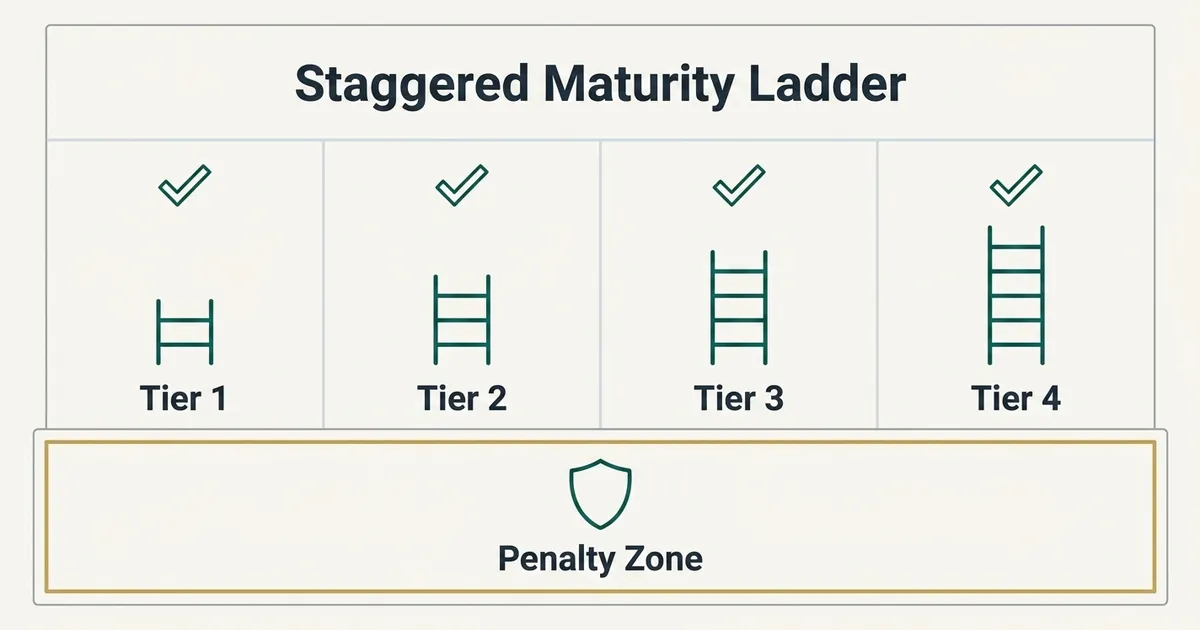
A CD ladder spreads a lump sum across several CDs with staggered maturity dates — for example, dividing $12,000 into four $3,000 CDs maturing at 3, 6, 9, and 12 months — so that a portion of the money becomes penalty-free and available roughly every quarter, while the whole balance still earns CD-level rates rather than a lower savings rate. As each CD matures, the saver can either withdraw that portion if it's needed or roll it into a new longer-term CD to keep the ladder running, which is the strategy covered in depth in the dedicated CD-laddering guide linked below this page.
The trade-off to weigh honestly is the early-withdrawal penalty. Under Regulation DD, the bank or credit union must disclose the penalty terms before the CD is opened, and those terms vary by institution and by term length — a penalty on a 3-month CD is commonly a matter of weeks of interest, while a penalty on a 5-year CD can run to many months of interest, occasionally reducing the payout below what was originally deposited if the CD is cashed out very early. This is the single costliest mistake families make with CDs: locking multi-year money into a CD without a ladder or a maturity date lined up against a known need, then facing a real penalty — or a real cash shortfall — when an emergency arrives before the term is up. A family building an emergency fund should treat any money going into a CD as money it is fairly confident it will not need before the maturity date, and should prefer a ladder or a series of shorter terms over a single long-dated CD for the bulk of that fund.
A related product worth naming so it isn't confused with a bank CD: a "brokered CD" purchased through a brokerage account is technically issued by a bank and can carry the same FDIC insurance, but according to a FINRA investor alert on brokered CDs, these can trade on a secondary market before maturity and may be sold for less than face value if interest rates have risen since purchase — a different risk profile from a CD held directly at the issuing bank, where the saver simply pays a stated penalty rather than facing a market price.
Common Mistakes That Cost Families Yield or Access
A few recurring errors show up across the account types covered here, and each is worth naming once, clearly.
Leaving an entire emergency fund at the same brick-and-mortar bank that holds the family checking account, purely out of inertia, often means earning a fraction of what an online high-yield savings account pays for an identical level of federal insurance protection — the underlying safety is the same; only the yield differs.
Chasing an eye-catching promotional rate without checking whether it's a short-term teaser that reverts to a much lower rate after a few months, or whether it requires a minimum balance or direct-deposit condition the household won't actually meet — the account's terms and conditions, not the advertised headline rate, determine what it actually pays.
Putting the whole fund, or too much of it, into a single long-term CD to capture a modestly higher rate, then needing to break it early during an actual emergency and losing part of the interest to the penalty described above.
Assuming a large balance is fully insured without checking ownership-category rules — a household with, say, $400,000 spread across a single individual account at one bank could have a portion sitting uninsured above the $250,000 limit, a gap the FDIC's EDIE tool referenced above is built to catch before it becomes a real loss.
Confusing a money market mutual fund inside a brokerage account with an FDIC-insured bank money market account, as covered above — the names sound alike, but only one carries a federal deposit-insurance guarantee.
How Interest From These Accounts Gets Taxed
Interest earned on a high-yield savings account, a money market account, or a CD is taxable as ordinary income in the year it's earned or credited, even if the saver doesn't withdraw it — this applies to a CD's interest annually over a multi-year term, not just at maturity. According to the IRS Instructions for Forms 1099-INT and 1099-OID (2025), a bank or credit union must send a Form 1099-INT to any account holder who earned $10 or more in interest during the year, and that $10 reporting threshold is a fixed statutory figure that does not adjust annually the way tax brackets do. For the current 2026 tax year, that reporting rule remains in force: the interest still counts as income even in years the account holder doesn't receive a form because it earned less than $10, per the general income-reporting rules described in IRS Publication 550. None of this changes where the money should be held for safety or liquidity — it simply means the yield numbers discussed throughout this page are pre-tax, and a household in a higher marginal tax bracket keeps a smaller share of the stated APY after filing.
Where to Go From Here
This page is meant to help a reader locate the right starting point among the more detailed guides on the site: a deep dive into shopping for and opening a high-yield savings account, a dedicated guide to money market accounts and how their tiered rates and check-writing features work, a step-by-step guide to building and managing a CD ladder, and a guide to sizing an emergency fund correctly for a specific household's expenses and income stability. The throughline across all of them is the same: match the account's liquidity to how soon the money might actually be needed, confirm the federal deposit insurance actually covers the full balance given how the accounts are titled, and treat any rate chasing as a secondary optimization — never worth compromising same-day access to money a family might need on short notice.
Guides in this cluster
- /saving-money/hysa-vs-money-market-account/
- How to Open a High Yield Savings Account (2026 Guide)
- Money Market Account Explained: 2026 Rates & Rules
- How to Build a CD Ladder in 2026: Step-by-Step Guide
- Treasury Bills vs CDs: Which Beats for Cash in 2026?
- Cash Management Account vs HYSA: Which Wins in 2026?
- Savings Account Interest: How It's Calculated in 2026
- Credit Union vs Bank in 2026: Which Is Better for You?
- Bank Account for Kids: Best Options for Parents in 2026