Treasury Bills vs CDs: Which Beats for Cash in 2026?

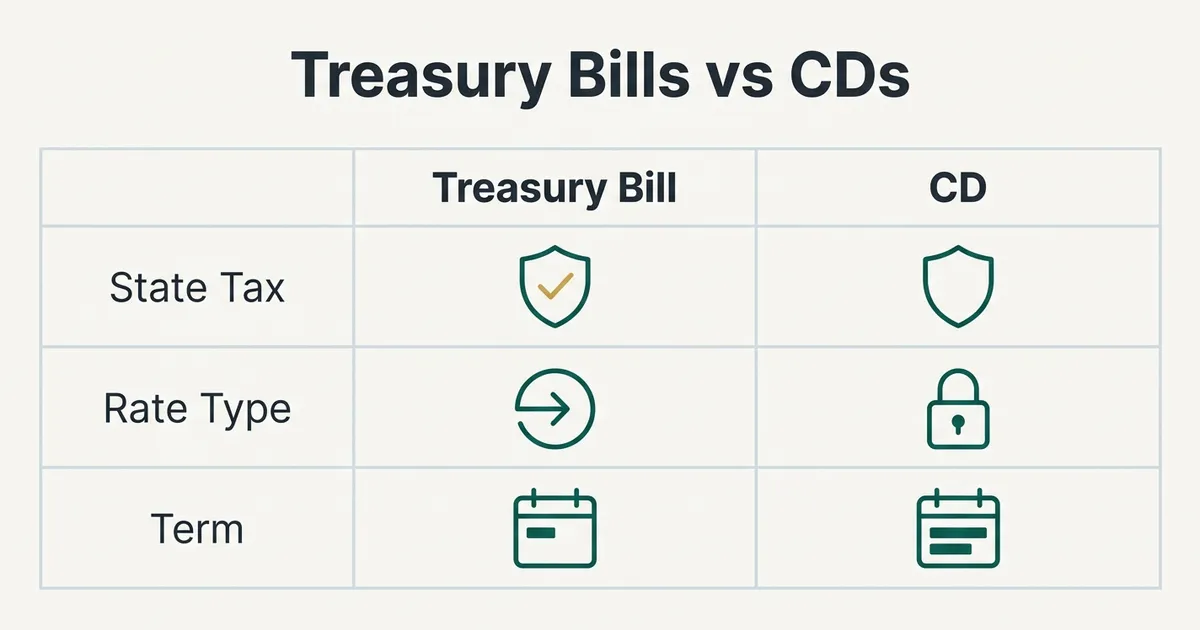
Treasury bills usually beat CDs for cash held to maturity, because T-bill interest is exempt from state income tax and current yields often match or exceed top CD rates. Choose a CD instead when you want a fixed rate locked in today without tracking weekly auction results.
Both are safe places to park the 3-to-6-month cash cushion most parents of young kids need for a broken furnace, a co-pay spike, or a stretch of reduced income. The choice comes down to how you value tax treatment, rate certainty, and access to your money before the term ends — not which one is "safer," because both are backed by the full faith and credit of the U.S. government or by federal deposit insurance.
What's the Difference Between Treasury Bills and CDs?
A Treasury bill (T-bill) is a short-term debt security issued by the U.S. Department of the Treasury that you buy at a discount and redeem at full face value when it matures. A CD (certificate of deposit) is a time deposit at a bank or credit union that pays a fixed annual percentage yield (APY) in exchange for leaving your money untouched for a set term.
The mechanism behind the price difference matters more than the labels. TreasuryDirect sells bills in $100 increments with maturities of 4, 8, 13, 17, 26, and 52 weeks, and you never pay the face value up front — you pay less, and the discount is your interest (TreasuryDirect, 2026). A CD works the opposite way: you deposit the full principal, and the bank credits interest into the account on a schedule (daily, monthly, or quarterly) until maturity, when Regulation DD requires the institution to have disclosed the exact APY, compounding frequency, and any early-withdrawal penalty at account opening (Consumer Financial Protection Bureau, 2026).
The tax mechanism is the biggest structural difference. Interest earned on Treasury bills is exempt from state and local income tax under 31 U.S.C. § 3124, while it remains taxable at the federal level and gets reported to you on Form 1099-INT the way any other interest income is (U.S. Treasury, 2026; Internal Revenue Service, 2026). CD interest is fully taxable at both the federal and state level, with no such carve-out — see Savings Account Interest: How It's Calculated in 2026 for how banks compute and report that interest before it hits your 1099-INT.
Worked example: Say you live in a state with a 5% income tax and you're comparing a $10,000, 26-week T-bill paying an annualized 4.50% against a $10,000, 6-month CD paying the same 4.50% APY. Both earn about $225 in interest before tax over six months. The CD's interest is hit by roughly $11.25 in state tax (5% of $225); the T-bill's isn't. That $11.25 is small in isolation, but scaled across a $50,000 emergency fund and repeated every six months for years, the state-tax exemption alone is worth tracking — it's the reason many CD rate-comparison sites understate what T-bills actually net you.
Treasury Bills vs CDs: Rate and Cost Comparison Table
The table below lines up the factors that actually change your outcome — not just headline rate, but access, insurance, and how the rate behaves once you buy. Every rate in this article is illustrative rather than a quote: T-bill discount rates are set at weekly auction and CD APYs are repriced by each bank at will, so check TreasuryDirect's latest auction results and your own bank's posted APY on the day you buy. Rates and terms described here are current as of August 2026.
| Factor | Treasury Bills | CDs (bank or credit union) |
|---|---|---|
| Where you buy | TreasuryDirect.gov, or through a brokerage (secondary market or auction) | Directly at a bank, credit union, or via a brokerage CD |
| Minimum investment | $100 increments (TreasuryDirect, 2026) | Commonly $0–$1,000; varies by institution |
| Term lengths offered | 4, 8, 13, 17, 26, 52 weeks (TreasuryDirect, 2026) | 1 month to 10 years, set by the issuing bank |
| Rate type | Set at weekly auction; locked in once you're awarded the bill | Fixed at account opening, disclosed under Regulation DD (CFPB, 2026) |
| State income tax | Exempt under 31 U.S.C. § 3124 (U.S. Treasury, 2026) | Fully taxable at state and federal level |
| Insurance/backing | Full faith and credit of the U.S. government (no dollar cap) | FDIC or NCUA insured up to $250,000 per depositor, per institution, per ownership category (FDIC, 2026; NCUA, 2026) |
| Exiting before maturity | Sell on secondary market — no penalty, but price can move with rates | Early withdrawal penalty, typically several months' interest, disclosed at opening (CFPB, 2026) |
| Noncompetitive bid cap | Up to $10 million per auction, per bidder (TreasuryDirect, 2026) | No cap; limited by deposit insurance comfort, not the product |
Read this table by matching the row that matters most to your situation. If state tax and top-line yield drive your decision, T-bills usually win once you account for the tax exemption. If you need a rate you can set and forget without opening a brokerage or TreasuryDirect account, or you want a term longer than 52 weeks (T-bills top out at one year), a CD or a CD ladder fills that gap.
How Do You Actually Buy a Treasury Bill?
You buy a T-bill by opening a free account at TreasuryDirect.gov, selecting a noncompetitive bid (the default and only realistic choice for individual savers), and specifying the term and dollar amount in $100 increments (TreasuryDirect, 2026). A noncompetitive bid guarantees you'll receive the bill at whatever rate the auction sets — you're not negotiating, you're accepting the market clearing price, which removes the guesswork retail buyers would otherwise face against institutional bidders.
Auctions for the 4-, 8-, and 13-week bills happen weekly, and results post the same day on TreasuryDirect, so you'll know your exact rate before settlement (TreasuryDirect, 2026). Funds move directly from your linked bank account on the issue date, and at maturity the face value lands back in that account automatically unless you set up a reinvestment schedule — a useful feature for parents who want a rolling 13-week ladder feeding a school-expenses fund without manual re-entry every quarter.
You can also buy T-bills through most major brokerages, which often let you hold them inside an existing account alongside your other cash holdings — convenient if you already use a brokerage sweep account, but check whether the broker charges a markup versus buying direct at auction.
Which Should You Choose for Your Emergency Fund?
Split your 3-to-6-month emergency fund by how soon you might need each slice, not by which product pays the highest headline rate. According to the Federal Reserve's Survey of Household Economics and Decisionmaking (May 2026), only about 63% of U.S. adults said they could cover a $400 emergency expense using cash or its equivalent — unchanged across the past several survey years — which is exactly why the first month of your fund belongs somewhere with zero withdrawal friction, not in a T-bill or CD at all.
Decision rule for month one (immediate access): Keep this slice in a high-yield savings account or a money market account, both of which let you move money same-day with no penalty. Compare the two using our HYSA vs. money market account guide if you're unsure which fits your bank relationship.
Decision rule for months two through four: Ladder 4-, 8-, and 13-week T-bills so a slice matures roughly every month. Because you can sell an unmatured T-bill on the secondary market with no fixed penalty, this tier stays more liquid than a CD of the same term while still capturing the state-tax exemption.
Decision rule for months five and six: Use a 26-week T-bill or a 6-month CD, whichever pays more after you account for your state's tax rate. If your state has no income tax — Texas, Florida, and Washington among them — the CD and T-bill are closer to a coin flip, and the deciding factor becomes which one is easier for you to actually set up and monitor.
Do not put your entire emergency fund into CDs if you're the type of household likely to need cash on short notice — a pediatric ER visit, a car repair, a job gap. The early-withdrawal penalty on a CD is real money lost at the worst possible time, whereas a T-bill sold early simply changes price with rates and returns your money faster, typically within a day or two of a sell order through a brokerage.
What Are the Risks and Downsides of Each?
Treasury bills carry price risk if you sell before maturity, not default risk: if market rates rose after you bought, your bill's secondary-market price will be a little below what you paid, because a new bill now offers a better rate at the same discount structure (TreasuryDirect, 2026). Hold to maturity and this risk disappears entirely — you get exactly the face value you were promised at auction.
CDs carry a different risk: the early-withdrawal penalty is fixed regardless of what rates do, and Regulation DD requires it to be disclosed but not standardized, so a "6 months' interest" penalty at one bank might be "90 days' interest" at another (CFPB, 2026). That means a CD can lock in a worse outcome than a T-bill even when its posted APY was higher, if life forces you to break it early.
Both products share one real downside versus a savings account: reinvestment risk. If rates fall by the time your T-bill or CD matures, your next purchase earns less — the same risk facing anyone in a CD ladder, which is why laddering across several maturities, rather than parking everything in one term, smooths that risk instead of eliminating it.
Is It Smart to Put $100,000 in a CD or T-Bill Ladder?
Putting $100,000 in a single CD at one bank stays fully insured, since FDIC coverage is $250,000 per depositor, per insured bank, per ownership category — $100,000 has plenty of room under that ceiling (FDIC, 2026). The bigger question isn't insurance; it's whether locking six figures into one rate for one term matches your family's actual cash-flow needs over the next year.
For $100,000 or more, a laddered approach across both products often beats a single lump-sum CD: split the money across three or four T-bill maturities and one or two CD terms, so a chunk becomes available every 4 to 13 weeks while another chunk locks in today's rate for longer. This spreads reinvestment risk and keeps a meaningful slice liquid without sacrificing the state-tax exemption on the T-bill portion. Review your full saving money and cash strategy before committing six figures to any single term, since your emergency-fund target should drive the split, not the rate alone.
Frequently asked questions
Is a Treasury bill better than a CD?
A Treasury bill is usually better than a CD of the same term if you hold it to maturity, because its interest is exempt from state income tax under 31 U.S.C. § 3124 while CD interest is fully taxable (U.S. Treasury, 2026). A CD is better when you want a rate fixed today for a term longer than 52 weeks, since T-bills only go out to one year, or when you'd rather manage one bank relationship than an auction schedule.
How much does a $10,000 Treasury bill cost?
A $10,000 Treasury bill costs less than $10,000 up front because it's sold at a discount to face value, with the difference paid to you as interest at maturity (TreasuryDirect, 2026). For example, a 26-week bill priced at an illustrative 4.50% annualized discount rate would cost roughly $9,775, returning the full $10,000 face value about six months later — a gain of about $225 before federal tax.
Is there a downside to Treasury bills?
Yes: if you sell a Treasury bill before its maturity date, its secondary-market price moves with interest rates, so you could receive slightly less than you paid if rates rose after purchase (TreasuryDirect, 2026). T-bills also cap out at a 52-week term, so they don't fit a savings goal more than a year out the way a longer CD or bond can, and buying requires either a TreasuryDirect account or a brokerage account rather than a simple bank visit.
Is it smart to put $100,000 in a CD?
It can be smart if $100,000 stays under the FDIC's $250,000 per-depositor, per-bank insurance limit, which it does, and if you won't need that cash before the CD's term ends (FDIC, 2026). It's less smart to put the entire amount into one CD term; splitting it across a T-bill ladder and one or two CD maturities reduces the early-withdrawal penalty risk and reinvestment risk that come with locking a large sum into a single rate and date.
What do people on Reddit say about Treasury bills vs CDs?
Personal-finance discussion threads on sites like Reddit generally converge on the same trade-off that government and consumer-protection sources describe: T-bills tend to win on after-tax yield and flexibility, while CDs win on simplicity and rate certainty for savers who don't want to manage TreasuryDirect auctions (TreasuryDirect, 2026; CFPB, 2026). The recurring caution in those threads — confirmed by Regulation DD's disclosure requirement — is to check a CD's early-withdrawal penalty before assuming its higher posted APY beats a T-bill, since breaking a CD early can erase that advantage.
T-bills vs CDs: which fits a short emergency fund better?
For an emergency fund with a 3-to-6-month time horizon, a T-bill ladder (4-, 8-, and 13-week bills) generally fits better because you can sell early with no fixed penalty and the interest skips state income tax (TreasuryDirect, 2026; U.S. Treasury, 2026). A CD fits better only for the portion of that fund you're confident you won't touch before its term ends, since Regulation DD requires banks to disclose a real, non-refundable penalty for breaking it early (CFPB, 2026).