Credit Union vs Bank in 2026: Which Is Better for You?

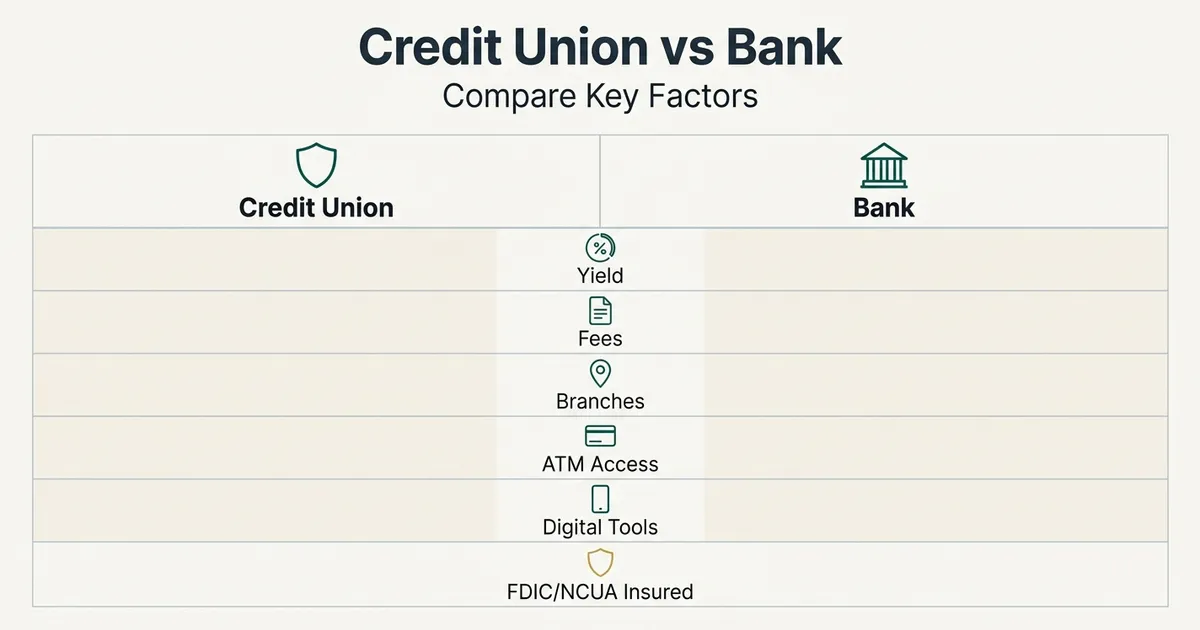
For a family holding cash savings, a credit union usually beats a bank on APY and fees because it returns profit to members instead of shareholders, while a bank usually beats a credit union on branch count, ATM network, and digital tools. Both are federally insured up to $250,000 per depositor.
That single trade-off — better pricing at a credit union versus broader convenience at a bank — drives almost every decision parents make about where to park a 3-to-6-month emergency fund. The right answer depends on how often you need in-person service, how much your balance earns sitting still, and whether you're also shopping for a mortgage or auto loan in the next year or two.
What's the actual difference between a credit union and a bank?
A credit union is a not-for-profit financial cooperative owned by its members; a bank is a for-profit institution owned by shareholders. According to the NCUA (2026), federal credit unions operate under the Federal Credit Union Act of 1934 and return surplus earnings to members as dividends, lower loan rates, or reduced fees rather than paying corporate shareholders. A bank, by contrast, is chartered under the National Bank Act or a state banking law and exists to generate profit that flows to stockholders, some of whom have no relationship with the institution beyond owning its stock.
This ownership structure is the mechanism behind almost every pricing difference you'll see later in this article. Because a credit union has no external shareholders demanding a quarterly return, it can afford to pay a higher rate on deposits and charge a lower rate on loans and still stay solvent. According to America's Credit Unions (2026), roughly 142 million Americans hold a credit union membership, and joining typically requires meeting a "field of membership" rule tied to your employer, geography, place of worship, or a small one-time donation to an affiliated nonprofit. According to the FDIC (2026), there are about 4,500 FDIC-insured banks holding a combined $23.7 trillion in assets, with no membership eligibility requirement — anyone can walk in and open an account.
Which pays a better APY on your savings, a credit union or a bank?
Credit unions pay a higher average savings rate than banks, but both trail top online high-yield savings accounts by a wide margin. According to the FDIC (July 2026), the national average savings account rate across all FDIC-insured banks was 0.43% APY, a figure dragged down by large brick-and-mortar banks that still pay near 0.01%. According to the NCUA (June 2026), the average credit union savings rate ran closer to 0.55% APY over the same period, reflecting the cooperative structure's tendency to pass earnings back to depositors rather than to shareholders.
Neither number is competitive with the top of the market. According to Bankrate (September 2026), the highest-paying online savings accounts were advertising 4.0% to 4.6% APY, nearly ten times the average bank rate. Run the math on a $20,000 emergency fund: at 0.43% APY you earn about $86 in a year; at 0.55% APY you earn about $110; at 4.3% APY you earn roughly $860 — a difference of more than $750 a year for the exact same balance, sitting in the exact same type of federally insured account. That gap exists because online banks and online-first credit unions carry no branch network to fund, so they pass the savings straight into your rate.
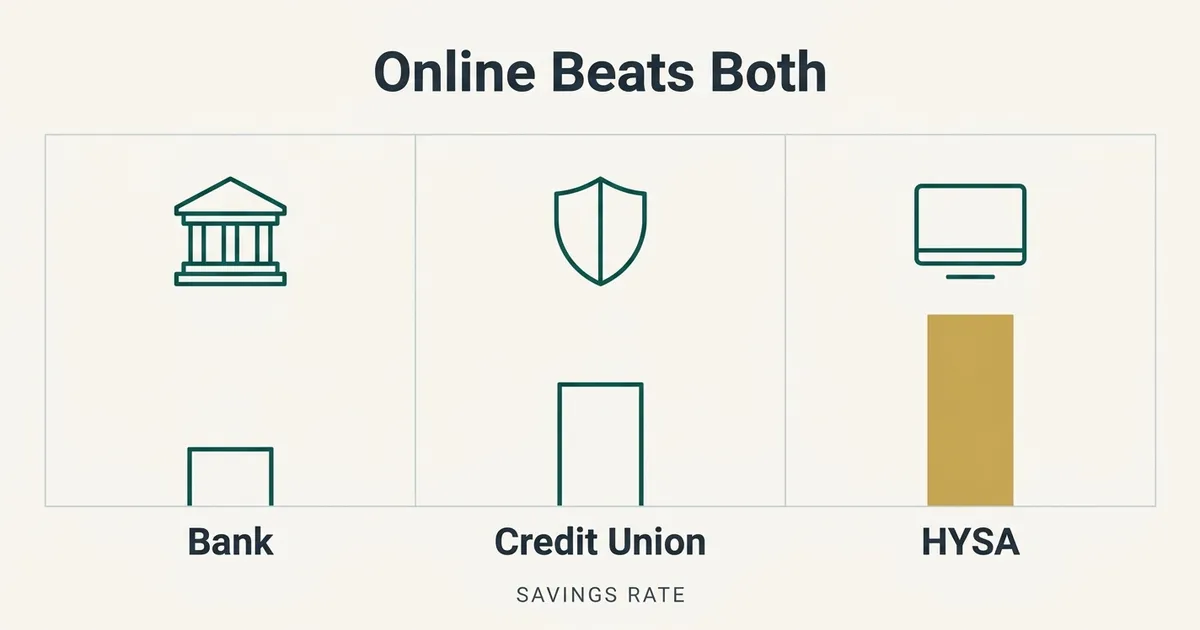
Decision rule: choose a local credit union for your everyday transaction account if you value in-person service and lower loan rates, but move the bulk of an emergency fund to whichever federally insured institution — bank, credit union, or online-only — posts the highest APY today. For a full rate-shopping walkthrough, see how to open a high-yield savings account.
Is your money equally safe at both?
Yes — deposits at a federally insured credit union and a federally insured bank carry the same $250,000 protection per depositor, per institution, per ownership category. According to the FDIC (2026), the standard deposit insurance amount covers checking, savings, money market, and CD balances at member banks, backed by the full faith and credit of the US government. According to the NCUA (2026), the National Credit Union Share Insurance Fund (NCUSIF) provides the identical $250,000 coverage at federally insured credit unions, using the same ownership-category rules — meaning a family can structure joint and individual accounts to insure well over $250,000 at a single institution.
The mechanism behind "equally safe" is that both funds are pre-funded insurance pools backstopped by federal statute, not by the individual bank or credit union's balance sheet. According to the NCUA (2026), no member has lost a penny of insured savings at a federally insured credit union since the NCUSIF began operating in 1971. According to the FDIC (2026), no depositor has lost FDIC-insured funds since the agency's founding in 1933. The one failure mode that erases this protection is depositing at an uninsured institution — always confirm coverage using the FDIC's BankFind tool or the NCUA's Research a Credit Union tool before opening an account, since a small number of state-chartered credit unions carry private insurance instead of NCUSIF coverage.
Credit union vs bank: side-by-side comparison
| Factor | Credit union | Bank |
|---|---|---|
| Ownership | Member-owned, not-for-profit | Shareholder-owned, for-profit |
| Avg. savings APY | ~0.55% (NCUA, June 2026) | ~0.43% (FDIC, July 2026) |
| Deposit insurance | $250,000 via NCUSIF (NCUA, 2026) | $250,000 via FDIC (2026) |
| Eligibility | Field-of-membership rule required | Open to anyone |
| Branch/ATM network | Smaller, often shared via CO-OP network | Larger, especially national megabanks |
| Overdraft fee (median) | Often lower or waived | $35 median (CFPB, 2024) |
| Mortgage approval rate | ~75% of applications (CFPB HMDA data, 2025) | ~70% of applications (CFPB HMDA data, 2025) |
| Digital tools | Improving, varies widely by institution | Generally more mature at large banks |
Read this table by what you're optimizing for: if your priority is the lowest fees and the best rate on savings and loans, credit unions win on average, but the gap between the "best" and "worst" credit union or bank is far bigger than the gap between the two categories — a bottom-quartile credit union can easily underperform a top-quartile bank. If your priority is nationwide branch access, 24/7 phone support, and a polished mobile app, a large bank still wins for most families, especially those who travel often or need same-day cash deposits at odd hours.
How do fees compare between credit unions and banks?
Credit unions generally charge fewer and smaller fees than banks because fee income funds shareholder profit at a bank, while a credit union has no shareholder to satisfy. According to the CFPB (2024), the median overdraft fee across financial institutions was $35, but many credit unions either waive overdraft fees entirely for members with direct deposit or cap them at $20-$25. According to Bankrate (2026), average monthly maintenance fees at large banks ran $5.50 to $16 unless the customer met a minimum balance or direct-deposit threshold, while credit unions were more likely to offer a genuinely free checking tier with no minimum at all.
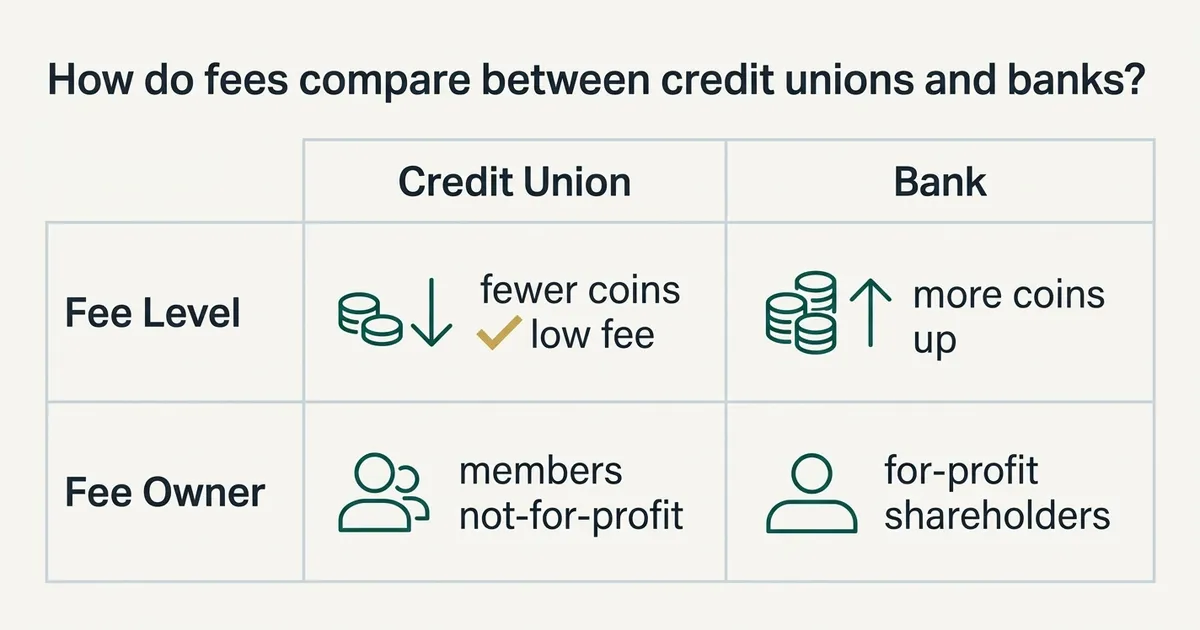
The mechanism matters for a family budget: a $12 monthly maintenance fee you forget to waive costs $144 a year, money that would otherwise sit in an emergency fund earning interest. Before opening any account, confirm the exact waiver conditions in writing — "maintain a $1,500 minimum daily balance" and "receive one direct deposit of any amount" are very different bars to clear, and both banks and credit unions bury this detail in the account's fee schedule (Regulation DD requires banks to disclose it, but not always prominently).
Should you keep your family's emergency fund at a credit union or a bank?
Split your emergency fund by time horizon rather than picking one institution type for the entire balance. Keep one to two months of essential expenses in an instantly accessible savings account — at whichever federally insured institution, bank or credit union, pays the best current APY — and ladder the remaining four to five months into short-term CDs or a money market account for a modest rate bump without losing access entirely.
For a household of four with $9,000 in essential monthly expenses aiming for a 4-month cushion ($36,000 total), a reasonable split looks like: $12,000 in an online savings account at 4.3% APY for true emergencies, $12,000 in a money market account for slightly higher yield with check-writing access, and $12,000 in a 3-to-6-month CD ladder to capture a locked-in rate on money you're unlikely to touch inside a quarter. Compare the mechanics of savings versus money market accounts at HYSA vs. money market account, check whether a money market account fits your check-writing needs, and see how to build a CD ladder before locking any portion of the fund away from instant access.
Choose a credit union if you qualify for membership through an employer or community group, want lower loan rates on a future auto loan, and don't need extensive branch access. Choose a bank — especially a large national one — if you travel frequently, need cash deposits at branches in multiple states, or want a mature mobile app with instant person-to-person transfers. Do not choose either simply for the emergency fund itself if a top online savings account is paying meaningfully more; move the bulk of that balance to the highest verified APY regardless of institution type, then keep a small transaction account locally for convenience.
Which is better for a mortgage, a credit union or a bank?
Credit unions approve mortgage applications at a slightly higher rate than banks, but banks offer a wider range of loan products and faster underwriting technology. According to CFPB Home Mortgage Disclosure Act data (2025), credit unions approved roughly 75% of mortgage applications compared with about 70% at banks, a gap often attributed to credit unions underwriting more manually and weighing a member's full relationship rather than a credit score alone. According to Freddie Mac (September 2026), the average rate on a 30-year fixed mortgage nationwide was around 6.3%, but individual credit union and bank rates varied by half a point or more depending on the applicant's credit profile and loan-to-value ratio.
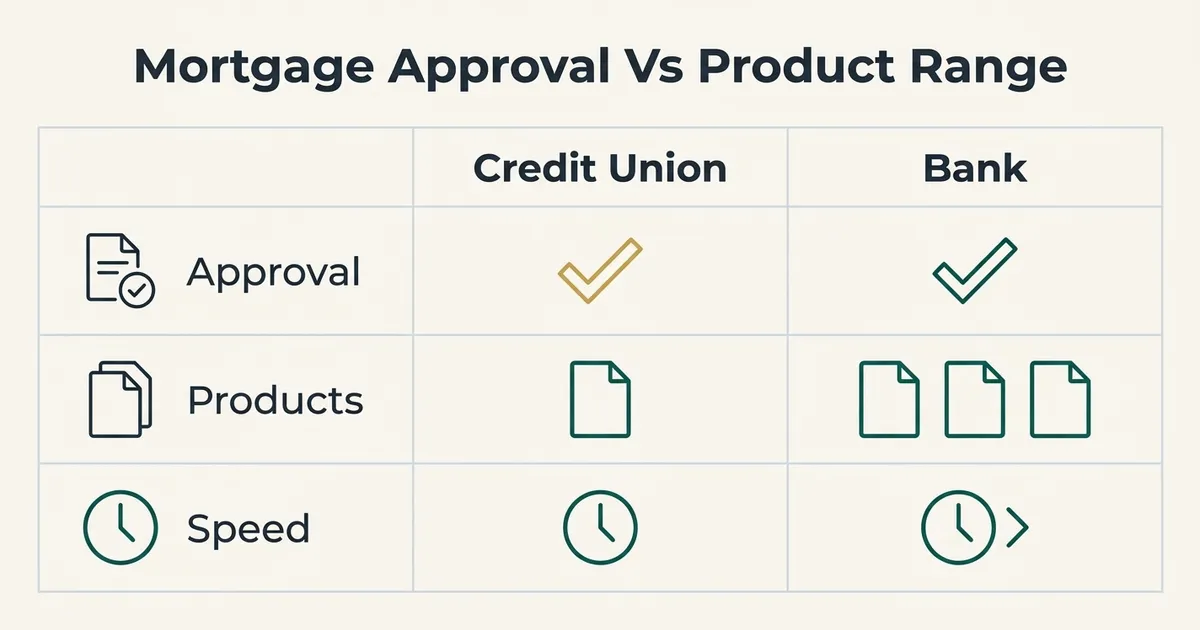
The practical mechanism: a credit union often keeps mortgages on its own books ("portfolio lending") instead of selling them to investors, which lets it approve a slightly nonstandard borrower — self-employed income, a thin credit file — that an automated bank underwriting system might reject. The trade-off is that a credit union's loan menu is usually narrower (fewer jumbo, interest-only, or specialty products) and its online application experience often lags a large bank's. Decision rule: get a rate quote from your credit union and at least two banks before applying anywhere, since the CFPB (2025) data shows the two categories are close enough on average that the individual institution matters more than the category.
For broader guidance on where to hold short-term cash across savings, money market, and CD options, start at the Saving Money pillar page.
Frequently asked questions
What are the disadvantages of joining a credit union?
The main disadvantages of a credit union are membership eligibility rules, a smaller branch and ATM network, and generally less mature digital banking tools compared with large national banks. According to the NCUA (2026), every federal credit union operates under a "field of membership" restriction tied to an employer, geography, or association, so you may need to meet a specific requirement or make a small donation to a partner nonprofit just to open an account. Credit unions also tend to offer a narrower product lineup — fewer specialty loan types and, at smaller institutions, no international wire or foreign-currency services.
What is the $3,000 bank rule?
There is no federal "$3,000 bank rule" tied to deposit insurance or account opening; the figure that most often causes confusion is the $10,000 currency transaction reporting threshold under the Bank Secrecy Act, which requires banks and credit unions to file a Currency Transaction Report for cash transactions above that amount. According to FinCEN (2024), the $10,000 threshold applies to cash deposits and withdrawals, not electronic transfers, and does not limit how much you can deposit — it only triggers a reporting requirement to the Treasury. If you've seen "$3,000" referenced, verify the specific claim against your bank's or credit union's actual disclosure, since it is not a recognized federal banking threshold.
Are credit unions more risky than banks?
No — a federally insured credit union carries the same $250,000 depositor protection as a federally insured bank, so neither category is inherently riskier for insured deposits. According to the NCUA (2026), the NCUSIF has never required a taxpayer bailout and has maintained an equity ratio at or above its statutory 1.20% minimum in most years since 1971. The only added risk applies to a small number of state-chartered credit unions that carry private deposit insurance instead of NCUSIF coverage — those deposits lack the same federal backstop, so confirm NCUSIF or FDIC status before depositing.
What is the biggest risk to credit unions?
The biggest structural risk to individual credit unions is concentration risk — relying heavily on one employer, industry, or region for both membership and loan demand. According to the NCUA (2026), credit unions tied to a single large employer or a single local industry (such as agriculture or energy) can see simultaneous deposit outflows and loan defaults if that employer or industry contracts, unlike a nationally diversified bank. This is an institution-level risk, not a depositor-level one: your insured deposits remain protected up to $250,000 through the NCUSIF regardless of the credit union's business risk.
What are the pros and cons of a credit union vs a bank?
The core pros of a credit union are higher average savings APYs, lower average fees, and lower average loan rates, driven by its not-for-profit, member-owned structure; the core cons are membership eligibility rules and a smaller branch network. According to the NCUA (June 2026), average credit union savings rates ran about 0.12 percentage points above the FDIC's (July 2026) average bank rate of 0.43% APY. A bank's pros are open eligibility, larger branch and ATM networks, and typically more advanced mobile apps, while its main con is fee income that keeps average rates and fees less favorable than a credit union's.
Is a credit union or a bank better for a mortgage?
Neither wins universally — credit unions post a slightly higher mortgage approval rate while banks offer a wider range of loan products, so the better choice depends on your credit profile and how nonstandard your income is. According to CFPB Home Mortgage Disclosure Act data (2025), credit unions approved about 75% of mortgage applications versus roughly 70% at banks, partly because credit unions more often keep loans on their own books and underwrite manually. Get quotes from both before committing, since individual institution pricing varies by more than the half-point average gap between the two categories.