How to Build a CD Ladder in 2026: Step-by-Step Guide

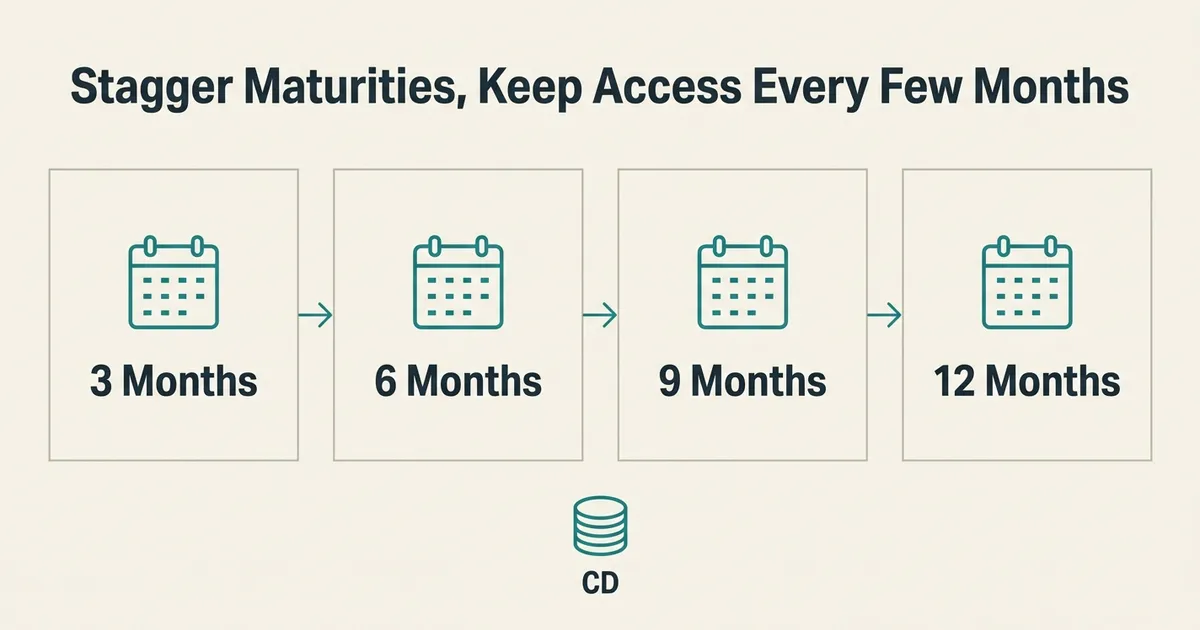
A CD ladder splits one lump sum across several certificates of deposit (CDs) with staggered maturity dates — say 3, 6, 9, and 12 months — so a CD matures every few months instead of your whole balance locking up at once. You get a higher rate than most savings accounts pay, plus rolling access to cash.
You build one by opening several CDs at once, or by rolling each matured rung into a new long-term CD to keep the schedule staggered indefinitely. Every CD in the ladder still carries the same federal deposit protection as a savings account: coverage up to $250,000 per depositor, per insured bank, per ownership category, a limit set by the Dodd-Frank Wall Street Reform Act, according to the FDIC (2010). If your emergency fund tops six figures, that ownership-category detail decides whether you need a second bank, not just a second rung.
What Is a CD Ladder, and How Does It Actually Work?
A CD ladder solves one specific trade-off: CDs pay more than savings accounts because you agree not to touch the money, but locking up all of your cash for a year defeats the point of an emergency fund. Staggering maturities means part of the balance is always coming due soon, so you get the CD rate premium without giving up rolling liquidity.
The mechanism matters more than the label. Once you open a CD, the bank fixes your rate for the full term regardless of what happens to market rates afterward — that fixed rate is the entire value proposition. According to the Federal Reserve (July 29, 2026), the Federal Open Market Committee held its benchmark federal funds rate at a target range of 3.50%–3.75% — its fifth consecutive hold, and well below the 5.25%–5.50% peak reached in July 2023 before the cutting cycle began. Savers who locked 12-month CDs earlier in that cycle kept earning the older, higher rates straight through the cuts, while savings account APYs fell within weeks. A ladder captures that same lock-in benefit on a rolling basis instead of a one-time bet.
Every bank must tell you the exact penalty for touching a CD early, in writing, before you fund the account. That disclosure requirement comes from Regulation DD, the Truth in Savings Act rule codified at 12 CFR 1030, according to the Consumer Financial Protection Bureau (2023). Read that penalty line before you open any rung — it's the number that determines how much a genuine emergency actually costs you.
How Do You Build a CD Ladder Step by Step?
- Size the ladder to your cash cushion, not your whole net worth. Only ladder the portion of your 3-to-6-month emergency fund you're confident you won't need inside the shortest rung's term. Keep one to two months of bare-bones expenses in an ordinary high-yield savings account for same-day access — see how to open a high-yield savings account if you don't already have that base layer.
- Pick the number of rungs. Four rungs (3, 6, 9, and 12 months) is the standard starting ladder for a family emergency fund; fewer rungs mean bigger gaps between access dates, more rungs mean smaller balances per CD and more accounts to track.
- Shop APYs across banks and credit unions before you fund anything. Rate gaps between institutions are large and persistent: according to the FDIC's published national rates (effective July 20, 2026), the national average rate on a 12-month CD was just 1.68%, versus roughly 4.40% at the top of Bankrate's one-year CD listings (August 2026) — a spread of more than two and a half percentage points, which exists because smaller branch-based banks pass through rate changes far more slowly than online banks and credit unions.
- Open every rung at once, with the same total maturity target. Funding all four CDs in the same week is what makes it a ladder instead of four unrelated accounts.
- Confirm federal insurance coverage before you deposit. Credit union deposits carry the same $250,000-per-depositor, per-ownership-category protection through the National Credit Union Share Insurance Fund, a coverage structure paralleling FDIC deposit insurance, according to the NCUA (2010) — see Credit Union or Bank: Where Should a Family Actually Hold Its Cash? for how the two compare beyond insurance limits.
- Reinvest each matured rung into a new longest-term CD. When your 3-month CD matures, roll it into a new 12-month CD; that keeps a rung maturing every three months permanently, without you adding new principal.
Which Cash Option Wins: CD Ladder, Single CD, HYSA, or Money Market?
| Feature | CD ladder | Single 12-month CD | High-yield savings account | Money market account |
|---|---|---|---|---|
| Access to funds | Partial access every 3 months (staggered) | Locked 12 months, one release date | Immediate, unlimited most months | Immediate, often with debit/check access |
| Rate stability | Locked per rung until each matures | Locked for the full term | Variable — falls when the Fed cuts | Variable — falls when the Fed cuts |
| Illustrative APY range* | 4.00%–4.40% blended across rungs | 4.25%–4.40% | 3.75%–4.20% | 3.80%–4.00% |
| Early withdrawal cost | Penalty applies only to the rung you break | Penalty on the entire balance | None — no lock-up | None — no lock-up |
| Federal insurance | Up to $250,000 per depositor per bank, per the FDIC (2010) | Same | Same | Same |
| Best for | Families who want CD-level rates without one big lock-up | Cash you're sure you won't touch for a year | True 24/7 emergency access | Emergency access plus occasional check-writing |
*Illustrative sample APYs, current as of August 2026 and drawn from the top of Bankrate's published listings for each product; deposit rates are variable or reset at renewal, change weekly, and vary by institution — verify current listings before opening an account.
Those top-of-market numbers sit far above the national baseline, which is the whole reason shopping matters: on the same date the national average was 0.38% for savings and 0.65% for money market accounts, according to the FDIC (effective July 20, 2026). The average account pays a small fraction of what the best-priced one does.
A single 12-month CD wins on raw yield if you're certain you won't need any of that cash for a full year. A CD ladder wins for the reader this guide is written for: parents holding 3–6 months of essential expenses who want most of that yield without betting the whole cushion on not having a surprise pediatric bill or car repair. A high-yield savings account or money market account wins only when you need same-day, unlimited access to every dollar — see HYSA vs. money market account for how those two differ from each other. A third option worth weighing alongside a HYSA is a brokerage-linked cash sweep account — see Cash Management Accounts vs. High-Yield Savings: Where Should a Family Park Cash? for how that structure compares on rate and access. If you're also weighing Treasury bills as a rung alternative, see Treasury Bills vs. CDs: Which Actually Pays More After Tax? for how state-tax exemption on T-bills can change the after-tax winner.
How Much Will a CD Ladder Actually Earn?
Run the math on a four-rung ladder built from $10,000, split evenly into $2,500 per rung, using illustrative sample APYs near the top of Bankrate's August 2026 listings — 4.00% (3-month), 4.15% (6-month), 4.25% (9-month), and 4.40% (12-month):
- 3-month rung: $2,500 × 4.00% × (3/12) = $25.00
- 6-month rung: $2,500 × 4.15% × (6/12) = $51.88
- 9-month rung: $2,500 × 4.25% × (9/12) = $79.69
- 12-month rung: $2,500 × 4.40% × (12/12) = $110.00
Total first-year interest: $266.57 on $10,000, before any rung is reinvested — that interest counts as taxable income the year it's credited, as explained in Savings Account Interest: How It's Calculated in 2026. Compare that with parking the full $10,000 in a high-yield savings account at 4.00% APY: $400 in a full year — APY already accounts for compounding, so no separate compounding adjustment applies — which is ahead of the ladder's first-year total, but only because the HYSA rate is variable and can be cut at any time, while the ladder's later rungs stay fixed even if savings rates drop. The ladder's advantage compounds after month 15 or so, once every rung has rolled at least once into a fresh 12-month term and the blended rate rises toward the top-rung APY.
This is a worked illustration with assumed rates, not a forecast — your actual return depends on the APYs available when you fund each rung and on any rate changes at renewal.
Which CD Ladder Term Structure Should You Choose?
Choose a 3/6/9/12-month ladder if your emergency fund sits in the standard 3–6 months of expenses range and you want a rung available every quarter — this is the right default for most families with young children, since childcare, medical, and car-repair surprises tend to surface on a timeline shorter than a year.
The yield you give up for that shorter structure is smaller than most savers expect. At the top of the market the spread between a 3-month and a 12-month CD was roughly 4.00% against 4.40%, per Bankrate (August 2026) — about four tenths of a point for four times the access. Averaged across all banks the gap is wider at the short end: the national average was 1.15% for a 3-month CD and 1.38% for a 6-month, according to the FDIC (effective July 20, 2026), another reason to shop rather than take your existing bank's shelf rate.
Choose a 6/12/18/24-month ladder only for money beyond your core emergency fund — a house-down-payment fund with a 2-to-3-year horizon, for example — because the longer rungs earn more but tie up cash for stretches too long for true emergency use.
Avoid putting emergency-fund money into any rung longer than 12 months. Longer CDs carry steeper early-withdrawal penalties: many banks forfeit 90 days of interest on CDs under 12 months but 180 days of interest on 12-month-or-longer CDs, and some 5-year CDs forfeit up to 365 days of interest, according to the Consumer Financial Protection Bureau (2023). Breaking a 5-year rung in year one can erase more interest than the CD has even earned yet.
When Should You Skip a CD Ladder and Use a HYSA Instead?
Skip the ladder if you need every dollar accessible same-day, with no exceptions — new parents managing unpredictable one-income stretches or frequent medical costs often fit this case, and a HYSA or money market account with no lock-up beats even a well-built ladder's shortest rung.
Skip it, too, if you genuinely expect rates to rise soon. A ladder's whole edge is locking in today's rate before it falls; if you lock a 12-month CD at 4.40% and top 12-month rates climb to 5.25% eight months later, you're stuck below market until that rung matures. The Federal Reserve's cutting cycle — down from a peak target range of 5.25%–5.50% set in July 2023, according to the Federal Reserve (July 2023), to the 3.50%–3.75% range the FOMC has now held for five consecutive meetings (Federal Reserve, July 29, 2026) — is the textbook case where laddering paid off: savers who locked rungs early in the cycle outearned anyone who waited for the next cut.
Don't ladder money you might need to move for a better mortgage rate, a job relocation, or a planned large purchase inside the next 90 days — the shortest practical CD term is usually three months, and breaking it early forfeits the interest that made the CD worth opening in the first place.
What Mistakes Sink a CD Ladder?
Exceeding the FDIC or NCUA insurance limit at one bank. If your ladder plus other deposits at the same bank exceed $250,000 per ownership category, the excess isn't insured, according to the FDIC (2010); credit unions apply the same ceiling through the NCUA (2010). Families with a large combined emergency-and-house-fund balance should split the ladder across two banks rather than stack every rung at one institution.
Missing the auto-renewal window. Regulation DD requires banks to send advance notice before automatically renewing a CD with a term longer than one year, typically with a grace period of about 10 calendar days after maturity to withdraw or restructure the funds without penalty, according to the Consumer Financial Protection Bureau (2023). Miss that window and your matured rung quietly re-locks at whatever rate the bank is currently offering — often lower than what you'd get by shopping it yourself.
Breaking a rung for a non-emergency. Cashing out a $2,500, 6-month CD at 4.15% APY two months early at a 90-day-interest penalty costs about $2,500 × 4.15% × (90/365) = $25.58 — roughly three-quarters of the $34.58 that rung had accrued in its four months, according to the penalty structure the CFPB (2023) requires banks to disclose under Regulation DD.
Forgetting the ladder needs upkeep. A ladder isn't "set and forget" — you have to actively reinvest each maturing rung into a fresh long-term CD, or the schedule collapses into one pile of cash sitting in savings at whatever rate the bank pays on matured funds, which is often near zero.
Explore the Saving Money pillar for the full framework on splitting an emergency fund across savings accounts, money market accounts, and CDs by time horizon.
Frequently asked questions
Is CD laddering a good idea?
CD laddering is a good idea for parents holding 3–6 months of essential expenses in cash who want a rate premium over a savings account without locking up the whole balance at once. It's a poor fit if you need unrestricted, same-day access to every dollar, since even the shortest rung in a standard ladder ties up part of your cash for at least three months; in that case a high-yield savings account with no lock-up, insured up to $250,000 per depositor under FDIC rules according to the FDIC (2010), is the safer default.
How much will a $10,000 CD earn in 6 months?
At an illustrative 4.15% APY — near the top of Bankrate's August 2026 six-month listings — a $10,000 CD held for exactly 6 months earns about $208 in simple interest, calculated as $10,000 × 4.15% × (6/12). The actual figure moves with the APY the bank offers and whether interest compounds monthly rather than posts as simple interest, so treat this as a planning estimate, not a quote — check the CD's disclosed APY, a figure banks must state using a standardized Truth in Savings Act formula under Regulation DD, according to the Consumer Financial Protection Bureau (2023).
What is the best way to ladder CDs?
The most common approach for a family emergency fund is a four-rung ladder — 3, 6, 9, and 12 months — funded all at once so a CD matures every three months. Shop APYs across at least three banks or credit unions before funding any rung, since national average CD rates trail top online-bank rates by more than two percentage points — the [FDIC's national rates](https://www.fdic.gov/national-rates-and-rate-caps) (effective July 20, 2026) put the 12-month average at 1.68%, against roughly 4.40% at the top of Bankrate's August 2026 one-year listings — then reinvest each matured rung into a new 12-month CD to keep the ladder rolling indefinitely.
What does CD ladder mean?
A CD ladder means splitting one sum of money across multiple certificates of deposit that mature on different dates instead of putting it all into a single CD with one maturity date. The "rungs" are the individual CDs — commonly spaced 3 months apart — and the strategy exists to give you rolling liquidity plus the higher fixed rate that CDs pay compared with a standard savings account.
How do you calculate CD ladder returns without guessing?
You calculate CD ladder returns rung by rung, using each CD's disclosed Annual Percentage Yield (APY) and term length, then summing the results — the formula for each rung is principal × APY × (term in months ÷ 12) for simple interest, or the compounding formula the bank discloses if interest compounds monthly. Banks are required to disclose APY using a standardized formula under Regulation DD (12 CFR 1030), according to the Consumer Financial Protection Bureau (2023), which is what makes rung-by-rung comparison and any CD ladder calculator tool accurate across different banks.
What is a common CD ladder strategy for families with young kids?
The common strategy for families with children under 10 is a four-rung, 3/6/9/12-month ladder built from the emergency-fund portion beyond one to two months of bare-bones expenses kept liquid in savings. This structure matches a family's realistic risk window — childcare gaps, medical costs, and car repairs tend to hit within a year — and it locks in a fixed rate on each rung before any future rate cut, the same dynamic that rewarded savers who laddered ahead of the Federal Reserve's cuts from a 5.25%–5.50% peak in July 2023 down to the 3.50%–3.75% target range the FOMC held again on July 29, 2026, according to the Federal Reserve (July 29, 2026).