Money Market Account Explained: 2026 Rates & Rules

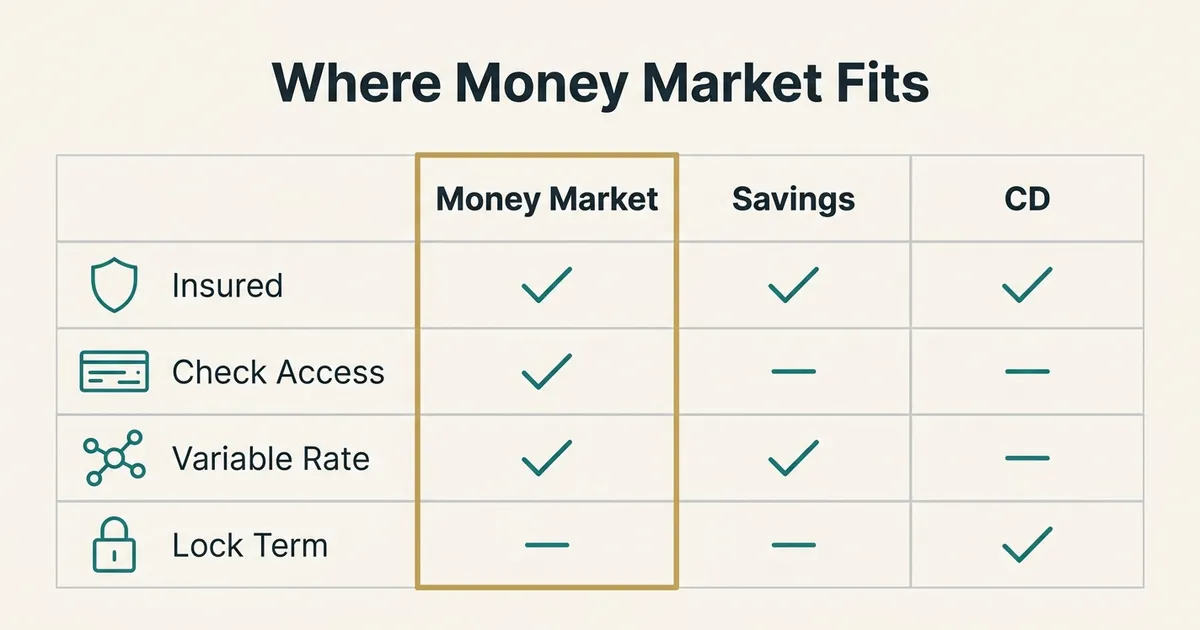
A money market account is a federally insured deposit account that pays a variable APY — often higher than a basic savings account — while allowing limited check-writing and debit-card access. As of August 2026, top-yielding accounts pay between roughly 3.80% and 4.00% APY, according to Bankrate's money market rate survey (August 2026).
That combination — savings-account yield plus checkbook access — makes a money market account (MMA) a middle option between a fully liquid high-yield savings account and a rate-locked CD. Banks and credit unions fund these accounts by holding pooled deposits in short-term, low-risk instruments like Treasury bills and short-term CDs, which is why yields track the Federal Reserve's benchmark rate closely and adjust within weeks of a Fed policy move, according to the Federal Reserve Bank of St. Louis (2025).
For a parent holding three to six months of essential expenses in cash, the question isn't whether an MMA is "good" — it's whether the extra check-writing feature is worth a monthly fee or higher minimum balance compared with a no-fee high-yield savings account, and whether you'd earn more locking part of that cash into a CD instead.
What Is a Money Market Account and How Does It Work?
A money market account is a deposit account, not an investment, and it is insured the same way a checking or savings account is. Your bank or credit union pays you a variable APY set by its own asset-liability committee, adjusted as often as weekly to track short-term rates, according to the FDIC's Truth in Savings disclosure requirements under Regulation DD (2026).
Don't confuse it with a money market mutual fund, which is a security sold by brokerages and fund companies, not a bank product. Money market mutual funds are not federally insured and can, in rare cases, lose value, according to the SEC's investor guidance on money market funds (2025). If your account statement comes from Fidelity, Vanguard, or Schwab rather than a bank or credit union, you likely hold a fund, not an MMA — check the disclosure documents before assuming FDIC coverage applies.
Most MMAs bundle three features a plain savings account doesn't: paper checks (usually limited to a handful per statement cycle), a debit card, and tiered interest rates that pay more as your balance grows. That tiering is the mechanism worth understanding: a bank might pay 2.00% APY on balances under $2,500 and 4.00% APY above $25,000, so the advertised "top rate" only applies once you clear the threshold.
How Do Money Market Account Rates Compare to High-Yield Savings Accounts and CDs?
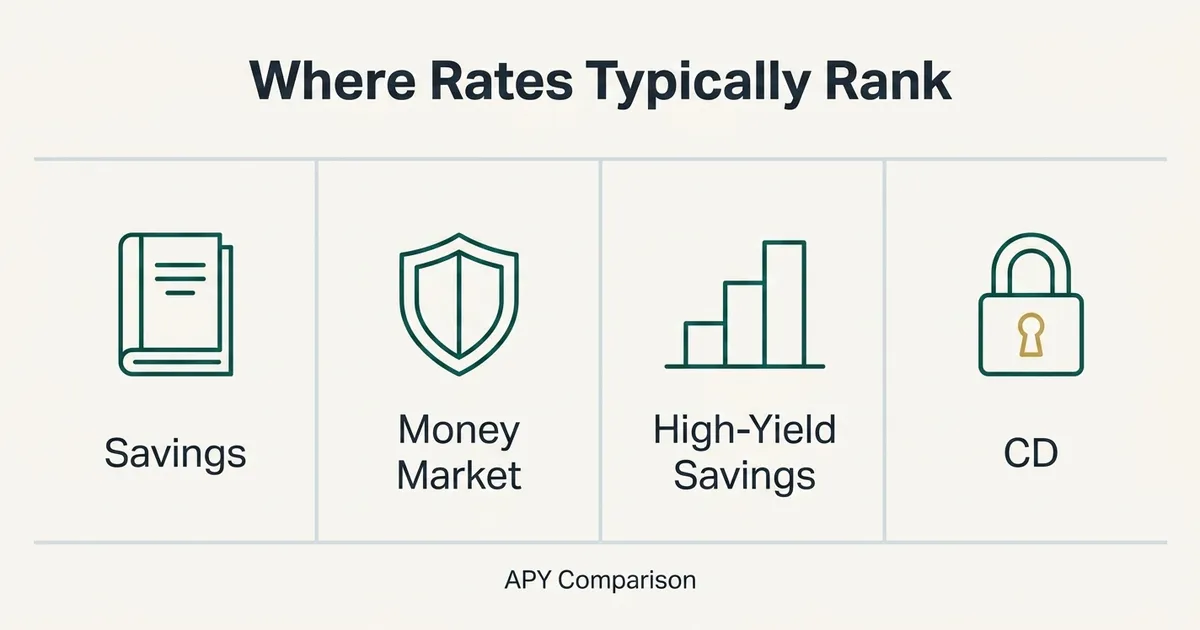
Money market accounts currently pay slightly less, on average, than the best high-yield savings accounts, but more than a standard bank savings account, and less than a locked-in CD at most maturities. The national average MMA rate sits far below the advertised top rates — 0.65% APY, according to the FDIC's National Rates and Rate Caps report effective July 20, 2026 — because that average includes big legacy banks paying near zero.
| Feature | High-Yield Savings | Money Market Account | 6-Month CD |
|---|---|---|---|
| Typical APY (Aug. 2026) | 3.75%–4.20% | 3.80%–4.00% | 4.00%–4.35% |
| Rate type | Variable | Variable | Fixed at opening |
| Minimum to open | $0–$100 | $0–$2,500 | $500–$1,000 |
| Check-writing / debit card | Rare | Yes, usually | No |
| Monthly fee if under minimum | Usually $0 | $5–$15, often waivable | None |
| Early-access penalty | None | None | 3–6 months' interest, per CFPB (2023) |
| FDIC/NCUA insured | Yes, to $250,000 | Yes, to $250,000 | Yes, to $250,000 |
Source ranges compiled from Bankrate's weekly national deposit survey (August 2026) and DepositAccounts.com's rate tables (August 2026); individual institution rates vary and change without notice.
Read the table by what you're optimizing for; our head-to-head on HYSA vs. money market accounts works through the same trade-off on a single decision. Choose a high-yield savings account if you want the simplest, fee-free option and never write paper checks against your emergency fund. Choose a money market account if you specifically need occasional check-writing — paying a contractor, a pediatric dentist, or a daycare deposit directly from savings — and can maintain the minimum balance to avoid the monthly fee. Choose a CD only for the portion of cash you're confident you won't touch before maturity, because you trade liquidity for a locked-in rate that won't fall if the Fed cuts again.
Is Your Money in a Money Market Account Actually Insured?
Yes — up to $250,000 per depositor, per insured bank, per ownership category, according to the FDIC (2026). At a credit union, the parallel protection is $250,000 per share owner, per insured credit union, administered by the NCUA (2026) rather than the FDIC.
The "per ownership category" clause matters for families. A married couple with a joint money market account gets $500,000 in combined coverage at one bank — $250,000 attributed to each owner — separate from any coverage on their individual accounts at that same institution, per FDIC ownership-category rules (2026). If you're holding close to $250,000 in cash reserves (unusual for most families, but possible after a home sale or inheritance), splitting funds across two FDIC-insured banks, or across individual and joint titling at one bank, keeps the entire balance covered instead of leaving a slice exposed.
How Much Interest Will You Actually Earn on $2,500 or $10,000?
On $10,000, a money market account paying 3.90% APY earns roughly $390 over one year, assuming the rate holds steady and interest compounds daily but is credited monthly. At the low end of today's competitive range — 3.80% APY — that same $10,000 earns about $380; at the high end, 4.00% APY, it earns about $400, a swing of roughly $20 a year based purely on which competitive bank you choose, using rate ranges from Bankrate's August 2026 survey.
On $2,500, the same math scales down proportionally: about $95 a year at 3.80% APY, and about $100 a year at 4.00% APY. The spread that actually matters isn't between good banks — it's between a good bank and a default one. Compare either figure with the FDIC's national average of 0.65% APY (effective July 20, 2026) — that $10,000 balance would earn just $65 a year at the average rate, meaning shopping for a top-tier online MMA rather than accepting your local branch's default rate is worth roughly $315 to $335 a year on a typical emergency fund. These figures are illustrative math on today's published rate ranges, not a guaranteed return — APYs are variable and can change with little notice, so your actual credited interest will differ from this estimate.
When Does a Money Market Account Beat a CD — and When Does It Lose?
A money market account wins when you need the cash to stay liquid and rates are flat or rising, because your APY adjusts upward automatically without penalty. A CD wins when rates are falling and you can lock today's yield for months before your bank cuts its variable rates to match, because variable MMA yields reprice within weeks of a Fed move while a funded CD keeps paying its contracted rate to maturity. That risk isn't acute at the moment: the FOMC held its target range at 3.50%–3.75% on July 29, 2026, a fifth consecutive hold, so the case for locking a CD today rests on where you think the next move lands rather than on a cut already underway.
The decision rule: split your emergency fund by function, not by chasing the single highest number. Keep one to two months of essential expenses in a fully liquid high-yield savings account or MMA for true no-notice access — see our guide on how to open a high-yield savings account for the account-opening mechanics that also apply to comparing MMA offers. Ladder the remaining four to five months across a money market account and a short CD (3–6 months) if you're confident you won't need that slice before maturity; this captures a locked rate on part of the fund without sacrificing all liquidity, and our step-by-step guide to building a CD ladder covers choosing rung lengths and what to do at each maturity. For the full framework on sizing and splitting a cash reserve by time horizon, see our broader guide to saving money strategies for short-term cash.
Skip the CD ladder entirely if your household income is irregular (self-employed, tipped, or commission-based) or if you're carrying high-interest debt — in both cases, full liquidity matters more than an extra quarter-point of yield, and an early-withdrawal penalty of three to six months' interest, per CFPB guidance (2023), can erase the CD's advantage if you're forced to break it.
What Fees, Minimums, and Transaction Limits Should You Expect?
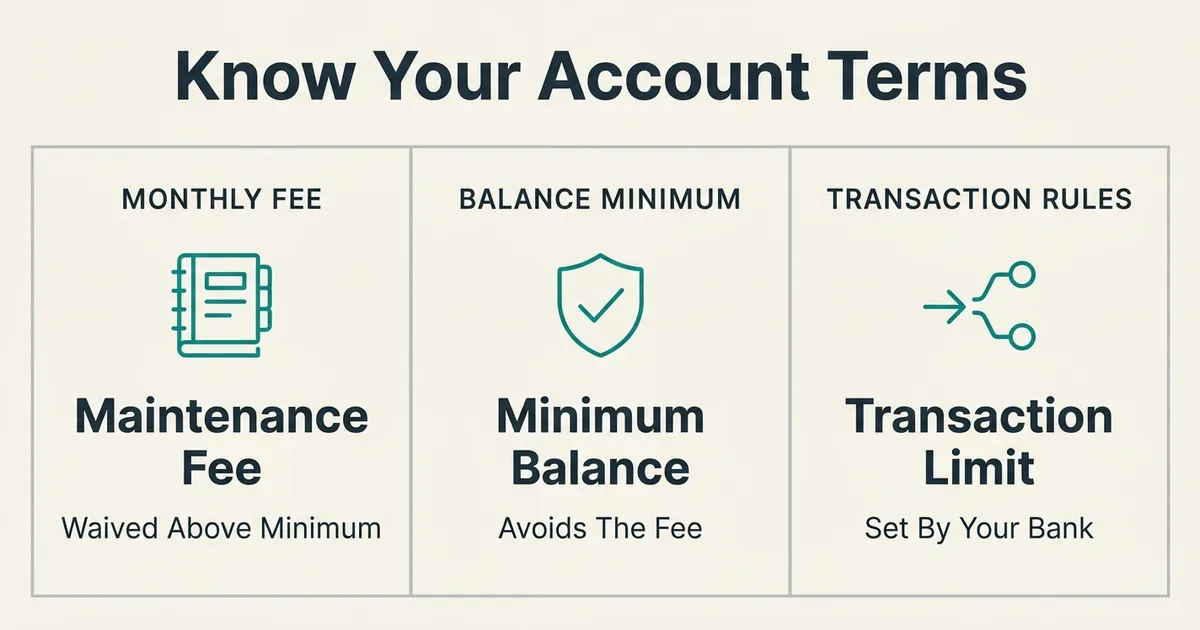
Expect a monthly maintenance fee of $5 to $15 if your balance drops below the bank's stated minimum — often $1,000 to $2,500 — which can wipe out several months of interest on a modest balance, according to DepositAccounts.com's fee comparison data (August 2026). A $2,500 balance earning about $100 a year in interest gives up a tenth of that to a single $10 monthly fee charged for one low-balance month — and a full year of those fees would wipe out the interest entirely.
Transaction limits are looser than they used to be but not gone. The Federal Reserve suspended the six-transfer-per-month limit on savings and money market accounts under Regulation D in April 2020, removing the federal reserve-requirement basis for that cap. Most banks still enforce a similar limit — commonly six external transfers or withdrawals per statement cycle — as a contractual account term rather than a federal rule, and charge $5 to $10 per excess transaction if you exceed it, per individual bank account agreements referenced in Regulation DD disclosures (2026). Read your specific account's fee schedule; "no federal limit" does not mean "no bank limit."
How Do You Open a Money Market Account in Under 15 Minutes?
Compare at least three online banks or credit unions on APY, minimum balance to earn the top tier, and monthly fee before applying — DepositAccounts.com and Bankrate both publish updated comparison tables weekly (August 2026). Apply online with your Social Security number, driver's license, and a funding source; most online banks complete identity verification instantly using the same process required for any deposit account.
Fund the account with an ACH transfer from your existing checking account — expect a one-to-three-business-day hold before the full balance is available for withdrawal, though it typically earns interest from the day it posts. Set up direct deposit or an automatic monthly transfer immediately if the bank waives its fee for maintaining a minimum daily balance; missing that threshold in your first statement cycle is the most common way new customers lose their first month's interest to a fee.
When Should You Skip a Money Market Account?
Skip an MMA if you can't reliably keep the minimum balance — a no-minimum, no-fee high-yield savings account guarantees you keep 100% of the advertised APY regardless of balance swings. Skip it if you never write checks against your cash reserve; the checkbook feature you're not using isn't worth a monthly fee or a slightly lower rate than a comparable savings account.
Skip it, too, if you're saving toward a goal more than five years out with money you won't need on short notice — that cash belongs in a diversified investment account, not a deposit account, a distinction that governs long-term growth but falls outside emergency-fund cash management.
Disclaimer: This article is for general educational purposes and does not constitute personalized financial advice. Rates, terms, and insurance limits cited above are current as of August 2026 and change over time — verify current APYs, fees, and coverage details directly with your bank, credit union, the FDIC, or the NCUA before making a decision.
Frequently asked questions
How much will $10,000 make in a money market account?
At today's competitive rates, $10,000 in a money market account earns roughly $380 to $400 over one year, based on APYs of 3.80% to 4.00% reported by Bankrate's money market survey (August 2026). At the FDIC's national average rate of 0.65% APY (effective July 20, 2026), the same $10,000 earns only about $65 a year, which is why choosing a competitive online bank rather than a default branch account matters more than the account type itself. Actual earnings vary because MMA rates are variable and can change monthly.
Which is better, a CD or money market?
A money market account is better when you need liquidity and want your rate to rise automatically if the Fed raises rates; a CD is better when you can lock funds away for a set term and want protection if rates fall. CDs currently yield roughly 4.00% to 4.35% APY for six-month terms, a touch above top MMA rates, but breaking a CD early costs three to six months' interest under typical bank penalty schedules referenced by the CFPB (2023), while an MMA never charges an early-access penalty.
How much will $2,500 make in a money market account?
At 3.80% to 4.00% APY — the competitive range reported by Bankrate (August 2026) — $2,500 earns roughly $95 to $100 over one year. At a bank paying the FDIC's national average of 0.65% APY (effective July 20, 2026), the same balance earns only about $16.25 a year, a difference worth actively shopping for even on a modest balance.
Where can I get 7% interest on my savings?
Standard money market accounts and savings accounts do not pay 7% APY nationally as of August 2026; the highest broadly available MMA rates sit near 4.00% APY, per Bankrate's money market survey (August 2026). Some regional banks and credit unions advertise "rewards checking" accounts paying up to 7.00% APY, but that rate typically applies only to balances up to $1,000–$2,500 and requires monthly debit-card swipes or direct deposit, with any excess balance earning a far lower rate, according to DepositAccounts.com's rewards-checking rate tables (2026).
What are money market account rates right now?
As of August 2026, competitive online money market accounts pay between 3.80% and 4.00% APY, while the FDIC-reported national average across all banks is 0.65% APY, according to the FDIC's National Rates and Rate Caps report effective July 20, 2026. The gap exists because the national average includes large legacy banks that rarely raise rates on existing deposit accounts, making rate-shopping the single biggest lever a saver controls.
How are money market account interest rates determined?
Banks set money market account rates based on the Federal Reserve's target federal funds rate, adjusting their own APY within weeks of a Fed policy change, according to the Federal Reserve Bank of St. Louis (2025). Because MMA rates are variable, not fixed, a bank can lower your rate at any time with only the notice required under its account agreement and Regulation DD disclosure rules (2026), which is the key trade-off against a fixed-rate CD.