Kiddie Tax Explained: 2026 Rules for Custodial Accounts

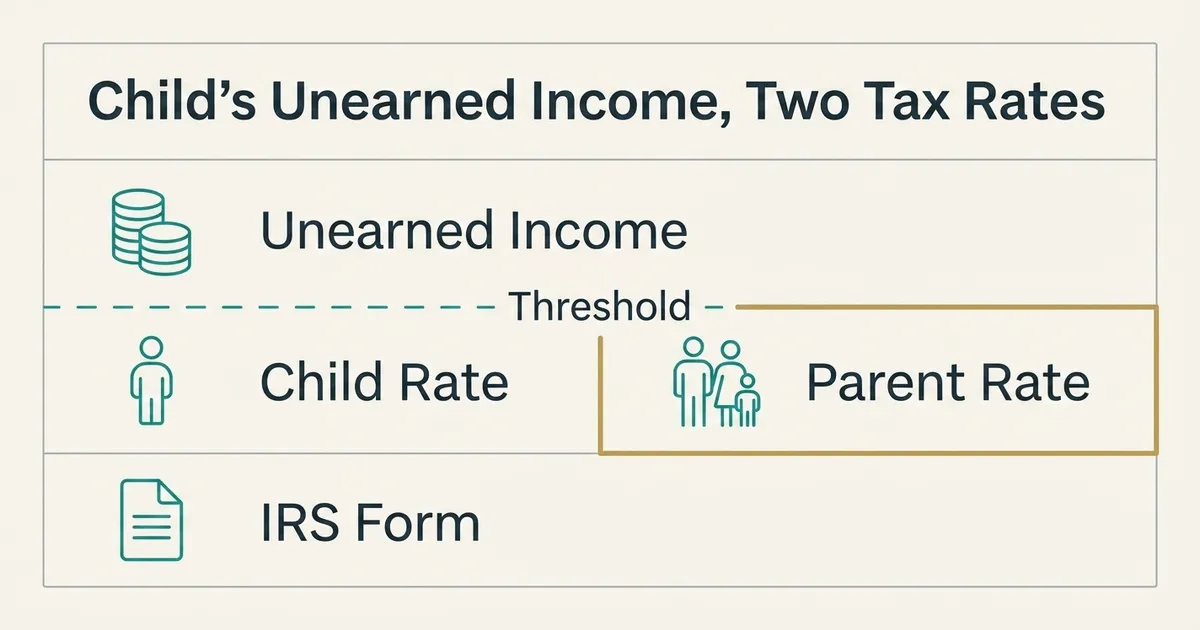
The kiddie tax is a federal rule that taxes a child's unearned income — dividends, interest, and capital gains — above a set threshold at the child's parent's marginal tax rate instead of the child's own lower rate. For 2026, the first $1,350 is tax-free, the next $1,350 is taxed at the child's rate, and anything above $2,700 is taxed at the parent's rate.
Congress built the rule to close a tax-shifting loophole, not to punish families who invest for their kids. Before 1986, parents could move stock into a child's name and let the dividends get taxed at the child's near-zero bracket. According to the IRS (Form 8615 Instructions, 2025), the kiddie tax now applies to any dependent child under 19, or under 24 if a full-time student, whose unearned income exceeds the annual threshold — regardless of whose account name is on the statement.
What Is the Kiddie Tax, and Why Does It Exist?
The kiddie tax taxes a child's unearned income above $2,700 (2026) at the parent's top marginal rate rather than the child's rate, closing the gap that once let families shelter investment income in a minor's name. The mechanism works through a layered calculation, not a flat penalty. According to IRS Topic No. 553 (2025), the first layer — up to the standard deduction floor for dependents — is entirely tax-free; the second layer is taxed at the child's own rate; only the third layer, income above the combined threshold, gets taxed at the parent's rate.
This three-tier structure matters for a parent building a $50–$500/month custodial dividend portfolio, because most young families never reach the third tier. A 6-year-old with $8,000 invested in a dividend ETF yielding 3% generates roughly $240 a year in qualified dividends — comfortably inside the first tax-free tier. The rule only bites once the account has grown large enough, or the dividend yield is high enough, to push unearned income past $2,700 a year. Because it reaches unearned income only, paying your child for real work in a family business moves those dollars into a category the kiddie tax cannot touch.
The kiddie tax applies only to unearned income, never to a child's wages from babysitting, a paper route, or modeling. Per the IRS (Form 8615 Instructions, 2025), earned income is taxed under the normal individual rate schedule for dependents, with its own separate standard deduction — the kiddie tax computation on Form 8615 never touches it.
How Much Dividend Income Can My Child Earn Before the Kiddie Tax Applies in 2026?
A child can earn up to $2,700 in unearned income for 2026 before any of it is taxed at the parent's marginal rate, and up to $1,350 of that is entirely tax-free. According to the IRS (Revenue Procedure 2025-32, November 2025), these two thresholds adjust for inflation every year, so a family relying on a figure from a prior tax year risks under- or over-withholding.
Here's the worked math for a custodial brokerage account holding a dividend ETF. Say a 4-year-old's UGMA account holds $30,000 in a fund yielding 3.5%, generating $1,050 in annual qualified dividends. That amount sits entirely inside the $1,350 tax-free tier — no return required beyond the account's own 1099-DIV recordkeeping. Now scale up: a $90,000 account at the same 3.5% yield throws off $3,150. The first $1,350 is tax-free, the next $1,350 is taxed at the child's rate (likely 10% on qualified ordinary income, or 0% if the dividends are qualified and the child's total taxable income stays under the 0% capital-gains bracket), and the remaining $450 is taxed at the parent's marginal rate — say 24% — adding $108 to the family's tax bill.
That $108 is the entire point of the rule for most families in this savings range: it's real, but it's rarely large enough to change the investing decision. Per the IRS (Form 8615 Instructions, 2025), Form 8615 is only required when a child's unearned income exceeds the year's second-tier threshold ($2,700 for 2026) and the child is required to file a return at all.
How Do Custodial Investment Vehicles Compare Under the Kiddie Tax?
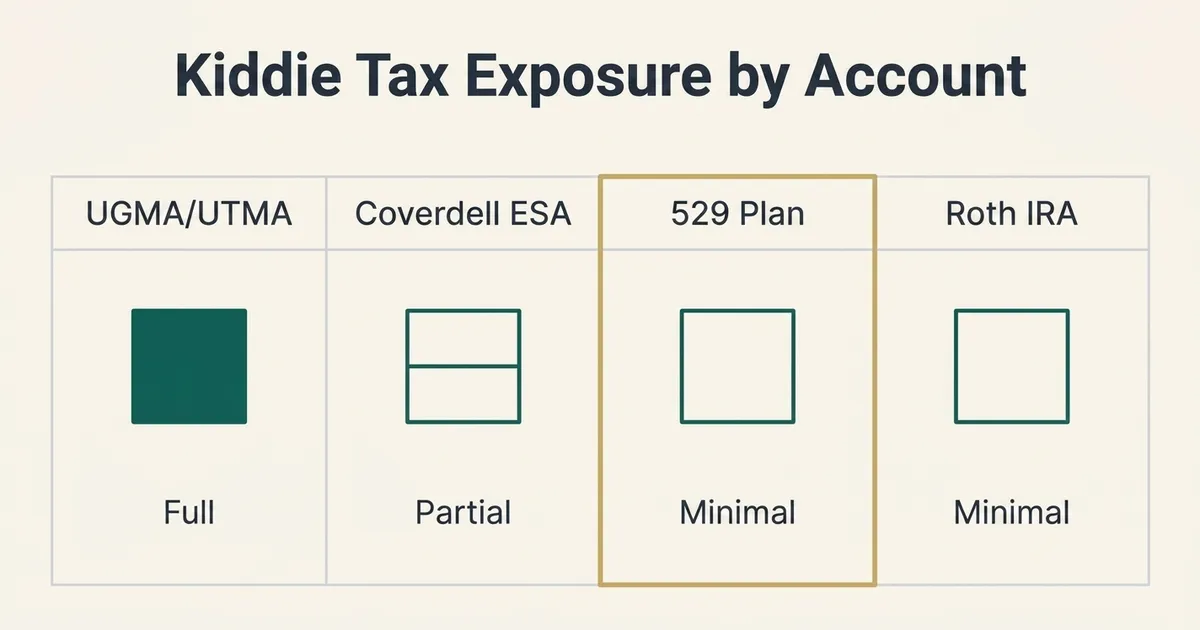
Not every account built for a child's future is exposed to the kiddie tax the same way. A taxable UGMA/UTMA brokerage account carries full exposure; a 529 plan carries almost none.
| Account type | Kiddie tax exposure | 2026 contribution limit | Who controls funds | Typical transfer age | Best for |
|---|---|---|---|---|---|
| UGMA/UTMA custodial brokerage | Full — unearned income over $2,700 taxed at parent's rate (IRS Rev. Proc. 2025-32, Nov. 2025) | No cap; gifts over $19,000/donor in 2026 trigger Form 709 (IRS Rev. Proc. 2025-32, Nov. 2025) | Custodian (parent) until transfer age | 18–21, state-set | Passive dividend growth, flexible-use savings |
| 529 college savings plan | None on qualified education withdrawals (IRS Publication 970, 2025) | No federal cap; CA ScholarShare 529 aggregate limit is $529,000 per beneficiary (ScholarShare 529, 2025) | Account owner (usually parent), indefinitely | No forced transfer | Education-earmarked savings only |
| Coverdell ESA | None for qualified K-12/college use; taxable plus 10% penalty otherwise (IRS Publication 970, 2025) | $2,000 per beneficiary per year (IRC Section 530(b); IRS Publication 970, 2025) | Responsible individual named on account | Must be spent by beneficiary's 30th birthday | Income-eligible families layering K-12 costs |
| Custodial Roth IRA | None — contributions and growth aren't unearned income (IRS Publication 590-A, 2025) | Lesser of child's earned income or $7,000 for 2025 (IRS Notice 2024-80, Nov. 2024) | Custodian until majority, then the child | 18–21, state-set | Teens with documented earned income, not passive-only accounts |
The table shows why age matters as much as tax rate. A custodial Roth IRA is off the table for most children under 10 because it requires the child's own earned income, which is rare before the tween years. Choose a UGMA/UTMA account if you want unrestricted dividend investing that can later fund anything from a car to a business; choose a 529 if the money is earmarked for tuition and you want to keep legal control past age 18; layer a Coverdell ESA only if your household income falls under the IRS phase-out and you also want K-12 flexibility. For a full walkthrough of the custodial-versus-education-savings decision, see this comparison of a custodial account vs. 529 plan.
Should You File Form 8814 or Let Your Child File Form 8615?
File Form 8814 if your child's only income is interest and dividends under the annual ceiling; file Form 8615 on the child's own return in every other case. According to the IRS (Form 8814 Instructions, 2025), parents may elect to report a child's unearned income directly on their own Form 1040 only if that income is between $1,350 and $13,500 for the 2025 tax year, consists solely of interest, dividends, and capital gain distributions, and no estimated tax payments were made in the child's name.
The mechanism behind the choice is administrative, not just financial: Form 8814 avoids filing a separate return for the child but adds the full unearned income to the parent's adjusted gross income, which can phase out other credits — the Child Tax Credit, education credits, or IRA deduction limits — that are sensitive to AGI. Form 8615, filed on the child's own return, keeps the parent's AGI clean but requires a standalone tax return for the child even if they're a toddler with no income of their own.
Decision rule: if your household is near a credit phase-out threshold (for example, the Child Tax Credit begins phasing out above $200,000 modified AGI for single filers and $400,000 for joint filers, per the IRS, 2025), file Form 8615 for the child instead of electing Form 8814, so the dividend income never touches your own AGI.
How Does the Kiddie Tax Affect Dividend Reinvestment in a Custodial Account?
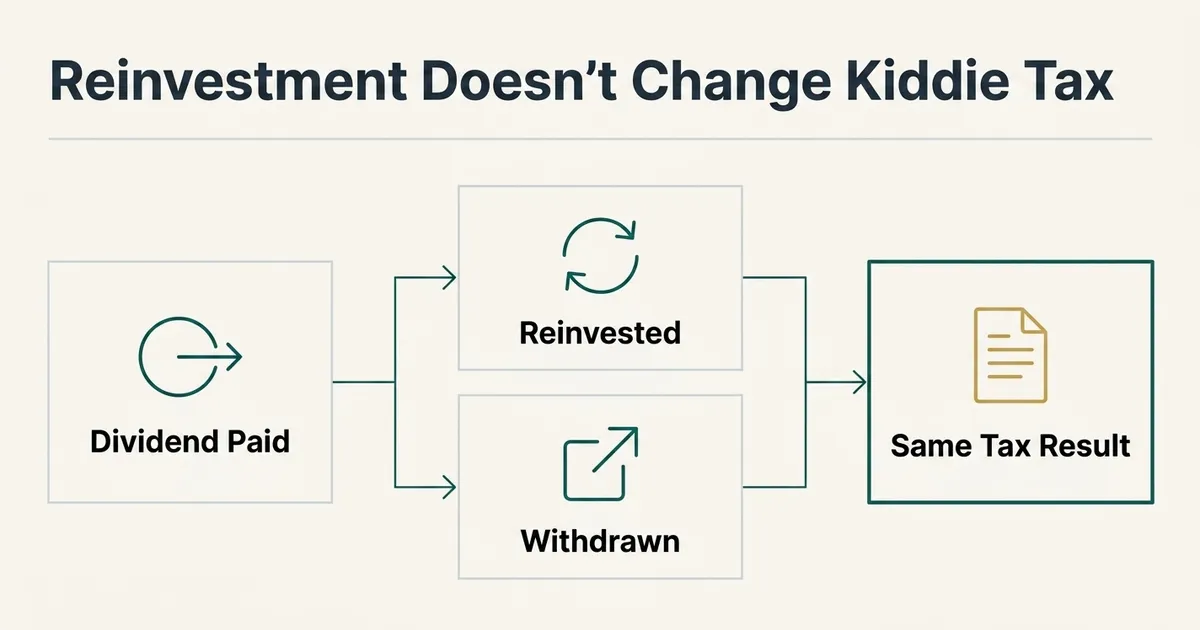
Automatic dividend reinvestment (DRIP) doesn't change kiddie tax exposure, because the IRS taxes dividends the year they're paid, whether they're reinvested or withdrawn. Per the IRS (Publication 550, 2025), qualified dividends are reportable income in the year received regardless of whether the brokerage immediately uses that cash to buy more shares.
This creates a compounding-versus-tax tradeoff worth planning for. A $200/month DRIP contribution into a dividend ETF yielding 3% builds roughly $8,400 in five years through contributions alone, before growth — and once the account's annual dividend income crosses $2,700, each additional reinvested dollar of dividends still generates a 1099-DIV that counts toward the kiddie tax calculation, even though no cash ever leaves the account. Parents sometimes assume reinvested dividends are somehow tax-deferred, similar to a 401(k); they are not, inside a taxable UGMA/UTMA. For the exact reinvestment mechanics and brokerage settings that automate this, see this guide to DRIP auto-compounding setup.
What Is the "Surprise" Kiddie Tax That Catches Parents Off Guard?
The "surprise kiddie tax" refers to a 2018–2019 policy change that briefly taxed children's unearned income at compressed trust tax rates as high as 37%, instead of the parent's marginal rate — hitting Gold Star military families and scholarship recipients hardest. The Tax Cuts and Jobs Act (Public Law 115-97, 2017) had replaced the parent's-rate method with flat trust brackets starting in tax year 2018, and those brackets reach the top 37% rate at only about $12,500 of income, far lower than the roughly $600,000+ threshold for the top individual rate.
According to reporting cited in the Further Consolidated Appropriations Act, 2020 (December 2019), military survivor benefits paid to children of fallen service members are treated as unearned income under the kiddie tax, so many Gold Star children saw their benefits taxed at the new 37% trust rate rather than their family's actual, often much lower, marginal rate. Congress repealed the trust-rate method in that same December 2019 law and reinstated the parent's-marginal-rate calculation retroactively to 2018, letting affected families amend prior returns.
For today's custodial-account parent, the practical lesson is that kiddie tax mechanics have changed before and can change again — the current parent's-rate method (in effect since the 2019 repeal) is the version that governs 2026 filings, but it is not a permanent fixture of the tax code.
Can You Gift Money to Your Child Without Triggering the Kiddie Tax or Gift Tax?
Yes — the kiddie tax and the gift tax are separate systems, and most family gifts trigger neither. According to the IRS (Revenue Procedure 2025-32, November 2025), an individual can gift up to $19,000 per recipient in 2026 without filing a gift tax return; that limit adjusts annually and typically rises in $1,000 increments as inflation warrants.
The gift itself is never taxed to the giver or the child. What becomes taxable is any dividend, interest, or capital gain the gifted money later earns once invested — that income is what the kiddie tax rules govern, separately from the size of the original gift. A $15,000 gift into a custodial brokerage account that earns 3% annually generates $450 in year-one dividends, which falls inside the tax-free tier; the $15,000 principal itself was never a taxable event for anyone.
What Should California Parents Know About UTMA Age of Majority?
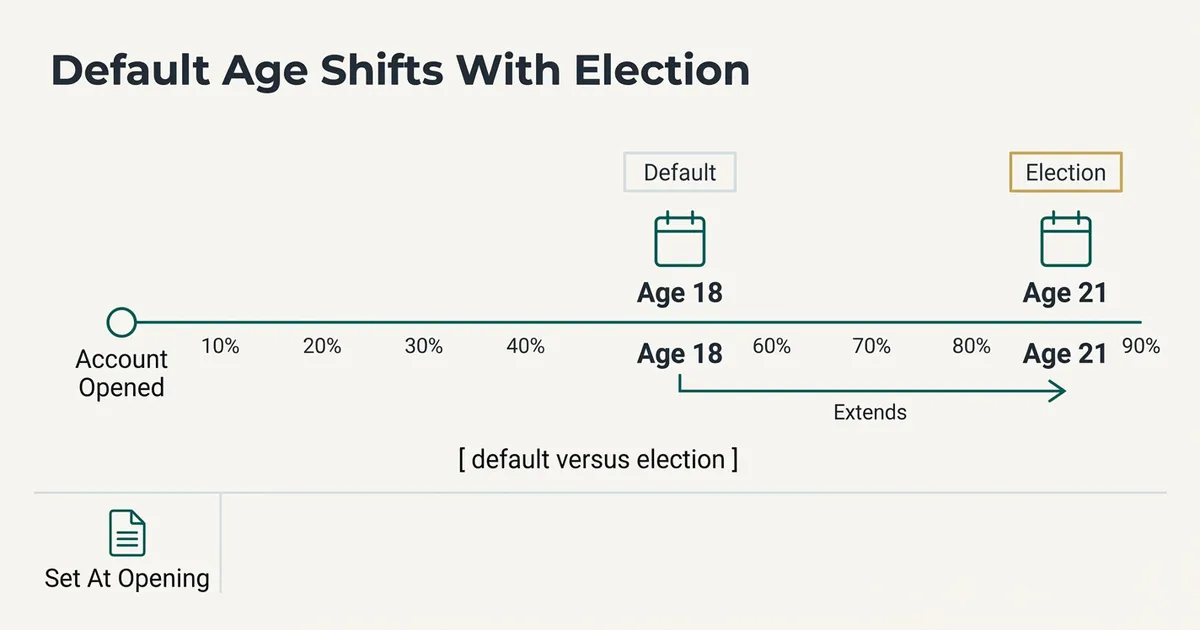
In California, custodial UTMA accounts default to transferring full control to the child at age 18, but the person funding the account can extend that to age 21 at the time the account is opened. Per the California Probate Code (Sections 3920–3925), the donor names the termination age in the account's governing instrument, and once set, that age generally cannot be changed later without a court proceeding.
This is a one-time, easy-to-miss decision at account opening. A parent who wants more runway before a young adult gains unrestricted access to a college fund's dividend-and-growth balance should elect the 21-year term when the custodial account is opened, not assume it's automatic. Other states set different default and maximum ages under their own adoption of the Uniform Transfers to Minors Act — verify your specific state's statute before opening the account, since the age-of-majority rule (not the kiddie tax itself, which is federal) is what varies state to state.
Choosing between account types before you hit this age-of-majority decision matters just as much as the tax treatment. Review this comparison of dividend ETFs vs. individual stocks for custodial holdings, and this list of best dividend stocks for a custodial account for concrete starting picks, before funding the account. For the broader framework this article sits inside, start from the family dividend investing pillar.
Frequently asked questions
What is the kiddie tax rule for 2026?
The kiddie tax rule for 2026 taxes a dependent child's unearned income above $2,700 at the parent's marginal tax rate, with the first $1,350 tax-free and the next $1,350 taxed at the child's own rate. According to the IRS (Revenue Procedure 2025-32, November 2025), these two threshold amounts adjust for inflation each year and apply to dependents under 19, or under 24 if a full-time student. The rule covers dividends, interest, and capital gains — never wages the child earns from work.
What is the surprise kiddie tax?
The "surprise" kiddie tax refers to a 2018–2019 rule that taxed children's unearned income at compressed trust tax rates reaching 37% at roughly $12,500 of income, instead of the parent's actual marginal rate. The Tax Cuts and Jobs Act (Public Law 115-97, 2017) created this trust-rate method, which unexpectedly hit military Gold Star families receiving survivor benefits and college scholarship recipients particularly hard. Congress repealed it in the Further Consolidated Appropriations Act, 2020 (December 2019), restoring the parent's-marginal-rate method retroactive to 2018 and allowing affected families to amend prior returns.
Can I give my kids $100,000 tax-free?
Not as a single gift under the annual exclusion, but likely yes using the lifetime exemption with a filed gift tax return. According to the IRS (Revenue Procedure 2025-32, November 2025), the annual per-recipient gift tax exclusion is $19,000 for 2026; a $100,000 gift exceeds that and requires filing Form 709, but the excess simply counts against the giver's lifetime exemption rather than triggering immediate tax. Per the One Big Beautiful Bill Act (Public Law 119-21, July 2025), the federal gift and estate tax exemption is $15 million per person starting in 2026, so a single $100,000 gift to a child would not create an actual tax bill for the vast majority of givers — it only requires the paperwork.
How much can my minor child earn without paying taxes?
For unearned income like dividends and interest, a child can earn up to $1,350 in 2026 completely tax-free, per the IRS (Revenue Procedure 2025-32, November 2025). For earned income from work, the IRS (Form 8615 Instructions, 2025) sets a separate standard deduction for dependents — generally earned income up to that year's standard deduction amount is untaxed — and the two income types are calculated independently, so a child can have both a tax-free unearned-income tier and a tax-free earned-income tier in the same year.
Kiddie tax explained 2025
For the 2025 tax year, a dependent child's unearned income above $1,350 started facing tax: the first $1,350 was tax-free, the next $1,350 was taxed at the child's own rate, and anything above $2,700 was taxed at the parent's marginal rate. According to the IRS (Form 8615 Instructions, 2025), Form 8615 was required whenever a child's unearned income exceeded $2,700 for that year and the child had a filing requirement. These same thresholds carry into the 2026 tax year unchanged: the IRS's annual inflation adjustment under Revenue Procedure 2025-32 (November 2025) held the tax-free and parent-rate figures flat at $1,350 and $2,700 from 2025 to 2026.
Child tax explained
"Child tax" commonly refers either to the kiddie tax on a child's investment income or to the Child Tax Credit a parent claims on their own return — they are different rules. The kiddie tax, per the IRS (Form 8615 Instructions, 2025), taxes a dependent's unearned income above $2,700 (2026) at the parent's marginal rate. The Child Tax Credit, by contrast, is worth up to $2,000 per qualifying child under age 17 and phases out above $200,000 modified AGI for single filers or $400,000 for joint filers, according to the IRS (2025) — it reduces the parent's own tax bill and has no connection to whether the child holds a custodial dividend account.