Dividend Reinvestment Plan Setup for Kids in 2026

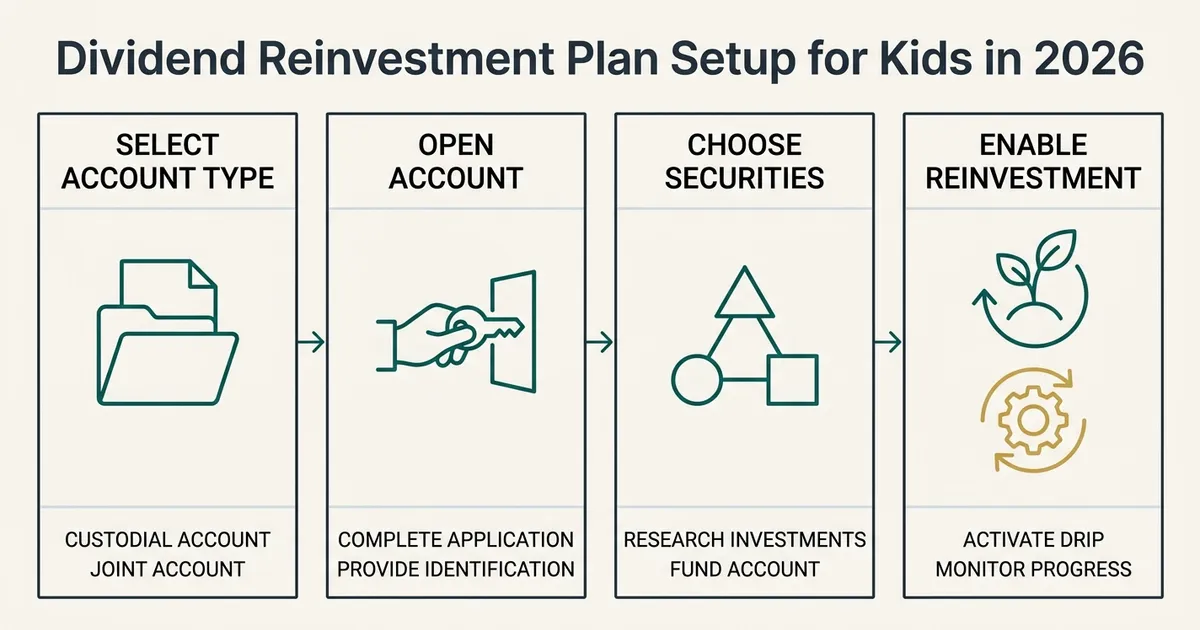
A dividend reinvestment plan (DRIP) automatically uses a stock or fund's cash dividend to buy more shares — including fractional shares — instead of depositing cash, so a child's custodial account compounds without you logging in each quarter. You turn it on once per holding, and every future payout re-buys shares at the market price on the payment date.
That single setting is the difference between a custodial account that grows on autopilot and one that quietly accumulates cash you have to manually reinvest. Because dividends on most large-cap U.S. stocks post quarterly, a DRIP re-buys shares four times a year per holding without you placing a trade. According to FINRA (2025), brokerage-sponsored reinvestment programs execute at no commission and can purchase fractional shares, so even a $4.12 dividend on 10 shares of an ETF gets fully reinvested rather than sitting as uninvested cash.
What Is a Dividend Reinvestment Plan, and How Does It Auto-Compound Inside a Custodial Account?
A DRIP redirects a stock or ETF's dividend into additional shares of the same security on (or near) the payment date, instead of routing it to your account's cash balance. The mechanism is straightforward: your broker calculates the dividend owed per share, divides it by that day's execution price, and credits your account with the resulting share count — often to four or more decimal places for fractional-share purchases.
Compounding happens because next quarter's dividend is now calculated on a larger share count. Hold 50 shares of a fund paying a $0.60 quarterly dividend and you receive $30, which — at a $75 share price — reinvests into 0.4 more shares. Next quarter you own 50.4 shares instead of 50, so the same $0.60-per-share dividend pays you $30.24, not $30. According to Hartford Funds (2024), reinvested dividends and the compounding they generate accounted for roughly 85% of the S&P 500's total return from 1960 through 2023 — the growth engine is the reinvestment, not the dividend check itself.
This matters more for a custodial account than an adult brokerage account because the time horizon is longer and the dollar amounts are smaller. A parent contributing $50–$500 a month for a child age 0–10 is not trying to generate spendable income today; every dividend left in cash is a dividend not compounding for the 8–18 years until the child needs the money for extracurriculars, a first car, or college costs. Custodial accounts under the Uniform Transfers to Minors Act (UTMA) or Uniform Gifts to Minors Act (UGMA) exist for exactly this kind of long, uninterrupted holding period.
How Do You Set Up Automatic Dividend Reinvestment for a Child's Custodial Account?
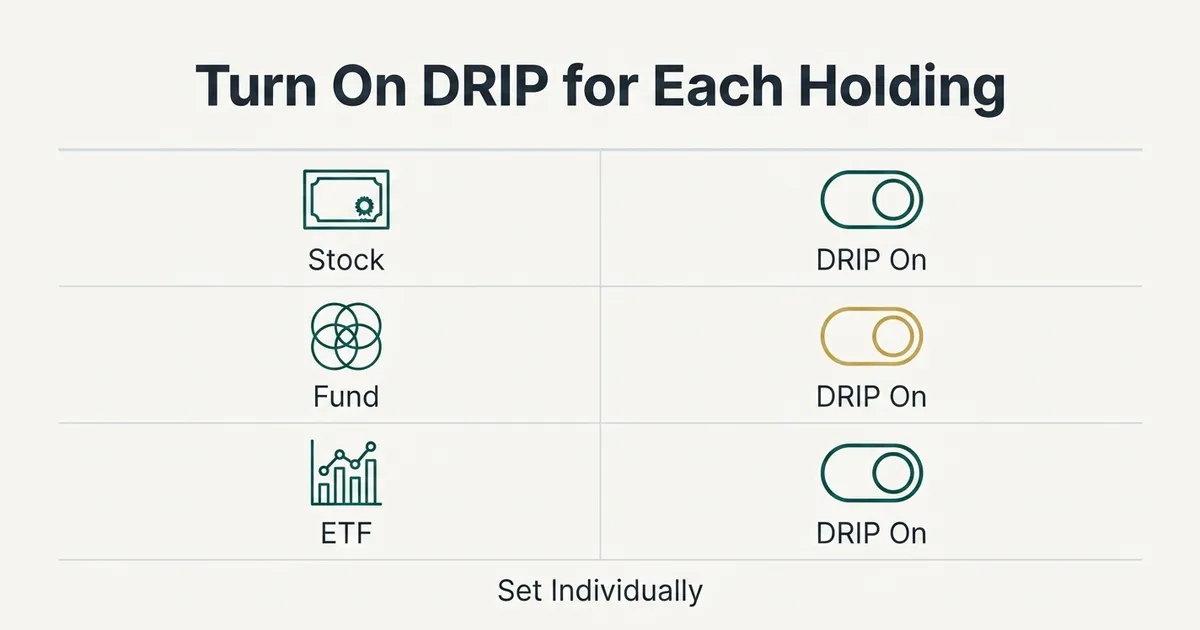
You enable DRIP per security, not once for the whole account, so you must turn it on for every stock or fund you hold. Most brokers default new custodial (UTMA/UGMA) accounts to cash dividends, meaning payouts sit uninvested until you act — so this is a setup step you cannot skip and assume is automatic.
The setup sequence is the same across major brokers, with minor naming differences:
- Open the custodial (UTMA/UGMA) account and fund it — most brokers, including Fidelity and Charles Schwab, require no minimum deposit as of 2025.
- Buy the shares or fund you want the child to hold.
- Navigate to the account's dividend or distribution settings — usually labeled "Dividend Reinvestment" or "DRIP Elections."
- Select "Reinvest in Security" (not "Deposit to Core Account") for each holding individually.
- Confirm the election applies to future dividends only — DRIP changes are forward-looking and do not retroactively reinvest a dividend already paid to cash.
Set a calendar reminder to check the election after adding any new stock or ETF to the account, because the default resets to cash for each new position. According to Charles Schwab (2025), custodial account dividend elections must be re-confirmed per security when a new position is added, which is the most common reason parents find un-reinvested cash sitting in an otherwise DRIP-enabled account.
Which Brokerage Offers the Best DRIP Setup for a Custodial Account?
Fidelity offers the deepest fractional-share DRIP support for custodial accounts among major brokers, reinvesting dividends into fractional shares for both stocks and ETFs at no commission. Charles Schwab and Vanguard also support commission-free reinvestment, but Schwab's DRIP purchases whole shares only for individual stocks, meaning small dividends can still leave a cash residue.
| Broker | Custodial Account Type | Fractional-Share DRIP? | Account Minimum | Notable Fee |
|---|---|---|---|---|
| Fidelity | UTMA/UGMA | Yes, stocks and ETFs | $0 | $0 online equity/ETF commission |
| Charles Schwab | UTMA/UGMA | ETFs/mutual funds yes; individual stocks whole-share only | $0 | $0 online equity/ETF commission |
| Vanguard | UGMA/UTMA | Yes for Vanguard mutual funds and ETFs | $0 | $0 online ETF commission; some mutual funds carry expense ratios |
| E*TRADE (Morgan Stanley) | UTMA/UGMA | Whole-share only | $0 | $0 online equity/ETF commission |
According to Fidelity (2025), its dividend reinvestment program supports fractional shares across both individual equities and ETFs in custodial accounts, which matters when a $200/month custodial account holds shares priced at $150–$400 each — whole-share-only DRIP at that scale routinely leaves 60–80% of a dividend un-reinvested in cash. Choose Fidelity or Vanguard if your child's account holds ETFs paying small quarterly dividends; choose based on fund lineup and your own comfort with the platform if the account will hold whole-share stocks paying larger per-share dividends, where the whole-vs-fractional distinction matters less. For help choosing between fund types in the first place, see our comparison of dividend ETFs vs. individual stocks for a custodial account.
How Does the Kiddie Tax Apply to Reinvested Dividends?
Reinvesting a dividend does not shield it from tax — the "kiddie tax" applies to a child's unearned income whether or not the dividend was reinvested, because the tax triggers on receipt, not on what you do with the cash afterward. According to IRS Form 8615 Instructions (2025), a dependent child's unearned income — which includes dividends — is tax-free up to the first $1,350, taxed at the child's own rate for the next $1,350, and taxed at the parent's marginal rate above $2,700. These thresholds adjust annually for inflation, so confirm the current-year figures in the IRS instructions for Form 8615 before filing.
The mechanism matters for account design: because the tax is assessed on the dividend income itself, not on whether it's reinvested, a $600/year dividend stream inside a $30,000 custodial account for a 6-year-old will typically fall entirely within the tax-free and child-rate bands and generate no meaningful tax bill. Brokers issue a Form 1099-DIV once a security pays more than $10 in dividends in a calendar year, per the IRS Instructions for Form 1099-DIV (2025), so even a small custodial account generates a tax document you'll need for the child's return once dividend income crosses that threshold.
There is no way to avoid taxation on reinvested dividends by choosing not to withdraw the cash — the reinvestment itself is treated as if you received the dividend and immediately used it to buy more shares. The only levers that reduce the tax bill are keeping the account's total unearned income under the annual thresholds, or holding dividend payers inside a tax-advantaged wrapper instead, which a taxable UTMA/UGMA custodial account is not. If college costs are the primary goal rather than general child wealth-building, compare the trade-offs in our guide to choosing a custodial account vs. a 529 plan, since a 529 plan's earnings avoid federal tax entirely when used for qualified education expenses.
What Does 10 Years of DRIP Compounding Look Like in Real Numbers?
Reinvesting dividends instead of taking them as cash added roughly $4,300 to a hypothetical $200/month custodial account over 10 years in an illustrative model built on a 7% average annual total return. This example is a simplified projection, not a promise — actual returns vary and can be negative in any given year.
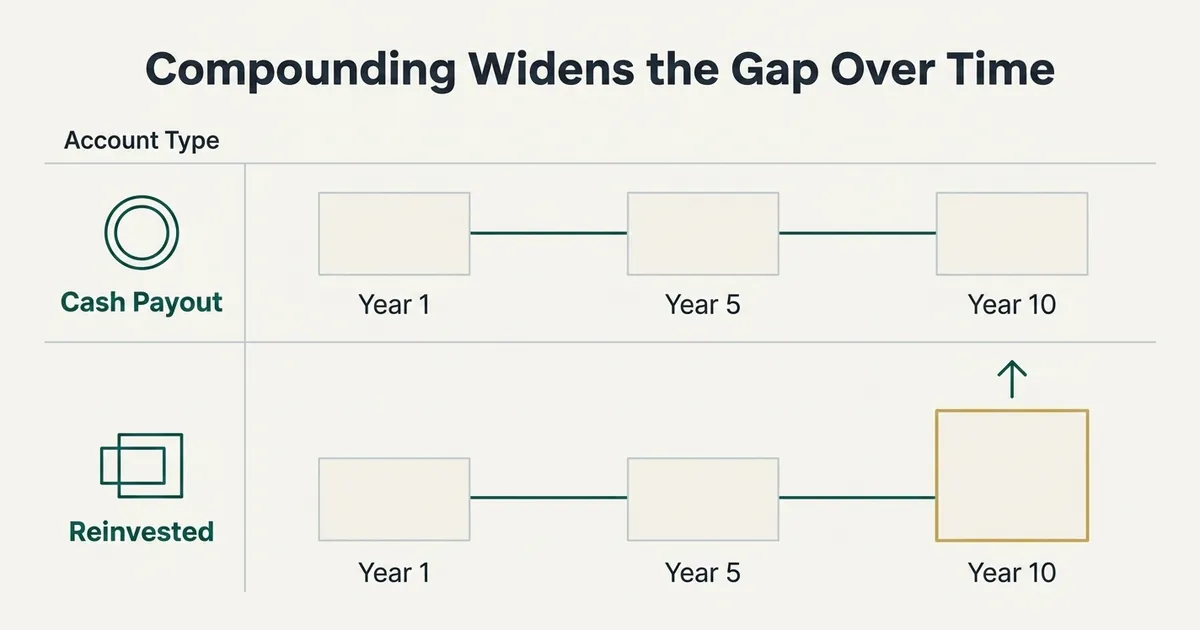
The math: a parent contributes $200/month ($2,400/year) into a broad dividend-paying fund with a 7% average annual total return, split illustratively into roughly 4% price appreciation and 3% dividend yield — a split consistent with S&P Dow Jones Indices' (June 2026) reported broad-market dividend yield near 1.3–1.5%, adjusted upward here for a higher-yielding dividend-focused fund. With dividends fully reinvested, the account compounds at the full 7%, growing to approximately $33,200 after 10 years using a standard future-value-of-an-annuity calculation. With dividends paid to cash and left uninvested rather than reinvested, only the 4% price return compounds inside the account, growing to approximately $28,800 over the same period — a roughly $4,400 gap driven entirely by the reinvestment mechanism, not by extra contributions.
That gap widens the longer the horizon runs, because compounding is exponential, not linear — the advantage in year 10 is larger than the advantage in year 5, and the advantage in year 18 (a common UTMA transfer age) is larger still. To set up the recurring contributions and holdings this compounding runs on, see our guide to building a monthly dividend portfolio for kids. For a shortlist of dividend-paying holdings sized for this kind of monthly contribution, see our picks for best dividend stocks for a custodial account.
When Should You Turn Off Automatic Reinvestment?
Turn off DRIP in the specific year you expect to withdraw funds from the custodial account, because reinvesting a dividend days before a planned sale creates a short-term tax lot and forces you to track cost basis on shares you'll immediately liquidate. Leave it on in every other year — the reinvestment mechanism only adds value when the shares have time to compound, so switching it off "just in case" during the accumulation years sacrifices growth for no benefit.
Also disable DRIP, or reinvest into a different holding, if a single position has grown to dominate the account — a phenomenon that happens naturally when one stock's dividend and price both outperform for several years running. According to the SEC's investor education materials (2025), automatic reinvestment does not rebalance a portfolio; it simply buys more of what you already own, so a DRIP-heavy account concentrated in one or two names can drift away from your target allocation without you noticing. Redirect that stock's dividend to cash and manually invest it into an underweighted holding instead if concentration exceeds roughly 25–30% of the account's total value.
Finally, reconsider DRIP as the account nears its state's age-of-majority transfer date, since a fund's fractional shares can complicate an in-kind transfer to the child's own brokerage account. Under California's Uniform Transfers to Minors Act (Cal. Probate Code §3920–3925), custodianship ends and the assets must transfer to the child at age 18, or as late as 25 if the custodian specified an extended term at account opening — other states set different default ages, so verify your state's UTMA/UGMA statute before the transfer date approaches.
Explore the full family dividend investing pillar for account selection, portfolio construction, and tax-treatment guides built specifically for custodial accounts.
Disclaimer: This article is for general educational purposes and does not constitute personalized tax, legal, or investment advice. Dividend yields, tax thresholds, and brokerage policies change and should be verified against current IRS publications and your brokerage's disclosures before you act. Consult a qualified tax professional for your family's specific situation.
Frequently asked questions
Is a dividend reinvestment plan a good idea?
A dividend reinvestment plan is a good idea for a long-horizon custodial account because it removes the manual step of re-buying shares and captures compounding automatically on every payout. According to Hartford Funds (2024), reinvested dividends drove approximately 85% of the S&P 500's total return between 1960 and 2023, so leaving dividends as uninvested cash forfeits most of the account's historical growth engine. It's a weaker fit only if you plan to withdraw the funds within a year or two, since reinvesting shares you're about to sell just adds cost-basis tracking without meaningful compounding benefit.
How much does it take to make $1,000 a month in dividends?
Generating $1,000 a month, or $12,000 a year, in dividends requires roughly $300,000 to $400,000 invested in dividend-paying assets yielding 3%–4% annually, based on standard yield-to-income math (annual income ÷ yield = required principal). A broad dividend-focused ETF yielding 3.5% would need about $342,857 invested to produce $12,000 a year, while a higher-yielding but riskier portfolio at 5% would need about $240,000. For a child's custodial account funded with $50–$500 a month, reaching that principal typically takes multiple decades of contributions plus reinvested growth, not a single lump-sum purchase.
How do I avoid paying taxes on reinvested dividends?
You cannot avoid federal tax on a dividend simply by having it automatically reinvested, because the IRS treats the reinvestment as receipt of the income followed by an immediate purchase of more shares. According to IRS Form 8615 Instructions (2025), a dependent's unearned income — including dividends — is taxed under kiddie-tax rules regardless of whether the dividend was paid to cash or reinvested, with the first $1,350 typically tax-free and the next $1,350 taxed at the child's rate for that tax year. The only ways to reduce the tax are keeping total account dividend income under the annual thresholds or holding dividend payers inside a tax-advantaged account instead of a taxable UTMA/UGMA custodial account.
Does Warren Buffett reinvest his dividends?
Warren Buffett's company, Berkshire Hathaway, does not pay a cash dividend to shareholders at all, so there is no dividend for Buffett to reinvest at the corporate level. According to Berkshire Hathaway's 2025 Shareholder Letter (February 2025), the company has not paid a cash dividend since 1967, instead retaining and reinvesting earnings directly into the business — a strategy distinct from an individual investor using a DRIP on dividend-paying stocks they personally own.
What does Fidelity's dividend reinvestment plan offer for a custodial account?
Fidelity's dividend reinvestment program lets a custodial (UTMA/UGMA) account owner reinvest dividends into fractional shares for both individual stocks and ETFs at no added commission. According to Fidelity (2025), this fractional-share support means a $12 quarterly dividend on a $310 ETF share fully reinvests into 0.039 additional shares rather than sitting as cash, which matters for accounts funded with $50–$500 a month where whole-share-only reinvestment would leave most dividends un-invested.
Why are dividend reinvestment plans popular?
Dividend reinvestment plans are popular because they remove the manual decision-making and timing risk of reinvesting cash dividends yourself, while capturing dollar-cost averaging automatically each payout date. According to FINRA (2025), broker-sponsored DRIPs execute at no commission and, in most cases, purchase fractional shares, so investors compound returns without needing to accumulate a full share's worth of cash first. For custodial accounts specifically, the appeal is compounding without ongoing parental effort across the 8–18 year holding period typical before a UTMA/UGMA transfer.