UTMA vs UGMA Differences: Which Fits Your Child in 2026

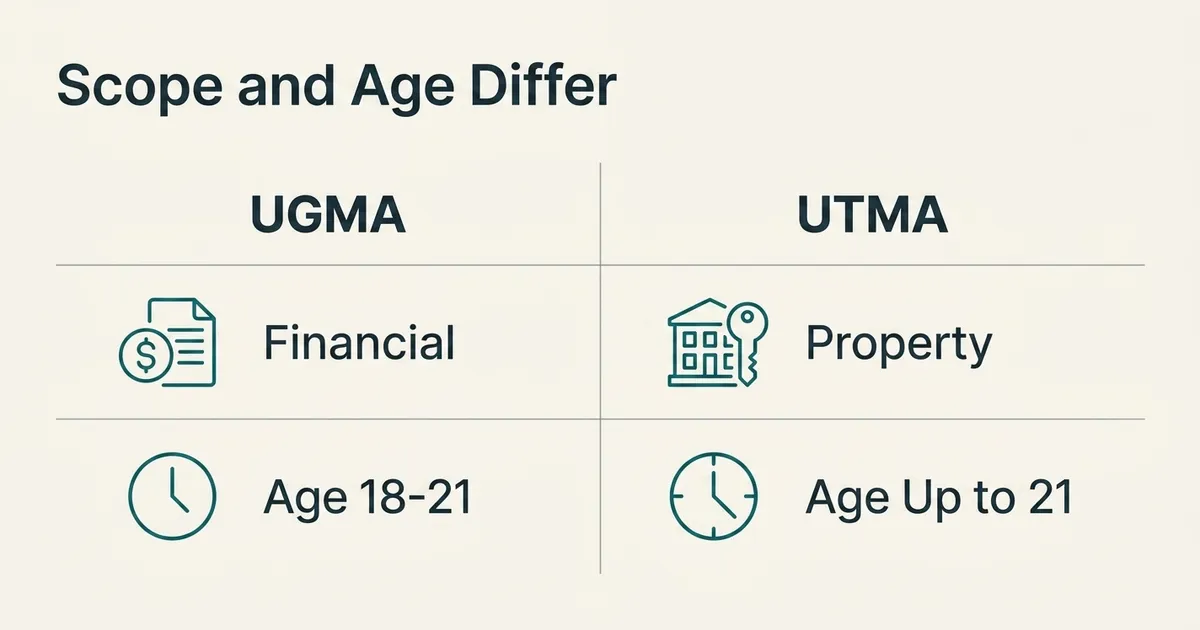
The core UTMA vs UGMA difference is asset scope and control age: UGMA (1956) holds only financial assets and always ends at 18-21, while UTMA (1986) also holds real estate and other property and lets a parent's outright gift delay transfer to as late as 21.
Both are custodial accounts under state law, meaning an adult (the custodian) manages money that legally belongs to the child from the moment it's deposited. The gift is irrevocable — you cannot move the money back into your own account once it's contributed, a distinction the SEC's Office of Investor Education and Advocacy (2025) flags as the single most-overlooked feature of both structures. For a parent putting $50-$500 a month into dividend-paying ETFs for a 3-year-old, this irrevocability is a feature for long-term compounding and a real constraint if you might need the cash back.
Almost every US brokerage now defaults new custodial accounts to UTMA, not UGMA, because UTMA is a legal superset — it can hold everything UGMA holds plus more. According to the Uniform Law Commission (2024), 49 states and Washington, D.C. have adopted UTMA, and South Carolina is the only state that never repealed its original UGMA statute, so custodial accounts opened there remain UGMA by default unless a broker offers an out-of-state UTMA alternative.
What's the Actual Difference Between UTMA and UGMA?
The Uniform Gifts to Minors Act (UGMA), finalized in 1956, restricts custodial gifts to financial instruments: cash, publicly traded stock, bonds, mutual funds, and life insurance policies. The Uniform Transfers to Minors Act (UTMA), finalized in 1986, expanded that list to include real estate, royalties, patents, fine art, and virtually any other property a donor wants to transfer to a minor.
That expansion exists because states wanted one custodial framework flexible enough to handle an entire estate plan, not just a brokerage gift — which is why UTMA statutes also let the person creating the account (the "transferor") name a termination age later than 18. California illustrates this well: according to California Probate Code Sections 3900-3925 (California Legislature, 1990), the state repealed its UGMA statute outright and now operates exclusively under the UTMA framework, so any custodial brokerage account opened by a California resident today is legally a UTMA account even if a firm's paperwork still says "UGMA/UTMA" out of habit.
For a family only ever planning to hold dividend stocks, bond funds, or ETFs, the asset-type difference is mostly academic — both accounts hold those fine. The practical difference that matters is the control-age rule covered next, plus which one your state and broker even offer.
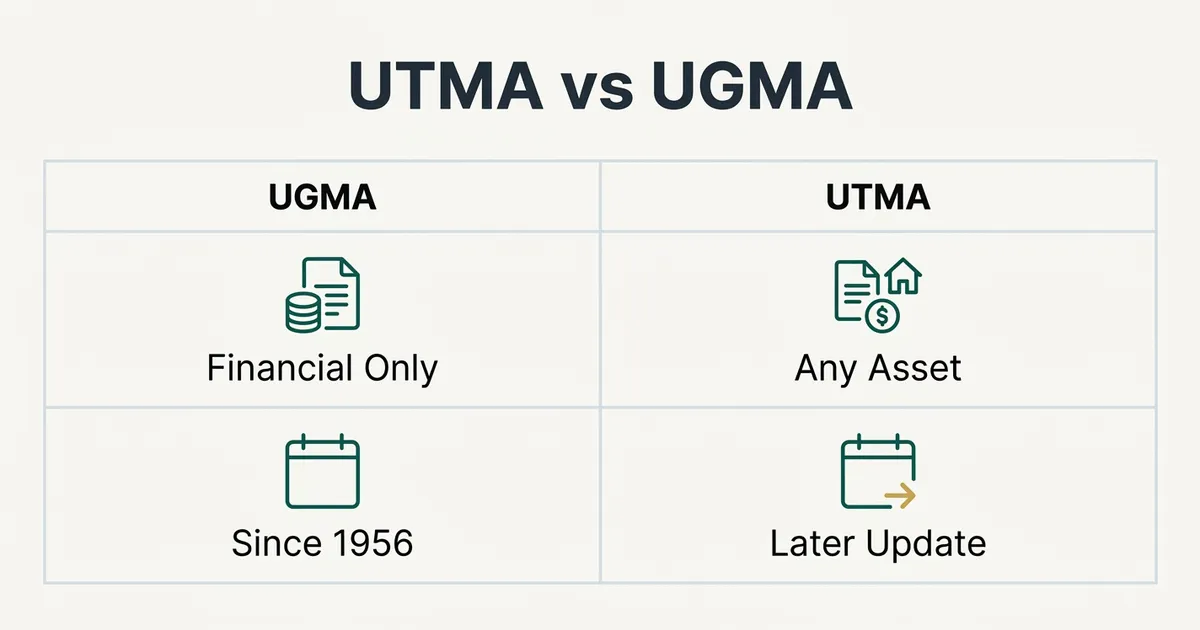
UTMA vs UGMA: Side-by-Side Comparison
| Feature | UGMA | UTMA |
|---|---|---|
| Year established | 1956 | 1986 |
| Assets allowed | Cash, stocks, bonds, mutual funds, insurance | All UGMA assets plus real estate, royalties, patents, other property |
| States offering it | South Carolina (default statute) | 49 states + D.C., per the Uniform Law Commission (2024) |
| Default control-transfer age | 18 (varies by state) | 18, extendable to 21 for an outright gift (25 only for will/trust-funded custodianships), set at account opening |
| Custodian can change age later? | No | No — must be selected when the account is opened |
| Typical use for dividend investing | Simple stock/ETF/fund holdings | Same, plus flexibility for non-financial gifts later |
| Contribution reversibility | Irrevocable | Irrevocable |
| Kiddie-tax treatment | Same federal rules apply | Same federal rules apply |
Read this table as: UTMA wins on flexibility and availability in nearly every state, so it's the practical default for a parent building a dividend portfolio. UGMA only becomes the operative choice if you live in South Carolina or your specific brokerage still issues UGMA-only paperwork there — the asset-type and tax mechanics are otherwise identical for a stock-and-ETF account.
How Does the Kiddie Tax Apply to Dividend Income in These Accounts?
Dividends paid inside a UTMA or UGMA account are taxed to the child under federal "kiddie tax" rules, not to the parent, but a large enough dividend stream still gets taxed at the parent's marginal rate. According to IRS Publication 929 (2025), a dependent child's unearned income — dividends, interest, and capital gains — is tax-free up to $1,350, taxed at the child's own rate on the next $1,350, and taxed at the parent's marginal rate above $2,700, using Form 8615 to compute the parent-rate portion.
That structure exists because Congress designed the kiddie tax to stop parents from shifting large investment portfolios to children solely to capture the child's lower bracket — the mechanism caps how much low-rate unearned income a minor can report before the parent's rate kicks back in. These thresholds are indexed for inflation annually, so confirm the current tax year's exact figures in the IRS's updated Publication 929 or the relevant Revenue Procedure before filing.
Worked example: Say your UTMA account holds $12,000 in a dividend ETF yielding 3.8%, generating roughly $456 a year in dividends. Because $456 sits well under the $1,350 tax-free threshold, your child owes $0 federal tax on that income as long as it's the only unearned income reported. Scale the same account to $60,000 at the same yield — about $2,280 in annual dividends — and the first $1,350 stays tax-free, the next $930 is taxed at the child's rate, and none of it yet hits the parent-rate bracket, since the total stays under $2,700.
Which Age Does Control Transfer — and Why Should Parents Care Now?
Control transfers automatically at the age the transferor selected when the account was opened, and that choice cannot be changed later — this is the decision point most parents skip. In UGMA states, that age is typically 18 or 21 by default; in UTMA states, California Probate Code Section 3920.5(e) (California Legislature) permits the transferor to specify any termination age up to 21 for an outright gift — the way a parent's ongoing contributions work — at the time the account is established. (Age 25 exists under the statute, but only for custodial property transferred via a will, trust, or trustee — not for a parent's direct deposits.)
The mechanism matters because the statute treats the age selection like a one-time contract term, not an adjustable setting — once the custodial account is opened with an 18-year termination, you cannot amend the paperwork at 15 to push it to 21. If your goal is a college-and-beyond fund your teenager can't liquidate the week they turn 18, open a UTMA account in a state that allows the extended age and select 21 upfront, not the default.
Decision rule: choose the extended-age UTMA option if you're funding an account intended to outlast high school spending decisions; accept the default 18 only if you're comfortable with your child having unrestricted access to the full balance the day they become a legal adult.
Should You Choose UTMA or UGMA for Building Dividend Income?
Choose UTMA by default — it's a superset of UGMA, available in 49 states plus D.C. per the Uniform Law Commission (2024), and it lets you set a later control age without giving up anything UGMA offers. Choose UGMA only if you live in South Carolina, the one state that never adopted UTMA, or your specific brokerage's custodial paperwork in your state is explicitly labeled UGMA-only.
For pure dividend-stock or ETF investing — the scenario for most parents saving $50-$500 a month — the two accounts behave identically on tax treatment, brokerage mechanics, and reporting. The decision that actually changes your outcome is the control-transfer age, not the UGMA/UTMA label itself, so spend your decision-making effort there instead of debating the acronym. If you're also weighing a 529 plan for the same goal, compare the two account types directly at the custodial account vs. 529 plan guide before funding either one.
What Are the Disadvantages of a UTMA or UGMA Account?
The biggest disadvantage is the loss of financial-aid efficiency: according to Federal Student Aid, U.S. Department of Education (2025), custodial account balances count as the student's own asset on the FAFSA and are assessed at up to 20% toward the expected family contribution, compared with a maximum of 5.64% for parent-owned assets like a 529 plan. A $20,000 UTMA balance can reduce financial aid eligibility by roughly $4,000 in a given year under that formula, versus about $1,128 for the same balance held in a parent-owned 529.
The second disadvantage is the irrevocable, no-strings handoff: at the state's control-transfer age, the child gets full legal ownership and can spend the entire balance on anything — a car, a gap year, cryptocurrency — with no educational-use restriction the way a 529 plan's non-qualified withdrawal penalty enforces. A third disadvantage is the annual gift-tax exclusion ceiling on contributions: per IRS Revenue Procedure 2024-40 (2024), the 2025 annual gift tax exclusion is $19,000 per donor per recipient, a figure that adjusts for inflation most years, so very large lump-sum contributions can trigger gift-tax filing requirements.
Is a Trump Account Better Than a UTMA for a Young Child?
Not for building ongoing dividend income — the two solve different problems. According to the U.S. Department of the Treasury (2025), Trump Accounts are federally created savings accounts for children born between 2025 and 2028, seeded with a one-time $1,000 government deposit, allowing added family contributions up to $5,000 a year invested in a low-cost fund tracking a U.S. stock index, with withdrawals locked until the child turns 18 and IRA-like tax treatment afterward.
A UTMA account lets you invest in any dividend stock or ETF you choose, starting at any dollar amount, with the child gaining unrestricted access at the state's chosen control age — more flexibility, but no federal seed money and no tax deferral on dividends beyond the kiddie-tax thresholds. Choose a Trump Account (where eligible) to capture the federal seed deposit and tax-deferred growth on a retirement-style timeline; choose UTMA if you want full control over fund selection today and the option for your child to use the money for anything, at any age past majority, not just retirement. Running both isn't mutually exclusive for eligible families — the seed deposit doesn't replace the flexibility a separately funded UTMA dividend portfolio provides.
How Do You Open and Automate a UTMA/UGMA for Passive Dividend Income?
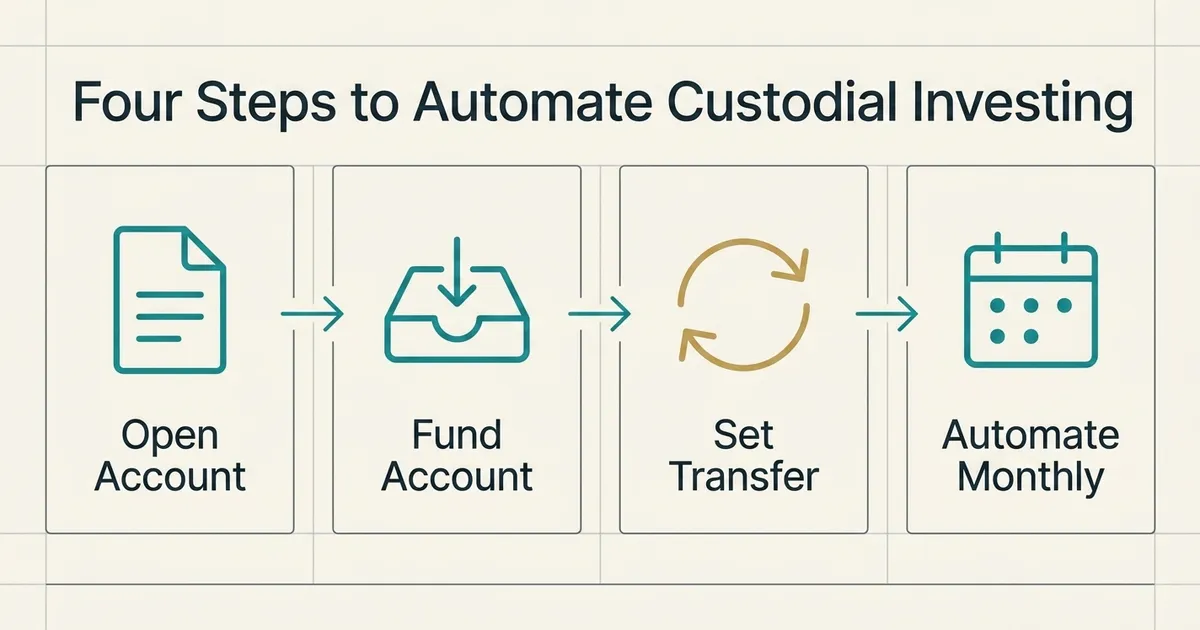
Open the account at a major brokerage that supports custodial UTMA/UGMA accounts, fund it with an initial deposit, then set up an automatic monthly transfer sized to what you can sustain — $50 to $500 works for most families in this savings range. Select a diversified dividend ETF or a small basket of established dividend-paying companies rather than a single stock; compare the trade-offs at the dividend ETFs vs. individual stocks guide and see specific fund and stock ideas suited to custodial accounts in the best dividend stocks for a custodial account guide.
Turn on automatic dividend reinvestment (DRIP) immediately after funding — this is the mechanism that compounds a small monthly contribution into meaningfully larger balances over a decade, because each reinvested dividend buys more shares that then generate their own dividends. Full setup steps, including how brokerages handle fractional-share reinvestment inside custodial accounts, are covered in the DRIP auto-compounding setup guide.
Illustrative example only, not a projection: contributing $200 a month into a dividend ETF from a child's birth to age 18, at an illustrative 7% average annual total return, would accumulate to roughly $81,000 by simple compound-growth math — actual results depend entirely on market performance, dividend yield changes, and fees, and are never guaranteed. Review your account allocation and contribution amount against your own budget and risk tolerance rather than treating any hypothetical return as a promise. Explore the full framework for building a child's dividend portfolio at the Family Dividend Investing pillar guide.
Frequently asked questions
Which one is better, UGMA or UTMA?
UTMA is better for almost every parent because it's a superset of UGMA — it holds every asset UGMA allows plus real estate and other property, and it's available in 49 states and D.C. according to the Uniform Law Commission (2024). UGMA only remains the operative choice in South Carolina, the sole state that never adopted the UTMA statute, or if a specific brokerage's paperwork in your state is UGMA-only.
What are the disadvantages of an UTMA account?
The main disadvantages are reduced financial-aid eligibility, loss of control at majority, and irrevocability. According to Federal Student Aid, U.S. Department of Education (2025), custodial account balances are assessed at up to 20% on the FAFSA versus a maximum of 5.64% for parent-owned 529 assets, and once the child reaches the state's control-transfer age, they gain unrestricted legal ownership of the entire balance with no requirement to use it for education or any specific purpose.
Do parents pay taxes on UTMA?
No — dividends and capital gains inside a UTMA account are taxed to the child under kiddie-tax rules, not to the parent, though a parent's marginal rate can apply to income above the threshold. According to IRS Publication 929 (2025), the first $1,350 of a child's annual unearned income is tax-free, the next $1,350 is taxed at the child's rate, and any amount above $2,700 is taxed at the parent's marginal rate using IRS Form 8615.
Is a Trump Account better than an UTMA?
Neither is universally better — they serve different goals. According to the U.S. Department of the Treasury (2025), a Trump Account provides a one-time $1,000 federal seed deposit for children born 2025-2028 with funds locked until age 18 and IRA-like tax treatment, while a UTMA account offers no government seed money but lets you invest any amount in any dividend stock or ETF with the child gaining full, unrestricted access at the control age your state's UTMA statute allows.
What's the difference between UGMA and UTMA?
UGMA, finalized in 1956, restricts custodial gifts to financial assets like cash, stocks, bonds, and mutual funds, while UTMA, finalized in 1986, also allows real estate, royalties, and other property and lets the transferor set a later control-transfer age. According to the Uniform Law Commission (2024), UTMA is now the law in 49 states plus D.C., with South Carolina the only holdout still operating under UGMA.
UTMA vs UGMA, which is better?
For a parent building a dividend-focused custodial portfolio, UTMA is better in nearly every state because it offers identical tax and stock-holding mechanics to UGMA plus the option to delay control transfer past age 18. According to California Probate Code Section 3920.5(e) (California Legislature), a California UTMA account funded by an outright gift — the way a parent's ongoing contributions work — lets the transferor specify a termination age up to 21 at the time the account is opened (age 25 applies only to custodial property transferred via a will, trust, or trustee, not to a parent's direct contributions), a flexibility UGMA's default statute does not provide.