529 Plan Uses Beyond College in 2026: What Qualifies

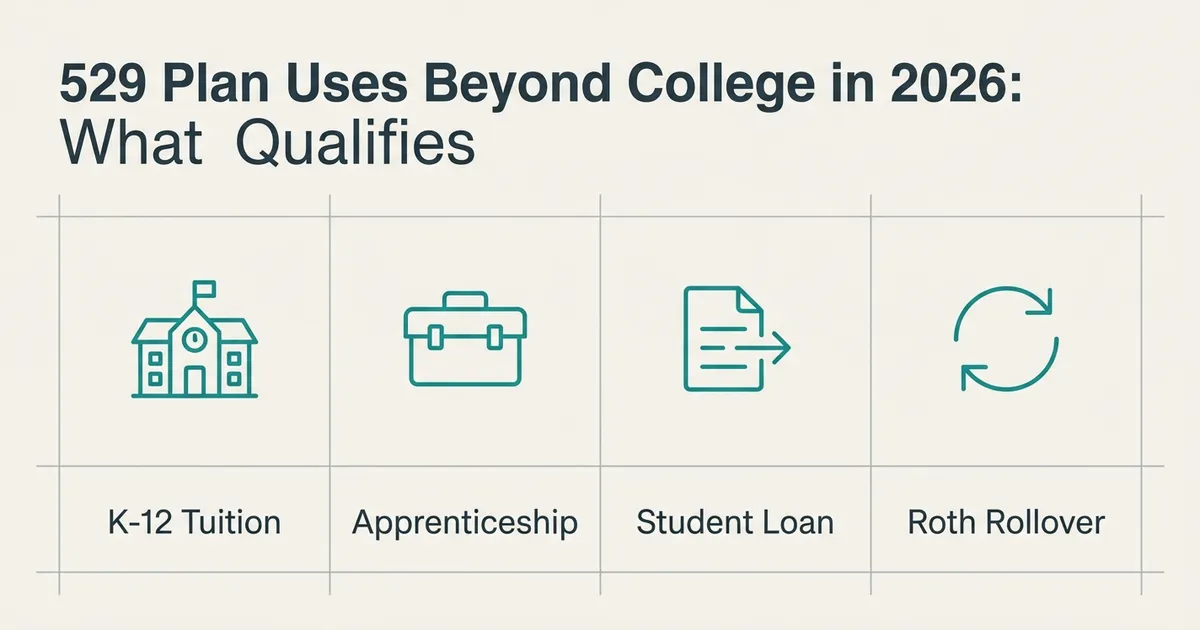
A 529 plan can fund K-12 tuition, registered apprenticeships, student loan repayment, and a $35,000 lifetime Roth IRA rollover — all qualified uses beyond four-year college under current federal law. Each carries its own dollar cap and paperwork trigger, and the K-12 and apprenticeship options apply nationwide, not just in California.
Most parents open a 529 assuming it only pays for a four-year degree, then panic when a child chooses a trade school, an apprenticeship, or no further schooling at all. That fear is outdated. According to the IRS Publication 970 (2025), the federal definition of a "qualified education expense" has expanded three times since 2017, and none of the expansions require the beneficiary to attend a traditional college.
What Counts as a "Qualified" Beyond-College Expense?
A withdrawal is qualified — meaning the earnings portion stays free of federal income tax and the 10% additional tax — if it matches one of five categories the IRS recognizes: college or vocational tuition and fees, room and board for at least half-time students, K-12 costs up to $20,000 a year as of 2026, registered apprenticeship and career-credentialing costs, and up to $10,000 in student loan repayment per borrower. Per IRS Publication 970 (2025), the "qualified" label lives with the expense, not the school, which is why an apprenticeship or a trade certificate program can qualify even though it isn't a bachelor's-degree track.
The mechanism matters because the IRS taxes only the earnings on a non-qualified withdrawal, never the original contributions, since those were already after-tax dollars. That's why a 529 with mostly contributions and little growth carries far less downside risk than one that has compounded for a decade — the penalty base shrinks to whatever the account actually earned.
Can You Use 529 Money for K-12 Tuition and Apprenticeships?
Yes, federally, and the ceiling just doubled: $20,000 per student per year for K-12 expenses at any public, private, or religious school as of January 1, 2026. The original $10,000 cap arrived with the Tax Cuts and Jobs Act of 2017 (December 2017); the One Big Beautiful Bill Act of 2025 (July 2025) doubled it to $20,000 effective with the 2026 tax year. The cap applies per student, not per 529 account, so splitting tuition across two 529 accounts for the same child doesn't raise the ceiling.
That same 2025 law also widened what counts at the K-12 level beyond tuition alone. Curriculum materials and books, tutoring from a qualified provider outside the home, standardized test and exam fees, dual-enrollment college courses taken in high school, and educational therapies for students with disabilities are now qualified K-12 expenses — a meaningfully broader list than the tuition-only rule that applied from 2018 through mid-2025. The same law extended 529 eligibility to postsecondary credentialing programs — trades like welding, plumbing, and CDL training, plus professional licensure such as the CPA and bar exams.
California is the exception every parent researching this needs to know: the state does not conform to the federal K-12 provision. Per ScholarShare 529 (2025), the plan's own program disclosure warns that a withdrawal treated as qualified by the IRS for K-12 tuition can still trigger California state income tax on the earnings portion, plus the state's own additional tax, because California's tax code defines "qualified higher education expense" more narrowly than the federal code. Confirm your state's conformity before withdrawing for private school — several states other than California apply the same mismatch.
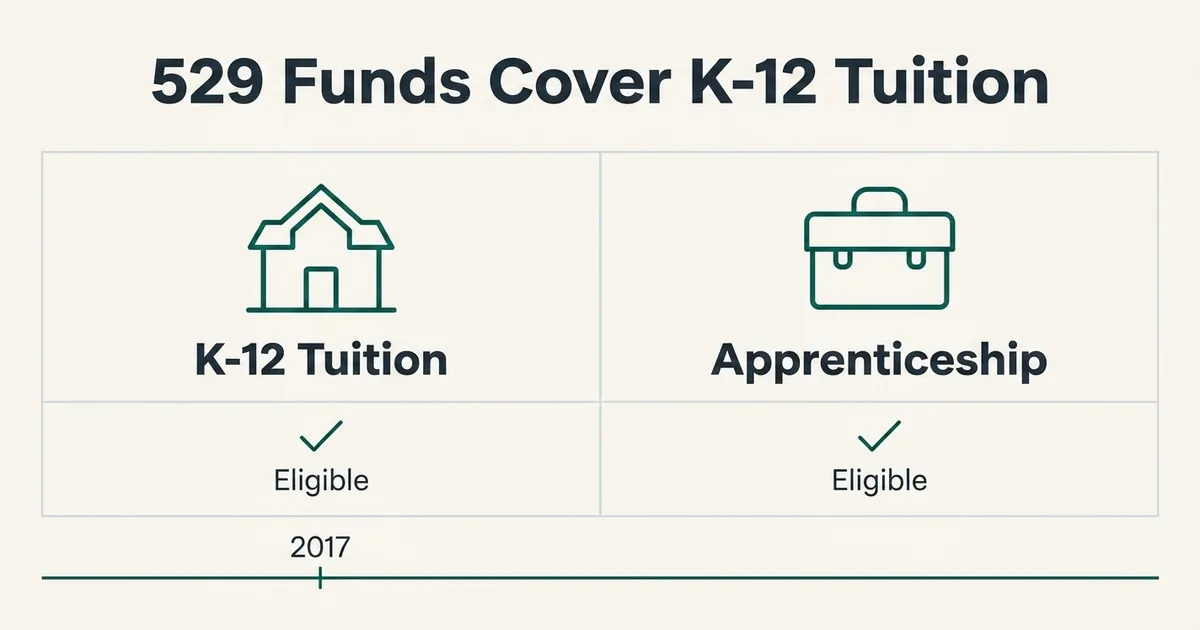
Registered apprenticeships qualify too. The Setting Every Community Up for Retirement Enhancement Act (SECURE Act, December 2019) added apprenticeship program expenses — fees, books, supplies, and required equipment — as qualified 529 expenses, but only for programs registered with the U.S. Department of Labor (2025) under the National Apprenticeship Act. An unregistered employer training program does not qualify, even if it functions like an apprenticeship — check the Department of Labor's apprenticeship finder before assuming eligibility.
Student loan repayment is capped at $10,000 lifetime per borrower, also added by the SECURE Act (2019). The cap resets per person: you can direct $10,000 toward the named beneficiary's loans and, by changing the beneficiary to a sibling, direct another $10,000 toward that sibling's loans from the same account.
How Does the SECURE 2.0 Roth IRA Rollover Actually Work?
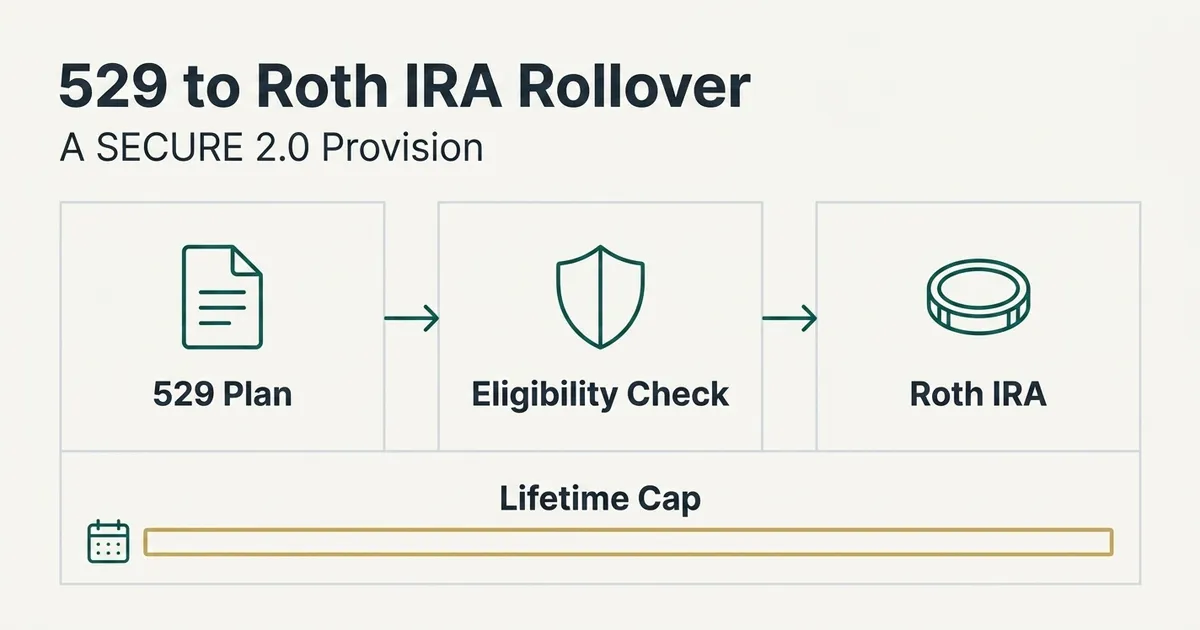
Since 2024, unused 529 funds can roll into the beneficiary's own Roth IRA, tax- and penalty-free, up to a $35,000 lifetime cap — a provision created by the SECURE 2.0 Act of 2022 (December 2022). This is the single biggest change to 529 flexibility in a decade, because it removes the old "use it or lose it to a penalty" pressure entirely.
Three conditions gate the rollover, and missing any one disqualifies it. First, the 529 account must have been open at least 15 years before the rollover starts, per the SECURE 2.0 Act (2022). Second, contributions made in the preceding five years — and the earnings on them — are ineligible, so you can't fund the account heavily right before rolling it over. Third, according to IRS Notice 2024-19 (January 2024), the amount rolled over in any year counts against the beneficiary's regular annual Roth IRA contribution limit and requires the beneficiary to have earned income for that year at least equal to the rollover amount — a detail many summaries skip.
Worked example: say you opened a ScholarShare 529 for your daughter in 2011 and contributed steadily; she earns a full scholarship and $28,000 sits unused with $9,000 of that being growth. The account clears the 15-year mark in 2026. If she works a summer job earning at least $7,500 in wages, you can roll $7,500 into her Roth IRA that year — the 2026 IRA contribution limit set by IRS Notice 2025-67 (November 2025) — and repeat annually until you hit the $35,000 lifetime cap or exhaust the 529 balance, whichever comes first. At that pace, moving $28,000 takes about four years, not one lump transfer.
What Happens If You Withdraw 529 Money for a Non-Qualified Expense?
You'll owe ordinary federal income tax plus a 10% additional tax on the earnings portion only, reported on IRS Form 5329 (2025), while the contribution portion comes back untouched. If your state gave you a tax deduction or credit for contributing, expect that state to "recapture" it — Saving for College, LLC (2025) confirms most states with a deduction claw back the benefit on non-qualified withdrawals, even though contributions themselves aren't penalized federally.
Worked example: a $12,000 non-qualified withdrawal made up of $8,000 in contributions and $4,000 in growth costs you 10% of $4,000 ($400) in additional federal tax, plus ordinary income tax on that same $4,000 at your marginal rate — roughly $880 more at a 22% bracket. The $8,000 of contributions comes out with zero tax or penalty. Total damage on this example: about $1,280, not $1,200 (10% of the full withdrawal) as many parents assume.
Two situations avoid the penalty even on a "non-qualified" looking withdrawal: the beneficiary receives a tax-free scholarship (the penalty is waived up to the scholarship amount, though ordinary income tax still applies to the earnings), or the beneficiary dies or becomes disabled. Outside those, changing the beneficiary to another qualifying family member — a sibling, first cousin, or even yourself — avoids the tax and penalty entirely and resets nothing about the account's 15-year clock for Roth-rollover purposes, per IRS Publication 970 (2025).
529 Plan vs. Custodial Brokerage Account: Which Wins for Non-College Goals?
If the goal is flexible passive income the child can use for anything — an instrument, a car, a wedding, or simply compounding dividends for decades — a custodial brokerage account under the Uniform Transfers to Minors Act (UTMA) beats a 529 on flexibility, though it gives up the 529's tax shelter for education. The table below lines up the trade-offs parents actually weigh.
| Factor | 529 Plan | Custodial Brokerage (UTMA/UGMA) |
|---|---|---|
| Allowed uses | Education-linked: tuition, apprenticeship, up to $10,000 student loans, $35,000 Roth rollover | Anything that benefits the child — no restriction |
| Tax on growth | Tax-free if qualified; 10% additional tax + income tax on earnings if not | Taxed yearly under kiddie-tax rules; no usage restriction or penalty |
| FAFSA treatment (parent-owned) | Parent asset, assessed up to 5.64% | Student asset, assessed at 20% |
| Contribution ceiling | State aggregate limit — $529,000 in California per ScholarShare 529 (2025) | No federal cap; annual gift-tax exclusion of $19,000 per donor for 2026 per IRS guidance in Revenue Procedure 2025-32 (October 2025) before a gift-tax return is required |
| Investment menu | Limited to the state plan's fund lineup | Full brokerage menu, including individual dividend stocks and ETFs |
| Control after majority | Parent (account owner) keeps control indefinitely | Child gains full legal control at the state age of majority; California custodians may extend this to age 25 under California Probate Code Section 3909 |
Choose the 529 if you're confident education costs — including apprenticeships or grad school — will absorb most of the balance, since the tax-free growth on education spending is hard to beat. Choose a custodial brokerage account if your goal is building a dividend income stream the child can redirect to anything at adulthood, or if the FAFSA's steep 20% student-asset assessment doesn't concern you because you don't expect to file for need-based aid. Many families use both: a modest 529 sized to likely tuition, and a custodial account for best dividend stocks for a custodial account that isn't tethered to education spending at all. Our custodial account vs. 529 plan comparison walks through the account-opening mechanics for both.
Should You Still Open a 529, or Build Dividend Income in a Custodial Account Instead?
Open a 529 first if you have strong reason to expect college, trade school, or an apprenticeship — the tax-free compounding on education spending isn't available anywhere else. Build a custodial account instead — or alongside it — if your $50–$500 monthly savings is meant to become a flexible, spendable asset your child controls at adulthood, since a custodial account carries no usage restriction and no penalty for using the money on something other than school.
The kiddie tax is the main cost of going the custodial route: unearned income above the annual threshold is taxed at the parent's marginal rate rather than the child's, with the exact thresholds adjusting yearly per IRS Revenue Procedure 2025-32 (October 2025). For most families depositing $50–$500 a month into dividend-paying ETFs, annual dividend income stays well under that threshold for years, meaning most or all of it is taxed at the child's low or zero bracket in practice. Our guide to dividend ETFs vs. individual stocks breaks down which holdings keep kiddie-tax exposure lowest, and setting up DRIP auto-compounding covers automating reinvestment so small monthly contributions compound without manual trades. For a fuller framework on building passive income for a child from scratch, start with our family dividend investing pillar guide.
What Should You Do If Your Child Skips College Entirely?
Don't cash out reflexively — you have four penalty-free paths before a taxable, penalized withdrawal makes sense. First, change the beneficiary to a sibling, niece or nephew, or even yourself, since the IRS Publication 970 (2025) definition of "family member" is broad enough to cover most blood and marriage relations without any tax consequence. Second, hold the funds for a future grandchild; 529 accounts have no expiration date. Third, use the $35,000 lifetime Roth IRA rollover under the SECURE 2.0 Act (2022) once the account clears its 15-year mark, effectively converting unused education savings into retirement savings for your child. Fourth, apply up to $10,000 toward the beneficiary's own student loans if they took any on, even without finishing a degree.
Only take a non-qualified withdrawal — paying ordinary income tax plus the 10% additional tax on earnings — after ruling out all four. According to the College Savings Plans Network (2025), the vast majority of 529 accounts eventually get used for some form of qualified expense, largely because the beneficiary-change option is broad enough to redirect funds within a family rather than force a penalized cash-out.
Frequently asked questions
Can a 529 plan be used for other than college?
Yes — federal law allows 529 funds for K-12 costs up to $20,000 a year as of January 1, 2026 (doubled from $10,000 by the One Big Beautiful Bill Act of 2025), registered apprenticeship program costs, up to $10,000 in student loan repayment per borrower, and, since 2024, a $35,000 lifetime rollover into the beneficiary's Roth IRA, per the SECURE 2.0 Act (2022) and IRS Publication 970 (2025). The K-12 provision has a state-level exception: ScholarShare 529 (2025) confirms California does not conform to the federal K-12 rule, so a withdrawal that's federally tax-free can still owe California state tax on the earnings — check your own state's conformity before withdrawing for private K-12 tuition.
Why are people boycotting 529 plans?
There's no organized boycott, but common criticism centers on restricted use, plan fees, and financial-aid treatment rather than the account itself. According to FINRA (2025), some state 529 plans carry total annual fees near 0.8%, well above the near-zero expense ratios available on comparable index ETFs in a custodial brokerage account, which pushes cost-conscious parents toward custodial accounts for non-education goals. The other recurring complaint is the historical "use it or lose it to a penalty" fear — now substantially reduced by the SECURE 2.0 Act's (2022) $35,000 Roth IRA rollover option and the broad family-member beneficiary-change rule under IRS Publication 970 (2025).
What can a 529 be used for after college?
A 529 remains usable indefinitely — it doesn't expire when the beneficiary finishes an undergraduate degree. Funds can pay for graduate school tuition, professional certification or licensing exam prep tied to an accredited program, up to $10,000 lifetime toward the beneficiary's own student loans under the SECURE Act (2019), or roll up to $35,000 lifetime into the beneficiary's Roth IRA under the SECURE 2.0 Act (2022) once the account has been open at least 15 years.
What if my child has a 529 but doesn't go to college?
You have several penalty-free options before taking a taxed, penalized withdrawal. Change the beneficiary to a sibling, cousin, or another qualifying family member as defined in IRS Publication 970 (2025) with no tax consequence; hold the account for a future grandchild since 529s have no expiration date; use up to $10,000 toward the beneficiary's own student loans if applicable; or, once the account clears the 15-year mark, roll up to $35,000 lifetime into the beneficiary's Roth IRA under the SECURE 2.0 Act (2022). Only a true non-qualified cash-out triggers ordinary income tax plus a 10% additional tax, and both apply only to the earnings portion, not the original contributions.