Child Tax Credit Eligibility Rules 2026: Who Qualifies

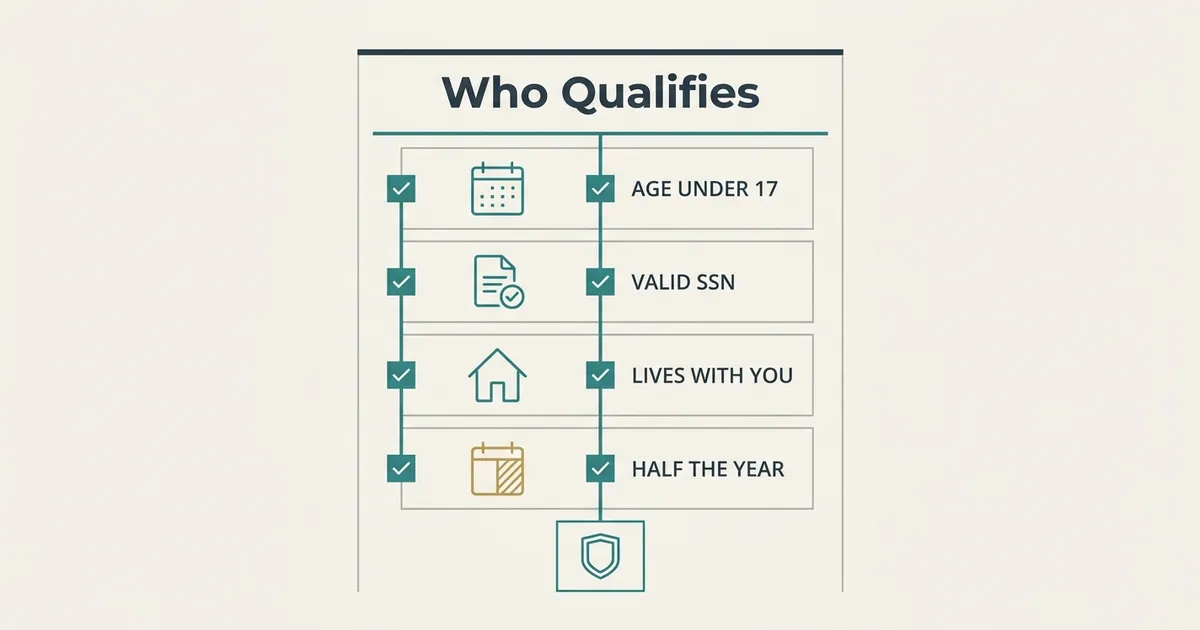
Child tax credit eligibility rules require a qualifying child under age 17 with a valid Social Security number who lived with you more than half the year. Full credit access also requires household income (MAGI) under $400,000 for joint filers, or $200,000 for others, to claim the full $2,200-per-child credit for tax year 2026.
Parents running a side hustle or small family business — the kind covered in our Home Office Deduction for Side Business: 2026 Guide — face an extra wrinkle: net self-employment profit flows straight into MAGI, pushing dual-income households over the phaseout threshold faster than a single W-2 salary would. According to the IRS (2025) Schedule 8812 instructions, MAGI for the credit equals adjusted gross income plus a small set of foreign-income exclusions that rarely apply to domestic side-hustle income — so for most filers, MAGI and AGI are effectively the same number to watch.
How Has the Child Tax Credit Changed Since 2021?
The credit amount, refundability, and income limits have changed four times since 2017 — twice since 2021 alone — which is why search results still surface $3,600 and $2,000 figures that no longer apply to your current return. The table below lines up each version against its statutory source so you can confirm which rule actually governs your filing year.
| Tax Year(s) | Max Credit per Child | Refundable Portion | Phaseout Starts (MFJ) | Source |
|---|---|---|---|---|
| 2017 and earlier | $1,000 | Up to $1,000 | $110,000 | Pre-TCJA IRC §24 |
| 2018–2020 | $2,000 | Up to $1,400 | $400,000 | Tax Cuts and Jobs Act (2017) |
| 2021 only | $3,600 (under 6) / $3,000 (ages 6–17) | Fully refundable | $150,000 | American Rescue Plan Act (March 2021) |
| 2022–2024 | $2,000 | Up to $1,700 (2024) | $400,000 | IRS Revenue Procedure 2023-34 (2023) |
| 2025–2026 | $2,200 | Up to $1,700 | $400,000 | One Big Beautiful Bill Act (July 2025); IRS Revenue Procedure 2025-32 (2025) |
Per the Tax Cuts and Jobs Act (2017), Congress doubled the credit from $1,000 to $2,000 per child starting in 2018 while raising the phaseout threshold from $110,000 to $400,000 for joint filers. The American Rescue Plan Act (March 2021) temporarily made the credit fully refundable and raised it to $3,600 for children under 6 and $3,000 for ages 6 through 17, but only for the 2021 tax year — it reverted afterward. According to IRS Revenue Procedure 2023-34 (2023), the refundable Additional Child Tax Credit cap for 2024 returns was $1,700 per child. Only the bottom row applies to a return you file for tax year 2025 or 2026: per the Tax Foundation (July 2025), the One Big Beautiful Bill Act made the $2,200 base amount and the $400,000/$200,000 phaseout thresholds permanent, removing the scheduled sunset that would otherwise have dropped the credit back toward $1,000 after 2025. The $2,200 base and the $1,700 refundable cap are both indexed for inflation, but the adjustment for tax year 2026 left each unchanged: per IRS Revenue Procedure 2025-32 (2025) §3.05, the 2026 maximum credit under §24(a) is $2,200 and the refundable amount under §24(d)(1)(A) is $1,700 — the same figures that applied in 2025.
Who Qualifies for the Child Tax Credit in 2026?
A child must clear seven IRS tests at once to generate a credit on your return, per the IRS (2025) Schedule 8812 instructions:
- Age — under 17 on December 31 of the tax year.
- Relationship — son, daughter, stepchild, foster child placed by a court or authorized agency, sibling, step-sibling, or a descendant of any of these (grandchild, niece, nephew).
- Residency — lived with you more than half the tax year; temporary absences for school, illness, military service, or vacation still count as time lived with you.
- Support — the child did not provide more than half of their own financial support during the year.
- Dependent status — you claim the child as a dependent on your Form 1040.
- Joint return — the child doesn't file a joint return with a spouse, except solely to claim a refund of withheld tax.
- Citizenship/SSN — the child is a US citizen, national, or resident alien with a Social Security number valid for employment.
Miss any single test and that child generates zero credit for the year — there's no partial credit for meeting six of seven. The SSN timing rule catches more families than any other test on this list. Per the IRS (2025) Schedule 8812 instructions, the SSN must be issued before the due date of your return, including extensions — the IRS retitled that instruction heading from "by Due Date" to "Before the Due Date" for tax year 2025, so a number issued on the deadline itself no longer counts, regardless of when you eventually file.
One requirement is new and easy to miss: the One Big Beautiful Bill Act (July 2025) extended the SSN rule from the child to the filer. Per the IRS Child Tax Credit page, you — or your spouse, if married filing jointly — must also hold a Social Security number valid for employment, issued before the return's due date. Previously only the child needed one, so a household filing on an ITIN that claimed the credit in prior years may no longer qualify for the CTC or the refundable ACTC, even when every test above is met.
What Income Limits Apply to the Child Tax Credit?
The credit phases out at $50 per $1,000 (or fraction of $1,000) that your MAGI exceeds $400,000 on a joint return, or $200,000 for single, head-of-household, and married-filing-separately filers, per IRC §24(h)(3) as amended by the One Big Beautiful Bill Act (July 2025). The reduction applies to your total credit across all children, not per child individually — a two-child family loses the same $50-per-$1,000 increment against its combined $4,400 credit that a one-child family loses against its $2,200 credit.
Consider a California couple filing jointly with two qualifying children, ages 10 and 14. One spouse earns a $95,000 W-2 salary; the other nets $150,000 from a side consulting business reported on Schedule C — a structure that might change once the business scales, per our guide to LLC or S-Corp? When a Family Side Business Should Elect S-Corporation Status. Combined MAGI lands at $410,000 — $10,000 over the $400,000 threshold. The IRS rounds that excess up to 10 full $1,000 increments and applies a $50 reduction to each, cutting the family's $4,400 combined credit by $500, down to $3,900.
California conforms to federal AGI as the starting point for state tax but does not mirror the federal Child Tax Credit on state returns. Per the California Franchise Tax Board (2025), the state's separate Young Child Tax Credit is available only to CalEITC-eligible filers with a qualifying child under age 6, independent of whether the same child's federal credit has phased out.
How Can Self-Employed Parents Protect Their Credit From the Phaseout?
Bringing MAGI back under the threshold before you file preserves the full credit, and the most direct lever for a self-employed parent is a retirement plan contribution that reduces net income on Schedule 1. A Solo 401(k) or SEP-IRA contribution lowers AGI dollar-for-dollar because it's an above-the-line deduction, and AGI is the starting point for MAGI on Schedule 8812 — see Solo 401k 2026: How Self-Employed Parents Cut Taxes for the contribution limits and spousal-hiring mechanics behind this move — a Health Savings Account contribution works the same way, as detailed in Health Reimbursement Arrangement: A 2026 Family Tax Guide.
In the example above, contributing $10,000 to a Solo 401(k) profit-sharing account brings MAGI from $410,000 down to exactly $400,000, eliminating the phaseout and restoring the full $4,400 credit — a $500 swing from that single contribution, on top of the income tax it shelters separately. For 2026, the IRS caps total Solo 401(k) contributions (employee deferral plus employer profit-sharing) at $72,000, per IRS Notice 2025-67 (November 2025), giving most side-hustle households ample room to make this adjustment before the filing deadline.
Make this move if your MAGI sits within roughly $50,000 of the $400,000/$200,000 threshold and you have uncommitted cash before your tax deadline — the combined income-tax and credit benefit typically outweighs the liquidity cost of parking money in a retirement account. Skip it if your MAGI already exceeds the full phaseout ceiling: about $444,000 MFJ for one child, $488,000 for two, and $532,000 for three, since each additional child adds roughly $44,000 to the ceiling ($2,200 ÷ $50 × $1,000). No contribution small enough to be practical pulls a family back under a ceiling that far away.
What Disqualifies a Family From Claiming the Child Tax Credit?
Five situations eliminate the credit even when a family assumes it qualifies, per the IRS (2025) Schedule 8812 instructions and IRC §152 tie-breaker rules:
- Age cutoff — the child turned 17 on or before December 31 of the tax year. A child who turns 17 on December 30 loses the full $2,200 for that year, not a prorated amount.
- Late SSN — a number issued on or after the return's due date, including extensions, for either the child or the filer, as described above.
- Residency shortfall — the child lived with you six months or less without a qualifying exception (shared custody, temporary absence, or birth/death during the year).
- Double-claiming conflict — another taxpayer, often an ex-spouse or grandparent, already claimed the child that year. Per IRC §152(c)(4) tie-breaker rules, the IRS resolves competing claims using a parent-first, then longer-residency, then higher-AGI order, and treats the losing claim as an error requiring an amended return.
- Full income phaseout — MAGI above the ceiling described in the previous section.
Married-filing-separately filers face the same $200,000 threshold as single filers, not half of the $400,000 joint threshold — a common and costly assumption error for separated spouses filing apart for the first time.
How Do Divorced or Separated Parents Handle the Residency Rule?
The parent the child lived with for the greater number of nights during the year — the custodial parent under IRS tie-breaker rules — claims the Child Tax Credit by default, regardless of which parent pays more child support or which parent a divorce decree names. The custodial parent can release that claim to the noncustodial parent for a specific year or permanently by signing Form 8332, per the IRS (2025) Instructions for Form 8332, which the noncustodial parent then attaches to their own return.
Releasing the credit via Form 8332 does not transfer the Earned Income Tax Credit or head-of-household filing status — those stay with the custodial parent regardless of the release. That distinction surprises noncustodial parents who assume signing the form hands over every child-related tax benefit at once.
Should You Redirect Your Child Tax Credit Savings Into a Custodial Roth IRA?
A Child Tax Credit refund can't be contributed directly to a child's Roth IRA because Roth contributions require the child's own earned income, not a parent's tax refund, per IRS Publication 590-A (2025). The practical move for a side-hustle family is to use the freed-up cash flow from the credit to cover payroll for age-appropriate work the child actually performs in the business — bookkeeping data entry, product photography, social media content, structured under the rules in Hiring Family Members: How to Pay Your Kids Tax-Free 2026 — and then contribute that documented wage income to a custodial Roth IRA.
Compare account structures built for exactly this setup in our guide to the best custodial Roth IRA providers, which breaks down minimums and parental-control features side by side. Households layering multiple credits can also look at solar tax credits and utility savings as a second federal lever for freeing up cash to redirect toward a child's account. If you are paying for daycare or after-school care, the childcare benefits are a separate question from this credit — the Dependent Care FSA versus the childcare tax credit works through the coordination rule that stops the same dollars from counting twice.
Disclaimer: Tax thresholds and dollar amounts adjust annually and by legislation; verify current-year figures against the IRS instructions for Schedule 8812 or a qualified tax professional before filing. For the broader set of family tax-reduction strategies this article draws from, start with our tax-saving hub.
Frequently asked questions
Who qualifies for the $3600 Child Tax Credit?
Nobody currently qualifies for a $3,600 Child Tax Credit — that amount applied only to tax year 2021 under the American Rescue Plan Act (March 2021), which temporarily raised the credit to $3,600 for children under 6 and $3,000 for ages 6 through 17 and made it fully refundable. The credit reverted to $2,000 per child for 2022 through 2024, then rose to $2,200 per child for 2025 and later years under the One Big Beautiful Bill Act (July 2025).
What are the rules for claiming the Child Tax Credit?
You must have a qualifying child under 17 with a Social Security number issued before your return's due date, who lived with you more than half the year and did not provide more than half of their own support. Since tax year 2025 you (or your spouse, if filing jointly) must hold a valid employment SSN as well, not just the child. Per the IRS (2025) Schedule 8812 instructions, you also need household MAGI under $400,000 (joint filers) or $200,000 (other filers) to receive the full $2,200-per-child amount, and you must file Schedule 8812 with your Form 1040.
What disqualifies you from getting a Child Tax Credit?
Common disqualifiers include a child turning 17 before year-end, a Social Security number issued on or after the filing deadline, a child who didn't live with you more than half the year without a qualifying exception, or household MAGI above the full phaseout ceiling — roughly $444,000 for a joint return with one child, higher with more children. Per IRC §152(c)(4) tie-breaker rules, you're also disqualified for a given child if another taxpayer already claimed that same child as a dependent that year.
Do you get $2000 per child on taxes in 2025?
No — for tax year 2025 the maximum Child Tax Credit is $2,200 per qualifying child, not $2,000, under the One Big Beautiful Bill Act signed in July 2025. The $2,000 figure applied to tax years 2018 through 2024 under the Tax Cuts and Jobs Act (2017). The $2,200 base is indexed for inflation, but the 2026 adjustment left it unchanged — per IRS Revenue Procedure 2025-32 (2025), the maximum credit for tax year 2026 is still $2,200 per qualifying child, with up to $1,700 refundable.