Best Custodial Roth IRA Providers for Kids in 2026

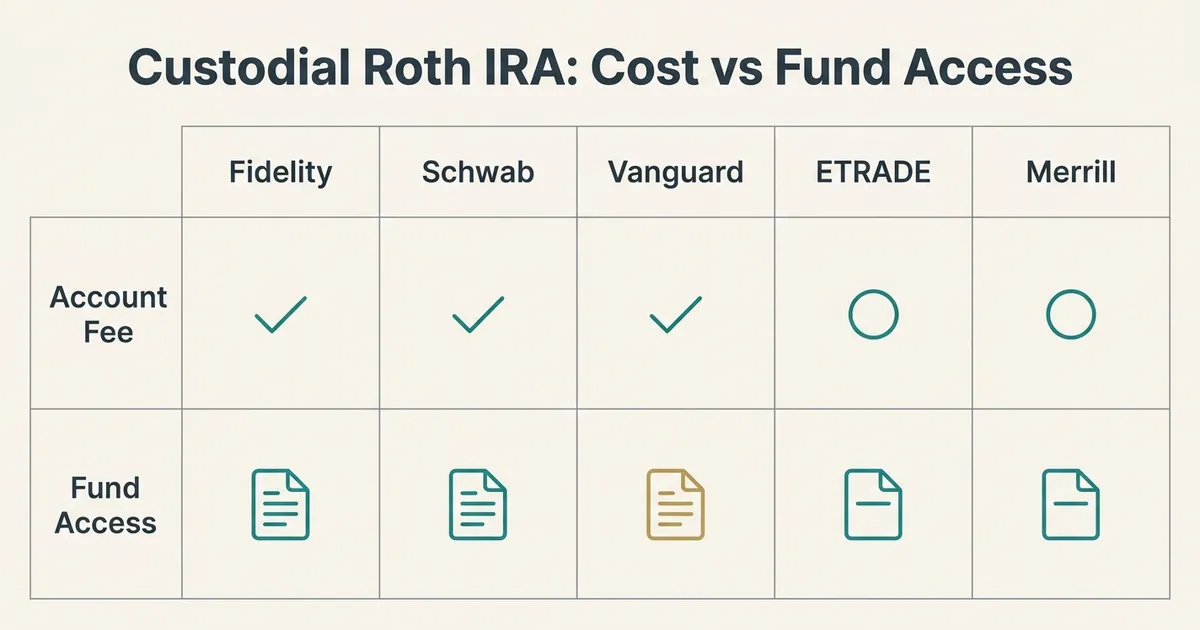
Fidelity, Charles Schwab, and Vanguard rank as the best custodial Roth IRA providers in 2026, each charging zero account fees and no minimum deposit. E*TRADE and Merrill compete closely on cost but lag on low-fee index fund selection, based on each firm's published 2026 account disclosures. The right pick depends on whether you want automatic index investing, a paired teen debit card, or self-directed stock trading for an older child.
Custodial Roth IRAs have grown alongside a broader shift toward earlier retirement saving. According to the Investment Company Institute (2025), total U.S. IRA assets reached roughly $16.8 trillion by the end of 2024, with Roth IRAs representing a growing share of new account openings among households under 45. A custodial version simply lets a parent or guardian open and manage that Roth IRA on behalf of a minor who has earned income, until the child reaches the age of majority in their state.
The mechanics matter more than the brand name. A custodial Roth IRA is not a special product with different tax rules — it is a standard Roth IRA titled in the child's name, with an adult listed as custodian who has trading authority. According to the IRS (Publication 590-A, 2025), the account follows the same contribution limits, income-eligibility mechanics, and five-year withdrawal rules as any other Roth IRA; the only difference is who can legally sign for it.
Which custodial Roth IRA providers are actually worth it in 2026?
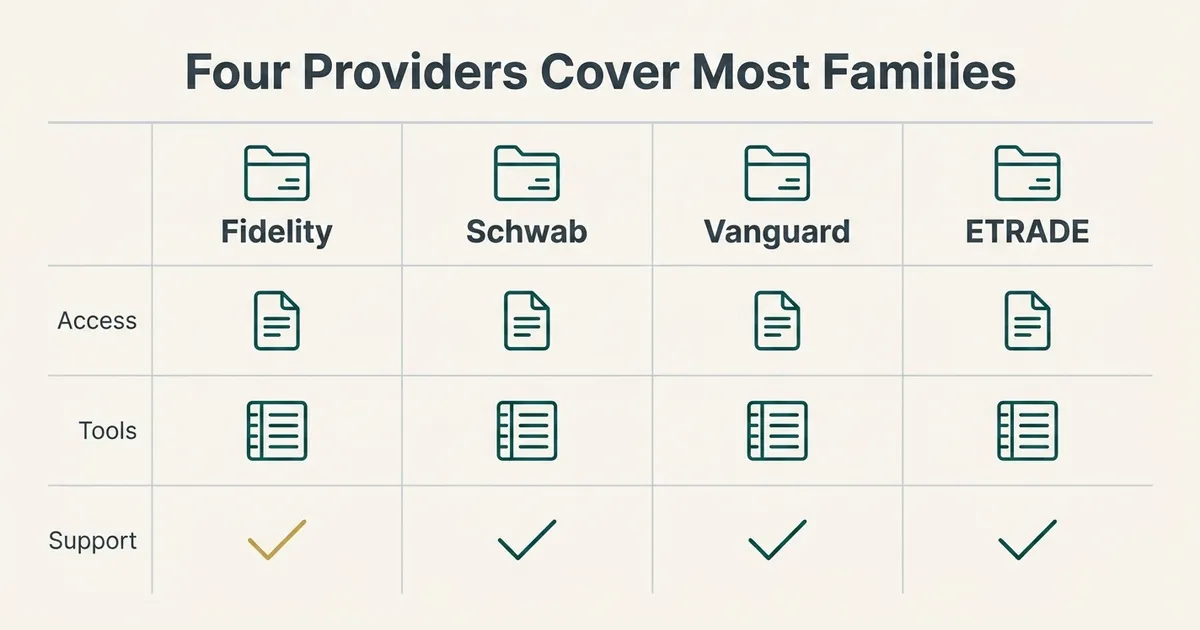
Four providers cover nearly every family's situation: Fidelity, Charles Schwab, Vanguard, and E*TRADE. Each has eliminated account minimums and maintenance fees over the past several years, so the real differences show up in fund lineup, platform tools, and what happens once your child turns 18.
| Provider | Minimum to open | Account/maintenance fees | Lowest-cost index option | Notable feature |
|---|---|---|---|---|
| Fidelity Roth IRA for Kids | $0 | $0 | 0.015% (FZROX Zero Total Market Index) | Pairs with the Fidelity Youth Account debit card for teens 13–17 |
| Charles Schwab Custodial Roth IRA | $0 | $0 | 0.03% (SWTSX Total Stock Market Index) | Access to Schwab Intelligent Portfolios robo-advisor at $0 minimum |
| Vanguard Custodial Roth IRA | $0 to open; most mutual funds require $3,000 | $0 | 0.03% (VTI Total Stock Market ETF, no minimum) | Deepest low-cost index fund lineup for buy-and-hold investors |
| E*TRADE Custodial Roth IRA | $0 | $0 | $0 commission on stocks/ETFs; no proprietary zero-fee index fund | Best self-directed trading tools for a teen who wants to pick stocks |
According to Fidelity (2026), Charles Schwab (2026), Vanguard (2026), and ETRADE (2026) account disclosures, all four now charge $0 in account or custodial fees, so the decision comes down to fund access rather than cost. Choose Fidelity or Schwab if you want a true "set it and forget it" index fund with no dollar-minimum friction. Choose Vanguard if you're comfortable buying its ETF share class (VTI, VXUS) rather than mutual fund share class to avoid the $3,000 minimum. Choose ETRADE only if your teen is old enough and interested enough to actively research individual stocks — it's the weakest option for a parent who wants pure index-fund simplicity.
How does a custodial Roth IRA actually work?
A custodial Roth IRA works exactly like an adult Roth IRA, except the parent controls trading and withdrawals until the child reaches the state's age of majority. The child owns every dollar in the account from day one — the custodian's role is purely administrative, not ownership.
The earned-income rule is the mechanism that trips up most parents. According to the IRS (Publication 590-A, 2025), a Roth IRA contribution cannot exceed the account holder's taxable compensation for the year — so a child with $2,400 in verifiable earned income can have at most $2,400 contributed to their Roth IRA that year, regardless of household cash available. Babysitting cash paid informally by neighbors, allowance, and gifts do not count as compensation for this test.
For 2026, the annual contribution limit is $7,000 for savers under 50, according to the IRS (2025) — unchanged from 2024 and 2025 because the inflation-adjustment formula didn't cross a rounding threshold; confirm the current figure at IRS.gov before contributing, since it resets every year. A child's contribution is capped at the lower of that $7,000 limit or their actual earned income, whichever is smaller.
Does my child need a W-2, or does side-hustle cash count?
Cash from a family business counts as earned income if it's properly documented — a W-2 isn't strictly required, but a paper trail is. If your child does real work in your sole proprietorship (product photography for your Etsy shop, filing, social media captions, farmers-market sales help), you can pay a reasonable wage and it qualifies as compensation for Roth IRA purposes.
This is where the tax-reduction mechanism compounds. According to the IRS (Publication 15, Circular E, 2025), wages paid to your own child under age 18 employed by a parent's sole proprietorship, or a partnership where both partners are the child's parents, are exempt from Social Security and Medicare (FICA) tax, and exempt from federal unemployment (FUTA) tax until the child turns 21. That wage is also a deductible business expense on your Schedule C, lowering your household's taxable income while funding your child's Roth IRA at the same time.
The child's own income tax exposure is minimal. According to the IRS (Rev. Proc. 2024-40, 2025), the standard deduction for a dependent is generally the greater of $1,350 or the dependent's earned income plus $450, up to the full single-filer standard deduction — which was $15,000 for 2025. A child earning $6,000 from your business in a year typically owes $0 in federal income tax on those wages after the standard deduction, even before the Roth contribution shelters any investment growth.
Fidelity vs. Schwab vs. Vanguard vs. E*TRADE — who should pick which?
Pick Fidelity if you want the simplest, lowest-cost setup with a built-in path to a teen debit card. Fidelity's zero-expense-ratio index funds mean a $500 contribution isn't quietly eroded by fees the way a 0.5%-expense-ratio fund would erode it over 20 years.
Pick Charles Schwab if you already bank there or want access to a no-minimum robo-advisor for a hands-off approach. According to Charles Schwab (2026), Schwab Intelligent Portfolios requires no advisory fee and no account minimum inside a custodial Roth IRA, which suits a parent who doesn't want to select individual funds.
Pick Vanguard if you're a buy-and-hold investor comfortable trading ETFs instead of mutual funds. Vanguard's mutual fund share classes often carry a $3,000 minimum per fund, according to Vanguard (2026), which is unrealistic for a first $500–$2,000 contribution — buying the ETF equivalent (VTI instead of VTSAX) sidesteps that minimum entirely.
Skip E*TRADE if your goal is pure long-term index investing for a young child; its strength is stock-picking tools for a financially engaged teenager, not the lowest-cost passive fund lineup. Skip all four, temporarily, if your child has no documented earned income this year — contributing without qualifying compensation is an excess contribution that the IRS penalizes.
What does opening one actually cost over 10 years, in real dollars?
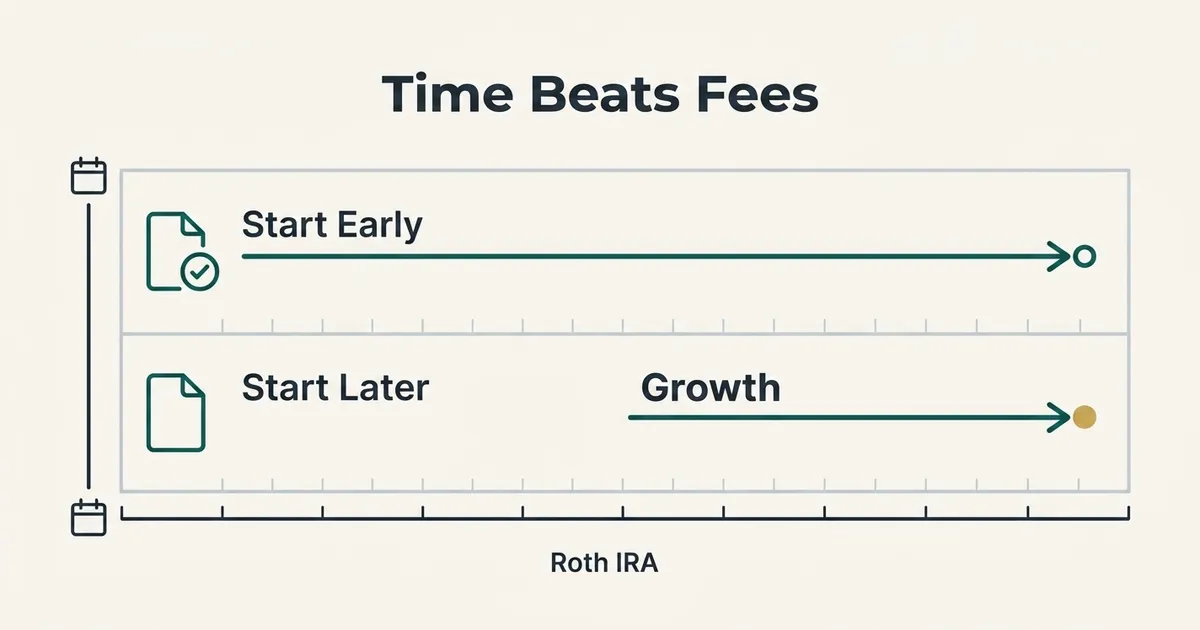
Fees matter less than the decision to start early. Consider a 10-year-old, Maya, who earns $3,000 in a single year working in her parents' small business and has that full $3,000 contributed to a custodial Roth IRA and invested in a total-market index fund.
According to Morningstar (2025), the S&P 500 has produced an average annual return of roughly 10% before inflation over the past several decades — a historical average, not a guaranteed future outcome. Using a more conservative illustrative 7% average annual return, that single $3,000 contribution left untouched for 55 years, until Maya turns 65, would grow to approximately $124,000 in this hypothetical scenario. No further contributions are assumed, and actual market performance will differ, sometimes substantially, from any historical average.
Now compare providers on cost drag alone. A 0.03% expense ratio (roughly Schwab's or Vanguard's index fund cost) on a $3,000 balance costs about $0.90 per year in fees at today's balance, versus $15 per year on the same balance at a 0.50% expense ratio common among actively managed mutual funds. The gap compounds: over 55 years, a 0.47-percentage-point annual fee difference can consume tens of thousands of dollars of the account's terminal value, which is why the near-zero expense ratios in the comparison table above matter more than any sign-up bonus.
Is a custodial Roth IRA the right move for your family, or should you skip it?
Open one if your child has real, documented earned income and you can afford to lock that money away until retirement age. The trade-off is irrevocability: unlike a 529 plan, Roth IRA contributions (though not earnings) can technically be withdrawn tax- and penalty-free at any time, but the earnings on those contributions are locked until age 59½ absent a qualifying exception, according to the IRS (Publication 590-B, 2025).
Skip it, or delay it, if your child has no verifiable earned income — paying a 6-year-old a "salary" for folding laundry does not meet the IRS reasonable-compensation standard for a bona fide employer-employee relationship, and an improperly documented wage can unravel both the business deduction and the Roth contribution if audited. Skip it also if you need that same cash for near-term goals like a 529 plan contribution or an emergency fund; a custodial Roth IRA is a poor substitute for liquid family savings because the growth portion isn't accessible without penalty before retirement age.
One underused advantage: a custodial Roth IRA avoids the kiddie tax entirely. According to the IRS (Form 8615 instructions, 2025), the kiddie tax applies to a child's unearned income — interest, dividends, and capital gains — above $2,700 for 2025, taxing the excess at the parent's marginal rate; because Roth IRA growth isn't taxed annually, it never touches that threshold, unlike a standard taxable custodial brokerage (UTMA/UGMA) account holding the same investments.
How do you open a custodial Roth IRA in five steps?
Opening the account takes under 20 minutes online at any of the four providers above. The steps are the same regardless of which firm you choose.
- Confirm and document earned income. Keep pay stubs, a simple timesheet, or a 1099 showing your child's wages from your family business for the tax year.
- Choose a provider from the table above based on whether you want zero-minimum index funds (Fidelity, Schwab) or ETF-only investing (Vanguard).
- Apply online as the custodian, providing your child's Social Security number, date of birth, and your own identifying information — no notarization is required at any of the four major providers.
- Fund the account up to the lesser of the child's earned income or the $7,000 annual limit for 2026, confirming the current-year cap at IRS.gov first.
- Select the investment — a total-market index fund or target-date fund is the standard low-maintenance choice for a multi-decade time horizon.
Coordinating this with the rest of your household's tax plan compounds the benefit — see the broader guide to reducing your household's federal tax bill for how a custodial Roth IRA fits alongside the Child Tax Credit and other family tax moves. Parents running a side business should also review the rules for paying your child from your side business before setting the first paycheck — that guide also covers the earned-income ceiling that stops a custodial Roth contribution from becoming an excess contribution.
Disclaimer: This article is for general educational purposes and is not individualized tax or investment advice. Contribution limits, standard deduction amounts, and state age-of-majority rules change annually and by jurisdiction — confirm current figures with the IRS and your state's statutes, or a licensed tax professional, before acting.
Frequently asked questions
Is a custodial Roth IRA a good idea?
A custodial Roth IRA is a good idea when your child has documented earned income and your family can afford to leave that specific money invested for decades. According to the IRS (Publication 590-A, 2025), contributions (but not earnings) can be withdrawn tax-free at any time, which limits the downside compared with a 529 plan restricted to education spending. It's a weaker idea if the contribution would otherwise go toward near-term needs, since the growth portion stays locked until age 59½ absent a qualifying exception.
Who has the best Roth IRA for kids?
Fidelity's Roth IRA for Kids is generally the best overall pick because it combines a $0 minimum, $0 account fees, and a 0.015% expense ratio index fund, according to Fidelity's 2026 published account terms. Charles Schwab is a close second for families who want a no-minimum robo-advisor option, while Vanguard suits parents comfortable buying ETFs instead of mutual funds to avoid its typical $3,000 mutual fund minimum, per Vanguard (2026).
Is Vanguard or Fidelity better for a custodial account?
Fidelity is better for most parents opening a first custodial Roth IRA because its index mutual funds carry no dollar minimum, unlike Vanguard's mutual fund share classes, which commonly require $3,000 per fund according to Vanguard (2026). Vanguard becomes competitive, and arguably cheaper long-term, if you buy its ETF share class (like VTI at 0.03%) instead of the mutual fund equivalent, since ETFs trade at share price with no separate minimum.
Where to set up a custodial Roth IRA?
You can set up a custodial Roth IRA directly on the website of Fidelity, Charles Schwab, Vanguard, or E*TRADE in under 20 minutes, providing the child's Social Security number and proof of earned income. According to the IRS (Publication 590-A, 2025), the custodian must be an adult — typically a parent or guardian — who manages the account until the child reaches the age of majority under state law, generally 18 to 21 depending on the state.