Hiring Family Members: How to Pay Your Kids Tax-Free 2026

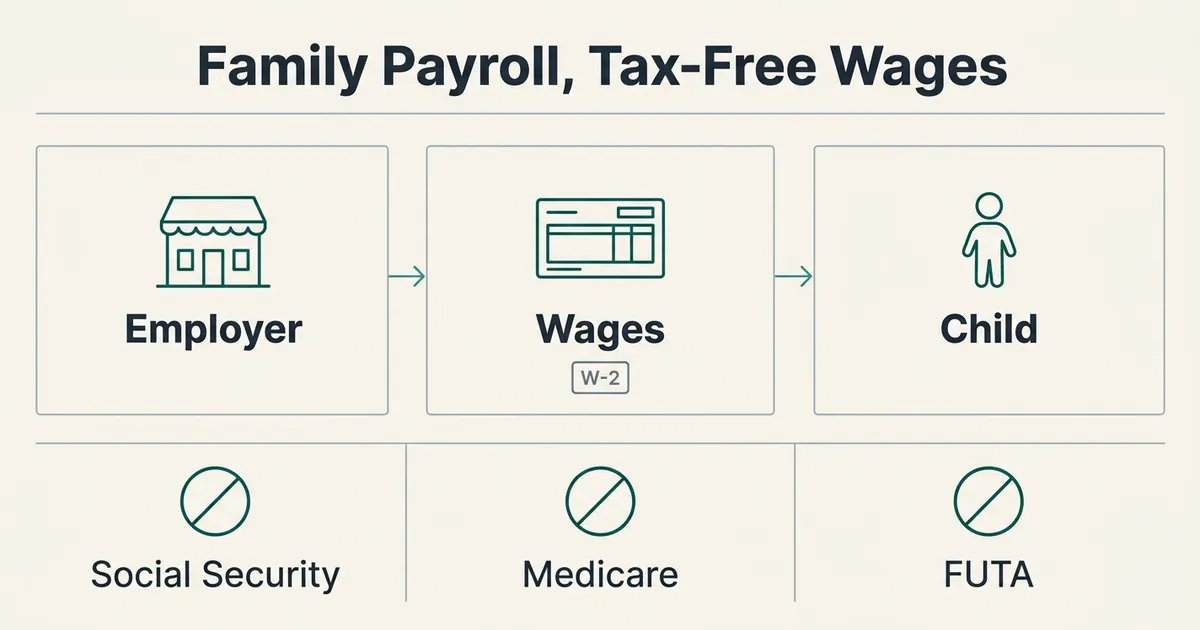
Hiring family members—your own minor children, specifically—lets a parent-owned sole proprietorship pay wages exempt from Social Security, Medicare, and federal unemployment tax. The child's earned income then stays free of federal income tax up to the standard deduction, and the whole strategy only works if the pay is for real work with real payroll records.
This isn't a loophole you stumble into by writing a check to your 8-year-old. It's a specific set of Internal Revenue Code provisions that reward parents who run a sole proprietorship, a single-member LLC taxed as a disregarded entity, or a partnership where both partners are the child's parents. Get the structure right and you convert a nondeductible allowance into a deductible business wage that also builds your child's retirement account.
What Does "Hiring Family Members" Tax-Free Actually Mean?
It means two separate tax breaks stack on top of each other when a parent's business pays a minor child a wage for real work. According to the IRS (Publication 15, 2026), wages paid to a child under 18 by a parent's sole proprietorship, or by a partnership where both partners are the child's parents, are exempt from Social Security and Medicare withholding under Internal Revenue Code Section 3121(b)(3)(A). According to the IRS (Publication 15, 2026), the same wages are also exempt from federal unemployment tax (FUTA) until the child turns 21, under Internal Revenue Code Section 3306(c)(5).
The second layer is the standard deduction. According to the IRS (Revenue Procedure 2025-32, November 2025), a dependent with earned income can claim a standard deduction up to $16,100 for the 2026 tax year — the same ceiling as a single filer. Because the wage is both deductible to the parent's business under Section 162(a) and shielded from federal tax on the child's return, the family effectively moves income from the parent's marginal bracket to the child's 0% bracket without the money ever leaving the household's control.
Which Business Structures Qualify to Hire Your Kids Tax-Free?
Your business structure decides whether the FICA and FUTA exemptions apply at all — this is the single most common thing generic advice gets wrong. Sole proprietorships and single-member LLCs taxed as disregarded entities qualify automatically, because the IRS treats the business and the parent-employer as the same taxpayer under Publication 15 (2026). A partnership qualifies only if every partner is a parent of the employed child; add a business partner who isn't the child's other parent, and the exemption disappears for that child's wages, according to the IRS (Publication 15, 2026).
S corporations and C corporations never qualify for the FICA/FUTA exemption, regardless of who owns the stock. According to the IRS (Publication 15, 2026), a corporation is a separate legal employer from its shareholder-parents, so a minor child's wages from a family S-corp are subject to Social Security, Medicare, and FUTA withholding exactly like any unrelated employee's pay. If you've elected S-corp status to capture the Section 199A qualified business income deduction, weigh that QBI savings against the roughly 15.3% combined FICA cost you'd give up by hiring your kids inside the corporate entity — for many families running a side hustle documented in a home-office side-hustle deduction strategy, staying a sole proprietorship for as long as the kids are minors is the better trade.
How Much Can You Pay Your Child Before Taxes Kick In?
Your child owes $0 in federal income tax on wages up to the standard deduction, and your business deducts the full wage as an ordinary and necessary expense the same year. According to the IRS (Revenue Procedure 2025-32, November 2025), that ceiling is $16,100 for 2026, though the IRS adjusts it for inflation every year, so recheck the figure each January.
Here's the mechanism with real numbers. Maria runs a sole-proprietor Etsy shop that nets $80,000 in 2026, putting her in the 22% federal bracket and subject to the 15.3% self-employment tax on most of that profit. She hires her 12-year-old for genuine work — product photography, inventory counts, and packing orders, roughly 8 hours a week — at $14,000 for the year, a rate consistent with what a local part-time helper would earn. That $14,000 is a deductible wage expense under Section 162(a), cutting Maria's taxable business profit to $66,000. She saves about $3,080 in income tax (22% × $14,000) and about $2,142 in self-employment tax (15.3% × $14,000), for roughly $5,222 in combined federal tax savings. Her daughter owes $0 federal income tax on the $14,000 because it falls entirely under the $16,100 standard deduction, and $0 FICA tax because Maria's sole proprietorship qualifies under Section 3121(b)(3)(A).
Wages don't trigger the kiddie tax, which only applies to unearned income like dividends and interest — how the kiddie tax treats a child's unearned income walks through both thresholds and which form the child files. According to the IRS (Revenue Procedure 2025-32, November 2025), a child's unearned income above $2,700 for 2026 is taxed at the parent's marginal rate under the kiddie tax rules in Internal Revenue Code Section 1(g) — but a paycheck for actual work is earned income and falls entirely outside that rule.
What Kind of Work Can Your Child Actually Do?
Your child can do any age-appropriate, non-hazardous task that a business genuinely needs, and the wage has to match what you'd pay an unrelated person for the same job. According to the U.S. Department of Labor (2024), the Fair Labor Standards Act exempts children employed by a parent in a non-hazardous occupation from the minimum working-age rules that apply to outside employers, but it does not waive the requirement that the work be real and the pay be reasonable.
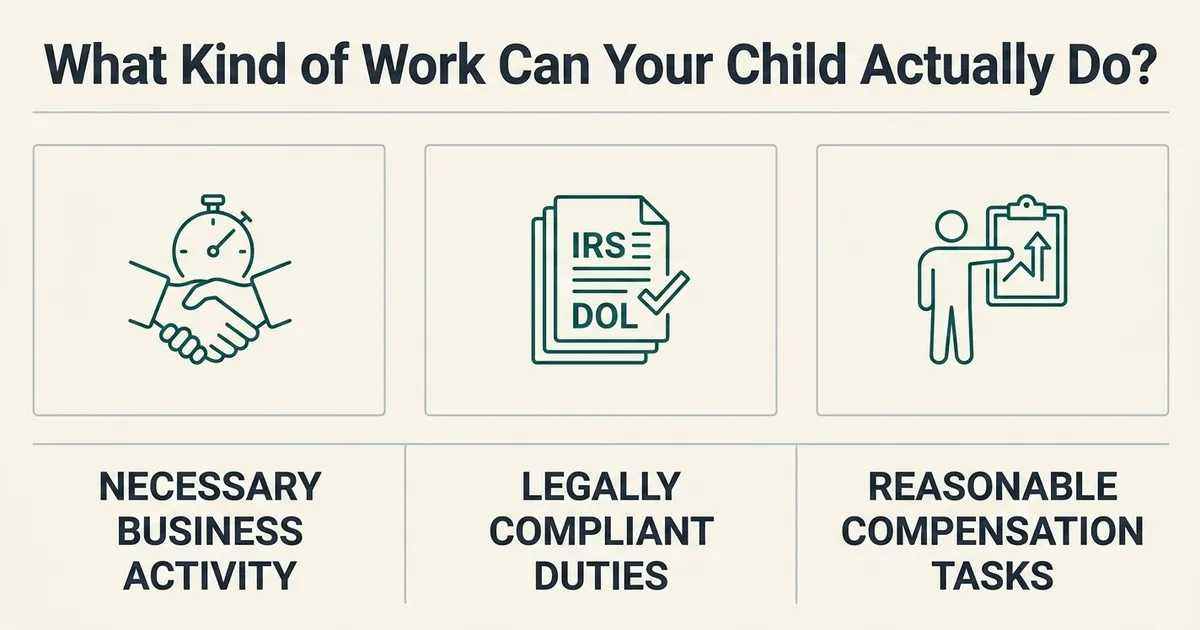
Match the task to the child's actual capability. A 5- to 7-year-old can model for product photos, shred documents, or help stock shelves for a modest hourly wage. An 8- to 10-year-old can file paperwork, sort inventory, or do basic data entry. An 11- to 13-year-old can manage social media captions under supervision, do more detailed bookkeeping entry, or handle packaging and shipping. According to the IRS (Publication 535, 2025), any wage deducted as a business expense must be ordinary, necessary, and reasonable for the services actually performed under Internal Revenue Code Section 162(a) — paying a 6-year-old $30,000 a year for "consulting" fails that test on its face.
How Do You Set Up Payroll So the IRS Accepts It?
Run your child's pay through the same payroll process you'd use for any employee, on paper, from day one. Start with an I-9 and W-4 on file, even though the child is a minor, and issue a Form W-2 by January 31 the following year — treating the wage as an informal allowance instead of documented payroll is the single fastest way to lose the deduction on audit.
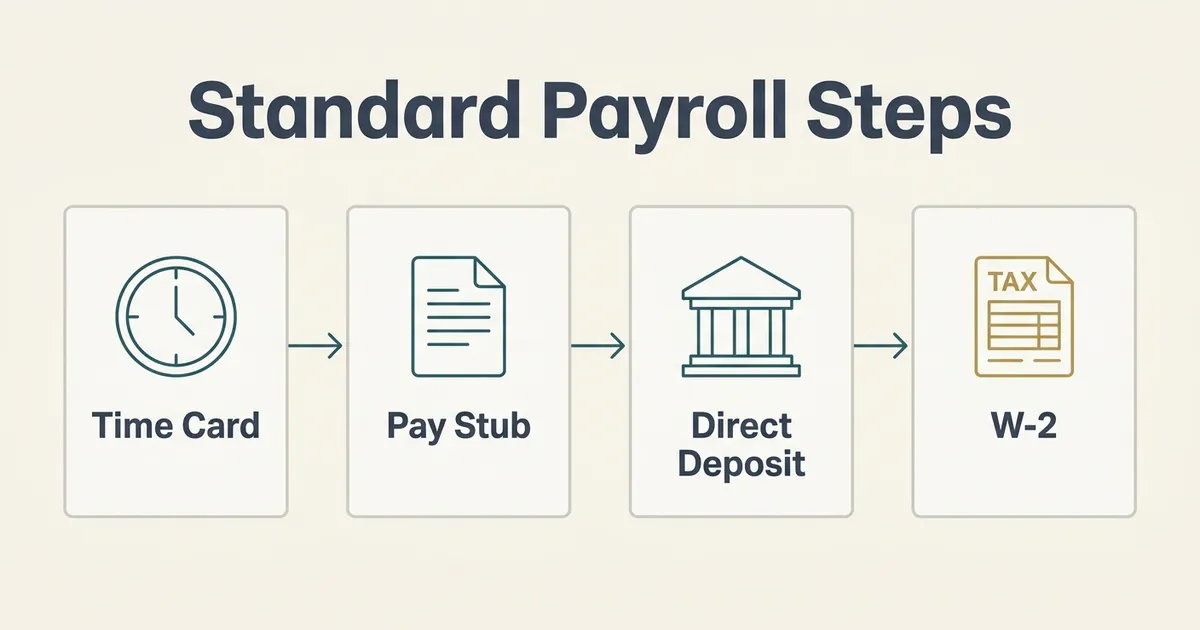
Pay from the business bank account, never from a personal account or in cash with no record. Log hours on a timesheet that matches the tasks described above, and keep it alongside canceled checks or bank statements. According to the IRS Audit Techniques Guide for Sole Proprietorships (2023), examiners routinely disallow family-wage deductions when a business can't produce timesheets or payment records tying the wage to specific work performed.
Check your state's wage-and-hour rules too, because the federal FICA exemption doesn't override state minimum wage law. California's minimum wage is $16.50 per hour for 2025, according to the California Department of Industrial Relations (2025), and the state's labor code does not carve out a blanket family exception to that rate — verify your own state's statute before setting an hourly figure. California also still requires State Disability Insurance withholding on a minor's wages even when the wages are exempt from federal FICA, according to the California Employment Development Department (2025), so don't assume a $0 federal payroll tax bill means $0 state withholding.
Should You Route the Paycheck Into a Custodial Roth IRA?
Routing the wage into a custodial Roth IRA is optional, but it's the move that turns a tax deduction into a long-term asset in your child's name. According to the IRS (Publication 590-A, 2025), a Roth IRA contribution can never exceed the account holder's own earned income for the year, so the $14,000 wage in the earlier example supports a full contribution up to the annual cap.
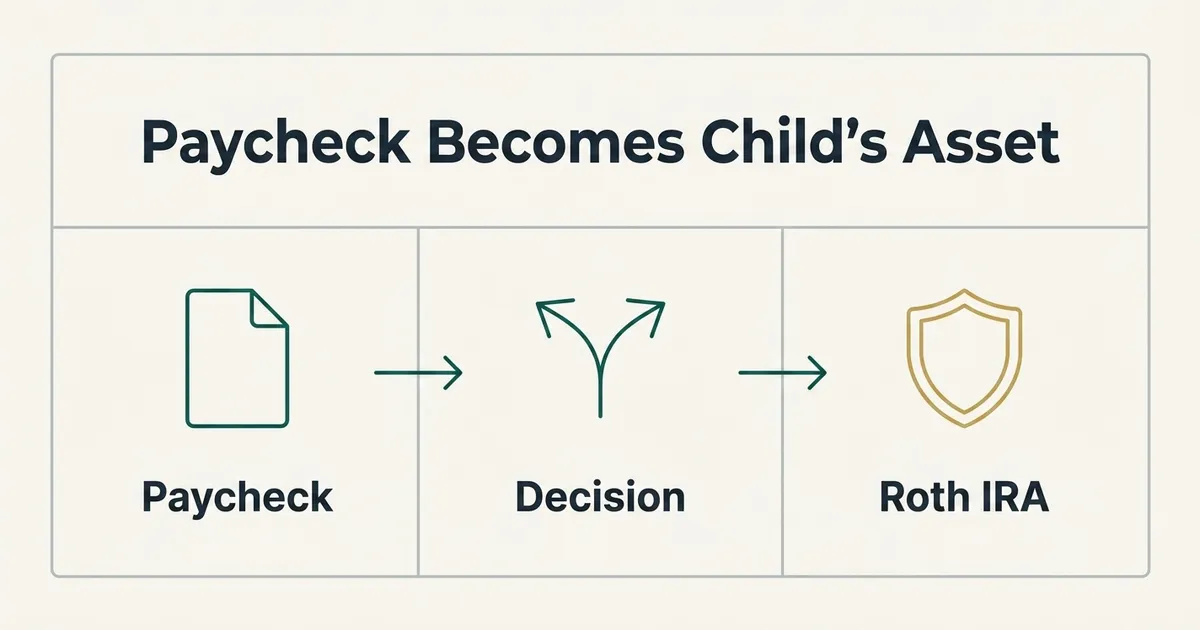
According to the IRS (Notice 2025-67, 2025), the annual Roth IRA contribution limit is $7,500 for 2026, up from $7,000 in 2025 — a figure the IRS reviews for inflation adjustments each year under Internal Revenue Code Section 408A. A parent acting as custodian can direct up to that $7,500 cap from the child's wages into the account; any remainder above the cap simply stays in a regular savings or brokerage account in the child's name — if that money is earmarked for something sooner than retirement, compare where to park short-term family cash so it earns a real yield while it waits. For a side-by-side comparison of providers that support this structure, see this roundup of the best custodial Roth IRA providers.
What Are the Common Mistakes That Trigger an IRS Audit?
The most common mistake is paying a wage that doesn't match the child's age or documented hours — a $40,000 salary to a 7-year-old with no timesheet reads as a disguised gift, not payroll. According to the IRS Audit Techniques Guide for Sole Proprietorships (2023), examiners specifically flag family-wage deductions that lack contemporaneous timesheets, a separate bank deposit trail, or a job description consistent with the child's age.
Three other failure patterns show up repeatedly. First, paying cash under the table with no W-2 — this erases both the FICA exemption's paper trail and the business deduction, because you can't substantiate the expense under Section 162(a). Second, commingling the child's pay with a joint family account instead of a separate account in the child's name, which makes it look like the money never really changed hands. Third, hiring inside an S-corp or C-corp and assuming the FICA exemption still applies — it doesn't, per the IRS (Publication 15, 2026), and that mismatch is an easy audit catch because the corporate payroll filings will show withholding that a sole-proprietor filing wouldn't.
Is Hiring Your Kids Right for Every Family Business?
Choose this strategy if you run a sole proprietorship, a single-member LLC, or a parent-only partnership with genuine, documentable tasks a young child can perform. Skip it if your only entity is an S-corp or C-corp and the FICA savings wouldn't offset what you'd give up elsewhere, or if you can't commit to real timesheets, a separate bank account, and a W-2 every January — an undocumented arrangement invites an IRS examiner to disallow the whole deduction retroactively.
Hiring your child doesn't change your eligibility for the Child Tax Credit. According to Internal Revenue Code Section 24(c), a qualifying child must be under age 17 at the end of the tax year, a threshold that has nothing to do with whether the child also earns wages from the family business — for the full mechanics of that credit, see this guide to maximizing the Child Tax Credit. The wages you save here are the raw material for the rest of the Family Tax Hacking approach: pair them with a residential solar tax credit strategy or a broader tax-saving plan to compound the household's total savings before you ever touch the investing side of the ledger. The same payroll setup unlocks a second deduction: once a family member is a legitimate employee, the business can reimburse the household's medical costs pre-tax — see writing off family health expenses through an HRA or HSA.
Disclaimer: This article is for general educational purposes and is not individualized tax or legal advice. Tax-year figures adjust annually and state rules vary — confirm current thresholds with the IRS and your state's labor and tax agencies, or a licensed tax professional, before setting up payroll for a family member.
Frequently asked questions
What is it called when you hire family members?
It's called family employment or nepotism hiring, and in a tax context it's often called a family-wage or kiddie-payroll strategy when the employee is the owner's minor child. According to the IRS (Publication 15, 2026), the specific FICA and FUTA exemptions for a parent-owned business employing a child under 18 fall under Internal Revenue Code Sections 3121(b)(3)(A) and 3306(c)(5), which is the formal legal basis for the arrangement described throughout this guide.
What is it called when you get hired by a family member?
There's no separate legal term for the employee side — the child is simply a family employee or a minor employee, subject to the same W-2, timesheet, and wage rules as any other worker despite the family relationship. According to the U.S. Department of Labor (2024), the FLSA's family-business exception affects only the minimum working-age rule for children employed by a parent in a non-hazardous job, not the employee's legal status or the employer's recordkeeping duties.
What are the rules for hiring family members?
The core rules are: the business must be a sole proprietorship, disregarded-entity LLC, or a partnership where both partners are the child's parents; the wage must match real work and real hours; and payroll must run through standard channels — W-4, timesheets, and a W-2 by January 31. According to the IRS (Publication 535, 2025), the wage deduction also has to satisfy the ordinary, reasonable, and necessary standard under Internal Revenue Code Section 162(a), and according to the IRS (Publication 15, 2026), the FICA/FUTA exemptions disappear entirely if the business is an S-corp or C-corp.
Is it okay to hire family members?
Yes — hiring your own minor children in a sole proprietorship or parent-only partnership is fully legal and IRS-sanctioned when the pay is for real, documented work at a reasonable wage. According to the IRS Audit Techniques Guide for Sole Proprietorships (2023), the arrangement becomes a problem only when the business can't produce timesheets, canceled checks, or a job description tying the wage to actual work performed, which is what turns a legitimate deduction into a disallowed one on audit.
What is a hiring family members policy?
A hiring family members policy is a business's written guideline for how it employs relatives — for a family sole proprietorship, that typically means a documented job description, an hourly rate benchmarked to market pay, a timesheet requirement, and payment through the business bank account rather than cash. According to the IRS (Publication 15, 2026), maintaining that kind of written policy and paper trail is effectively what substantiates the FICA and FUTA exemptions available under Internal Revenue Code Sections 3121(b)(3)(A) and 3306(c)(5) if the return is ever examined.
How does hiring family members work in a small business?
In a small business, hiring family members works the same way as hiring any employee — job description, agreed hourly wage, timesheet, and a W-2 — with the added tax benefit that a sole proprietor's minor child is exempt from FICA and FUTA withholding. According to the IRS (Revenue Procedure 2025-32, November 2025), the child can also earn up to $16,100 in 2026 with $0 federal income tax owed, which is why small sole-proprietor and single-member LLC owners use this structure more than owners of S-corps or partnerships with non-parent partners, who don't qualify for the same exemptions.