
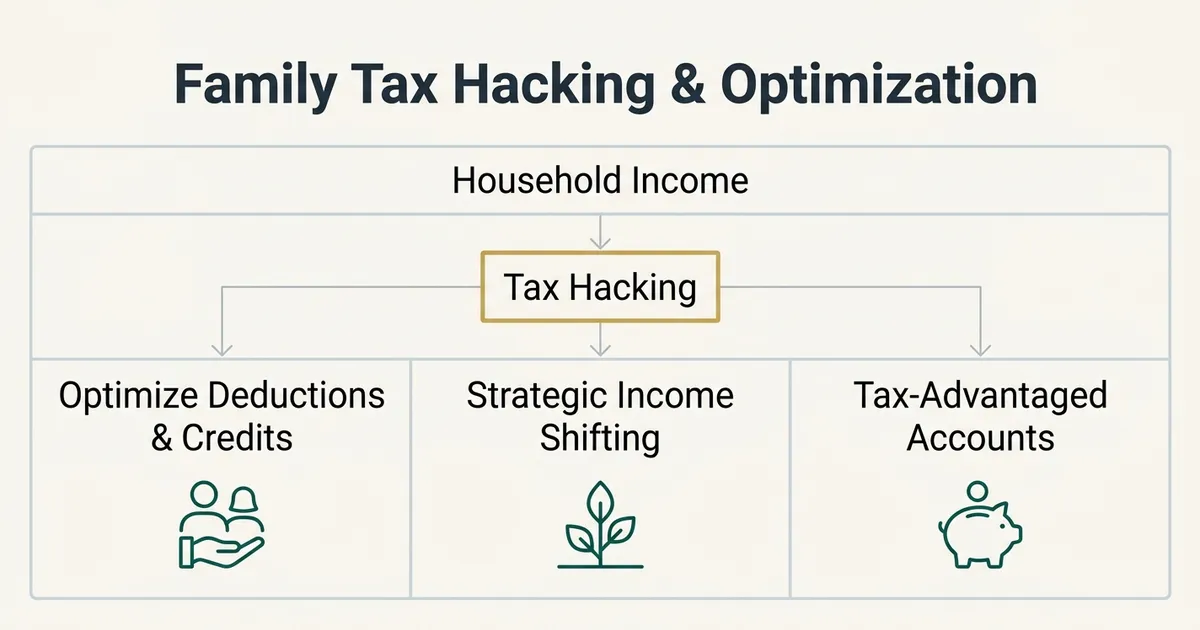
Every dollar a household sends to the IRS unnecessarily is a dollar that can't compound in a child's Roth IRA or a 529 plan. For parents of pre-K through middle-school kids who also run a side business — an Etsy shop, a consulting LLC, a rental, freelance design work — the tax code offers a specific, legal set of levers that most families never pull: paying kids for real work and funneling that income into Roth accounts, running dependent care and health costs through pre-tax accounts instead of after-tax dollars, claiming the Child Tax Credit correctly instead of leaving phase-out math to chance, deducting a legitimate home office, and (where still available) claiming what's left of residential energy credits. None of these require aggressive interpretations of the law. They require sequencing: knowing which lever applies to your income level, your business structure, and your state, and in what order to pull them before the money ever becomes "spendable" income subject to full marginal tax.
This hub maps that decision tree. It does not tell you where to invest what you save — that's the domain of family dividend-investing strategy — but it tells you, mechanically and with current thresholds, how to shrink the tax bill in the first place so there's more principal to invest at all.
Who is this actually for, and what changed recently?
The strategies below assume three things: you have at least one dependent child under 17, you have some form of self-employment or business income (even modest, part-time income counts), and you file a federal return where itemizing or business deductions are on the table. If you're a W-2-only household with no side business, most of the earned-income and home-office material won't apply to you directly — go straight to the Child Tax Credit and dependent-care sections.
The landscape shifted materially in 2025. The One Big Beautiful Bill Act (Pub. L. 119-21, signed July 4, 2025) permanently raised the Child Tax Credit to $2,200 per qualifying child starting with tax year 2025, indexed for inflation thereafter, and made the 20% qualified business income (QBI) deduction under IRC §199A permanent instead of letting it expire after 2025 as originally scheduled under the 2017 Tax Cuts and Jobs Act. The same law also terminated two credits this hub used to recommend without reservation: the Residential Clean Energy Credit (IRC §25D, mainly solar) and the Energy Efficient Home Improvement Credit (IRC §25C, insulation, windows, heat pumps) both stopped applying to property placed in service after December 31, 2025. If you're reading this in the 2026 tax year, those two credits are gone for new purchases — a caveat covered in full in its own section below, not repeated elsewhere in this hub.
Which lever should a parent pull first?
Order matters because some levers reduce taxable income before your marginal rate is calculated (pre-tax accounts, business deductions), while others are credits applied after tax is computed (Child Tax Credit, Child and Dependent Care Credit, remaining energy credits). Generally: maximize above-the-line and pre-tax reductions first (HSA, Dependent Care FSA, legitimate business deductions including a home office and paying your kids), because those reductions can also affect your eligibility for phase-in/phase-out credits computed on adjusted gross income (AGI) or modified AGI (MAGI). Only after AGI is set do you calculate what credits you're entitled to.
A parent earning $140,000 from a W-2 job plus $30,000 net from a side LLC, filing married filing jointly, sits in the 22% federal bracket for 2025 (taxable income roughly $96,950–$206,700 for MFJ, per IRS Rev. Proc. 2024-40, issued October 2024). Every dollar of legitimate business deduction at that income is worth 22 cents in federal tax plus whatever the applicable state marginal rate adds — in California, up to 9.3% at moderate incomes per the Franchise Tax Board's rate schedule, meaning some deductions there are worth over 31 cents on the dollar combined.
How do you legally pay your kids and fund their Roth IRAs?
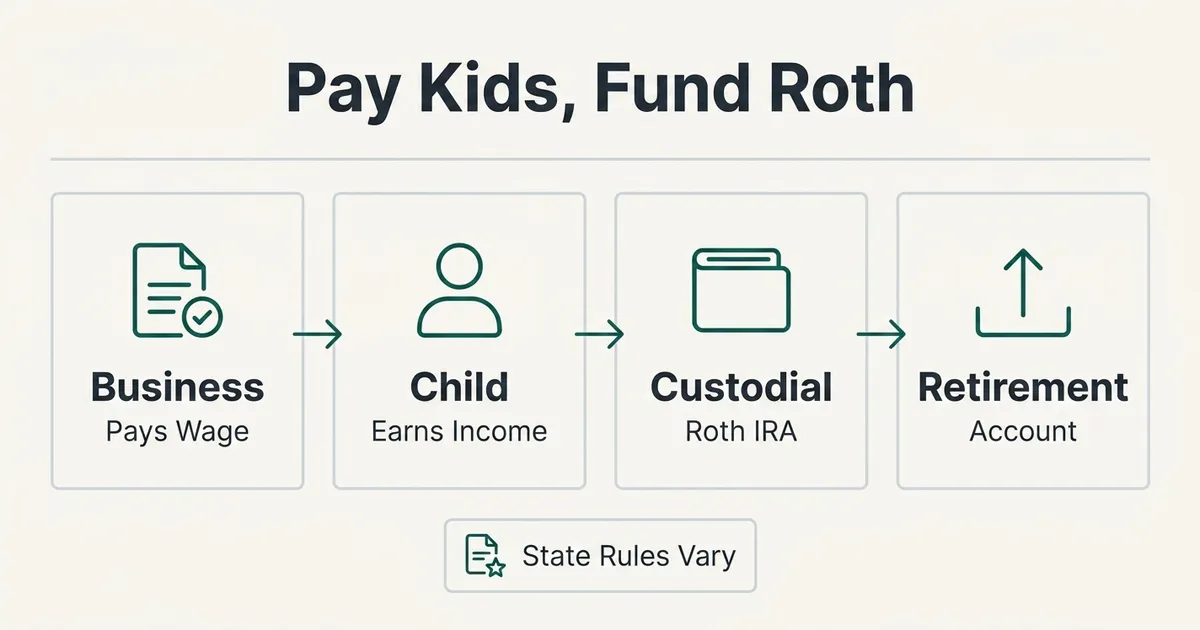
This is usually the single largest lever available to a parent-owned side business with young kids. If your business is a sole proprietorship, or a partnership where both partners are the child's parents, wages paid to your under-18 child for real work are exempt from Social Security and Medicare tax under IRC §3121(b)(3) — the business still deducts the wage as an ordinary and necessary expense, but neither the child nor the parent-employer owes FICA on it. That exemption does not apply if the business is a corporation or a partnership with a non-parent partner.
The child's earned income is then largely shielded from federal income tax by their own standard deduction. For 2025, a dependent's standard deduction equals earned income plus $450, capped at the regular single standard deduction of $15,750 (a figure raised by the OBBBA from the pre-law $15,000 baseline; confirm the 2026 inflation-adjusted number before filing, since Rev. Proc. 2025-32 or its successor resets it each fall). Practically: pay a 10-year-old $9,000 for real, documented tasks — organizing inventory photos, packing orders, basic data entry appropriate to their age — and the child owes zero federal income tax on it, because $9,000 is under the standard deduction. The wage must be reasonable for the work performed and the child's age; the IRS has successfully challenged wages to very young children for implausible "executive" tasks, so keep a timesheet and pay by the actual job.
Because the child now has $9,000 of earned income, they (or their parent, as custodian) can contribute up to that amount — capped at the annual IRA limit of $7,000 for 2025 under IRC §219(b)(5), unchanged from 2024 — into a custodial Roth IRA. Contribution amounts can never exceed the lesser of earned income or the annual cap; unearned income like dividends or gifted cash does not count toward eligibility. This is the mechanical bridge between this pillar and family dividend-investing: the tax code determines how much can legally reach the Roth account; what happens to it once invested is a separate decision.
Illustrative example (not a projected outcome): A family LLC pays two children, ages 8 and 12, a combined $12,000 in 2025 for documented, age-appropriate work. The business deducts $12,000 as wage expense. At a 24% marginal federal bracket, that deduction saves the parents roughly $2,880 in federal tax (24% × $12,000), plus a state-tax benefit that varies by state — in California, an additional roughly $1,116 at a 9.3% marginal rate, for illustration only. Each child owes no federal income tax because $6,000 is under their standard deduction. If both children's full $6,000 is contributed to custodial Roth IRAs (within the $7,000 annual cap), $12,000 moves from the parents' side-business profit into two Roth accounts that can compound tax-free for 50+ years before any withdrawal. The actual dollar benefit of decades of compounding is not guaranteed and depends on market returns, contribution consistency, and account fees — this example illustrates the tax mechanics only, not an investment return.
Dependent care and health accounts: FSA, credit, or HSA — how do they stack?
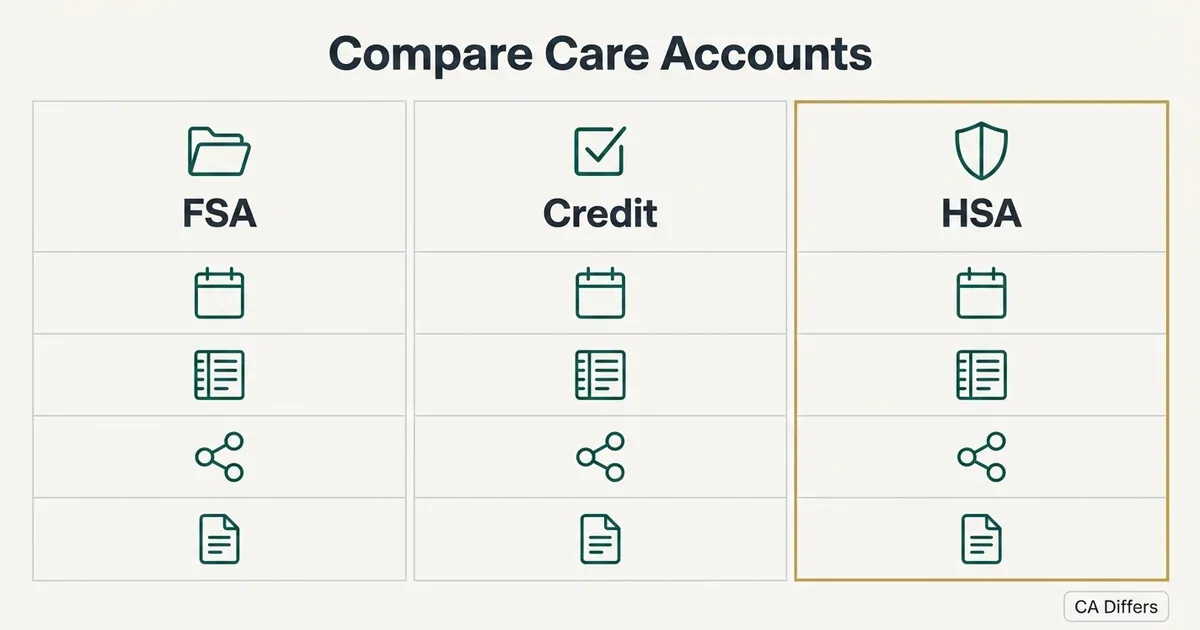
Parents of pre-K and elementary-age kids typically pay for some mix of daycare, before/after-school care, or summer day camp, plus ordinary medical costs. Three federal mechanisms address this, and they interact in ways that trip people up: a Dependent Care Flexible Spending Account (FSA) run through an employer, the Child and Dependent Care Credit claimed on Form 2441, and a Health Savings Account (HSA) paired with a qualifying high-deductible health plan. You generally cannot double-dip — expenses reimbursed by a Dependent Care FSA can't also be counted toward the Child and Dependent Care Credit.
The Dependent Care FSA cap has been fixed by statute at $5,000 per household ($2,500 if married filing separately) under IRC §129(a)(2)(A) since 1986 — it is one of the few major tax figures in this hub that Congress has never indexed for inflation, so its real value has eroded for four decades. The Child and Dependent Care Credit, described in IRS Publication 503, allows a credit of 20%–35% of up to $3,000 in care expenses for one qualifying child or $6,000 for two or more, with the percentage sliding down to 20% once AGI exceeds $43,000 — a threshold that has also stayed flat for years, meaning most dual-income households land at the 20% floor. For a family with $6,000 in eligible expenses and two kids, that's a maximum $1,200 nonrefundable credit if no FSA was used, versus potentially larger savings from running $5,000 through a pretax FSA at a 24%+ marginal rate (worth $1,200+ in tax reduction) and claiming the credit only on the $1,000 remainder.
HSAs are a separate track, tied to health expenses, not dependent care, but they matter because many self-employed parents choose a high-deductible health plan for the household precisely to unlock one. According to the IRS in Rev. Proc. 2025-19 (May 2025), 2026 HSA contribution limits rise to $4,400 for self-only coverage and $8,750 for family coverage, with a $1,000 catch-up contribution for account holders 55 and older (a fixed statutory amount, not adjusted for inflation). HSA contributions are deductible even if you don't itemize, the funds grow tax-free, and qualified medical withdrawals are tax-free at any age — making it arguably the single best tax-advantaged wrapper in the federal code, ahead of even a traditional IRA, for a family that can afford to pay some medical costs out of pocket and let the HSA balance grow.
| Lever | 2025–2026 Federal Cap | Pretax or Credit | Key Restriction |
|---|---|---|---|
| Dependent Care FSA | $5,000/household (IRC §129) | Pretax salary reduction | Employer plan required; use-it-or-lose-it in most plans |
| Child & Dependent Care Credit | $3,000 (1 child) / $6,000 (2+) in expenses | Nonrefundable credit, 20–35% | Cannot overlap with FSA-reimbursed expenses |
| HSA (family coverage) | $8,750 for 2026 (Rev. Proc. 2025-19) | Pretax/above-the-line deduction | Requires HDHP; unused balance rolls over indefinitely |
| Child Tax Credit | $2,200/child (OBBBA, 2025 forward) | Partially refundable credit | Phases out above $200,000 single / $400,000 MFJ MAGI |
| Kids' earned-income Roth | Lesser of earned income or $7,000 (2025 IRA cap) | Tax-free growth wrapper | Wage must be for real, documented, age-appropriate work |
| Home office (simplified method) | $5/sq ft up to 300 sq ft = $1,500 max | Above-the-line business deduction | Space must be used regularly and exclusively for business |
What does the Child Tax Credit actually pay, and who gets phased out?
For 2025 and beyond, the Child Tax Credit is $2,200 per qualifying child under age 17, set permanently by the OBBBA rather than reverting to the pre-2018 $1,000 figure that TCJA's sunset had threatened. Up to $1,700 of the credit is refundable as the Additional Child Tax Credit for taxpayers with at least $2,500 of earned income (2025 figure; this cap is indexed and should be confirmed against the current-year revenue procedure before filing). The credit phases out at $50 for every $1,000 of MAGI above $200,000 for single/head-of-household filers or $400,000 for married filing jointly — thresholds that, unlike most tax figures, are not indexed for inflation and have stayed fixed since 2018, meaning more families drift into the phase-out zone every year as wages rise.
The child must have a Social Security Number valid for employment, live with the taxpayer more than half the year, and be claimed as a dependent — rules unchanged by the 2025 law. Parents running a side business that produces a large Schedule C loss should note the credit is based on MAGI, so aggressive expense timing that pushes MAGI down in one year can preserve a bigger CTC that year, but shifting income between years has its own complications (self-employment tax still applies to net Schedule C profit regardless of income-shifting for CTC purposes) and should be modeled with an actual tax return, not assumed.
Can your side hustle or home office shrink your tax bill?
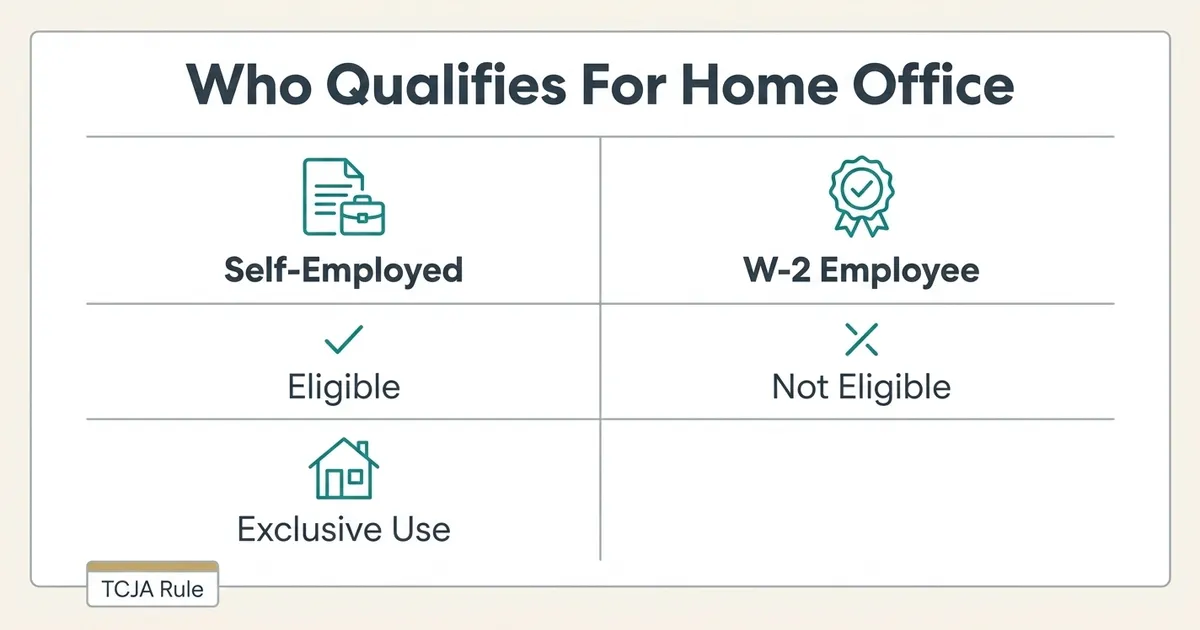
A home office deduction is available to self-employed parents (not W-2 employees, following the TCJA suspension of the unreimbursed employee expense deduction) if part of the home is used regularly and exclusively for business. The IRS's simplified method allows $5 per square foot up to 300 square feet, for a maximum $1,500 deduction — no receipts required for the space itself, though business supply and equipment costs are still deducted separately. The regular method instead prorates actual home expenses (mortgage interest or rent, utilities, insurance, depreciation) by the business-use percentage of square footage, which produces a larger deduction for households with high housing costs but requires more substantiation and triggers depreciation recapture rules if the home is later sold at a gain.
Beyond the home office, the OBBBA's permanent extension of the 20% Qualified Business Income deduction under IRC §199A means most sole proprietors, single-member LLCs, and pass-through partnership owners can deduct 20% of qualified business income before it hits their individual tax return — subject to income-based limitations for specified service trades (law, accounting, consulting, health, among others) once taxable income exceeds roughly $197,300 single / $394,600 MFJ for 2025 (figures indexed annually; confirm the exact 2026 thresholds). A parent netting $30,000 from a side consulting business below that threshold can typically deduct $6,000 (20% of $30,000) before calculating income tax, though self-employment tax (15.3% on net earnings up to the Social Security wage base, adjusted annually by the Social Security Administration) still applies to the full net profit regardless of the QBI deduction.
Ordinary business expenses — a percentage of internet and phone bills used for the business, mileage for business errands at the IRS standard mileage rate, a portion of software subscriptions, business insurance — reduce Schedule C net profit dollar-for-dollar and lower both income tax and the self-employment tax base. Documented mileage logs and separate business bank accounts are the difference between a clean deduction and an unsupportable one in an IRS examination; commingled personal and business expenses are the most common reason a home-based side business's deductions get disallowed on audit.
Are residential energy credits still worth pursuing in 2026?
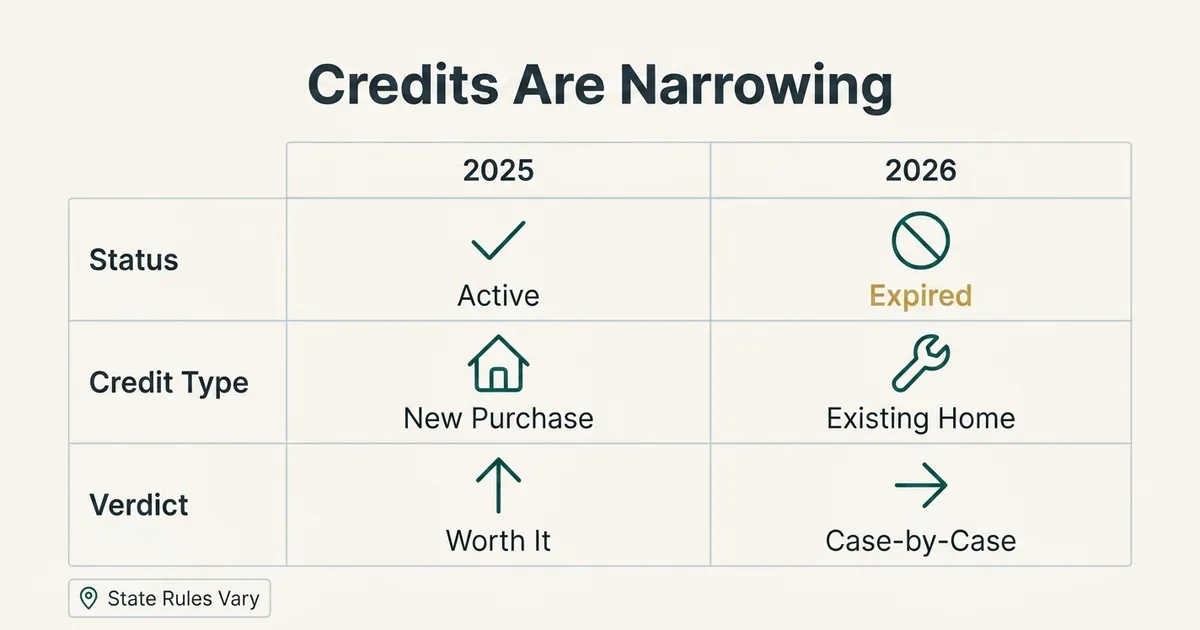
Largely, no — for new purchases. The Inflation Reduction Act of 2022 had extended the Residential Clean Energy Credit (25D, 30% of solar, battery storage, and geothermal costs with no dollar cap) and the Energy Efficient Home Improvement Credit (25C, 30% of costs for insulation, doors, windows, and heat pumps, capped at $1,200/year for most improvements and $2,000/year for heat pumps) through 2032 and 2033 respectively. The OBBBA reversed that: both credits terminate for property placed in service after December 31, 2025. A family installing solar panels or a heat pump in 2026 gets no federal credit under these sections, a significant change from guidance many households were relying on as recently as mid-2025.
What survives: if a qualifying installation was placed in service on or before December 31, 2025, the credit can still be claimed on that year's return (filed in 2026) even though the credit itself no longer applies going forward — check installation and "placed in service" dates carefully, since a signed contract in 2025 with installation completed in January 2026 would not qualify. Some state-level incentives remain independent of the federal repeal; California's Self-Generation Incentive Program and various utility rebates, for instance, operate under state authority and were unaffected by the federal statute, so a California family should check state and utility programs separately rather than assume all incentives disappeared with the federal credit.
What's the biggest mistake that costs families the most?
The most expensive error is treating the Child Tax Credit's non-refundable and phase-out mechanics as an afterthought instead of planning around them, followed closely by paying children informally (cash, no timesheets, no W-2 or 1099) in a way that can't survive scrutiny if the IRS ever questions the wage deduction. A wage paid to a child must be for real work reasonably compensated at a defensible rate; a $20,000 "salary" to a 6-year-old for undefined duties invites the IRS to disallow the deduction entirely, which erases both the business deduction and the FICA exemption assumption built on top of it. Second-most-expensive: forgetting that a Dependent Care FSA and the Child and Dependent Care Credit can't both apply to the same dollar of expense, so a family maxes out a $5,000 FSA and then mistakenly also claims the credit on that same $5,000 — a mismatch the IRS's matching program on Form 2441 is specifically designed to catch. Third: missing that HSA contributions, unlike most retirement contributions, have no income phase-out at all — high earners routinely skip HSAs because they assume income limits apply, when the only gating requirement is enrollment in a qualifying high-deductible health plan.
How does this play out in California versus other states?
Federal rules above apply nationwide regardless of state of residence, but state conformity varies, and California is a useful — and unusually non-conforming — example. California does not conform to the federal HSA deduction: contributions are deductible for federal purposes but remain taxable income at the state level, and HSA earnings are taxed annually by California as ordinary investment income rather than growing tax-deferred, according to the California Franchise Tax Board's guidance in Publication 1005. A California family maximizing an $8,750 family HSA contribution in 2026 gets the full federal above-the-line deduction but no matching state deduction, and owes California tax each year on interest, dividends, or capital gains inside the account — a meaningful erosion of the HSA's usual advantage for California residents specifically.
California does conform closely to federal Dependent Care FSA and Child and Dependent Care Credit treatment, and layers its own refundable Young Child Tax Credit on top of the federal CTC for lower-income working families with a child under age 6, available to households that also qualify for the California Earned Income Tax Credit — a benefit worth confirming directly with the Franchise Tax Board given its income ceiling is far lower than the federal CTC's phase-out range. Other states vary widely: several states with no income tax (Texas, Florida, Washington among them) make state conformity questions moot for these specific credits, while most states with an income tax broadly follow federal AGI as their starting point but diverge on HSA and, in a few cases, dependent-care specifics — verify your own state's treatment before assuming the federal answer applies at the state level too, since an incorrect assumption here is a common source of state tax notices for families who otherwise filed correctly.
Putting the pieces together before reinvesting
None of these levers exist in isolation. A parent running a side business typically works through them in a rough order across a tax year: set up payroll for kids doing real work first (it affects both the business deduction and the FICA/Roth math), enroll in the Dependent Care FSA or plan for the Child and Dependent Care Credit depending on which produces a larger benefit at your marginal rate, maximize HSA contributions if enrolled in a qualifying high-deductible plan, claim the home office and ordinary business deductions on Schedule C along with the QBI deduction, and only then calculate what Child Tax Credit amount survives the phase-out at your final MAGI. What's left over — the dollars that would otherwise have gone to the IRS — is the pool this hub is designed to shrink the outflow from. Where those saved dollars go next, whether into a custodial brokerage account, a 529 plan, or a family dividend-investing strategy built around the children's Roth IRAs funded through the earned-income mechanics above, is a separate decision covered elsewhere on this site.
Guides in this cluster
- Best Custodial Roth IRA Providers for Kids in 2026
- Solar Tax Credit for Homeowners: What Changed in 2026
- Child Tax Credit Eligibility Rules 2026: Who Qualifies
- Home Office Deduction for Side Business: 2026 Guide
- Hiring Family Members: How to Pay Your Kids Tax-Free 2026
- Health Reimbursement Arrangement: A 2026 Family Tax Guide
- Childcare Tax Credit vs. Dependent Care FSA in 2026
- S Corp vs LLC: Which Saves Your Family More Tax in 2026?
- Solo 401k 2026: How Self-Employed Parents Cut Taxes