Solo 401k 2026: How Self-Employed Parents Cut Taxes

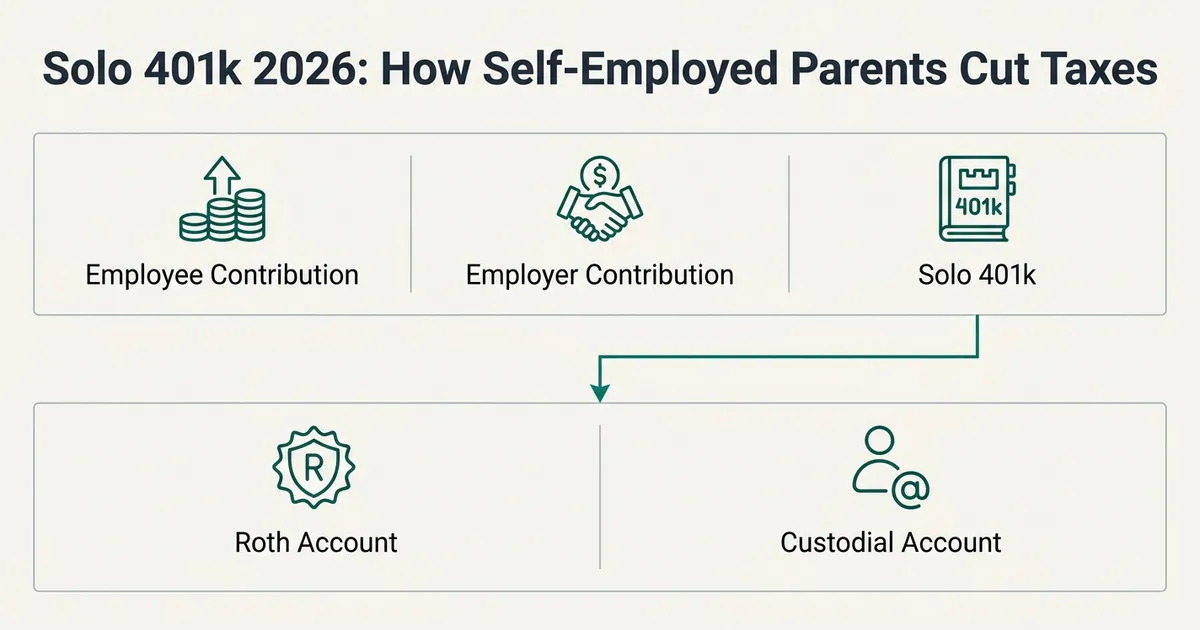
A solo 401k lets self-employed parents shelter up to $72,000 of 2026 self-employment income from federal tax in a single plan. You contribute as both the "employee" and the "employer" of your own side business, then redirect the tax savings into your kids' Roth or custodial accounts.
This account works best for parents earning consistent 1099 or Schedule C income from a side business — freelance consulting, e-commerce, tutoring, real estate side deals — with no full-time employees other than a spouse. According to the IRS (Publication 560, 2025), a solo 401k is formally a "one-participant 401(k) plan," open to any business owner who has no common-law employees besides a spouse, regardless of whether the business is a sole proprietorship, single-member LLC, partnership, or S-corp. The entity you operate as does change how much you can contribute and how the payroll tax lands, which S-corp vs LLC for a family business works through.
What Is a Solo 401k, and Who Actually Qualifies?
A solo 401k is a 401(k) plan for a business with exactly one working owner (or an owner-and-spouse team) instead of a workforce. The mechanism that makes it powerful: because you are simultaneously the employer and the employee of your own business, IRS rules let you make contributions in both roles, stacking two separate contribution limits into one account.
You qualify if you have self-employment income — Schedule C profit, a partnership K-1, or W-2 wages from your own S-corp — and no employees who work 1,000 or more hours a year (or, under newer rules, 500-999 hours for two consecutive years) other than your spouse. Per the IRS (2025), hiring even one qualifying non-spouse employee generally forces you to either cover that worker under the plan or replace the solo 401k with a standard 401(k) or SEP IRA that treats employees equitably.
A side hustle that nets $15,000 a year from freelance graphic design qualifies exactly the same as one netting $150,000 — the plan has no minimum income requirement, only a minimum-eligibility test on employees.
How Much Can You Contribute to a Solo 401k in 2026?
You can contribute up to $72,000 to a solo 401k in 2026 if you're under 50, combining an employee deferral with an employer profit-sharing contribution. According to the IRS's annual cost-of-living adjustment notice (November 2025), the 2026 elective deferral limit is $24,500, and the overall combined employee-plus-employer limit under Internal Revenue Code Section 415(c) is $72,000.
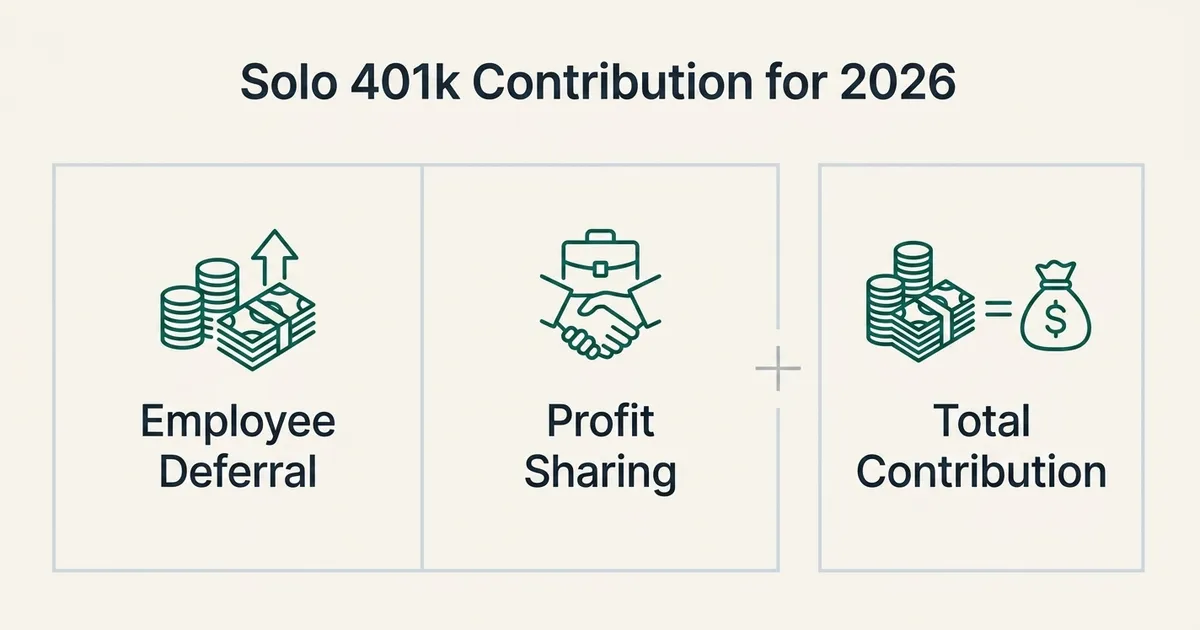
The mechanism behind the higher cap versus a SEP IRA is the two-part structure. As the "employee," you can defer up to $24,500 of net self-employment earnings directly, dollar for dollar, regardless of how much you earn (as long as you earn at least that much). As the "employer," your business can then add a profit-sharing contribution of roughly 20% of net self-employment earnings — per the IRS Publication 560 (2025) worksheet, sole proprietors and single-member LLCs use 20% rather than the 25% corporate figure because the calculation nets out half of self-employment tax before applying the rate.
Worked example: A parent runs a freelance design business netting $80,000 in Schedule C profit in 2026 and is 42 years old. She defers the full $24,500 as the "employee." Her net self-employment earnings after the one-half SE tax adjustment run about $74,350, so her "employer" profit-sharing contribution is roughly $14,870 (20% of $74,350). Total contribution: about $39,370 — all deductible from both her federal and California taxable income, well under the $72,000 combined cap.
If she were 55 instead, she could add an additional $8,000 catch-up deferral, per the IRS (November 2025) 2026 catch-up figure, pushing her total to about $47,370 without touching the profit-sharing math. Parents aged 60-63 get an even larger catch-up of $11,250 under a SECURE 2.0 Act (2022) provision aimed at workers closest to retirement. A separate SECURE 2.0 provision — the mandatory-Roth catch-up rule — takes effect for 2026, and it is widely misreported, so read it carefully if you are 50 or older. It applies only to participants whose FICA wages from the employer sponsoring the plan exceeded $150,000 in the prior year ($145,000 is the statutory base; $150,000 is the indexed 2026 figure). Because a sole proprietor's Schedule C profit and a partner's K-1 income are not FICA wages, most self-employed parents reading this are outside the rule entirely and may still make catch-up contributions pre-tax. If you pay yourself a W-2 salary from your own S-corp above that threshold, you are inside it — and then all of your catch-up must be Roth, not merely the age 60-63 portion. Treasury and the IRS published final regulations on 2025-09-16; their applicability date is 2027-01-01, so 2026 operates under reasonable good-faith compliance.
Solo 401k vs. SEP IRA vs. SIMPLE IRA: Which Wins for a Side-Hustling Parent?
| Feature | Solo 401k | SEP IRA | SIMPLE IRA |
|---|---|---|---|
| 2026 max contribution (under 50) | $72,000 (employee + employer) | 20-25% of net earnings, up to $72,000 (employer only) | ~$17,000 deferral + employer match |
| Employee salary deferral allowed | Yes, up to $24,500 | No | Yes, up to ~$17,000 |
| Catch-up (age 50+) | $8,000 | Not applicable | $4,000 |
| Roth option | Yes, most providers | Yes, since SECURE 2.0 (2022) | Yes, since SECURE 2.0 (2022) |
| Participant loans | Yes, up to $50,000 or 50% of balance | No | No |
| Form 5500-EZ filing | Required once assets exceed $250,000 | Never required | Never required |
| Employees other than spouse | Disqualifying (with narrow exceptions) | Must cover eligible employees | Must cover eligible employees, up to 100 |
| Best for | Highest earner wanting max deduction and loan access | Owner with fluctuating income wanting zero paperwork | Owner with a few part-time staff wanting a cheap plan |
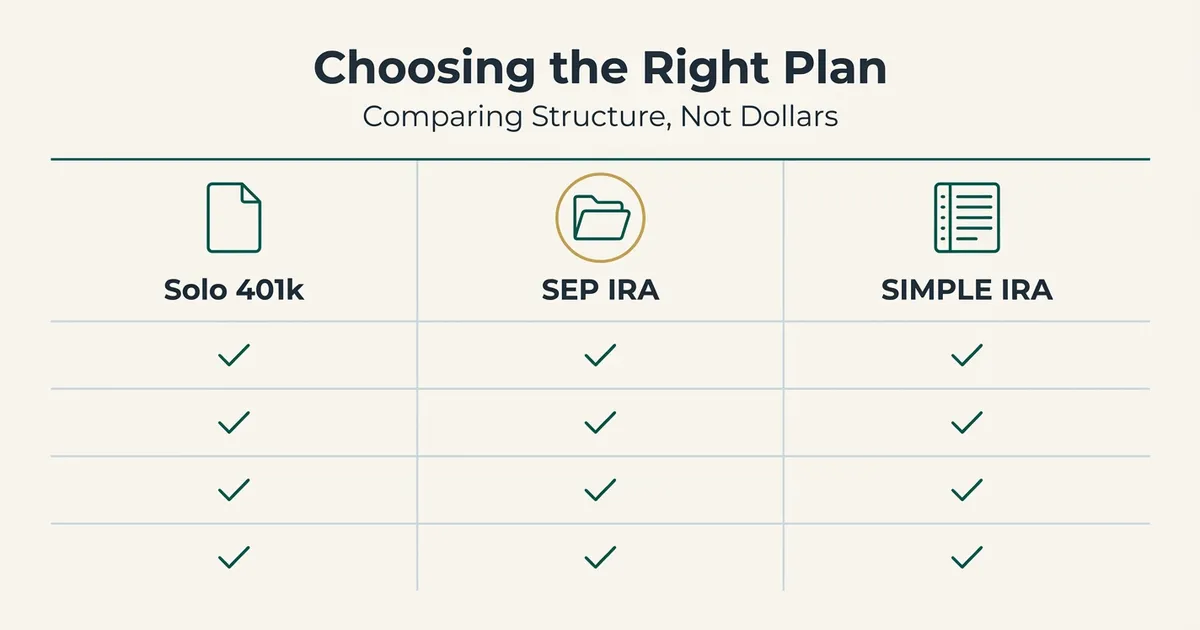
The solo 401k wins for a parent who earns at least $60,000-$80,000 in net side-hustle income and wants the largest possible deduction, because the employee-deferral piece lets you max out contributions on far less income than a SEP IRA requires — a sole proprietor's SEP IRA needs roughly $360,000 of net earnings — after the half-of-SE-tax adjustment — to reach the same $72,000 cap through the 20% employer formula alone, per the IRS Publication 560 (2025) contribution worksheet. (The often-quoted $288,000 breakeven is the 25% figure that applies to W-2 compensation in a corporation, not to Schedule C net earnings.) Choose a SEP IRA instead if you expect to bring on a part-time employee soon and don't want to unwind a solo 401k, or if you want a plan you can open and fund with a single form and no ongoing filing. Choose a SIMPLE IRA only if your side business already has a couple of part-time employees you're contractually obligated to include — it's rarely the right fit for a solo-parent side hustle from the start.
How Does a Solo 401k Actually Cut Your Tax Bill This Year?
A solo 401k cuts your tax bill by removing dollars from your adjusted gross income (AGI) before your federal and state brackets ever apply to them, not by giving you a tax credit. The mechanism: contributions are an "above-the-line" deduction claimed on Schedule 1 of Form 1040, so they lower AGI directly rather than requiring you to itemize.
Worked example: A California parent nets $120,000 from a side consulting business and sits in the 24% federal bracket and California's 9.3% state bracket. Contributing $30,000 to her solo 401k (a mix of employee deferral and employer contribution) lowers her combined marginal tax hit by roughly $9,990 (33.3% of $30,000) in the year she contributes. According to the California Franchise Tax Board (2025), California generally conforms to federal rules for deducting solo 401(k) contributions, so the same $30,000 reduces both her federal and state taxable income simultaneously — she doesn't get a double deduction, but she also doesn't lose the benefit at the state level the way she would with certain federal-only credits.
That $9,990 in avoided tax is the "family tax hacking" lever: instead of sending it to the IRS and California's Franchise Tax Board, she can route it into her children's custodial or Roth accounts, provided the kids have their own qualifying earned income. Compare providers for that next step using this guide to the best custodial Roth IRA providers, which covers account minimums and fees for parents opening a child's first retirement account.
What Rules Can Sink Your Solo 401k If You Break Them?
The rule that trips up the most side-hustling parents is the plan-establishment deadline, because it's earlier than most people assume for the deferral portion of the contribution. Under the SECURE 2.0 Act (2022), a sole proprietor can now adopt a brand-new solo 401k after December 31 and still make an employee elective-deferral contribution for that prior year — but only if the plan is adopted and the deferral election is made by the unextended tax-filing deadline (April 15 for most sole proprietors), not the extended October deadline. Employer profit-sharing contributions, by contrast, can still be made up until the extended filing deadline.
Second, once your solo 401k's total assets exceed $250,000 at the end of the plan year, you must file Form 5500-EZ with the IRS annually — a rule the IRS (2025) enforces with a penalty of $250 per day the return is late, capped at $150,000, though first-time filers can often use the IRS's delinquent filer relief program to avoid the penalty entirely.
Third, hiring even a single part-time non-spouse worker can end your solo 401k's eligibility faster than you'd expect. Per Department of Labor and IRS guidance on long-term part-time employees (2024), workers who log 500-999 hours a year for two consecutive years must generally be allowed into your retirement plan starting with plan years beginning in 2025, which for a solo plan usually means converting to a standard 401(k) or SEP IRA rather than covering them under the same one-participant structure.
Finally, contributing above the $72,000 combined cap (or $80,000-$83,250 with catch-up) creates an excess annual addition under Section 415(c), which has to be corrected through the IRS's Employee Plans Compliance Resolution System — typically a corrective distribution reported on Form 1099-R and included in your income, though the 10% early-distribution tax under Section 72(t) does not apply to it. (The flat 6% excise tax you may have read about is the IRA rule under Section 4973, not the 401(k) one.) Either way the fix costs time and money, so if your income projection changes mid-year, true up your contribution before your tax-filing deadline rather than after.
What's the Downside of a Solo 401k for a Parent Running a Side Hustle?
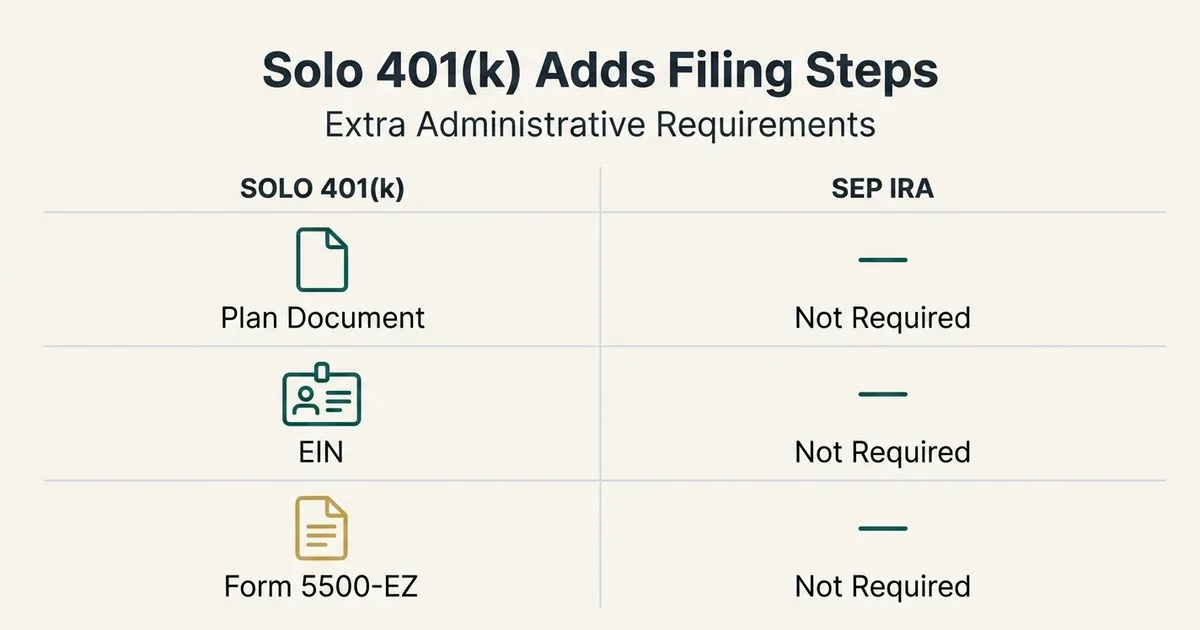
The main downside is administrative: a solo 401k requires a formal plan document, an EIN for the plan, and — once you cross $250,000 in assets — an annual Form 5500-EZ filing that a SEP IRA never requires, per the IRS (2025). That paperwork burden is a real cost in time, not just dollars, for a parent already juggling a side business and school pickup.
The second downside is inflexibility around employees: the moment your side hustle grows enough that you need part-time help beyond your spouse, you likely have to unwind or convert the plan, which most providers can do without penalty but which still costs you an afternoon of admin work. The third downside is that the two-part contribution math (employee deferral plus employer profit-sharing) is easy to miscalculate for a first-timer, and overcontributing means the EPCRS correction discussed above.
Decision rule: Skip the solo 401k and use a SEP IRA instead if your side-hustle income is inconsistent year to year, if you're likely to hire even one part-time employee within two years, or if your net earnings are under roughly $25,000 a year — at that income level, the extra deduction room a solo 401k offers over a SEP IRA is small, and a Roth IRA in your own name may deliver more usable flexibility. Choose the solo 401k if you earn a stable $50,000+ in side income, want the participant-loan option, and expect to run the business solo for the foreseeable future.
How Do You Open a Solo 401k and Redirect the Savings Into Your Kids' Accounts?
Open the plan with a brokerage that supports Roth contributions, and check the loan question against the plan document rather than the marketing page — neither Fidelity's Self-Employed 401(k) nor Schwab's Individual 401(k) permits participant loans, and Schwab's basic plan document says so in terms ("Loans are not permitted under this Plan"). E*TRADE's Solo 401(k) does allow loans of up to $50,000 or 50% of the vested balance, whichever is less. Solopreneurs who want both a major custodian and loan access typically adopt a third-party plan document that permits loans and custody the assets at the broker. Vanguard exited the small-business retirement plan market in 2022, transferring existing individual 401(k) accounts to Ascensus, according to Vanguard (2022) — so new solo 401k shoppers generally won't find a Vanguard-branded option today.
Step-by-step:
- Confirm eligibility — no non-spouse employees working 500+ hours a year, per the long-term part-time employee rules above.
- Adopt the plan document before December 31 for full flexibility, or by your unextended filing deadline if you're claiming a prior-year deferral under the SECURE 2.0 Act (2022) sole-proprietor provision.
- Calculate your contribution using the IRS Publication 560 (2025) worksheet — employee deferral up to $24,500, employer contribution around 20% of net self-employment earnings.
- Fund the employee-deferral portion by your tax-filing deadline and the employer portion by your extended deadline.
- Quantify the tax savings (multiply the contribution by your combined marginal federal-plus-state rate) and route that freed-up cash into a child's custodial account or, if the child has qualifying earned income, a custodial Roth IRA.
Parents stacking multiple tax-reduction strategies in the same year often combine a solo 401k with the deductions covered in this guide to home office and side-hustle deductions, then layer in the Child Tax Credit maximization rules and, for families with home-equity to deploy, solar tax credits and utility savings. For the full framework on sequencing these moves, start at the family tax-reduction strategies hub.
Frequently asked questions
What is the downside of a Solo 401k?
The main downside is administrative burden: a solo 401k requires a formal plan document and, once assets exceed $250,000, an annual Form 5500-EZ filing with the IRS, a requirement a SEP IRA never triggers, according to the IRS (2025). It also becomes disqualifying the moment you hire a non-spouse employee who works 500 or more hours a year for two consecutive years, per Department of Labor and IRS long-term part-time employee guidance (2024), forcing a costly plan conversion.
What are the rules for a Solo 401k?
You must have self-employment income and no common-law employees besides a spouse, and your combined employee-plus-employer contribution can't exceed $72,000 in 2026 (before catch-up), according to the IRS's annual cost-of-living adjustment notice (November 2025). Employee deferrals for a newly adopted plan covering a prior year must be elected by your unextended tax-filing deadline under the SECURE 2.0 Act (2022), while employer profit-sharing contributions can wait until your extended deadline, and plans holding over $250,000 must file Form 5500-EZ annually.
Which company has the best Solo 401k?
The best provider depends on whether you value loan access or rock-bottom simplicity. Participant loans are rarer than you'd expect at the big discount brokers: Schwab's Individual 401(k) basic plan document states plainly that loans are not permitted, and Fidelity's Self-Employed 401(k) does not allow them either. E*TRADE's Solo 401(k) does permit loans of up to $50,000 or 50% of the vested balance, whichever is less. If loan access matters, check the plan document itself rather than the marketing page, or use a third-party plan document that allows loans while custodying the assets at your preferred broker. Vanguard no longer offers new individual 401(k) plans directly, having transferred its small-business retirement business to Ascensus in 2022.
Is there a difference between an individual 401k and a Solo 401k?
No — "individual 401(k)," "one-participant 401(k)," and "solo 401k" all describe the same IRS plan structure for a business owner with no employees other than a spouse, per the IRS Publication 560 (2025). Providers simply use different marketing names for the identical underlying plan design, so the contribution limits and eligibility rules are the same regardless of which term a brokerage uses on its website.
What are the Solo 401k contribution limits?
A solo 401k combines an employee elective deferral with an employer profit-sharing contribution, capped in total by the IRS's Section 415(c) annual limit. For the current tax year, that combined limit is $72,000 for participants under 50, rising with age-based catch-up contributions, according to the IRS's annual cost-of-living adjustment notice (November 2025) — figures that adjust for inflation every year, so confirm the current-year numbers directly at IRS.gov before filing.
What are the Solo 401k contribution limits for 2026?
For 2026, the employee elective-deferral limit is $24,500, the combined employee-plus-employer limit is $72,000 for those under 50, and catch-up contributions add $8,000 for ages 50-59 or $11,250 for ages 60-63, according to the IRS's annual cost-of-living adjustment notice (November 2025). The SECURE 2.0 mandatory-Roth catch-up rule bites from 2026, but it keys on FICA wages, so it reaches far fewer self-employed parents than the headlines suggest: it applies only if your prior-year FICA wages from the business sponsoring the plan exceeded $150,000 (the 2026 indexed figure; $145,000 is the statutory base). A sole proprietor or partner has no FICA wages — Schedule C profit and a K-1 are not W-2 wages — so the mandate does not reach them at all. An owner drawing a W-2 salary from their own S-corp above that threshold is caught, and then every catch-up dollar must be Roth, not just the age 60-63 amount. Treasury and the IRS published final regulations on 2025-09-16 with an applicability date of 2027-01-01, so 2026 runs on reasonable good-faith compliance.