Dividend ETFs vs Stocks 2026: Best for Kids' Accounts?

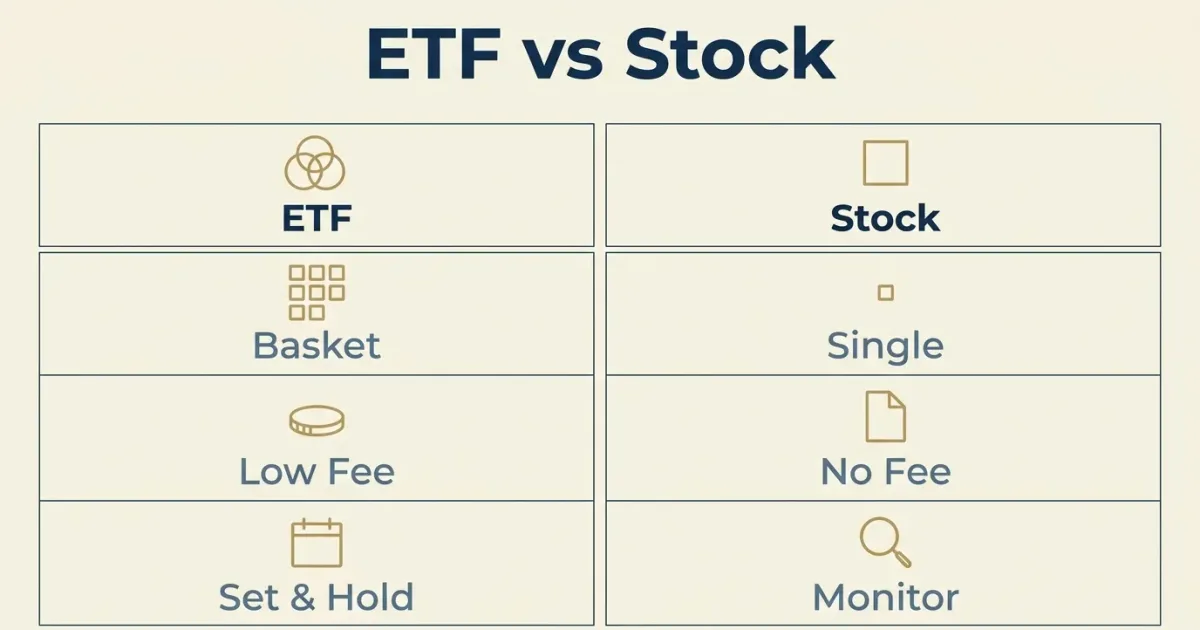
Dividend ETFs beat individual stocks for most custodial accounts because they spread risk across dozens of companies for one low annual fee. Individual stocks can outperform, but only when a parent researches and monitors each company closely. According to Morningstar (2024), the average U.S. dividend ETF holds more than 100 companies, reducing single-stock risk for a child's portfolio.
Disclaimer: This article is for educational purposes only and does not constitute personalized financial, tax, or legal advice. Consult a licensed financial advisor or tax professional before opening or funding a custodial brokerage account.
What's the Core Difference Between Dividend ETFs and Stocks?
The core difference is diversification versus concentration: a dividend ETF pools money into a basket of dividend-paying companies, while an individual stock ties a portfolio's return to one company's performance. According to the Securities and Exchange Commission (2024), an exchange-traded fund must hold a diversified basket of securities that trades under a single ticker, spreading company-specific risk automatically across every dollar invested. Per S&P Dow Jones Indices (2023), the S&P 500 Dividend Aristocrats index alone includes more than 65 companies that have raised dividends for at least 25 consecutive years, illustrating how much single-company risk an ETF removes compared with owning just one aristocrat directly in a custodial account.
How Do Dividend ETFs Work in a Custodial Account?
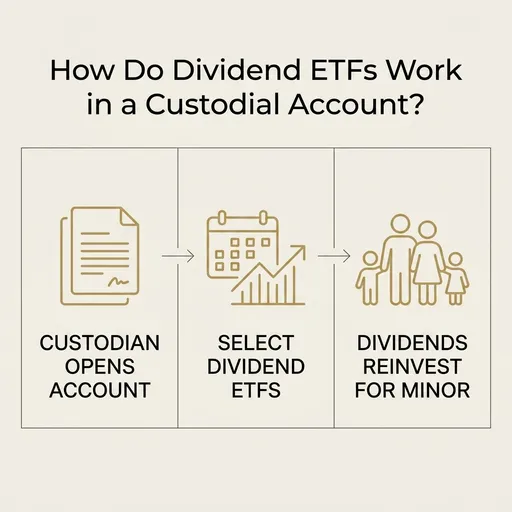
Dividend ETFs work inside a custodial account by automatically pooling quarterly payouts across every underlying holding, letting the child's balance compound without a parent selecting individual companies. According to Vanguard (2024), the Vanguard High Dividend Yield ETF (VYM) charges a 0.06% expense ratio and distributes income quarterly, which custodians can route into automatic dividend reinvestment inside a UTMA or UGMA account. Per FINRA (2023), assets held under the Uniform Transfers to Minors Act become the child's legal property once they reach their state's age of majority, typically 18 or 21, a rule that applies equally whether the account holds ETFs or single stocks—a distinction explored further in UTMA vs. UGMA: The Differences Parents Need to Know.
How Do Individual Dividend Stocks Work for Kids' Portfolios?
Individual dividend stocks work by giving a custodial account direct ownership of one company's shares, so that company's dividend growth, cuts, or suspensions flow straight through to the child's balance. According to Hartford Funds (2024), dividends and dividend growth have contributed approximately 40% of the S&P 500's total return since 1930, though that contribution varies sharply by individual company rather than applying evenly across the index. Per Charles Schwab (2024), a single dividend-paying stock carries materially higher volatility than a diversified dividend ETF, because one earnings miss or dividend cut can move an entire custodial position that cannot be diversified away without buying many additional stocks.
Which Option Wins on Cost, Risk, and Taxes?
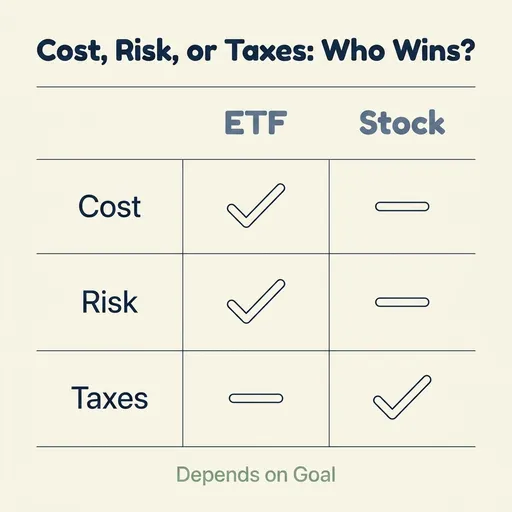
Dividend ETFs generally win on cost and risk, while individual stocks can win on tax-lot control and freedom from a recurring expense ratio, so the better choice depends on what the family wants the account to do. According to the IRS (Revenue Procedure 2025-32, November 2025), unearned income above $2,700 in a custodial account is taxed at the parent's marginal rate under the 2026 kiddie tax rules, a threshold that applies identically whether the income comes from ETF distributions or individual stock dividends—a tax profile that differs sharply from a 529 plan's tax-free treatment for qualified education expenses, though families should know a 529 isn't locked into tuition alone, as detailed in Beyond College Tuition: 4 Other Ways to Use a 529 Plan (Including the Roth IRA Rollover), a distinction covered in Custodial Account vs. 529 Plan: Which Wins in 2026?, and explained in full in Kiddie Tax Explained: 2026 Rules for Custodial Accounts.
| Factor | Dividend ETFs | Individual Dividend Stocks |
|---|---|---|
| Diversification | Broad, often 50–400+ holdings in one fund (Morningstar, 2024) | Concentrated in one company per position |
| Ongoing cost | Expense ratio, e.g., 0.06% for VYM (Vanguard, 2024) | No expense ratio, but per-trade or spread costs may apply |
| Minimum to start | Often the price of one share or a fractional share | Price of one share; fractional shares vary by broker |
| Kiddie tax treatment | Same $2,700 threshold applies (IRS Rev. Proc. 2025-32, Nov. 2025) | Same $2,700 threshold applies (IRS Rev. Proc. 2025-32, Nov. 2025) |
| Control over holdings | Limited to the fund's index or strategy | Full control over which companies are owned |
| Typical volatility | Lower, due to pooled holdings (Charles Schwab, 2024) | Higher, tied to single-company performance |
| Reinvestment | Automatic DRIP widely available (FINRA, 2023) | Automatic DRIP widely available (FINRA, 2023) |
What Happens to a Custodial Account When a Company Cuts Its Dividend?
A single-stock cut drains the entire position's income overnight, while a diversified ETF absorbs the same cut as a small fraction of total fund distributions. Per S&P Dow Jones Indices (2023), a company removed from the S&P 500 Dividend Aristocrats index for cutting or freezing its payout only reduces that stock's pro-rata weight within a broader index-based ETF, rather than eliminating a meaningful share of the fund's total income. Reuters (August 2024) reported that Intel suspended its quarterly dividend as part of a multibillion-dollar cost-cutting plan, an event that would have zeroed out a custodial account's entire dividend stream if Intel were the sole holding, but barely moved total income for a fund holding Intel at a small single-digit-percent weight. This is the edge case that "just buy individual stocks for a higher yield" advice tends to skip: concentration risk isn't only price volatility, it's income volatility, and a custodial account earmarked for near-term goals can't easily absorb an unplanned income gap. Parents who still want single-stock exposure should cap any one company at a small percentage of total account value, similar to the informal 7% ceiling described in Investopedia (2023), and pair it with an ETF core so a single dividend cut never threatens the account's overall income.
Should Parents Choose ETFs or Individual Stocks for a Child's Account?
Parents building long-term passive income for a child should generally choose dividend ETFs as the core holding and add individual stocks only as a smaller, educational satellite position. According to a Charles Schwab (2023) investor survey, 61% of parents who opened custodial brokerage accounts cited "simplicity and diversification" as their primary reason for selecting funds over single stocks. Per Morningstar (2024), dividend ETFs with expense ratios below 0.10% outperformed the average actively managed dividend fund by roughly 0.7 percentage points annually after fees over the trailing five-year period, reinforcing cost as a durable advantage for buy-and-hold custodial accounts. Families researching how to structure this decision can review the broader framework in building a custodial dividend investing strategy before selecting specific holdings. Parents who want that same core-satellite structure to fund a specific recurring cost, rather than open-ended growth, can adapt the income-matching approach in How to Build a Monthly Dividend Portfolio for Kids' Extracurriculars. For a vetted shortlist of individual names suited to a long time horizon, see our guide to the best dividend stocks for a custodial account.
How Can Families Automate Dividend Investing Safely?
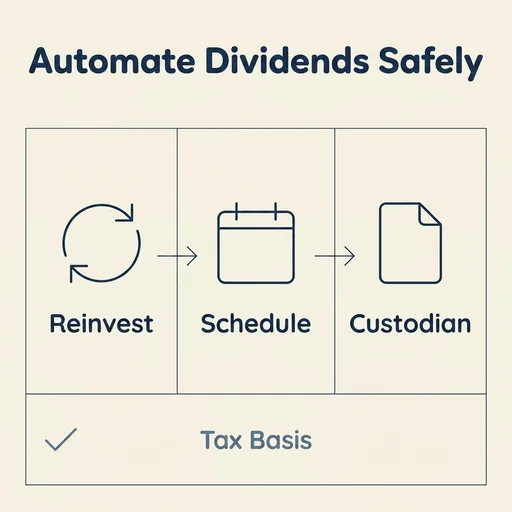
Families automate dividend investing safely by enabling automatic dividend reinvestment—a process detailed step by step in Setting Up DRIP Auto-Compounding in a Kid's Custodial Account—scheduling recurring contributions, and choosing a custodian that reports cost basis for accurate tax filing. According to the IRS (Revenue Procedure 2025-32, November 2025), a child's unearned income—reported to the family on the custodian's Form 1099-DIV—triggers a tax-return filing requirement once it exceeds $1,350 for the 2026 tax year, making automated cost-basis tracking essential for correct kiddie tax reporting. Per FINRA (2023), most major brokerages now offer fee-free automatic dividend reinvestment on both ETFs and individual stocks inside custodial accounts, removing manual trading as a barrier to long-term compounding. A deeper walkthrough of setup steps is available in this guide to dividend reinvestment plans for custodial accounts, alongside broader guidance on passive dividend income portfolio construction for families just getting started.
Frequently asked questions
How much money do I need to make $10,000 a month in dividends?
To generate $10,000 a month, or $120,000 a year, in dividends, an investor typically needs between roughly $3 million and $4 million invested, depending on the portfolio's yield. According to Vanguard (2024), the Vanguard High Dividend Yield ETF (VYM) yields approximately 2.9%, which would require about $4.14 million invested to produce $120,000 annually, while a higher-yield mix closer to 4% would require closer to $3 million. These figures describe a full-scale retirement portfolio and are far larger than what any custodial account for a minor typically holds.
Why does Dave Ramsey say not to invest in ETFs?
Dave Ramsey generally favors actively managed mutual funds over ETFs for long-term retirement investors, not because ETFs are structurally unsafe, but because he argues intraday trading can encourage market timing. According to Ramsey Solutions (2023), Ramsey has stated that the ability to trade ETFs throughout the trading day can tempt investors into emotional, short-term decisions that hurt long-term returns, framing this as a behavioral risk rather than a flaw in the ETF structure itself.
What is the 7% rule in ETF?
The 7% rule in ETF investing is an informal guideline, not an official regulatory standard, that caps any single ETF position at roughly 7% of a total portfolio to limit concentration risk. According to Investopedia (2023), the rule borrows from broader diversification guidance and is most commonly applied by investors building multi-ETF portfolios rather than single-fund custodial accounts for a child.
What did Warren Buffett say about ETFs?
Warren Buffett has repeatedly recommended low-cost S&P 500 index funds, a category that includes broad-market ETFs, as the best option for most investors rather than picking individual stocks. According to Buffett's shareholder letter (Berkshire Hathaway, 2017 annual report), he reiterated that a low-cost S&P 500 index fund would outperform the results most professional investors deliver after fees over a long enough period.
Dividend ETFs or stocks: which should a parent buy first?
For most parents opening a custodial account, dividend ETFs are the better starting choice because one fund provides instant diversification across dozens of dividend payers for a single low fee. According to Morningstar (2024), diversified dividend ETFs have historically shown lower volatility than individual dividend stocks, making them a more predictable core holding before a family adds single companies for educational purposes.
Dividend ETF vs individual stocks: what's the real-world difference?
The real-world difference is that a dividend ETF spreads a custodial account's risk across many companies for one expense ratio, while an individual stock concentrates both the upside and the downside in a single company. According to the Securities and Exchange Commission (2024), ETFs are structurally required to hold diversified portfolios of securities, a built-in safeguard that individual stock ownership does not provide on its own.