How to Open a High Yield Savings Account (2026 Guide)

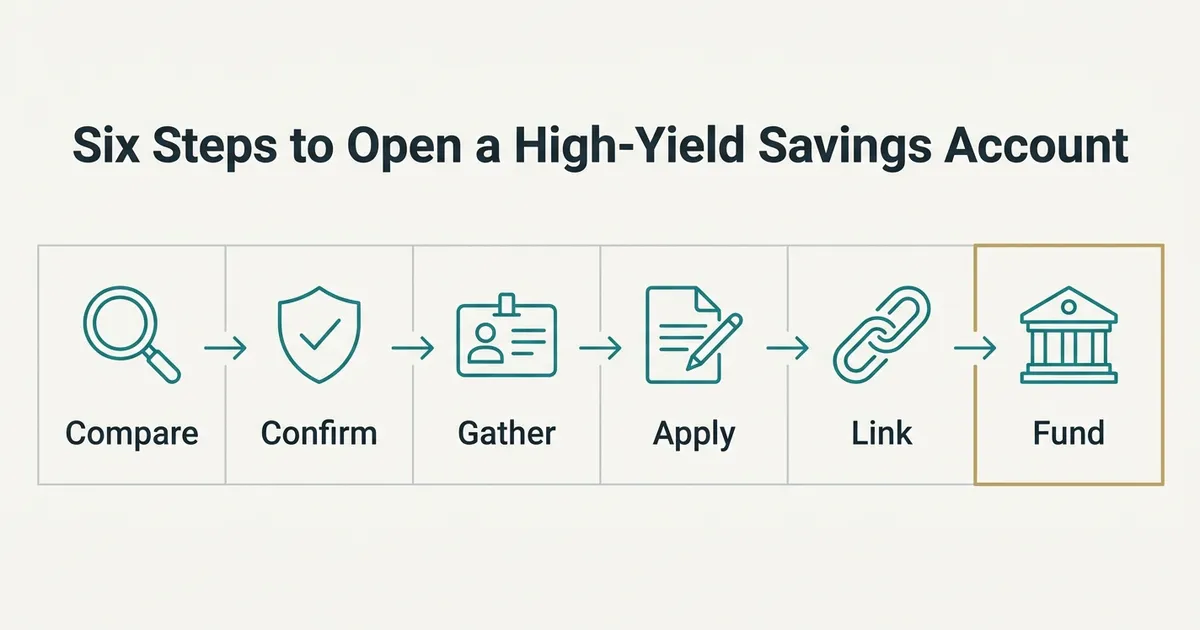
Opening a high-yield savings account takes about 10 minutes: choose an FDIC-insured bank, compare its APY and fees, then apply online with your Social Security number and ID. You'll fund it by linking an existing checking account, then transfers typically post within one to three business days.
Online-only banks pay more than branch-based banks because they skip the cost of physical branch networks and pass that savings to depositors as higher yield. According to the FDIC's national rates (effective July 20, 2026), the national average savings account rate is 0.38% APY, while the top nationally available high-yield accounts surveyed in August 2026 paid up to about 4.20% APY. That gap means a family holding $15,000 in an average-rate account earns roughly $57 a year, versus about $630 a year in a top-yield account — a difference that costs nothing to capture once the account is open. Every APY in this guide is variable and current as of August 2026; confirm a bank's published rate before you move money.
What Is a High-Yield Savings Account, and How Is It Different From a Regular Savings Account?
A high-yield savings account (HYSA) is a federally insured deposit account that pays several times the national average savings rate while keeping your principal fully liquid and risk-free. The rate quoted is the annual percentage yield (APY), a figure that already factors in compounding, so you can compare two banks head-to-head no matter how often each one compounds interest.
Interest on a HYSA usually compounds daily and posts monthly, which means each day's interest is calculated on a slightly larger balance than the day before. According to the Consumer Financial Protection Bureau (2023), Regulation DD — the rule implementing the Truth in Savings Act — requires every bank and credit union to disclose the APY, the minimum balance needed to earn it, and any fees before you open the account, so the number advertised on the homepage should match the number in your account agreement.
A traditional savings account, often the free account bundled with a checking account at a branch bank, tends to pay close to that same national average rather than a competitive yield. Per the FDIC's national deposit rates (effective July 20, 2026), the average traditional savings account paid 0.38% APY while the average 12-month CD paid 1.68% APY — both far below the top online savings yields tracked the same month.
How Do You Open a High-Yield Savings Account, Step by Step?
You can open a high-yield savings account online in six steps that take about 10 minutes total, then wait one to three business days for your first funding transfer to clear.
- Compare APY, fees, and minimums across at least three banks. Check each bank's own disclosure page rather than a comparison site, since rates move with Federal Reserve policy — the FOMC held the federal funds target range at 3.50%–3.75% at its July 29, 2026 meeting, a fifth consecutive hold following the cuts of late 2025, and online savings APYs drift within weeks of each decision.
- Confirm the account is FDIC-insured or NCUA-insured before applying. Per the FDIC (2026), deposits are insured up to $250,000 per depositor, per insured bank, per ownership category; the NCUA (2026) applies the identical $250,000 limit at federally insured credit unions.
- Gather your Social Security number, government-issued ID, date of birth, and a US residential address. Banks require this to satisfy the Customer Identification Program under the Bank Secrecy Act before opening any deposit account.
- Submit the online application and choose individual or joint ownership. Opening the account jointly with a spouse doubles your coverage on that single account to $500,000, per the FDIC's deposit insurance rules (2026).
- Link an external checking account, verified instantly or with two small test deposits. Instant verification confirms ownership in under a minute; test-deposit verification typically takes one to two business days to appear, per the CFPB (2023).
- Fund the account and set up an automatic transfer. A recurring $100-a-month transfer from checking keeps the balance growing without relying on memory.
How Much Money Do You Need to Open a High-Yield Savings Account?
Most high-yield savings accounts require $0 to $100 to open, and the largest online banks charge no ongoing minimum balance to earn the advertised APY. According to Ally Bank's account disclosure (2026), its Savings account has no minimum opening deposit, no minimum balance, and no monthly maintenance fee. According to Marcus by Goldman Sachs (2026), its Online Savings account likewise requires $0 to open and charges no monthly fee.
Some brick-and-mortar banks still require $500 to $1,000 to open a savings account and waive a monthly fee only above a minimum balance — always confirm the fee schedule in the Regulation DD disclosure before you fund the account, per the CFPB (2023). A tiny opening deposit is technically enough, but the math barely moves at small balances: $25 at 4.20% APY earns about $1.05 over a year. The account's real payoff comes from the emergency-fund target you're building toward — our saving money hub walks through sizing that target against your household's essential monthly expenses — not from the size of the opening transaction.
Which Account Should You Use for Your Emergency Fund: HYSA, Money Market, or CD?
Choose a high-yield savings account for money you might need on short notice, a money market account (MMA) if you want occasional check-writing or debit access to the same balance, and a CD only for cash tied to a known future date you won't disturb (see Treasury Bills vs. CDs: Which Actually Pays More After Tax? for how that fixed-rate cash compares to a T-bill after tax). The right split depends on how many of your 3-to-6 months of essential expenses you'd need within 24 hours versus within a few months.
| Feature | High-Yield Savings | Money Market Account | 12-Month CD |
|---|---|---|---|
| Top nationally available APY (Aug 2026) | up to ~4.20% | up to ~4.00% | up to ~4.50% |
| Access to funds | Transfer anytime; some banks cap withdrawals by contract | Often includes check-writing or a debit card | Locked until maturity |
| Typical minimum to open | $0–$100 | $0–$2,500 | $500–$1,000 |
| Federal deposit insurance | FDIC/NCUA, $250,000 per category | FDIC/NCUA, $250,000 per category | FDIC/NCUA, $250,000 per category |
| Early withdrawal cost | None | None | Often 90–180 days of interest, disclosed under Regulation DD |
| Best for | Full emergency fund, instant access | Fund you occasionally write checks against | Cash earmarked for a fixed future date |
Read the table by matching it to your access timeline, not the highest number in the APY column. A family with a $18,000 emergency fund who might need $6,000 within a day should keep that portion in a HYSA even if a CD's headline rate is 0.50 points higher, because a CD ladder only pays off once you've secured instant-access cash first. For side-by-side numbers on yield, debit-card access, and minimum-balance tiers, see our comparison of HYSA vs money market account before committing new deposits. If it's the check-writing and tiered-rate mechanics you're weighing, our money market account guide covers those in depth. If a brokerage's sweep account is also on your shortlist, see Cash Management Accounts vs. High-Yield Savings: Where Should a Family Park Cash? for how sweep-account yields and pass-through FDIC insurance stack up against a standalone HYSA.
How Do You Open a High-Yield Savings Account With SoFi?
You open a SoFi high-yield savings account at sofi.com or in the SoFi app by selecting "Checking and Savings," entering your SSN and ID, and choosing a starting deposit. According to SoFi's account disclosures (2026), members who set up qualifying direct deposit earn a higher APY tier on their SoFi Savings balance than members who fund the account without direct deposit, and both tiers still apply to balances up to the FDIC's $250,000 insured limit through SoFi's partner banks.
To capture the higher tier, add your employer's direct deposit routing and account number in the SoFi app within your first pay cycle; SoFi typically applies the boosted rate starting the deposit period after direct deposit is detected. If you don't plan to run payroll through SoFi, you'll still earn the base APY, which historically has remained well above the FDIC's tracked national average — verify SoFi's current published tier rates before funding, since APYs adjust with Federal Reserve policy and are not locked in at signup.
How Do You Open a High-Yield Savings Account With Chase?
Chase's standard Savings account is not a high-yield product, so opening one won't get you a competitive APY without an added step. According to Chase's consumer deposit rate sheet (2026), the base APY on Chase Savings is 0.01%, and the boosted "relationship" rate — available to customers who link a Chase Premier Plus Checking or Sapphire Banking account and make at least five customer-initiated transactions per statement period — is 0.02%.
If you still want a Chase account — for example, to keep an emergency fund physically linked to a Chase checking account for instant transfers — open it through chase.com or a branch with your SSN, ID, and an opening deposit, then ask a banker about the relationship tier before assuming the base rate applies. Since even the relationship rate is a small fraction of the national average, let alone a competitive online yield, the better decision rule is to keep the checking account at Chase for bill pay and debit-card convenience while parking the actual emergency fund at an online bank paying a nationally competitive APY, then link the two accounts for same-day-initiated transfers.
How Should You Split Emergency Cash Between Savings, Money Market, and CDs?
Layer a 3-to-6-month emergency fund by access speed: keep 1 month of essential expenses in a HYSA for same-day access, put the next 2 to 3 months in a HYSA or MMA for slightly different liquidity features, and only place money beyond a fully funded 6-month cushion into a short CD. This layering matters because a CD's early withdrawal penalty — often 90 to 180 days of interest, which Regulation DD requires the bank to disclose before you open the account — can erase months of gains if a real emergency forces you to break it early.
For a household with $4,000 in essential monthly expenses — a $24,000 six-month target — that means roughly $4,000 in an instant-access HYSA, $8,000 to $12,000 split between a HYSA and MMA, and only cash above the 6-month mark belongs in a CD ladder — see How to Build a CD Ladder: Step-by-Step Guide for how to stagger those maturities. Money beyond that cushion is what actually belongs in longer-horizon vehicles — our family dividend investing pillar covers where it goes next. Parents of children under 10 should weight toward the liquid end of this range: pediatric visits, childcare gaps, and appliance failures tend to arrive without warning and rarely wait for a CD to mature.
What Mistakes Should You Avoid When Opening a High-Yield Savings Account?
Chasing an introductory APY that reverts after 90 to 180 days. Some banks advertise a promotional rate for new money only, then drop to a lower standing rate — read the disclosure's "APY effective date" and any promotional-period language before you transfer a large sum.
Exceeding $250,000 in a single ownership category at one bank. Per the FDIC (2026), the $250,000 limit applies per depositor, per insured bank, per ownership category (single, joint, certain trust and retirement categories) — the FDIC's own EDIE calculator lets you check coverage across accounts before you consolidate cash at one institution.
Assuming unlimited withdrawals are guaranteed everywhere. The Federal Reserve's Regulation D amendment (April 2020) removed the federal six-withdrawal-per-month limit on savings accounts, but individual banks may still enforce a contractual cap and charge a fee for exceeding it — check the account agreement, not just the federal rule.
Skipping a beneficiary or payable-on-death designation. Adding one doesn't change your FDIC coverage category calculation but does route the balance directly to your named beneficiary outside probate in most states — confirm the specific process with your bank, since documentation requirements vary by institution.
Frequently asked questions
How much will $10,000 earn in a high-yield savings account?
At a 4.20% APY — around the top of the nationally available range in August 2026 — $10,000 in a high-yield savings account earns approximately $420 over one year, assuming the rate holds and interest compounds daily and posts monthly with no withdrawals; that $420 counts as taxable interest income in the year it's credited, as explained in [Savings Account Interest: How It's Calculated in 2026](/saving-money/savings-account-interest-taxes/). At the FDIC's tracked national average of 0.38% APY (effective July 20, 2026), the same $10,000 would earn only about $38 in a year, illustrating why the account you choose matters roughly as much as the amount you deposit. Savings APYs are variable and move with Federal Reserve policy, so check a bank's current published rate before you fund.
How much money do you need to open a high-yield savings?
Most high-yield savings accounts require $0 to $100 to open, and none of the largest online banks impose an ongoing minimum balance to earn their advertised APY. According to Ally Bank's account disclosure (2026) and Marcus by Goldman Sachs (2026), both banks let customers open a high-yield savings account with $0 and earn the full advertised rate on any balance from the first dollar.
How much will $1,000 make in a high-yield savings?
At a 4.20% APY, $1,000 in a high-yield savings account earns roughly $42 over one year with daily compounding and no withdrawals. At the FDIC's national average rate of 0.38% APY (effective July 20, 2026), that same $1,000 would earn about $3.80 in a year — an eleven-to-one difference in earnings for holding the identical amount in a lower-rate account.
What happens if I put $5,000 in a high-yield savings account?
Putting $5,000 in a high-yield savings account paying 4.20% APY earns approximately $210 over one year if left untouched, and the full $5,000 stays covered by federal deposit insurance since it's far below the FDIC's $250,000 per-depositor, per-bank limit (FDIC, 2026). You retain full access to the money — most online banks allow transfers out at any time, though some cap same-day transfer amounts for new accounts during an initial fraud-review window.
How do you open a high-yield savings account with SoFi?
You open a SoFi high-yield savings account through sofi.com or the SoFi app by selecting "Checking and Savings," entering your Social Security number and government ID, and making a starting deposit. According to SoFi's account disclosures (2026), setting up qualifying direct deposit within the first pay cycle unlocks a higher APY tier on the savings balance than the base rate paid to accounts funded without direct deposit.
How do you open a high-yield savings account with Chase?
You open a Chase Savings account at chase.com or a branch with your SSN, ID, and an opening deposit, but the standard account is not a competitive high-yield product. According to Chase's consumer deposit rate sheet (2026), the base APY on Chase Savings is 0.01%, and the "relationship" rate it unlocks by linking a Chase Premier Plus Checking or Sapphire Banking account is only 0.02%, so most families are better served pairing Chase checking with a separate online high-yield savings account for the actual emergency fund.