Bank Account for Kids: Best Options for Parents in 2026

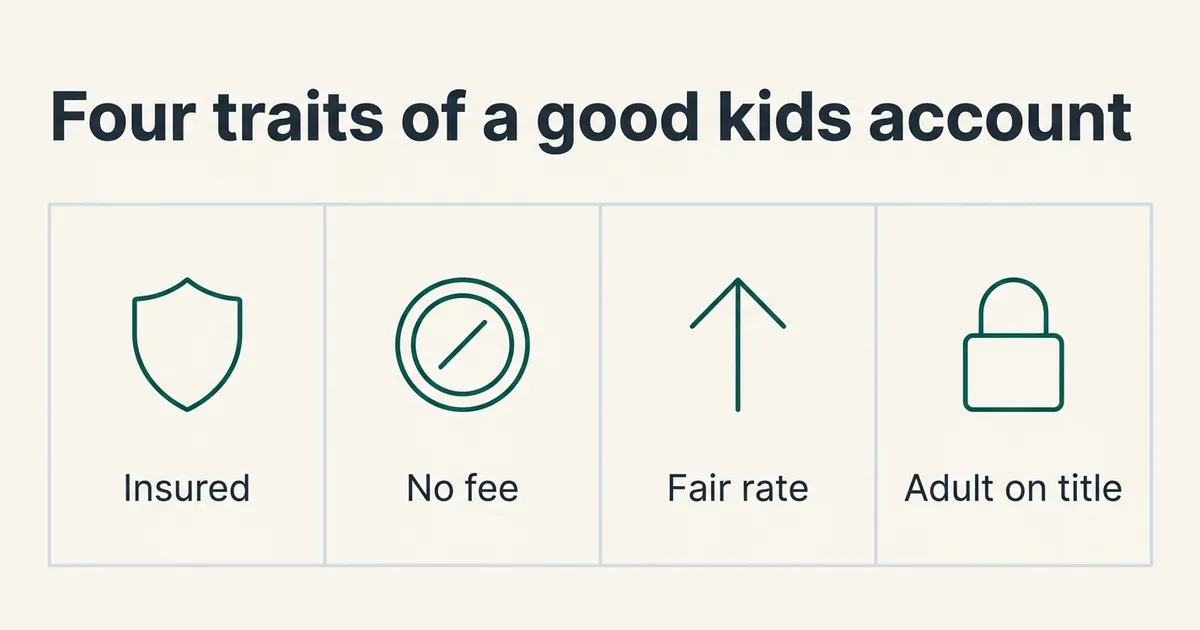
The best bank account for kids is a federally insured savings account that pays a competitive APY, charges no monthly fee, and has an adult on the title. For most parents of children under 10, that means a custodial (UTMA) or joint high-yield savings account at an FDIC- or NCUA-insured institution.
Two decisions sit inside that choice, and most guides collapse them into one. The first is who legally owns the money. The second is where your own emergency cash sits relative to it. Get the first wrong and a gift becomes irrevocable. Get the second wrong and part of your three to six months of expenses ends up in your child's name.
Rate is the third variable. According to the FDIC's National Rates and Rate Caps (September 2026), the national average savings rate was 0.37% APY, close to 0.4%. On $1,000, that is about $4 a year. At an illustrative 4.00% APY, the same $1,000 earns $40.
Which bank account for kids fits your family?
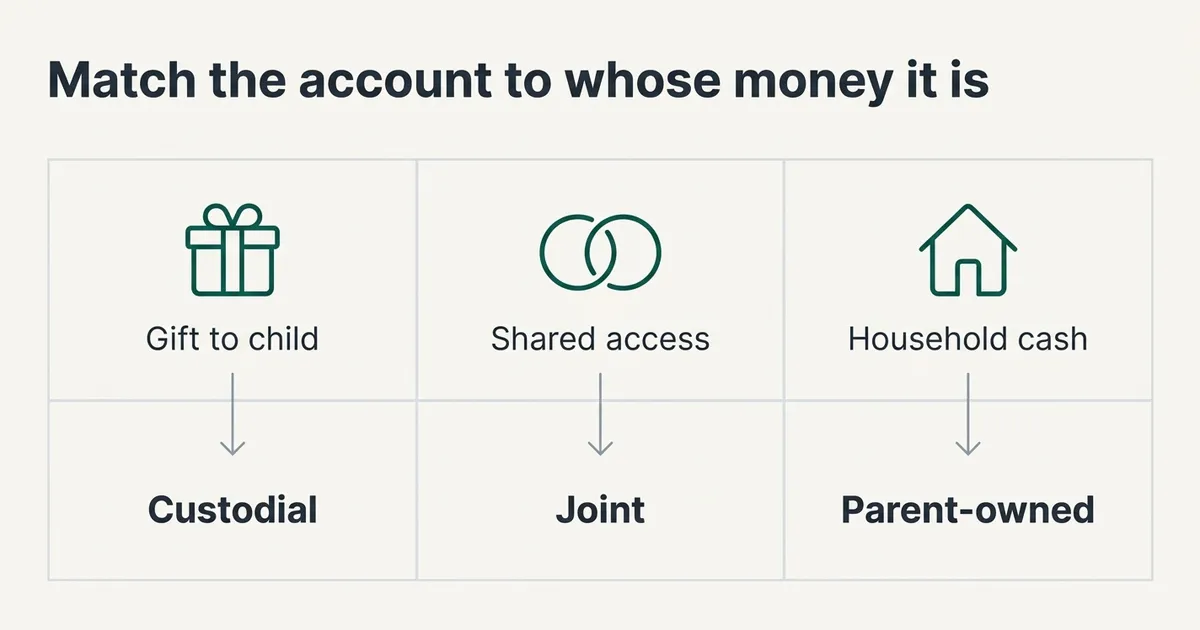
Choose a custodial account if the money is a gift to your child, a joint account if you want shared access, and a parent-owned high-yield savings account if the money is really your household's. Five structures cover nearly every option for a child under 10.
| Account type | Who owns the money | Insurance limit | Adult control ends | Child's minimum age |
|---|---|---|---|---|
| Custodial (UTMA/UGMA) savings | The child; the gift is irrevocable | $250,000 under the child's single-account category | Age 18–25, set by state law | None federally; the adult custodian opens it |
| Joint savings (parent + child) | Both owners | $250,000 per co-owner ($500,000 for a two-owner account) | Never automatic; the parent must leave the title | Bank policy; no federal minimum |
| Parent-owned high-yield savings with a goal label | The parent | $250,000 per depositor, per ownership category | Never; the parent keeps control | None; the child is not a customer |
| Credit union youth savings | The child or joint, per credit union rules | $250,000 per owner, per category (NCUA) | Same as the account type used | Credit union policy; membership usually runs through the parent |
| Fintech kid app with debit card | Parent-controlled; deposits sit at a partner bank | $250,000 only if the partner bank fails, not the app | Parent-controlled until the app's age cutoff | App policy |
For a family that already holds a funded emergency reserve, the winner is a two-part setup. Use a custodial or joint savings account for money that belongs to the child, such as gifts, birthday cash, or a fixed monthly transfer. Keep everything else in your own savings.
Choose the fintech app only if your child is old enough to use a debit card and you accept that insurance covers the partner bank's failure, not the app's.
Who owns the money, and why does it matter?
Ownership decides three things: who can legally spend the money, how it is insured, and how it counts for college aid. Each one has a trap.
Spending. According to the Uniform Law Commission's Uniform Transfers to Minors Act (1986), a transfer to a custodian is irrevocable, and the custodian must use the property for the minor's benefit. States set when custodianship ends, generally between 18 and 25, so verify your state's UTMA or UGMA statute. Because the gift is complete, you cannot pull it back for a furnace repair.
Insurance. According to the FDIC (2026), funds in a UTMA custodial account are insured as the minor's single-ownership deposits, up to $250,000 at one insured bank. That coverage is separate from your own accounts. It does combine with any other single accounts the child holds at the same bank, such as a second custodial account funded by a grandparent.
Joint accounts work differently. According to the FDIC (2026), each co-owner's share of all joint accounts at one bank is insured up to $250,000, so a parent-and-child joint account carries up to $500,000 of coverage.
College aid. According to Federal Student Aid's 2026-27 Application and Verification Guide (2025), the Student Aid Index assesses student assets at 20% and parent assets at 12% of net worth above an asset protection allowance. Illustratively, $5,000 in a custodial account can add up to $1,000 to the index, versus up to $600 if a parent owns it. Your child is years from filing a FAFSA, and the formula can change, so treat this as a tiebreaker, not a driver.
Keep your emergency fund in your own name. Custodial money cannot legally fund household expenses, and a custodian who drains it for rent has misused the account.
What should you compare before opening a bank account for kids?
Compare five things, in this order: APY, fees and minimums, insurance status, withdrawal rules, and what happens at age 18. Most kids' accounts fail on the first two.
APY, not "interest rate." According to the Consumer Financial Protection Bureau (2026), Regulation DD (12 CFR Part 1030) requires banks to disclose the annual percentage yield, which reflects compounding, along with the fees and minimum balances that apply. Interest compounds daily at most banks but posts monthly, so APY is the only apples-to-apples number. Branch-based "kids' club" accounts often pay near the national average, so check the APY against online savings rates before you sign.
Fees and minimums. A fee can outrun interest on small balances. A $500 balance at 4.00% APY earns about $20 a year, and a $3 monthly fee costs $36, leaving you $16 behind. Require $0 monthly fees and $0 minimum balance, or a minimum you already exceed.
Insurance status. According to the NCUA (2026), federal share insurance covers $250,000 per share owner, per insured credit union, per ownership category. Confirm the institution in the FDIC's BankFind Suite or the NCUA's Research a Credit Union tool.
Fintech apps need extra scrutiny. According to the FDIC (2024), pass-through deposit insurance protects customers if the partner bank fails, not if the nonbank app fails. The FDIC's September 2024 proposal on recordkeeping for custodial deposit accounts followed the 2024 collapse of fintech middleman Synapse, which left many customers unable to reach their funds.
Withdrawal rules. According to the Federal Reserve Board (April 2020), an interim final rule removed Regulation D's six-per-month limit on savings withdrawals. Banks may still impose their own caps, so read the account agreement.
Interest reporting. According to the IRS Instructions for Forms 1099-INT (2026), payers report interest of $10 or more. A custodial account is reported under the child's Social Security number. How that interest is taxed is covered in savings account interest: how it's calculated. A child's unearned income above an annual threshold can also trigger the kiddie tax, which kiddie tax explained covers.
How do you open a bank account for your child?
Opening one takes about 15 minutes online once you have the documents. Follow these steps in order.
- Pick the structure. Use the comparison table above. Custodial for gifts, joint for shared access, parent-owned for money that is really yours.
- Pick an insured institution. Shortlist two or three with $0 fees and a competitive APY. If you have never opened an online savings account, the walkthrough on how to open a high-yield savings account covers the application screens and funding. To choose between a credit union and a bank first, see credit union vs bank.
- Gather documents. Have your child's Social Security number, your government-issued ID, and proof of address. Some banks also ask for a birth certificate.
- Apply and verify. According to FinCEN's Customer Identification Program rule, 31 CFR 1020.220 (2003), banks must collect each owner's name, date of birth, address, and identification number before opening an account. For a custodial account, you sign as custodian and the child's details go on the title.
- Fund it. Transfer a starter amount, then set a recurring transfer of an amount you will never miss, timed for the day after payday.
- Calendar the milestones. Note your state's custodianship end age and the child's 18th birthday, because control changes hands on those dates.
Can a child under 13 or under 18 open an account alone?
No. A child cannot open a bank account alone at any age under 18, because banks require an adult owner, co-owner, or custodian. Minors generally lack the legal capacity to sign binding contracts, though that rule is set by state law.
Under 13, the barrier is also federal privacy law. According to the Federal Trade Commission (2025), the COPPA Rule (16 CFR Part 312) requires verifiable parental consent before online services collect personal information from children under 13. In practice, a parent opens and controls the account.
From 13 to 17, banks commonly offer teen checking and savings with a parent as co-owner, and the teen gets a debit card and app access. At 18, the child can open an account in their own name, and many teen accounts convert or close.
How much will a child's savings account earn?
At an illustrative 4.00% APY, $1,000 earns $40 in one year. At 0.40% it earns $4. The $36 gap is the cost of leaving a child's money in a low-rate branch account.
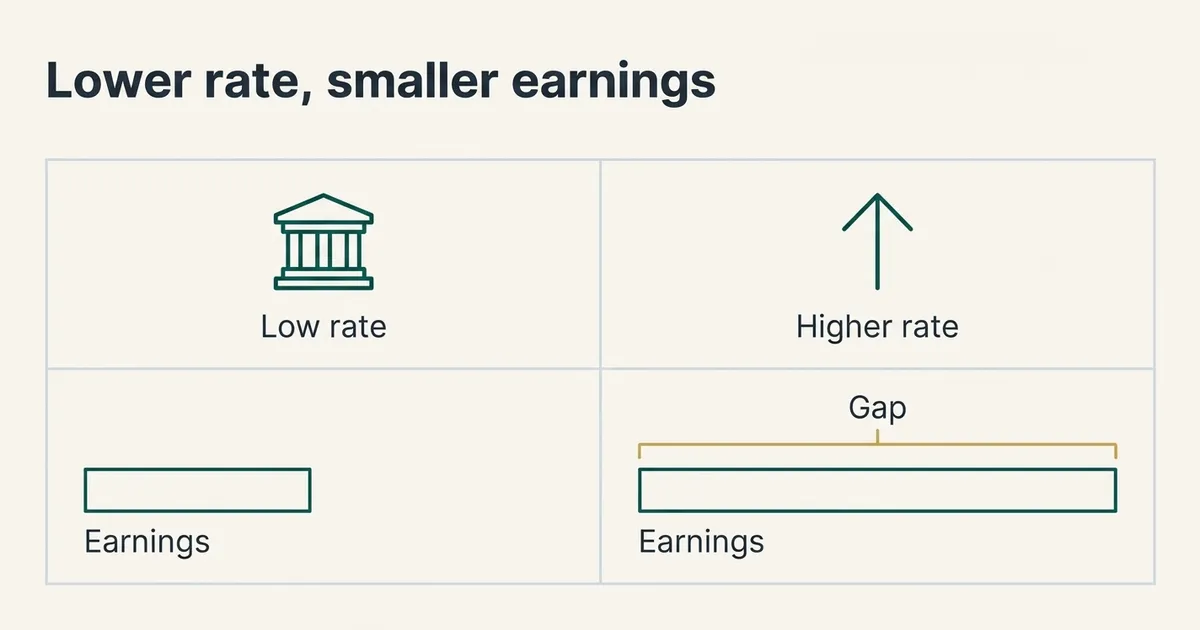
Add a monthly deposit and the gap widens. Suppose you open an account for a 4-year-old with $1,000, add $50 a month for six years, and the APY holds at 4.00%. The balance reaches about $5,318. You contributed $4,600, and about $718 is interest. At 0.40%, the interest would be roughly $70.
This is an illustration, not a forecast. Savings APYs are variable, so the bank can lower the rate at any time, and your result will follow the rate in effect each month.
Know the ceiling, too. A savings account protects principal and pays modest interest, so it suits money you will need within roughly five years. Money for goals a decade or more away is an investing question outside deposit accounts, which the guide to a brokerage account for kids covers.
How does a child's account fit with the rest of your cash?
Treat the child's account as its own bucket, sized by what the child will need and when. Your emergency reserve stays separate.
Take a family with $4,000 a month in essential expenses. Six months is $24,000, which at an illustrative 4.00% APY earns about $960 a year. That fund belongs in your name, split across accounts by time horizon. The comparison of a high-yield savings account vs a money market account and the guide to money market accounts explained show how.
Then add the child's money: say $2,000 in gifts and a $50 monthly transfer, held in a custodial or joint savings account. Match each pot to a horizon:
- Needed within 12 months (a bike, a class fee): keep it in the savings account.
- Needed on a known date in one to five years (a family trip, a fixed purchase): lock part of it in certificates of deposit, with staggered maturities from how to build a CD ladder. Do not lock money you may need sooner, since early-withdrawal penalties apply.
- No date at all: leave it in savings until you decide.
This is where the child's account earns its place: it stops a $50 monthly habit from blurring into your household budget. For the full set of deposit options, see the saving money hub.
What are the key rules and limits for a bank account for kids?
As of October 2026, these are the federal figures that govern a child's deposit account, with the issuing document for each. Insurance limits and form thresholds can change, so confirm them before you act.
| Item | Figure or rule | Issuing document |
|---|---|---|
| Standard FDIC insurance | $250,000 per depositor, per insured bank, per ownership category | FDIC, 12 CFR Part 330 |
| Credit union share insurance | $250,000 per share owner, per insured credit union, per category | NCUA, 12 CFR Part 745 |
| Custodial (UTMA) account insurance | Insured as the minor's single account | FDIC deposit insurance guidance |
| Joint account coverage | $250,000 per co-owner | FDIC, 12 CFR Part 330 |
| Online consent age | Under 13 requires verifiable parental consent | FTC, COPPA Rule, 16 CFR Part 312 |
| Bank ID collection | Name, date of birth, address, ID number | FinCEN, 31 CFR 1020.220 |
| APY disclosure | Required for deposit accounts | CFPB, Regulation DD, 12 CFR Part 1030 |
| Interest reporting | Form 1099-INT for interest of $10 or more | IRS, Instructions for Forms 1099-INT |
| Custodianship end age | 18–25, set by state | Uniform Transfers to Minors Act (1986) and state statutes |
| FAFSA asset weighting | Student assets 20%; parent assets 12% of net worth above an asset protection allowance | Federal Student Aid, 2026-27 Application and Verification Guide, Student Aid Index chapter |
| Savings withdrawal limit | Six-per-month federal cap suspended; banks may set their own | Federal Reserve Board, April 2020 interim final rule |
Where do these figures come from?
- FDIC: deposit insurance regulation, 12 CFR Part 330, and its guidance on custodial and joint accounts (2026); National Rates and Rate Caps (September 2026).
- FDIC: consumer guidance on pass-through insurance and nonbank apps (2024), and the proposed rule on custodial deposit account recordkeeping (September 2024).
- NCUA: share insurance regulation, 12 CFR Part 745 (2026).
- CFPB: Regulation DD, 12 CFR Part 1030 (2026).
- FinCEN: Customer Identification Program rule for banks, 31 CFR 1020.220 (2003).
- Federal Trade Commission: COPPA Rule, 16 CFR Part 312 (2025 amendments).
- IRS: Instructions for Forms 1099-INT (2026).
- Federal Student Aid: 2026-27 Application and Verification Guide, Chapter 3, Student Aid Index and Pell Grant Eligibility (2025).
- Federal Reserve Board: interim final rule amending Regulation D (April 2020).
- Uniform Law Commission: Uniform Transfers to Minors Act (1986).
Disclaimer: This article is general educational information, not personalized financial, legal, or tax advice. Dollar figures and APYs in examples are illustrative, not promised outcomes, and savings rates change. Confirm current rates, fees, and insurance coverage with the institution before you open an account.
Frequently asked questions
What is the best bank account to open for a child?
The best account is a no-fee custodial or joint savings account at an FDIC- or NCUA-insured institution with a competitive APY. According to the FDIC (2026), deposits are insured up to $250,000 per depositor, per insured bank, per ownership category, and a custodial account counts as the child's own single account. Pick custodial for gifts the child will own, and joint if you want access too.
Can my 4 year old have a bank account?
Yes, a 4-year-old can have a bank account when a parent opens it as custodian or joint owner. According to FinCEN's Customer Identification Program rule, 31 CFR 1020.220 (2003), banks must collect the owner's name, date of birth, address, and identification number, which for a young child means their Social Security number. There is no federal minimum age, so confirm the bank's own policy.
How can I open a bank account for my child?
Choose a structure, pick an insured bank or credit union, and apply with your ID and your child's Social Security number. According to the NCUA (2026), credit union share insurance covers $250,000 per share owner, per institution, per ownership category, the same limit as the FDIC. Online applications usually finish in about 15 minutes, followed by a funding transfer.
How to invest $1000 for a child?
For money your child may need within about five years, keep the $1,000 in an insured savings account, where an illustrative 4.00% APY earns $40 in a year. According to the FDIC (2026), deposit insurance does not cover stocks, bonds, or mutual funds, even when bought through an insured bank. Investing for goals a decade or more away is a separate decision with market risk and its own account types.
What bank account can kids under 18 have?
Kids under 18 can have a custodial (UTMA/UGMA) account, a joint account with a parent, or a teen checking or savings account with a parent as co-owner. According to the Uniform Law Commission's Uniform Transfers to Minors Act (1986), custodial gifts are irrevocable, and state law sets when the custodian's control ends, generally between ages 18 and 25. A minor cannot open an account alone.
What bank account can kids under 13 have?
Kids under 13 can have a parent-opened custodial or joint savings account, and an online-only service must follow federal consent rules. According to the Federal Trade Commission (2025), the COPPA Rule (16 CFR Part 312) requires verifiable parental consent before an online service collects personal information from a child under 13. The parent controls the account, and the child typically gets view-only or limited access.