Business Bank Account Sole Proprietor: 2026 Guide

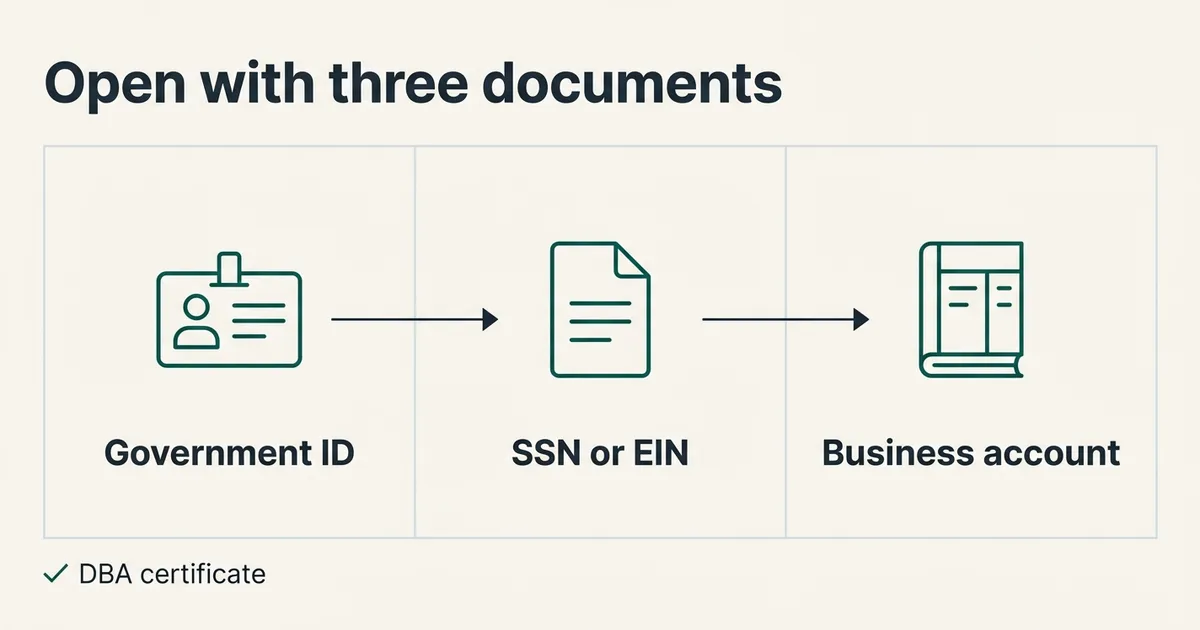
Yes: a sole proprietor opens a business bank account with a government ID, an SSN or EIN, and a DBA certificate if trading under a business name. No law requires the account, but it is the cheapest way to prove your Schedule C deductions and keep an audit short.
For a parent running a side hustle, the account does more than tidy the books. It is the paper trail that lets you deduct a home office, pay your child for real work, and move that money into the child's Roth IRA without a dispute over where it came from.
This guide covers what you need to open the account, which type fits which kind of side business, how it connects to your tax savings, and when an LLC changes the picture. It is part of our Family Tax Hacking pillar, which focuses on cutting household tax drag so you can reinvest the difference.
Does a sole proprietor legally need a separate business bank account?
No federal law requires one. A sole proprietorship has no legal existence apart from you, so a bank cannot be forced on the business the way it can be on a corporation. The IRS still expects you to substantiate every deduction, and a dedicated account is the easiest way to do that.
According to IRS Publication 583 (2024), a separate business bank account is a recommended recordkeeping practice because it keeps business receipts and expenses apart from personal ones. The mechanism is simple. Schedule C lets you deduct only expenses you can document, and a clean account turns your bank statement into a ledger.
The exposure lasts longer than most parents expect. Per the IRS (2026), you should keep records for 3 years from the date you file, and for 6 years if you omit more than 25% of your gross income.
Here is what a mixed account costs you. Say Maria, a San Jose parent with a $38,000 net print-selling profit, runs everything through one personal checking account. In an audit she can't separate $4,200 of supplies from groceries and Target runs, so the examiner disallows them.
At an assumed 22% federal bracket plus 14.13% effective self-employment tax, that is about $1,517 in added federal tax. A 20% accuracy-related penalty under Internal Revenue Code §6662 can add roughly $300 on top, and California taxes the same added profit. This is an illustration, not a prediction.
Payment apps add a second reason. Under the One Big Beautiful Bill Act (July 2025), the Form 1099-K reporting threshold for third-party payment networks returned to $20,000 and 200 transactions. Reporting may not trigger, but your income is still taxable. Depositing every payout into one business account means your deposits match your reported revenue.
What do you need to open a business bank account as a sole proprietor?
You need proof of identity, a taxpayer ID, and, if you use a trade name, proof you registered it. Banks collect these because of federal law. According to FinCEN's Customer Identification Program rule, 31 CFR 1020.220 (2003), every bank must verify the name, address, date of birth, and taxpayer ID of each account holder before opening the account.
Work through these steps in order:
- Choose your business name. Using your own legal name (for example, "Maria Lopez") needs no registration. Using anything else makes it a fictitious or "doing business as" (DBA) name.
- Get an EIN. Per the IRS (2026), an Employer Identification Number is free through IRS.gov, and a sole proprietor with no employees may use an SSN instead. Get the EIN anyway if you plan to pay your child as an employee, because employers need one. It also keeps your SSN off vendor forms.
- File your DBA if you need one. In California, Business and Professions Code §17910 (2026) requires a fictitious business name statement filed with the county clerk within 40 days of starting to do business under that name. Other states register DBAs at the county or state level, so verify your state's rule.
- Gather your documents. Bring a government photo ID, your SSN or EIN confirmation letter (CP 575), the DBA certificate, and any city business license your locality requires.
- Confirm the account title. Ask for the account to be titled in your name "DBA" your business name, so checks and deposits made out to the trade name clear.
Which business bank account is best for a sole proprietor?
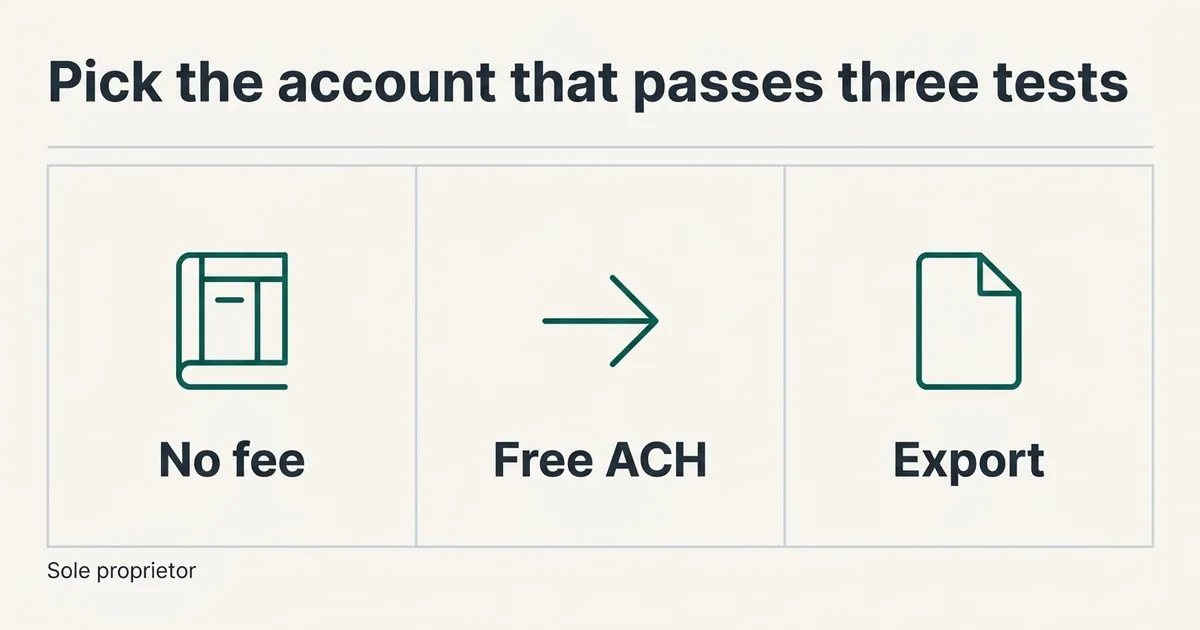
The best account is the one with no monthly fee at your balance, free ACH transfers, and a way to export transactions to your bookkeeping. Which type wins depends on how you get paid. The fee and minimum ranges below are screening ranges, not quotes, so confirm each bank's current fee schedule before opening. As one dated reference point, Chase's own Business Complete Banking page (October 2026) lists a $15 monthly service fee that a $2,000 minimum daily balance waives.
| Account type | Typical monthly fee | Typical opening deposit | Deposit insurance | Best for |
|---|---|---|---|---|
| Personal checking used for business | $0–$12 | $0–$100 | $250,000 (FDIC) | Nobody; commingling is the problem |
| Second personal checking labeled for the business | $0–$12 | $0–$100 | $250,000 (FDIC) | A stopgap under about $1,000 a month, if the bank's terms allow business use |
| Online (fintech) business checking | $0 | $0 | $250,000 via a partner bank | Etsy, Shopify, freelance, and app-based income |
| Credit union business checking | $0–$10 | $25–$100 | $250,000 (NCUA) | Local service work with some cash or checks |
| National bank business checking | $10–$30, often waived at $1,000–$5,000 balances | $0–$100 | $250,000 (FDIC) | Cash-heavy sales, in-person deposits, future loans |
Read the table by how you get paid. Choose an online business account if your revenue arrives by ACH, card processor, or payment app, because the $0 fee is hard to beat. Choose a credit union or national bank if you deposit cash or paper checks weekly, because those channels often charge fees or cap cash deposits at fintechs.
Skip the personal-account route unless you are testing a business for a month or two. It saves nothing in fees once a free business account exists, and it defeats the purpose.
Check the insurance on any fintech. According to the FDIC (2026), standard coverage is $250,000 per depositor, per insured bank, per ownership category, and deposits owned by a sole proprietorship are insured as the owner's single accounts. Your business balance therefore stacks with your personal checking and savings at the same bank. Fintech apps are not banks themselves, so confirm the named partner bank that holds your deposits.
How does a separate bank account cut a parent's tax bill?
The account does not lower your tax by itself. It makes deductions provable and moves money cleanly to the places that save you tax. The biggest lever for parents is the self-employment tax.
According to the IRS Schedule SE instructions (2025), you owe 15.3% (12.4% Social Security plus 2.9% Medicare) on 92.35% of net self-employment earnings, which works out to about 14.13% of profit. Per the Social Security Administration (October 2025), the 2026 Social Security wage base is $184,500, so a side hustle below that pays the full 15.3% on every profit dollar. Every deductible dollar you document saves about 14 cents of self-employment tax before income tax. For the full calculation and ways to cut it, see Self Employment Tax 2026: Rate, Math and How to Cut It.
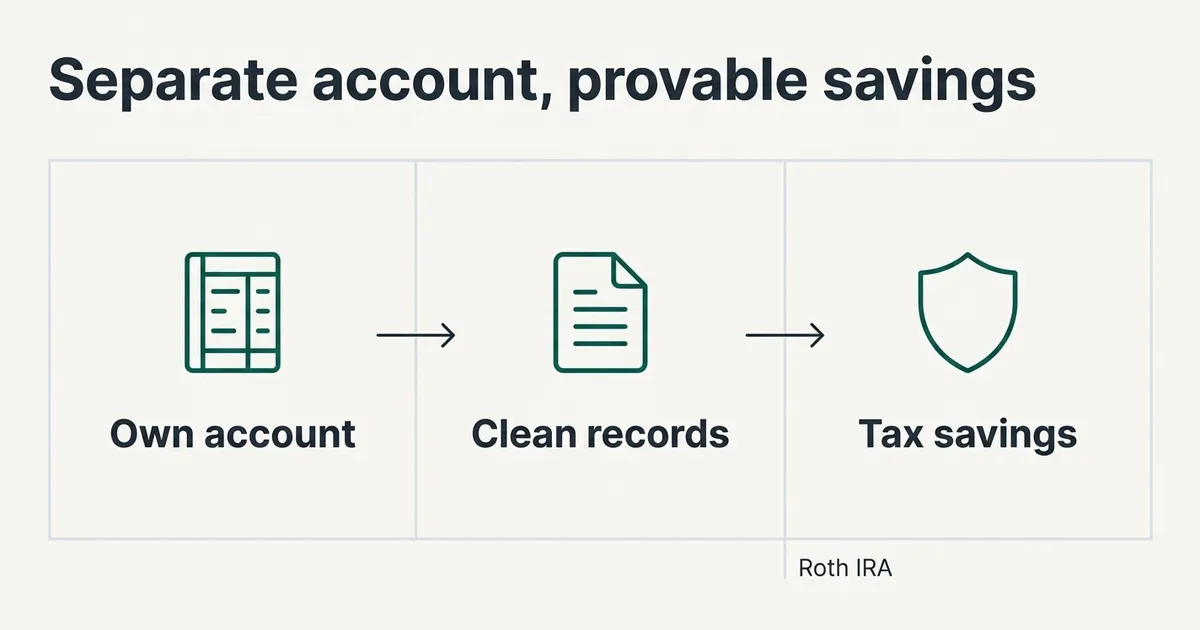
The best-documented example is paying your child. Assume you net $60,000 in 2026 and sit in a 22% federal bracket. Your 11-year-old photographs and packs products about 8 hours a week, 400 hours total, at $14 an hour, and you pay $5,600 from the business account by direct deposit to the child's own account.
- Income tax saved: $5,600 × 22% = $1,232.
- Self-employment tax saved: $5,600 × 0.9235 × 15.3% ≈ $791.
- Federal total: about $2,023, plus any California income tax the deduction also reduces.
The child pays no federal income tax on it. According to IRS Revenue Procedure 2025-32 (October 2025), the 2026 standard deduction for a single filer is $16,100, and earned income below it is untaxed. Per IRS Publication 15 (2026), wages paid by a parent to a child under 18 in a sole proprietorship are exempt from Social Security and Medicare tax.
The child can then fund a Roth IRA. According to IRS Notice 2025-67 (November 2025), the 2026 IRA contribution limit is $7,500, capped at the child's earned income, so the $5,600 fits. See our guide to the best custodial Roth IRA providers for where to open it.
Three guardrails apply:
- The work must be real and the pay reasonable. Tasks and hours need a log, and the rate must match what you'd pay an unrelated worker.
- Pay from the business account. A transfer from the business account to the child's account is the proof.
- The numbers are illustrative. Your bracket, state, and the child's other income change the result.
The same account supports other deductions. Under IRS Publication 587 (2025), the simplified home-office method deducts $5 per square foot up to 300 square feet, a $1,500 maximum. Our home-office and side-hustle deductions guide covers when the regular method beats it. The business account also keeps your net profit clear when you maximize the Child Tax Credit, since credits depend on income you can report accurately. The same net-profit figure drives the QBI deduction, and it sets the ceiling on a solo 401(k), whose contribution limit is computed from the net earnings your books establish.
Should you form an LLC or stay a sole proprietor?
Stay a sole proprietor if your side hustle has low liability exposure and thin profit. Form an LLC if you sell physical products, work in clients' homes, or run activities involving other people's children. A single-member LLC changes your legal liability, not your federal income tax.
Under Treasury Regulation §301.7701-3 (1996), a single-member LLC is a "disregarded entity" by default, so its income lands on your Schedule C exactly like a sole proprietorship. It does not reduce self-employment tax.
The cost is state-level. According to the California Franchise Tax Board (2026), every LLC pays an $800 annual minimum franchise tax, and LLCs with gross receipts of $250,000–$499,999 owe an additional $900 fee. On Maria's $38,000 profit, the $800 is about 2.1% of profit every year. Other states charge anything from nothing to a few hundred dollars in annual fees, so check yours.
An LLC needs a separate bank account in practice, and often by the bank's own rules. Courts weigh commingling personal and business funds when deciding whether to ignore an LLC's liability shield, so one shared account can erase the protection you paid $800 for. If you are also weighing an S-corporation election, S Corp vs LLC: Which Saves Your Family More Tax in 2026? covers when it pays.
Also note that a disregarded LLC is treated as a corporation for employment tax purposes under Treasury Regulation §301.7701-2(c)(2)(iv), which can jeopardize the under-18 FICA exemption for paying your child. Confirm this before forming the LLC if hiring your kids is part of your plan.
Reporting burden has eased. According to FinCEN (March 2025), an interim final rule removed beneficial ownership information reporting for U.S.-formed companies and their owners, so a domestic single-member LLC no longer files a BOI report.
What mistakes break a sole proprietor's business account?
Most failures come from habits, not rules. Avoid these:
- Paying personal bills from it. Move money to yourself only through transfers labeled "owner draw," never by swiping the business debit card at the grocery store.
- Depositing only some income. Cash tips or app payouts that skip the account create revenue you can't match to your return.
- Sending kids' wages to your own account. Pay your child into the child's own account. Roth contributions must come from the child's own earned income.
- Ignoring balances above $250,000. Spread large balances across banks, since the FDIC limit applies per bank and ownership category.
- Skipping the monthly reconciliation. Match the statement to your bookkeeping file in the first week of each month, while you still remember what each charge was.
- Spending the tax money. Keep a second sub-account for the share of each deposit you set aside for quarterly estimated payments, so the cash is still there when a payment is due.
Disclaimer: This article is general educational information, not tax, legal, or financial advice. Tax figures cited are for 2026 and adjust annually, bank fees and terms change, and your state's rules may differ from the California examples used here. Confirm current figures with the issuing source or a qualified tax professional before acting.
Frequently asked questions
Can I set up a business bank account as a sole proprietor?
Yes, banks and credit unions routinely open one once you pass identity verification, though a credit union also requires you to qualify for membership. According to FinCEN's Customer Identification Program rule, 31 CFR 1020.220 (2003), the bank must verify your name, address, date of birth, and taxpayer ID. Expect to bring a photo ID, your SSN or EIN, and a DBA certificate if you operate under a name other than your legal one.
What is the best bank account for a sole proprietorship?
The best account has a $0 monthly fee at your balance, free ACH transfers, and exportable transactions. Online business checking suits income that arrives electronically, while a credit union or national bank suits regular cash or check deposits. Per the FDIC (2026), coverage is $250,000 per depositor, per insured bank, so confirm the insured bank behind any fintech app.
Does a sole proprietor LLC need a separate bank account?
Yes in practice, though no federal statute requires it. Courts consider commingled personal and business funds when deciding whether to disregard an LLC's liability shield. According to the California Franchise Tax Board (2026), California LLCs pay an $800 annual minimum tax, so mixing accounts can waste the protection you are paying for.
Is it better to be LLC or sole proprietor?
Stay a sole proprietor when liability risk and profit are low, and form an LLC when you face real liability exposure. Under Treasury Regulation §301.7701-3 (1996), a single-member LLC is taxed like a sole proprietorship by default, so it saves no federal tax. In California, the LLC's $800 annual minimum tax makes it a poor fit for a side hustle clearing under a few thousand dollars.
Business bank account sole proprietor reddit: what do Reddit threads recommend?
Reddit threads on this topic mix useful experience with anecdotes about one person's bank, so use them to build a checklist rather than pick a winner. Verify every claim against the bank's own fee schedule and deposit insurance disclosure. Per the FDIC (2026), standard insurance covers $250,000 per depositor, per insured bank, which no forum post can change.
Business bank account sole trader: is that different from a sole proprietor?
"Sole trader" is the UK and Australian term, and the closest US equivalent is a sole proprietor. A US sole proprietor reports profit on Schedule C and pays self-employment tax. According to the IRS Schedule SE instructions (2025), self-employment tax applies once net earnings reach $400, and a business account lets you document those earnings.