Self Employment Tax 2026: Rate, Math and How to Cut It

Self employment tax is 15.3% of 92.35% of your net business profit, an effective rate of about 14.13% that covers Social Security and Medicare. On $30,000 of profit, you owe about $4,239 before income tax. You can lower it only by shrinking the profit it is measured on, such as through deductions or by paying your children under 18.
According to the IRS Schedule SE instructions (2025), the 15.3% rate combines 12.4% for Social Security and 2.9% for Medicare. A W-2 employee splits that bill with an employer at 7.65% each. You pay both halves, and the 92.35% factor (100% minus 7.65%) roughly strips out the employer half from the base.
This guide covers the 2026 rates, a step-by-step calculation, a $30,000 worked example, and the strategies that cut the bill. California is the example state, and it adds its own rules. It is written for parents who run a side hustle or family business and want to redirect the savings into their kids' accounts. Other tactics in the same family live in our family tax-saving strategies hub.
What is the self employment tax rate in 2026?
The 2026 rate is 15.3% on net earnings up to $184,500, then 2.9% above that. According to the Social Security Administration (October 2025), the 2026 Social Security wage base is $184,500. The 12.4% Social Security portion stops at that ceiling. The 2.9% Medicare portion has no cap.
Three thresholds decide whether and how much you pay:
- The $400 floor. According to IRS Topic No. 554 (2026), you owe self employment tax once your net earnings from self-employment reach $400. Below that, you file nothing on Schedule SE.
- The high-earner surcharge. According to the IRS Form 8959 instructions (2025), an extra 0.9% Additional Medicare Tax applies to combined wages and self-employment income above $200,000 for single filers and $250,000 for married couples filing jointly.
- The shared wage base. Your W-2 wages use up the Social Security ceiling first, and your side hustle only gets taxed at 12.4% on whatever room is left.
The shared base matters for parents with a day job. Say you earn $170,000 in W-2 wages and $40,000 of net side-business profit. Your net earnings are $36,940 ($40,000 × 92.35%). Only $14,500 of room remains under the $184,500 ceiling, so Social Security tax is $1,798. Medicare tax on the full $36,940 is $1,071. Your total is about $2,869, or 7.2% of the profit instead of 14.13%.
How do you calculate self employment tax?
Multiply your net profit by 92.35%, then by 15.3%. The shortcut is net profit × 14.13%, which is accurate whenever your total earnings stay under the wage base.
Follow these steps:
- Find net profit. Take gross receipts minus business expenses (Schedule C). Expenses reduce this number, which is why they cut self employment tax and not just income tax.
- Multiply by 0.9235. This gives net earnings from self-employment.
- Multiply by 15.3%. Use 12.4% only up to the remaining wage base, plus 2.9% on everything.
- Deduct half. According to IRS Topic No. 554 (2026), you deduct half of your self employment tax when figuring adjusted gross income. That deduction lowers income tax, not self employment tax.
The table applies those steps at common profit levels. These are illustrative calculations using the formula above.
| Net profit | Net earnings (× 92.35%) | Self employment tax (× 15.3%) | Half-tax deduction |
|---|---|---|---|
| $20,000 | $18,470 | $2,826 | $1,413 |
| $30,000 | $27,705 | $4,239 | $2,119 |
| $50,000 | $46,175 | $7,065 | $3,532 |
| $80,000 | $73,880 | $11,304 | $5,652 |
| $120,000 | $110,820 | $16,956 | $8,478 |
Every $1,000 of net profit costs you about $141 in self employment tax. Every $1,000 you legitimately deduct saves the same $141, on top of your income-tax savings.
How much tax will you pay on $30,000 of self-employment income?
On $30,000 of net profit, a head-of-household filer pays about $4,239 in self employment tax and about $299 in federal income tax, roughly $4,538 total before credits. That is 15.1% of profit. Children's credits can cut it sharply.
Here is the income-tax math. Half of self employment tax ($2,119) brings adjusted gross income to $27,881. According to IRS Revenue Procedure 2025-32 (2025), the 2026 standard deduction is $16,100 for single filers, $32,200 for married couples filing jointly, and $24,150 for heads of household. Using $24,150 leaves $3,731 of income. The 20% qualified business income deduction takes off $746, which Public Law 119-21 (July 2025) made permanent. The remaining $2,985 is taxed at 10%, or about $299.
Now add children. According to Public Law 119-21 (July 2025), the Child Tax Credit is $2,200 per qualifying child starting in tax year 2025. According to the IRS Schedule 8812 instructions (2025), the refundable portion is 15% of earned income above $2,500, capped at $1,700 per child. With two children under 17, the credit erases the $299 of income tax. Up to $3,400 of refundable credit then offsets the self employment tax. The illustrative net bill falls to about $840. This example ignores the Earned Income Tax Credit and any state tax.
Our guide to child tax credit maximization covers phase-outs and how to claim the full amount.
Do self-employed people pay 30% tax?
No. Most self-employed parents pay between 15% and 30% of profit in total, and the 30% figure is a safe set-aside, not a rate. The federal pieces are 14.13% self employment tax plus 10% to 12% income tax at typical family incomes, before credits.
California adds state income tax. According to the California Franchise Tax Board (2025), the state's marginal rates run from 1% to 12.3%. California has no state self employment tax, but it taxes your net profit. It also gives you no break for the federal QBI deduction: according to the California Franchise Tax Board (2025), California does not conform to the federal Section 199A deduction. Your state taxable profit can therefore run higher than your federal one.
Set aside 25% to 30% of each payment if you are in the 12% federal bracket and live in California. A 25% set-aside suits most states without income tax or with flat low rates. Drop the cushion once your credits are certain.
How can you legally reduce self employment tax?
You reduce it by lowering net profit, by keeping income out of the self-employment base, or by changing your business structure. Deductions for retirement contributions and health insurance do not reduce it.
According to the IRS Schedule SE instructions (2025), the calculation starts from your Schedule C net profit. Anything taken after that, including Solo 401(k) or SEP contributions and the self-employed health insurance deduction, reduces income tax only.
| Strategy | What it reduces | Illustrative self employment tax saved | Who qualifies | Main catch |
|---|---|---|---|---|
| Deduct ordinary business expenses | Schedule C profit | $141 per $1,000 deducted | Any sole proprietor | Expenses must be ordinary, necessary, and documented |
| Pay a child under 18 | Schedule C profit, plus the child's wages are exempt from payroll tax | About $1,060 on $7,500 of wages | Sole proprietorship or parents-only partnership | Real work, reasonable pay, payroll filings |
| S corporation election | Payroll tax on profit above a salary | About $4,950 gross on $100,000 profit; roughly $2,000 to $3,000 net after costs | Profit well above $50,000 | Reasonable salary required; $800 California minimum tax; kids' wages lose the exemption |
| Solo 401(k), SEP, health insurance deduction | Income tax only | $0 | Any self-employed filer | Does not touch self employment tax |
| Half-tax deduction | Income tax only | $0 | Automatic | Lowers AGI, not Schedule SE |
Start with expenses, because every filer qualifies and the rules are the simplest. Our guide to home office and side hustle deductions walks through what counts. Move to your child's wages next if you run a sole proprietorship, because that strategy saves tax twice. Consider the S corporation only when profit is high enough to cover its costs and you have no plans to pay your kids from the business.
How does paying your child cut self employment tax?
Paying your child a reasonable wage for real work deducts the wage from your Schedule C and, for children under 18, removes that wage from payroll tax entirely. According to IRS Publication 15 (2026), wages paid to a child under 18 for work in a parent's unincorporated business are exempt from Social Security and Medicare tax. The exemption ends at 18.
The child's own tax bill is usually zero. According to IRS Revenue Procedure 2025-32 (2025), a dependent's 2026 standard deduction is earned income plus $450, capped at $16,100. A child can earn up to $16,100 in wages and owe no federal income tax.
Here is an illustrative example. You net $80,000 from a sole proprietorship. Your 12-year-old packs orders, labels inventory, and photographs products, and you pay $15 an hour for 500 hours, or $7,500. Your profit falls to $72,500. You save about $1,060 in self employment tax ($7,500 × 14.13%). At a 12% marginal bracket, you save another $720 to $900 in income tax, depending on how the QBI deduction shrinks. Your child owes nothing.
Then the child's earned income opens a Roth IRA. According to the IRS (November 2025), the 2026 IRA contribution limit is $7,500, and the contribution cannot exceed earned income. The $7,500 wage supports a full custodial Roth contribution, which grows tax-free. Compare account options in our review of the best custodial Roth IRA providers.
The IRS will challenge a wage that is not real, so follow these rules:
- Use the right structure. The exemption covers sole proprietorships, single-member LLCs treated as sole proprietorships, and partnerships made up only of the child's parents. It does not cover S corporations or C corporations.
- Pay for real work. According to Internal Revenue Code §162(a)(1) (2026), only a reasonable allowance for services actually rendered is deductible. Pay what you would pay an unrelated person for the same task, and keep timesheets.
- Run actual payroll. Collect a Form W-4, pay by check or direct deposit into the child's own account, and file a Form W-2. An allowance for chores is not a wage.
- Check your state. California requires employer registration with the EDD, and its payroll rules for family employees differ from federal ones. Confirm the exemptions with the EDD before you rely on them. Child-labor and work-permit rules also vary by state and by the child's age.
When does an S corporation beat a sole proprietorship?
An S corporation wins when your net profit is high enough that payroll tax saved on the profit above your salary exceeds the added costs. The break-even usually starts above $50,000 of profit, and the benefit grows with income. It fails if your plan is to pay children from the business.
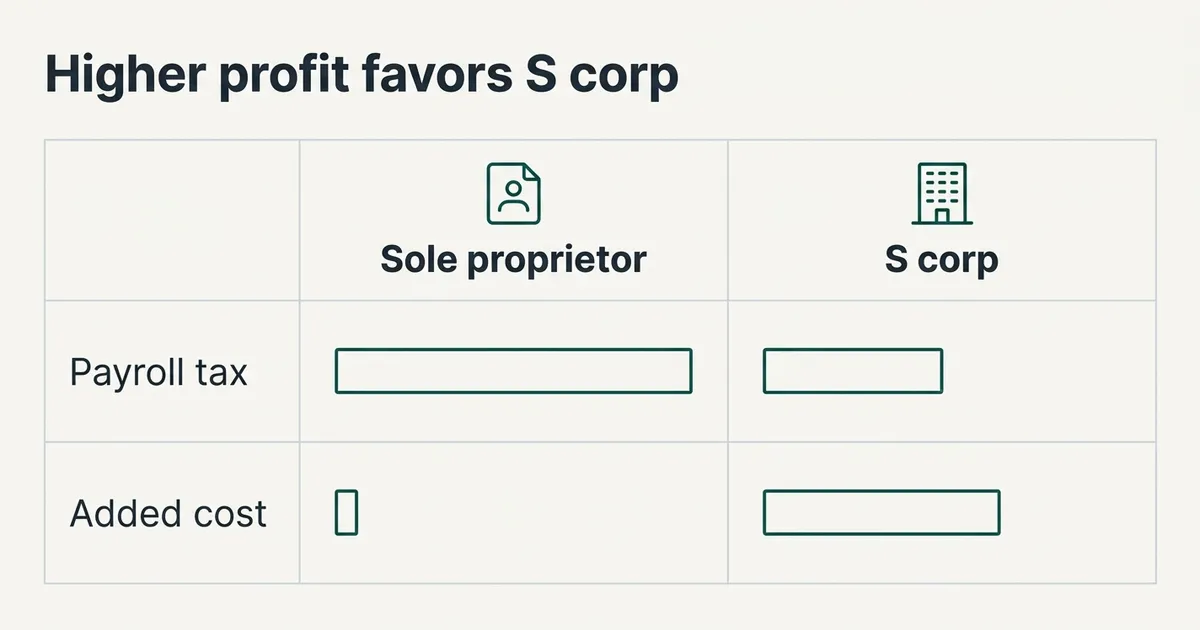
Here is an illustrative case with $100,000 of profit before owner pay. As a sole proprietor, you owe $14,130 in self employment tax. As an S corporation paying yourself $60,000, payroll tax is $9,180 combined ($4,590 employer, $4,590 employee). The gross saving is $4,950.
The costs follow. According to the California Franchise Tax Board (2026), S corporations pay the greater of 1.5% of net income or an $800 minimum annual franchise tax. Add a payroll service and a separate business tax return, which can plausibly run $1,200 to $1,800 a year. Net savings land around $2,000 to $3,000 here. The S corporation salary also lowers your QBI deduction, because owner wages are excluded from qualified business income.
You cannot set the salary at zero. According to IRS Fact Sheet FS-2008-25 (2008), S corporation officers must receive reasonable compensation for services before taking non-wage distributions. A salary far below what the job pays invites reclassification of distributions as wages. And once you pay your children as S corporation employees, their wages are no longer exempt from payroll tax.
How and when do you pay self employment tax?
You pay self employment tax through quarterly estimated payments during the year and settle the balance with your return. According to IRS Form 1040-ES (2026), you avoid an underpayment penalty by paying at least 90% of this year's tax or 100% of last year's, rising to 110% if your prior-year adjusted gross income exceeded $150,000. The IRS applies the penalty when you owe $1,000 or more at filing.
The 2026 federal due dates were April 15, June 15, and September 15. The final payment is due January 15, 2027. If you missed earlier quarters, paying more in January reduces but does not erase the penalty, because the penalty accrues by quarter.
California runs a different schedule. According to the California Franchise Tax Board Form 540-ES (2026), the state's estimated payments are split 30%, 40%, 0%, and 30% across the four dates, not even quarters. A California filer who sends in four equal payments can underpay early and trigger a state penalty.
What mistakes make self employment tax savings backfire?
Four mistakes cost parents the most:
- Counting retirement or health-insurance deductions as a self employment tax fix. They lower income tax only. Keep funding them, but do not expect a Schedule SE reduction.
- Driving profit toward zero. The refundable Child Tax Credit depends on earned income above $2,500, and Social Security credit toward your future benefit depends on reported earnings. Deduct what is legitimate, not what drops your profit to nothing.
- Skipping the wage-base check. Parents with a W-2 job and a side hustle often overestimate their self employment tax because they forget the shared ceiling, or underestimate it when their wages are under the ceiling.
- Treating payroll for kids as optional paperwork. Missing timesheets or a W-2 turns a $1,800 saving into a disallowed deduction with penalties.
Run the numbers in October, not April. Wages for your child must be paid in 2026 to count for 2026, while the Roth contribution can still be made until the April 2027 filing deadline.
Disclaimer: This article is general education about US federal tax rules and California as an example state, not individualized tax or legal advice. Figures reflect the tax year 2026 documents cited and are indexed or amended periodically. Examples are illustrative, exclude credits and state taxes unless noted, and do not promise any result. Confirm your situation with the IRS instructions or a licensed tax preparer before filing.
Frequently asked questions
How much to pay in taxes if self-employed?
Most self-employed filers pay 14.13% of net profit in self employment tax plus ordinary income tax, typically totaling 25% to 30% of profit at middle incomes before credits. According to the IRS Schedule SE instructions (2025), the self employment portion is 15.3% on 92.35% of net earnings. Credits such as the Child Tax Credit, and any state tax, move your final percentage up or down.
Do self-employed pay 30% tax?
No, self-employed people do not pay a flat 30% tax. According to IRS Topic No. 554 (2026), the self employment tax is 15.3% of 92.35% of net earnings, and income tax is added at your bracket. A single filer in the 12% bracket in California lands near 25% to 30% combined, but a parent with credits can land far lower.
How to avoid self employment tax?
You cannot avoid it entirely, but you can reduce it by lowering net profit through deductions, paying your children under 18 from a sole proprietorship, or electing S corporation status at higher profits. According to IRS Publication 15 (2026), wages paid to a child under 18 working for a parent's unincorporated business are exempt from Social Security and Medicare tax. Retirement and health-insurance deductions do not reduce self employment tax.
How much tax will I pay if I earn $30,000 self-employed?
You will pay about $4,239 in self employment tax and roughly $299 in federal income tax as a head of household, around $4,538 total before credits. According to IRS Revenue Procedure 2025-32 (2025), the 2026 head-of-household standard deduction is $24,150. Child Tax Credit and Earned Income Tax Credit eligibility can reduce the net bill, sometimes to under $1,000 with two children.
What is a self employment tax calculator, and how do I run one by hand?
A self employment tax calculator multiplies your net profit by 92.35% and then by 15.3%, which equals net profit × 14.13% under the wage base. According to the IRS Schedule SE instructions (2025), the calculation starts from Schedule C net profit. On $50,000 of profit, the result is $7,065, and half of it ($3,532) is deductible on your return.
What is the self employment tax rate?
The self employment tax rate is 15.3%, made up of 12.4% Social Security and 2.9% Medicare, applied to 92.35% of net earnings. According to the Social Security Administration (October 2025), the 12.4% portion applies only to the first $184,500 of earnings in 2026. An extra 0.9% Medicare tax applies above $200,000 for single filers and $250,000 for joint filers.