REIT Investing vs. Rentals: Which Wins in 2026?

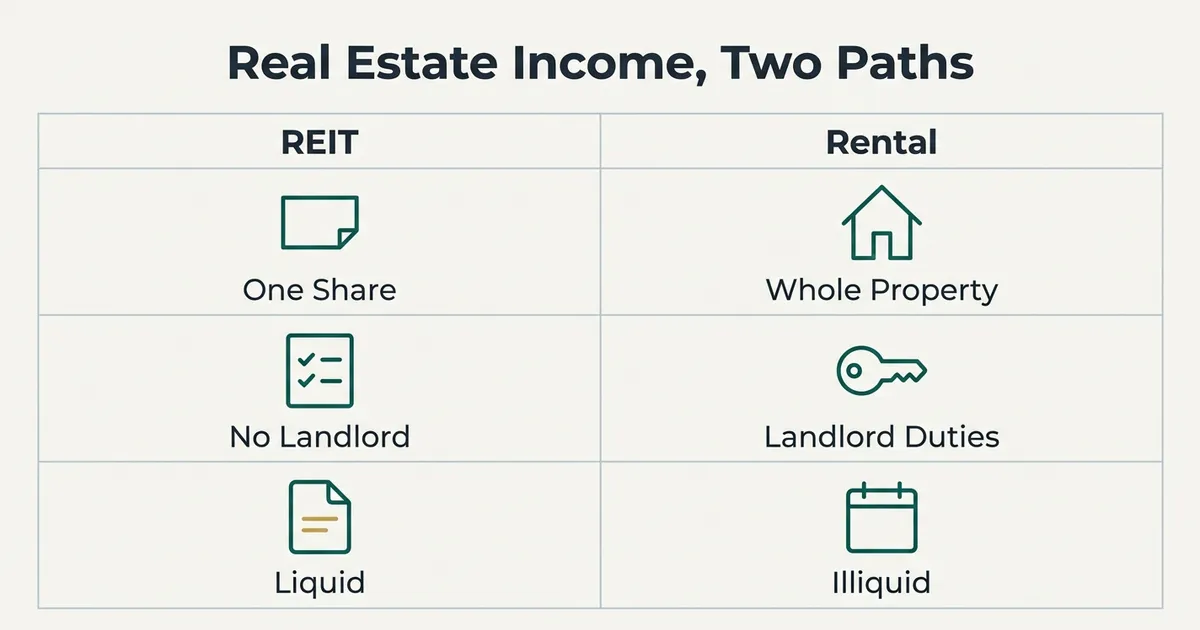
REIT investing wins for most working parents who want real estate income without landlord duties: publicly traded REITs need as little as one share. Rental properties can still out-earn REITs over a decade through leverage and depreciation, but only if you have $20,000 or more for a down payment and hours each month for management, repairs, and tenant screening.
That trade-off — liquidity and simplicity versus leverage and control — is the entire decision. If you're working full-time with a $10,000–$50,000 investable balance and two kids who need dinner made and homework checked, the calculus tilts hard toward paper real estate, not physical real estate. According to Nareit (2025), publicly traded REITs collectively held more than $1.3 trillion in equity market capitalization as of year-end 2024, spanning sectors from apartments to data centers, which means you can diversify across property types with a single trade instead of underwriting one building yourself.
What Is REIT Investing, and How Is It Different From Owning a Rental?
A REIT (real estate investment trust) is a company that owns, operates, or finances income-producing property and passes most of its profit to shareholders as dividends. Held inside a child's custodial account, those payouts are unearned income like any other dividend, so the kiddie tax thresholds apply to them. Under Internal Revenue Code Section 857, a company must distribute at least 90% of its taxable income to shareholders each year to qualify for REIT tax status, according to the IRS (2025). That 90% rule is the mechanism behind the sector's high yields: REITs can't retain much cash to reinvest, so they pay it out instead, which is why REIT dividend yields typically run higher than the S&P 500's. If you want that same payout-first income from ordinary shares held in a brokerage or custodial account rather than from property, that is the subject of our family dividend investing guide.
Owning a rental property works differently because you, not a distribution rule, decide what happens to the cash flow. You collect rent, pay the mortgage and repairs, and keep whatever's left — but you also field the 2 a.m. burst-pipe call, or pay 8% to 12% of collected rent to a property manager who handles it for you, a range reported by the National Association of Residential Property Managers (2024). If that's the path you'd take, our guide to outsourcing rental property management covers vetting a firm, reading its full fee schedule, and what your margin looks like after management. REIT investing removes that operational layer entirely: you buy shares on an exchange the same way you'd buy an index fund, and a professional management team runs the buildings.
How Do REIT Returns Compare With Rental Property Returns?
REITs have delivered an average annualized total return near 9.5% over the 20 years ending in 2024, according to Nareit (2025) data on the FTSE Nareit All Equity REITs Index — comparable to broad stock market returns over the same stretch, but with less of that gain tied to any single property. Rental properties can post higher returns in strong markets because a mortgage lets you control an asset worth four to five times your cash down, but that leverage cuts both ways when values or occupancy drop.
| Factor | Publicly Traded REITs | Non-Traded / Private REITs | Self-Owned Rental Property |
|---|---|---|---|
| Minimum investment | $1–$100 (one share) | $1,000–$25,000 | $20,000–$62,500+ (down payment) |
| Typical annual fees | 0.13%–0.6% fund expense ratio | 1%–3% annual fee, plus up to 10% sales load | 8%–12% of rent for a property manager |
| Liquidity | Sell any trading day | Locked 1–5 years; quarterly redemption caps | Weeks to months; ~5%–6% agent commission to sell |
| Weekly time commitment | Near zero | Near zero | 2–10 hours if self-managed, near zero with a manager |
| Historical average return | ~9.5% annualized, 20-year (Nareit, 2025) | Varies widely; often 4%–8% stated | Highly variable; leverage amplifies both gains and losses |
| Tax treatment | Ordinary income, partly offset by a 20% QBI deduction | Same as publicly traded REITs | Depreciation and mortgage interest shelter income; 1031 exchange available |
The table shows the real fork in the road: REITs win on cost of entry and liquidity, while rentals win on leverage and tax shelter — if you have the down payment and the time to manage one. A parent with $15,000 and a 45-hour work week has no realistic path to direct ownership at that budget; a REIT position is the only one of the two that's actually available to them today.
Which Type of REIT Fits a $10,000–$50,000 Budget?
Choose a publicly traded REIT index fund if you want the lowest cost and same-day liquidity. The Vanguard Real Estate ETF, for example, charges a 0.13% expense ratio, according to Vanguard (2026) — that's $13 a year on a $10,000 position, and you can sell it the moment you need cash for a car repair or a kid's orthodontist bill.
Choose a non-traded REIT only if you can lock money away for years and want exposure a public fund doesn't offer. Platforms such as Fundrise accept a $10 minimum, according to Fundrise (2026) — see our Real Estate Crowdfunding Platforms Compared for 2026 for how it stacks up against competitors — but the SEC's Office of Investor Education (2023) warns that non-traded REITs often cap redemptions at a small percentage of fund assets per quarter and can suspend redemptions entirely during downturns. FINRA (2024) has separately flagged that non-traded REIT sales loads and fees can run as high as 10% of the amount invested, which erodes years of dividend income before you see a dime of return.
Skip individual private REITs or syndications entirely if you don't meet SEC accredited-investor thresholds — net worth over $1 million excluding your primary residence, or income over $200,000 individually ($300,000 joint) in each of the last two years, per SEC Rule 501 of Regulation D (2024). Most parents in the $10,000–$50,000 range don't clear that bar, which makes publicly traded REIT funds the only fully liquid, fully compliant option without extra paperwork. For a broader menu of ways to earn low-maintenance real estate income beyond REITs alone, compare fractional platforms in our Fractional Real Estate Investing: Is It Worth It in 2026? guide and read Turnkey Real Estate Investing: Worth It in 2026? before committing new savings to any single vehicle.
How Much Do You Need to Invest in REITs to Replace $1,000 in Monthly Rental Income?
You'd need roughly $307,700 invested at the sector's average 3.9% dividend yield to generate $1,000 a month ($12,000 a year) in REIT dividends, based on Nareit's (2025) reported average yield for equity REITs. That math — $12,000 divided by 0.039 — is the reason REITs work best as a supplement to other income, not a standalone replacement for a full-time salary, at the $10,000–$50,000 starting balance this reader typically has.
Compare that with a single rental: a $250,000 property purchased with 25% down ($62,500) can plausibly clear $1,000 a month in net cash flow after a property manager's 8%-to-12% cut, mortgage, taxes, and insurance — see What a Rental Property Actually Nets: Income After Every Expense for the full expense breakdown and Landlord Insurance: 2026 Costs, Coverage & Quotes for what that insurance line item actually covers — illustrative math, not a promised outcome, since actual cash flow depends on local rents, vacancy, and financing terms. Freddie Mac (2026) puts the average 30-year fixed mortgage rate near 6.7%, which materially changes that cash-flow math from one purchase to the next. The honest takeaway: a single leveraged rental can reach $1,000 a month with a fraction of the capital a REIT position needs, but it concentrates all your risk in one property, one tenant, and one local market.
What Are the Tax Differences Between REIT Dividends and Rental Income?
REIT dividends are taxed mostly as ordinary income, but Internal Revenue Code Section 199A lets you deduct 20% of qualified REIT dividends before that income hits your tax return, a provision the IRS (2025) confirms Congress made permanent in 2025 tax legislation. That deduction shows up on your 1099-DIV in Box 5 and flows through IRS Form 8995 — no extra paperwork or entity setup required, which is part of what makes REIT investing simple for a busy household. This section covers only the tax difference between the two vehicles; household tax strategy in its own right — deductions, credits, and tax-advantaged accounts — belongs to our family tax guide.
Rental income gets a different, often larger shelter: you can depreciate a residential rental building over 27.5 years on a straight-line basis under IRS Publication 946 (2025), which can offset most or all of your reported rental profit even while cash flow stays positive. Active landlords with adjusted gross income under $100,000 can also deduct up to $25,000 of rental losses against other income under IRC Section 469(i), a benefit that phases out completely at $150,000 AGI, per the IRS (2025). REIT shareholders get none of that loss offset because they don't own the underlying property directly — the trade-off for skipping the maintenance calls is skipping the depreciation write-off too.
How Do You Build a REIT Portfolio in 5 Steps?
- Set a target allocation before you buy anything. Decide what share of your $10,000–$50,000 goes to real estate versus other assets; a common starting point is 5%–15% of an investable portfolio, though your number depends on other savings and your mortgage status.
- Pick the vehicle that matches your time horizon. Use a low-cost REIT index fund like VNQ for money you might need within five years; consider a non-traded platform only for money you can lock up 5+ years, given the redemption caps FINRA (2024) has documented.
- Open or use an existing brokerage account. Most publicly traded REIT funds trade like any stock or ETF, so no new account type is required if you already hold a taxable brokerage or IRA.
- Automate dividend reinvestment. Turning on a DRIP (dividend reinvestment plan) compounds the 90%-of-income payout rule in your favor by buying more shares every quarter without manual trades.
- Rebalance once a year and check sector concentration. Nareit (2025) reports that residential, industrial, and data-center REITs together make up a large share of the FTSE Nareit All Equity Index, so a single sector-focused REIT can leave you less diversified than the "real estate" label suggests.
When Does a Rental Property Still Beat REIT Investing?
Choose a rental over a REIT if you can supply a 20%–25% down payment — see How to Finance an Investment Property: Down Payment, Rates, and DSCR Loans for how lenders qualify that purchase — hire a property manager to absorb the hands-on work — or, for a lighter lift, explore Airbnb Management for Parents: 2026 Costs & Options as a middle path between full self-management and a REIT — and want the leverage a mortgage provides, since a $62,500 down payment controlling a $250,000 asset outperforms an unleveraged REIT position dollar-for-dollar when local prices and rents rise. National Association of Realtors (2025) data put the median existing U.S. home price at roughly $407,500 for 2024, a useful benchmark for sizing what that down payment buys in most metro areas.
Rentals also unlock a tax deferral REIT shares can't offer: Internal Revenue Code Section 1031 lets you sell one investment property and roll the gain into another without paying capital gains tax at the time of sale, according to the IRS (2025) — a benefit tied to owning real property directly, not shares of a trust. In California, factor in extra landlord obligations before you commit: Civil Code Section 1947.12, amended under the Tenant Protection Act, caps annual rent increases at 5% plus the local CPI (up to 10% total) for most units, and Civil Code Section 1950.5, as amended by AB 12 (2024), limits security deposits to one month's rent for landlords who own two or fewer rental properties. Skip direct rental ownership if you can't absorb a vacancy — the U.S. Census Bureau (2025) reported a national rental vacancy rate near 6.6% in late 2024, meaning even well-located units sit empty some months, and a $250,000 property with no tenant still carries a full mortgage payment.
Disclaimer: This article is for general education, not personalized investment, tax, or legal advice. REIT and rental property returns are not guaranteed, tax rules referenced here apply to the current tax year and adjust annually, and state landlord-tenant rules vary — confirm current figures with the IRS, the SEC, or a licensed professional before acting.
Frequently asked questions
Are REITs a good investment now?
REITs remain a reasonable way to add real estate exposure in 2026 for investors who want income and liquidity without property management, though "good" depends on your time horizon and existing allocation. According to Nareit (2025), the sector's 20-year annualized total return runs near 9.5%, comparable to broad equities, but REIT share prices are sensitive to interest-rate moves because higher rates make REIT dividend yields less competitive against bonds — check current 10-year Treasury yields against a REIT fund's dividend yield before adding a large position.
How much do you need to invest in REITs to make $1,000 a month?
You'd need roughly $307,700 invested at the sector's average 3.9% dividend yield, based on Nareit's (2025) reported average yield for publicly traded equity REITs, since $12,000 in annual dividends divided by a 3.9% yield equals that balance. Higher-yielding mortgage REITs sometimes pay 8% or more, which would lower the required investment to around $150,000, but that higher yield typically reflects added interest-rate and credit risk, not free extra income.
What is the downside of a REIT?
The main downside is that REIT shares trade like stocks, so their price can fall 20% or more in a downturn even if the underlying buildings keep collecting rent, unlike a paid-off rental that still produces cash flow. Non-traded REITs carry an added downside: the SEC's Office of Investor Education (2023) warns that these funds can cap or suspend investor redemptions during stress periods, locking up money you may need on short notice, and FINRA (2024) notes sales loads on some non-traded REITs run as high as 10% of the amount invested.
Can you invest $1,000 in a REIT?
Yes — a $1,000 position easily buys multiple shares of a publicly traded REIT ETF like the Vanguard Real Estate ETF, which carries a 0.13% expense ratio according to Vanguard (2026), or several shares of an individual listed REIT priced under $100. Non-traded platforms such as Fundrise also accept deposits starting at $10, per Fundrise (2026), making $1,000 well above the minimum entry point across nearly every retail REIT option.
What do Reddit investors say about REIT investing?
Discussion on personal-finance forums like r/REBubble and r/dividends generally centers on two recurring themes: REIT share prices swing more than the underlying real estate's actual value would suggest, and non-traded REIT fee structures are frequently flagged as a reason to prefer low-cost, publicly traded funds instead. Those forum observations track with regulatory findings — FINRA (2024) has documented non-traded REIT loads up to 10%, which is the exact complaint that surfaces most often in those threads, so treat the sentiment as a prompt to check a fund's actual fee disclosure, not as investment advice on its own.
What returns can you expect from REIT investing?
Publicly traded equity REITs have returned an average of about 9.5% annualized over the 20 years ending in 2024, according to Nareit (2025), though any single year can swing well above or below that average — REITs posted negative total returns in 2022 as interest rates rose sharply. Dividend yield alone has averaged near 3.9% sector-wide per the same Nareit (2025) data, with the remainder of total return coming from share-price appreciation, which is the more volatile of the two components.