Landlord Insurance: 2026 Costs, Coverage & Quotes

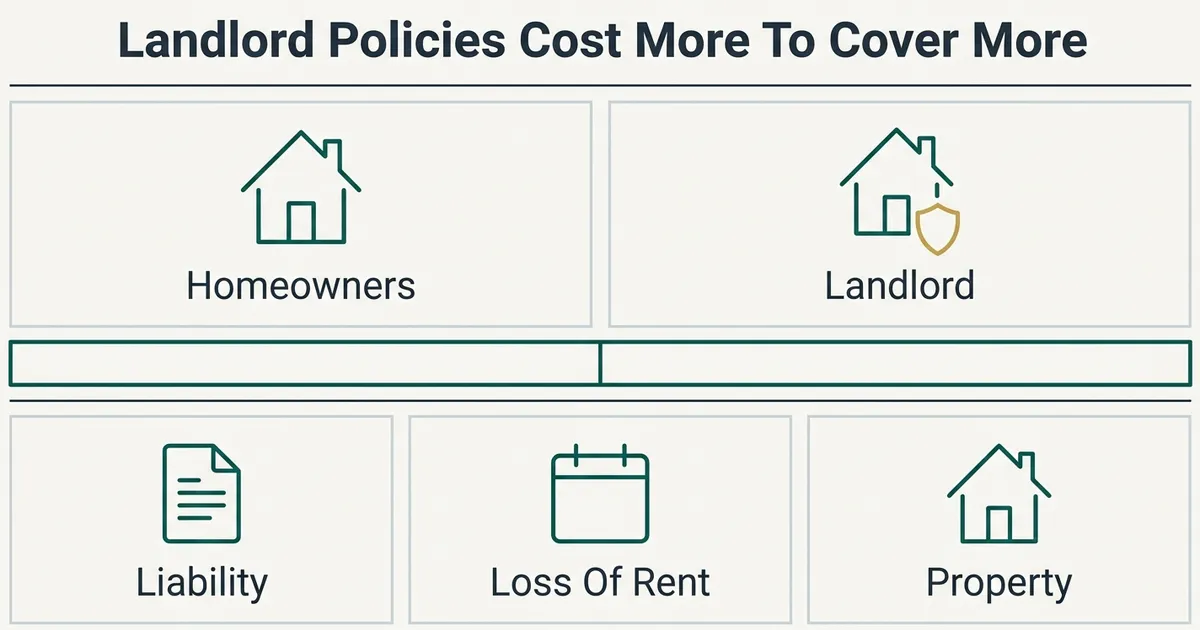
Landlord insurance costs about $900 to $2,600 a year for a typical single- family rental, and more in catastrophe-exposed states — roughly 25% more than a comparable homeowners policy — because it adds liability coverage for tenants and loss-of-rent protection if a covered claim makes the unit uninhabitable. Coverage and price both scale with dwelling value, location risk, and policy form.
You owe this coverage the moment you hold title to a rental property, even if a property manager collects the rent and fields the maintenance calls — insurance follows ownership, not day-to-day duties. According to the Insurance Information Institute (2024), landlord insurance — also called rental dwelling insurance — covers habitational risks that a standard homeowners policy excludes once a property is rented to someone other than the owner. That gap matters for the working parent who bought a turnkey rental for cash-flow yield and outsourced everything else: the property manager's contract does not transfer the insurance obligation to them, and a lapsed or wrong policy leaves you personally exposed to a tenant's lawsuit or a fire-damage repair bill.
This guide breaks down what a landlord policy actually pays for, what it costs at different coverage levels, and when it makes more sense to skip direct ownership altogether in favor of a REIT or fractional platform that carries insurance at the entity level instead of on your personal policy. For how this decision fits alongside the other low-maintenance property routes, start from our low-maintenance real estate pillar guide.
What Does Landlord Insurance Actually Cover?
A landlord policy pays for three things a homeowners policy does not: liability from tenant injuries, loss of rental income during a covered repair, and higher-risk perils tied to non-owner occupancy. According to the Insurance Information Institute (2024), most landlord policies bundle these into a single "DP" (dwelling policy) form alongside standard dwelling and detached-structure coverage.
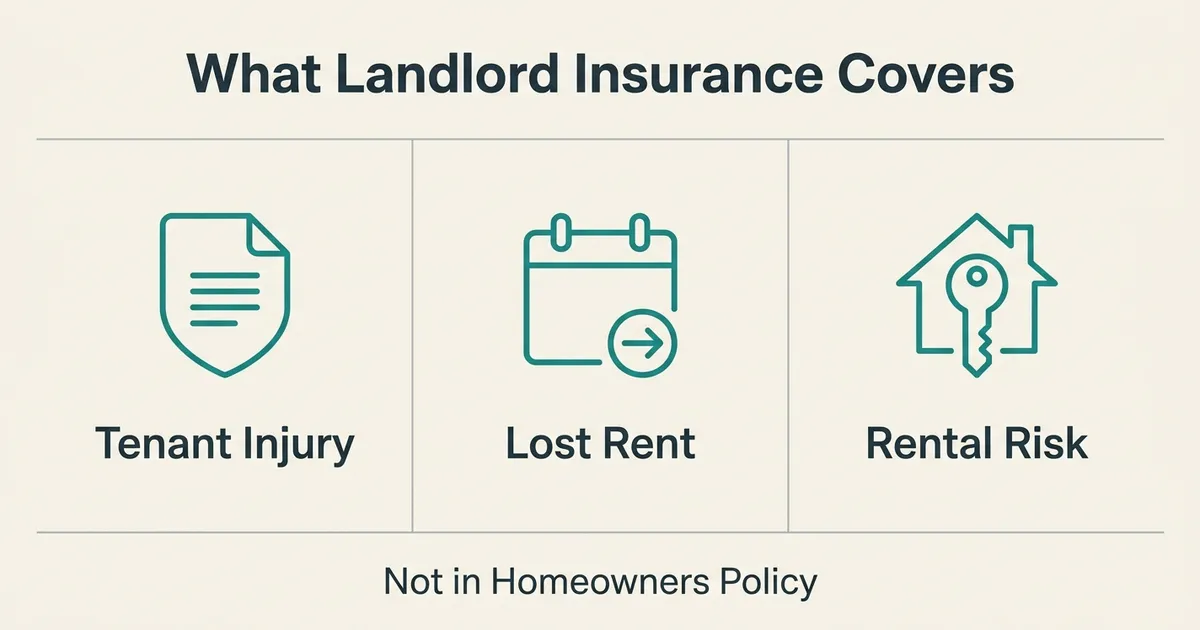
Loss-of-rent coverage, sometimes called "fair rental value," reimburses you for the rent you'd have collected while the unit is unlivable after a covered loss like a kitchen fire or a burst pipe. On ISO dwelling forms this coverage is capped at a percentage of your dwelling limit — commonly 10% on the broad and special forms and up to 20% on some, typically payable for up to 12 months — so a policy with $250,000 in dwelling coverage and a 20% limit caps loss-of-rent payouts around $50,000 (and around $25,000 at 10%, which is why the percentage is worth reading on your own declarations page), which is the mechanism that keeps your mortgage payments covered during a multi-month rebuild.
Liability coverage pays legal and medical costs if a tenant or their guest is injured on the property and sues you. Most carriers set a $300,000-$500,000 minimum liability limit on landlord policies, according to the Insurance Information Institute (2024), because rental properties see more foot traffic — and more turnover-related slip, trip, and dog-bite claims — than owner-occupied homes. What a standard landlord policy never covers: the tenant's own furniture and belongings. That's the mechanism behind requiring tenants to carry renters insurance in the lease — their policy, not yours, replaces their couch.
How Much Does Landlord Insurance Cost Per Month?
Landlord insurance runs about $75 to $215 a month nationally for a mid-value single-family rental, with the exact figure driven by dwelling value, roof age, claims history, and state catastrophe risk. Be sceptical of any single national average you see quoted: no regulator publishes an audited landlord- premium survey, so the figures in circulation come from brokers and comparison sites, not from measured industry data. At the most common coverage level — $300,000 of dwelling coverage — marketplace quotes run roughly $900 to $1,800 a year, with the 2026 all-limits national average near $1,478 (Steadily, 2026). The comparison that is on firmer footing is the differential rather than the level: the Insurance Information Institute puts a landlord policy at about 25% more than a comparable homeowners policy on the same structure.
Here's a worked example: a $280,000 single-family rental in Ohio, insured under an open-peril DP-3 form with $300,000 liability and 20% loss-of-rent coverage, runs about $1,450 a year — $121 a month. The same house in coastal South Carolina or hurricane-exposed Florida commonly prices at $2,800-$3,600 a year for identical coverage limits, because wind and named-storm deductibles push base rates up sharply in those states. That spread is the reason you should always request a quote for the specific address, not a regional average — two houses ten miles apart can price hundreds of dollars apart if one sits in a different flood or wind zone.
Three levers move your premium the most: raising your deductible from $1,000 to $2,500 typically cuts premium 10-15%, per Policygenius (2024); bundling multiple rental properties under one landlord policy (a "landlord portfolio" endorsement) often saves 5-10% per unit; and choosing a named-perils DP-1 form instead of an open-peril DP-3 form can cut premium by 25-35% at the cost of narrower coverage, discussed below.
Which Policy Type Should You Choose: DP-1, DP-2, or DP-3?
Choose a DP-3 "special form" policy if your lender requires broad coverage or the property is newer and higher-value; choose a DP-1 "basic form" policy only if you're self-insuring an older, lower-value rental and want the lowest possible premium. The form number determines which perils are covered and how claims get evaluated.
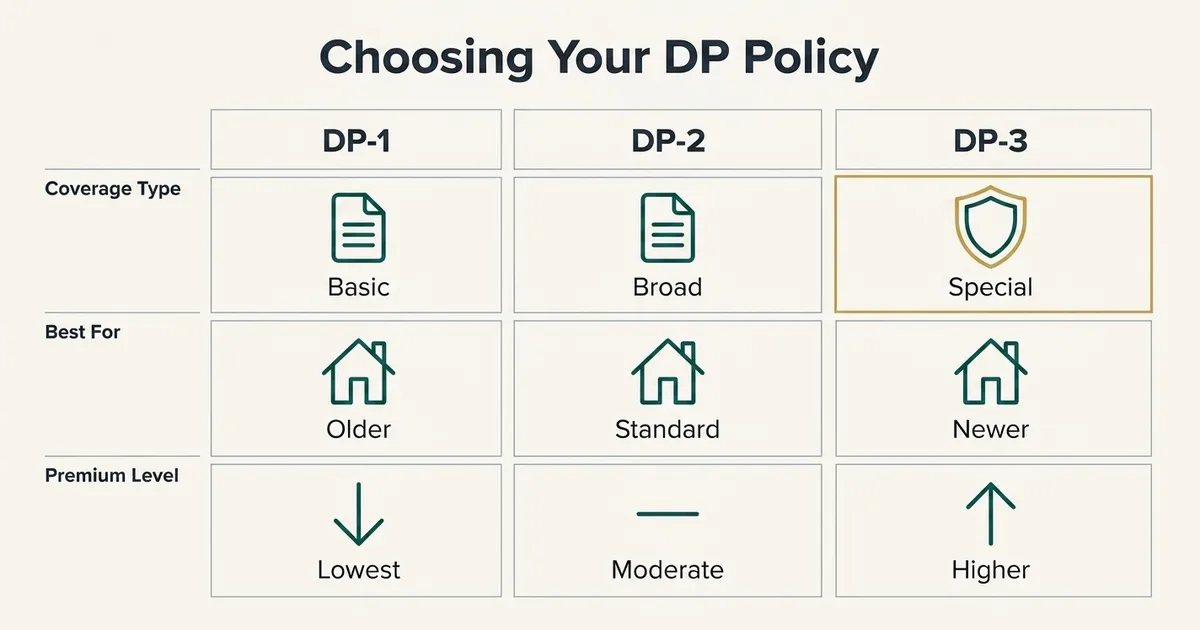
| Policy form | Typical annual premium ($300k dwelling) | Perils covered | Loss-of-rent included? | Best for |
|---|---|---|---|---|
| DP-1 (Basic Form) | $900 – $1,300 | Named perils only — typically 10, including fire, lightning, and windstorm | No — add as a rider, ~$50-100/yr | Older or low-value rentals, cash-flow-first turnkey buyers self-insuring the rest |
| DP-2 (Broad Form) | $1,300 – $1,900 | Broader named-peril list (16), adding falling objects and weight of ice/snow | Often an optional add-on | Mid-tier turnkey rentals in moderate-risk states |
| DP-3 (Special Form) | $1,700 – $2,600 | Open/all-risk on the dwelling — every peril except named exclusions (flood, earthquake, wear) | Usually included, ~20% of dwelling limit | Newer or renovated homes; lender-required minimum on most financed rentals |
DP-3 wins for most readers financing a rental through a conventional mortgage, because lenders generally require dwelling coverage written on a replacement- cost basis for at least the loan amount, and a DP-1 basic form — named perils, and settled at actual cash value unless you buy the replacement-cost option — often won't satisfy that clause on its own. Read your own loan documents rather than assuming a form number: the requirement is set by the lender's insurance clause, not by any insurance regulator. DP-1 only makes sense if you own the property free and clear and have enough cash reserve to self-insure the perils it excludes. None of the three forms cover flood or earthquake damage; per FEMA's National Flood Insurance Program (2024), a separate NFIP policy caps residential building coverage at $250,000, so a $400,000 dwelling in a flood zone needs a private excess-flood policy layered on top.
How Is Landlord Insurance Different From Homeowners Insurance?
The core difference is who's exposed and for how long: a homeowners policy assumes the owner lives there and can spot problems immediately, while a landlord policy prices for a tenant who might not report a leak for days. That gap in oversight is a large part of the actuarial reason landlord premiums run above owner-occupied rates for an identical structure — the Insurance Information Institute puts the differential at about 25%.
The vacancy clause is the edge case that trips up the most landlords. The standard ISO dwelling forms suspend a specific list of perils — vandalism, glass breakage, water damage, sprinkler leakage, theft and attempted theft — once the unit has been vacant for more than 60 consecutive days before the loss. If you're between tenants for two months while a property manager re- leases the unit, ask your carrier for a vacancy permit endorsement before you cross that line, not after a claim is denied.
Do You Need Landlord Insurance If a Property Manager Runs the Rental?
Yes — the property manager's coverage protects their business, not your building, so you still need your own landlord policy even with full-service management in place. A management contract typically requires you to list the property manager as an "additional insured" on your policy, which extends limited liability protection to them without shifting the underlying obligation to insure the structure itself.
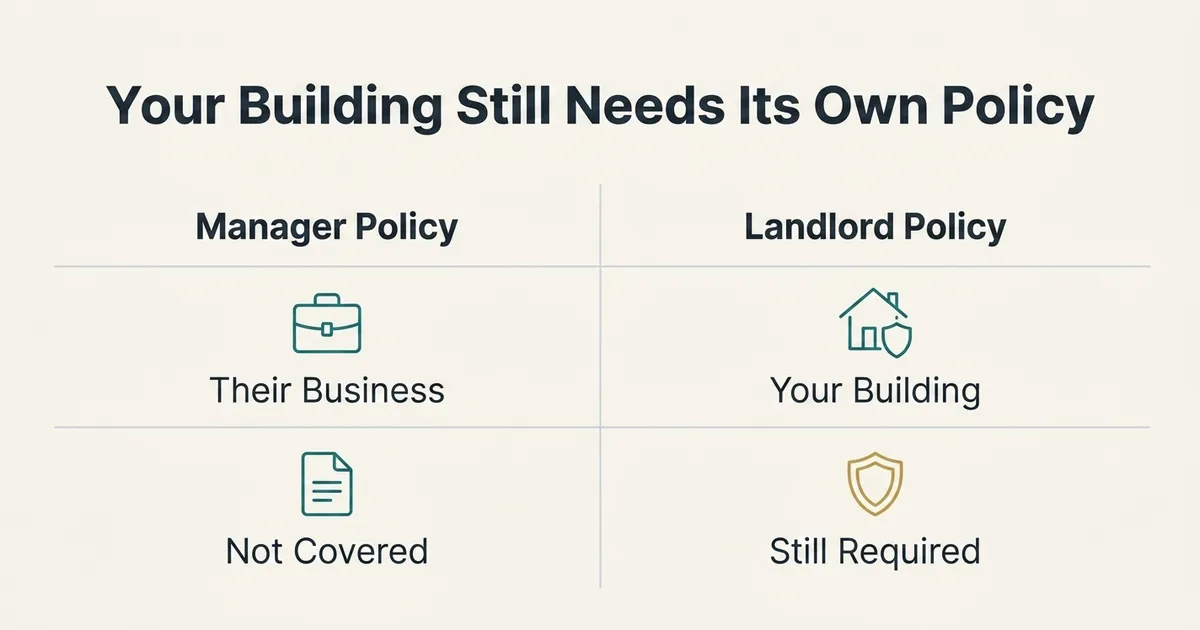
This is the coverage gap that catches readers who bought a turnkey rental specifically to avoid hands-on work: outsourcing repairs and rent collection does not outsource risk of loss. If you want a fuller breakdown of what a manager's contract should and shouldn't cover, see our guide on how to outsource rental property management — the insurance clause is one of the four items worth negotiating before you sign.
Should You Buy Landlord Insurance Directly or Choose a Vehicle That Skips It Entirely?
Buy landlord insurance yourself if you hold title to a rental directly, whether through a turnkey purchase or a self-found deal with a property manager running it. Skip landlord insurance entirely if you'd rather earn real-estate-backed yield through a vehicle that never puts your name on a deed.
REITs and fractional real estate platforms hold the underlying properties inside a fund or single-purpose entity, and that entity — not you — carries the landlord policy. Our comparison of REITs vs. rental properties walks through the yield and control trade-offs in more depth, and our analysis of whether fractional real estate is worth it covers the fee drag you take on in exchange for that hands-off structure. If you've decided fractional ownership fits your $10,000-$50,000 investable range better than a $30,000-$60,000 down payment on a turnkey rental, our roundup of the best fractional real estate platforms compares minimums and fee loads directly.
Don't buy direct if you can't absorb a $2,000-$5,000 insurance-plus-deductible surprise in a bad year — that's the honest trade-off conventional "just buy a rental" advice skips. Direct ownership plus a property manager gets you full rent and appreciation upside, but you own the insurance decision, the deductible, and the claims process. A REIT or fractional stake trades some of that upside for a fixed, disclosed fee and zero insurance administration.
How Do You Get a Landlord Insurance Quote in Under 15 Minutes?
Get a landlord insurance quote by gathering four numbers before you call: purchase price or estimated rebuild cost, roof age, square footage, and annual gross rent — carriers price primarily off rebuild cost, not market value. Rebuild cost is typically lower than purchase price in expensive markets, which is why your quote may come in under what you'd guess from the sale price.
Request quotes from at least two sources: a landlord-specialty carrier or marketplace such as Steadily or Foremost, which price exclusively for rental exposure, and an independent agent who can compare three to five regional carriers on the same limits. According to Insurance.com (2024), shopping three or more quotes for an identical coverage set commonly turns up $200-$400 a year in premium spread for the same policy limits on the same property. Ask every quote for the same deductible, the same liability limit, and the same loss-of-rent percentage — comparing a $1,000-deductible DP-3 against a $2,500-deductible DP-1 will make the cheaper number meaningless.
What Mistakes Cause Landlord Insurance Claims to Get Denied?
The most common denial reason is occupancy misrepresentation: telling the carrier the home is owner-occupied to get a lower homeowners rate, then renting it out. Per the Insurance Information Institute (2024), a carrier can deny a claim outright and rescind the policy if it discovers the property was rented without disclosure at the time of loss — the mechanism is that the insurer priced the risk wrong from day one and never collected the higher landlord premium that risk required.
Short-term rentals create a second, less obvious gap. A standard long-term landlord policy is underwritten for tenants on 6-12 month leases, and per the Insurance Information Institute (2024), listing that same unit on Airbnb or Vrbo without a short-term-rental endorsement can void coverage for a stay-related claim entirely. California landlords converting a long-term rental to short-term stays should also check whether their property sits in a wildfire-exposed area where standard carriers have pulled back; per the California FAIR Plan Association (2024), the state's insurer-of-last-resort program has grown to cover a rising share of wildfire-zone dwellings that private carriers declined to renew.
The third mistake is letting loss-of-rent coverage lapse when you refinance or switch carriers. Because that add-on isn't automatic on every policy, per Bankrate (2024), a landlord who switches carriers to save $150 a year and forgets to re-add fair rental value coverage can lose $15,000-$25,000 in unreimbursed rent during a six-month post-fire rebuild — a far larger loss than the premium saved.
Insurance decisions like these carry real financial consequences; verify current rates, endorsements, and state-specific rules with a licensed agent before binding a policy.
Frequently asked questions
What is the best insurance for landlords?
The best landlord policy for most financed single-family rentals is a DP-3 "special form" policy with at least $300,000 in liability coverage and the highest loss-of-rent percentage your carrier offers — commonly 10% to 20% of the dwelling limit depending on the form. DP-3 is the only dwelling form written on an open-perils basis for the structure, covering everything except named exclusions like flood and earthquake, which is why it is usually the form that satisfies a lender's insurance clause where a cheaper DP-1 named-perils policy settled at actual cash value may not.
How much is landlord insurance per month?
Landlord insurance runs about $75-$150 a month nationally for a mid-value single-family rental with $300,000 in dwelling coverage — roughly $900 to $1,800 a year (Steadily, 2026). No regulator publishes an audited national landlord-premium survey, so every figure of this kind is a marketplace estimate rather than a measured average; Steadily put the 2026 all-limits national average near $1,478. Coastal and wildfire-exposed states commonly run $230-$300 a month for identical coverage limits because of higher wind, hail, and fire catastrophe pricing.
How much is a $100,000 rental insurance policy?
A landlord policy with $100,000 in dwelling coverage — typical for a low-value single-family home or a small condo — costs roughly $500-$900 a year, since premium scales with a rate per $1,000 of coverage rather than a flat fee. Carriers rate dwelling coverage per $1,000 of insured value, so raising the dwelling limit raises the base premium roughly in step — though not exactly, since fixed policy expenses and liability limits do not scale with it. The NAIC's Homeowners Insurance Report, whose most recent data year is 2022, publishes average dwelling fire and homeowners premiums by amount of insurance if you want the underlying distribution.
Is landlord insurance required in Oklahoma?
No state, including Oklahoma, legally mandates landlord insurance, but nearly every mortgaged rental requires it as a lender condition, and Oklahoma's severe-weather exposure pushes premiums above the national average. Per the National Weather Service's Norman office, Oklahoma has averaged about 59 tornadoes a year across the 1950-2025 record, and that wind and hail frequency is a primary reason Oklahoma landlord premiums commonly run above the national average for equivalent coverage limits — an industry-wide observation rather than a figure any single body publishes.
How do you get a landlord insurance quote?
Get a landlord insurance quote by providing a carrier or agent with the property's rebuild cost, roof age, square footage, and expected annual rent, then compare at least two to three quotes at identical coverage limits and deductibles. According to Insurance.com (2024), shopping multiple carriers on the same $300,000 dwelling limit and $1,000 deductible commonly surfaces a $200-$400 annual price spread, which is enough to justify the 15 minutes it takes to request a second quote before renewing.