Turnkey Real Estate Investing: Worth It in 2026?

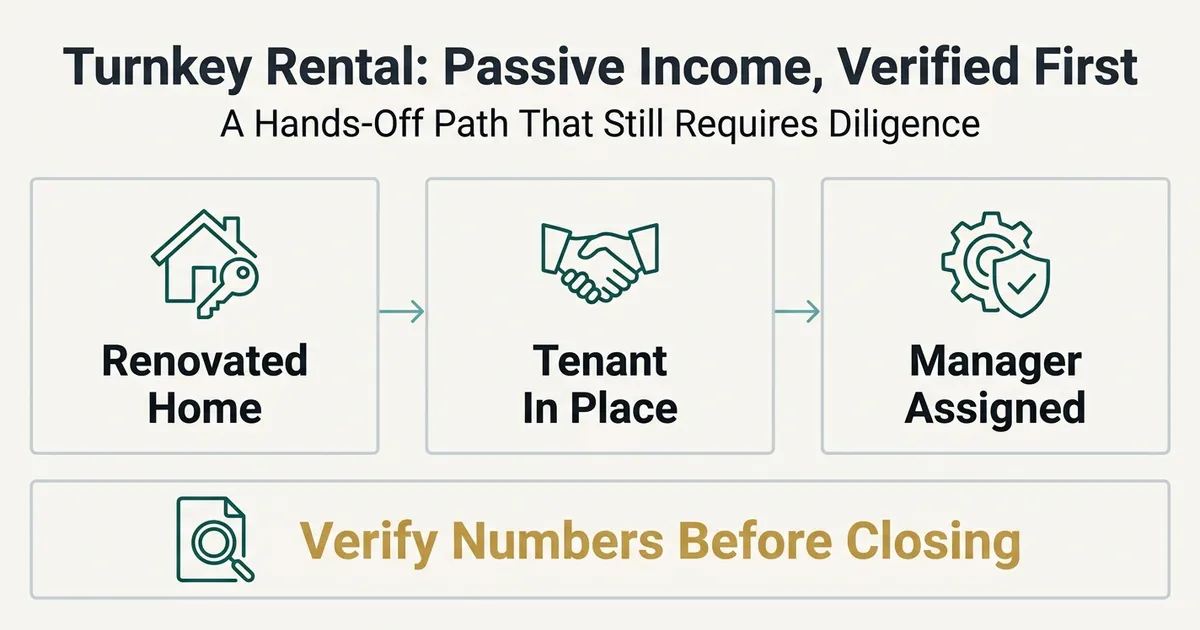
Turnkey real estate is a renovated rental property sold with a tenant and manager already in place, so you collect rent without landlord duties. It suits investors with roughly $30,000 or more in investable savings who want rental income hands-off — but only if you verify the seller's rent and expense numbers before closing.
For a full-time employee who can't take a 2 a.m. call about a burst pipe, that division of labor is the entire appeal. A licensed property manager handles tenant screening, rent collection, and repair dispatch, typically for 8-12% of collected rent — the range that recurs across published fee schedules from national franchises and independent firms. You still own the deed, still owe the mortgage, and still owe the IRS a Schedule E — you just don't own the to-do list.
Single-family homes make up roughly a third of the nation's rental housing stock, according to Harvard's Joint Center for Housing Studies, and turnkey providers operate almost exclusively in that segment rather than in condos or apartment buildings. This guide walks through the mechanics, the real numbers, and the exact situations where turnkey beats — or loses to — REITs, fractional platforms, and syndications.
What Is Turnkey Real Estate?
A turnkey property is a home a company has already bought, renovated, leased, and staffed with a property manager before selling it to you as a finished income-producing asset. The "turnkey" name refers to the idea that you turn one key — closing — and rental income starts the same month, without a renovation phase or a vacancy gap while you find a first tenant.
The provider's business model depends on that gap between what they paid and what they sell it for. Turnkey single-family listings on marketplaces such as Roofstock span a wide band — roughly $80,000 in lower-cost Midwest markets to $400,000 and above in Sun Belt metros — reflecting both the regions where most providers operate and the margin built into that price for renovation labor, holding costs, and profit. That markup is not a hidden fee — it's the price of skipping the sourcing, rehab, and leasing work yourself.
Turnkey differs from three adjacent options this pillar covers. A real estate investment trust (REIT) buys shares of a diversified portfolio you never touch — see REITs vs. rental properties for the trade-offs. A fractional platform lets you buy a slice of one property alongside other investors — covered in is fractional real estate worth it. Turnkey, by contrast, puts your name alone on the deed, the mortgage, and the Schedule E.
How Does Turnkey Real Estate Investing Actually Work?
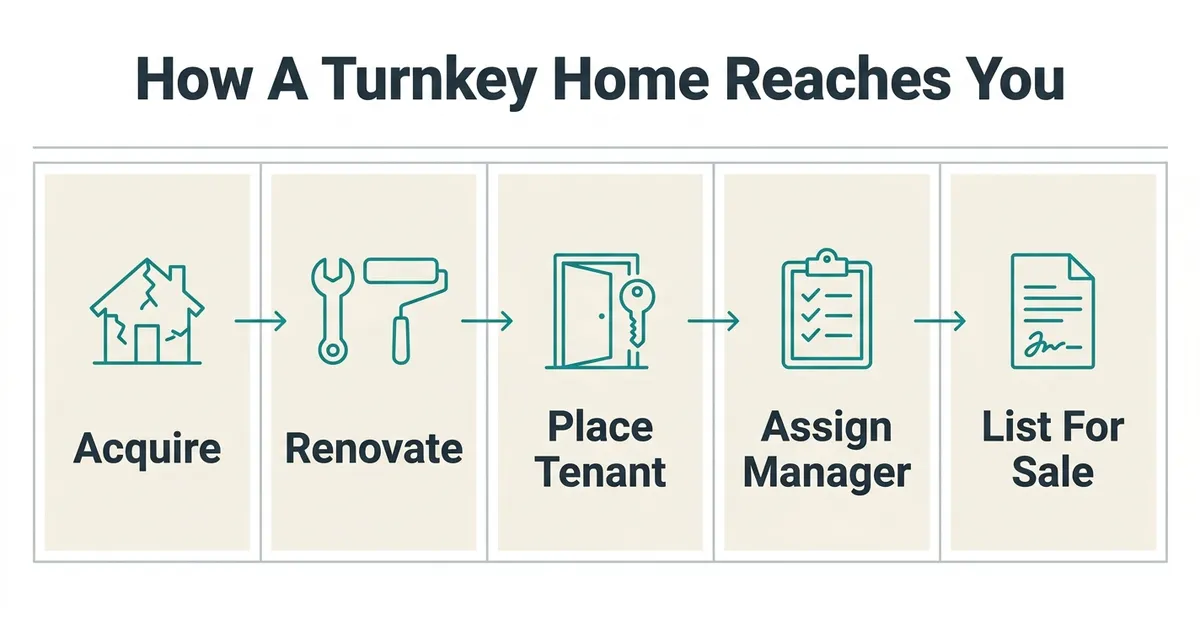
The transaction runs through five steps: the provider acquires a distressed property, renovates it, places a tenant, arranges third-party management, then lists it for sale with a lease and management agreement attached. You buy the finished package, usually with a conventional investment-property mortgage, and rent starts arriving the month after closing because the tenant is already paying.
Financing works differently than a primary residence. Fannie Mae's Selling Guide (2025) sets a 15% minimum down payment for a one-unit investment property, though most lenders overlay a 20%-25% requirement in practice because investor loans carry more default risk than owner-occupied ones. Investment-property mortgage rates also price above the rate on an otherwise identical owner-occupied loan — commonly by roughly half a point to a point and a half depending on down payment — because Fannie Mae and Freddie Mac apply loan-level price adjustments to investment-property loans that lenders pass through in the rate. Note that Freddie Mac's Primary Mortgage Market Survey, the weekly rate figure most often quoted in the news, surveys owner-occupied purchase loans only, so the headline rate you see is not the rate you will be quoted on a rental.
Once you own it, the existing management contract usually transfers to you at closing, so you inherit the same manager the tenant already knows. That continuity is the mechanism that makes turnkey genuinely lower-effort than buying a random rental and hiring a manager afterward — there's no gap where the property sits unmanaged or the tenant re-signs under new terms. If you'd rather buy your own property and add management after the fact, how to outsource rental property management covers that sequencing. A turnkey deal also assumes a long-term tenant already in place; if you'd rather run the property as a short-term rental, running a family Airbnb without full-time hosting covers the different providers and nightly-yield economics.
What Does a Turnkey Rental Cost, and What Return Can You Realistically Expect?
Expect to bring 20%-25% of the purchase price in cash, plus 2%-3% for closing costs and a reserve fund, and to net a single-digit cash-on-cash return in year one before appreciation or tax benefits. The math below is illustrative, not a projection of what any specific property will do.
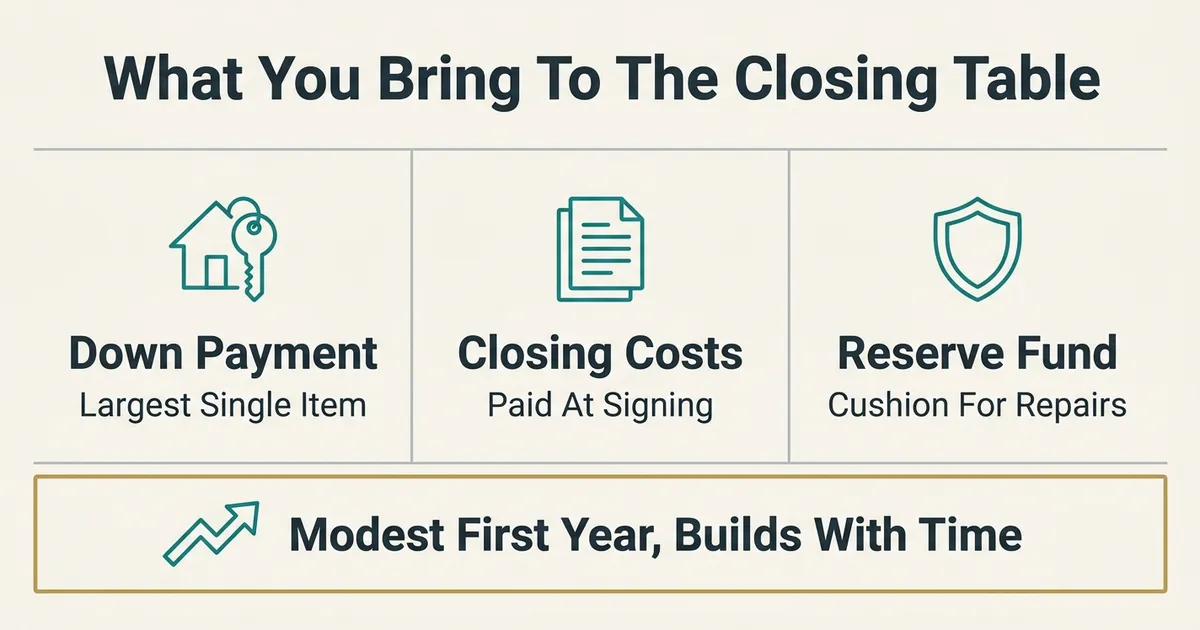
Take a $180,000 turnkey home renting for $1,650 a month, a price point in line with Roofstock's (2025) reported marketplace range. A 20% down payment is $36,000; add roughly $5,000 in closing costs and you need about $41,000 in cash. The $144,000 loan, at an illustrative 7.25% 30-year fixed rate consistent with the investor-rate premium Freddie Mac (2025) describes, carries a principal-and-interest payment near $982 a month.
Itemized monthly operating costs — separate from the mortgage — run roughly: property tax $150, insurance $90, management fee at 9% of rent ($148.50), toward the low end of the 8-12% range above, and a combined 10% maintenance-and-vacancy reserve ($165). That totals about $553.50, leaving net operating income (NOI) of $1,096.50 a month, or $13,158 a year — a 7.3% cap rate on the $180,000 price. After the $982 mortgage payment, monthly cash flow is about $114.50, or roughly $1,374 a year — a 3.4% cash-on-cash return on the $41,000 invested, before any principal paydown, appreciation, or depreciation tax benefit.
Depreciation is where turnkey earns back some of that thin cash-on-cash number. Per IRS Publication 527 (2025), you depreciate the building (not the land) over 27.5 years using straight-line depreciation, which on a $180,000 home with a $40,000 land allocation works out to roughly $5,090 a year in paper losses that offset rental income on your tax return. Because the property is held in your name rather than a fund's, IRS Publication 925 (2025) also allows a special allowance of up to $25,000 in losses against ordinary income for active participants, phasing out between $100,000 and $150,000 in modified adjusted gross income — a benefit REITs and most syndications don't pass through directly to you.
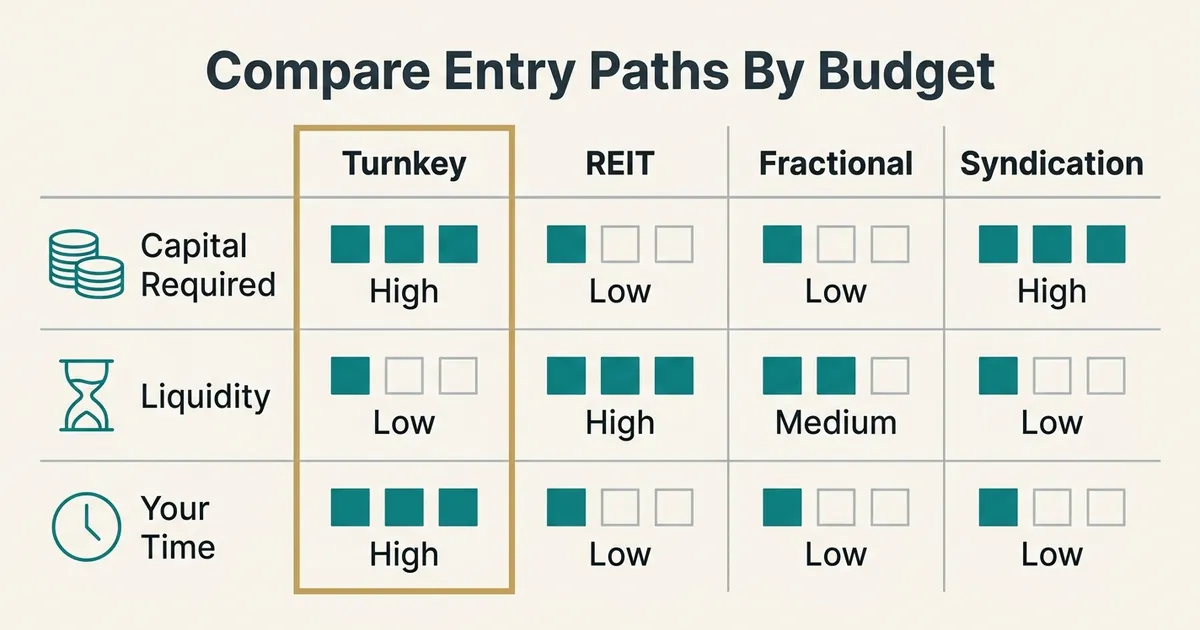
Turnkey vs. REITs vs. Fractional Platforms vs. Syndications: Which Fits Your Budget?
| Vehicle | Minimum to Start | Typical Fees | Time to Access Cash | Your Weekly Time | Primary Risk |
|---|---|---|---|---|---|
| Publicly traded REIT | ~$1-$500 (one share) | 0% direct; costs embedded in share price | Same trading day (T+1 settlement) | Under 15 min/month | Share price swings with interest rates |
| Fractional/crowdfunding platform | $10-$100 | 0.15%-1% annual asset fee + spread | Quarterly window, commonly capped near 5% of NAV/quarter | Under 30 min/month | Redemption gates during downturns |
| Turnkey single-family rental | $20,000-$50,000 (down payment + reserves) | 8-12% of rent for management + built-in purchase markup | 2-4 months to sell | 1-3 hrs/month | Single-property concentration, vacancy |
| Self-sourced rental + outsourced manager | $25,000-$60,000 | 8-12% of rent for management, no markup | 2-4 months to sell | 3-6 hrs/month | Underwriting mistakes, same landlord risk |
| Private syndication (e.g., multifamily) | $25,000-$50,000 | 1%-2% asset management + ~20% profit split | Locked 3-7 years | Under 1 hr/quarter | Illiquidity, sponsor execution risk |
Liquidity and check size move in opposite directions here. A REIT bought through a brokerage account settles in one day and needs no minimum beyond a share price, which is why it dominates the best fractional real estate platforms comparison for readers under $10,000. Turnkey and self-sourced rentals demand the largest cash outlay and the longest exit timeline — months, not days — but they're the only two rows on this table where you personally hold title and claim the depreciation. Syndications sit in between on check size but lock your money for years and often require accredited-investor status: the SEC (2025) defines that as $200,000 in individual income ($300,000 joint) or $1 million in net worth excluding your primary residence for most Regulation D 506(c) offerings, though Regulation A+ deals — capped at $75 million raised per SEC (2025) rules — stay open to non-accredited investors.
What Are the Biggest Risks of Turnkey Real Estate?
The single biggest risk is paying a markup you don't recognize because you never compared the turnkey price to nearby resale comps. BiggerPockets' investor education materials warn that turnkey premiums of 10%-20% over comparable owner-occupant resale value are common, since the price bakes in the provider's renovation labor and profit — money you're paying whether or not the renovation quality justifies it.
Vacancy is the second risk, and it's a national average problem, not a this-property problem, until it happens to you. The U.S. Census Bureau's Housing Vacancy Survey put the national rental vacancy rate at 7.3% in the second quarter of 2026, meaning roughly one in fourteen rental units sits empty at any given time — a single vacancy month on a $1,650-rent property erases more than the entire annual cash flow calculated above.
Rent-control exposure is state- and city-specific and matters most in California. Under California Civil Code Section 1947.12 (the statewide Tenant Protection Act, in effect since January 2020), annual rent increases on covered units are capped at 5% plus local CPI, not to exceed 10% total — a ceiling that can suppress your ability to raise rent to match a mortgage payment that resets with a refinance. Security deposits are similarly capped: California Civil Code Section 1950.5, as amended by Assembly Bill 12 (effective July 1, 2024), limits most landlords to one month's rent as a security deposit regardless of whether the unit is furnished, with a narrow exception: a landlord who is a natural person (or an LLC whose members are all natural persons) and owns no more than two residential rental properties totaling no more than four dwelling units may collect up to two months' rent, and even that exception does not apply when the tenant is a service member — a rule that affects how much cushion you have against tenant damage.
Depreciation recapture is the tax risk that shows up only when you sell. Per IRS Schedule D instructions (2025), the depreciation you claimed each year gets taxed back as "unrecaptured Section 1250 gain" at a rate up to 25% when you sell, on top of ordinary capital gains tax on the appreciation — a bill that catches first-time sellers off guard because it wasn't due annually. You can defer both the gain and the recapture by rolling proceeds into a replacement property under IRC Section 1031, but only if you identify a replacement within 45 days and close within 180 days of the sale.
How Do the 50% Rule and 70% Rule Help You Vet a Turnkey Deal?
The 50% rule estimates that operating expenses — everything except the mortgage — will consume about half of gross rent over the long run, giving you a five-second sanity check before you build a full budget. BiggerPockets (2024) popularized the rule as a quick screen, not a substitute for itemized underwriting, because it averages in irregular costs like roof and HVAC replacement that a single year's line-item budget often misses.
Run the 50% rule against the $1,650-rent example above: 50% of gross rent is $825 available to cover both operating costs and the mortgage. The itemized budget showed only $553.50 in operating costs, leaving $1,096.50 for debt service — but the actual mortgage payment was $982, close to that itemized cushion but well above the $825 the 50% rule would allow. The gap is the mechanism worth understanding: the itemized number looks fine in a normal year, but the 50% rule is warning you that a bad year — a new roof, an eviction, two months vacant — could flip this specific deal negative, because $553.50 doesn't include a large one-time capital expense.
The 70% rule is a different tool built for house flippers, not buy-and-hold turnkey buyers, but it explains why turnkey purchase prices run above what a flipper would pay. Per the convention BiggerPockets (2024) documents, a flipper caps their purchase price at 70% of the after-repair value (ARV) minus repair costs, to leave a margin for profit and holding costs. On a home with a $180,000 ARV, the 70% rule caps combined purchase-plus-repair spending at $126,000 — so if the turnkey provider bought the distressed house for $90,000 and spent $30,000 on renovation ($120,000 total, within that $126,000 cap), the $180,000 resale price to you represents roughly a $60,000 gross margin for the provider before their own selling costs. Knowing that math tells you exactly what you're paying for: a finished, de-risked, tenant-occupied asset, at a price that reflects someone else's labor and margin, not just materials.
Is Turnkey Real Estate Worth It If You're a Working Parent With $10k-$50k?
Choose turnkey if you have $30,000 or more in cash after your emergency fund, want the depreciation and Section 1031 benefits that come with holding title yourself, and can commit to owning one illiquid asset for five years or longer. The itemized example above nets a modest 3.4% cash-on-cash return in year one — turnkey rewards patience and mortgage paydown over time, not first-year cash flow, so a shorter horizon defeats the purpose.
Don't buy turnkey if any of three things are true: you have less than $20,000 in true investable savings, you'd need to touch this money within three years, or you can't independently pull comparable sales within a half-mile of the listing before you sign. In each of those cases, a REIT or a fractional platform delivers real-estate-linked income with same-day-to-quarterly liquidity and no financing exposure — the trade-off is giving up the depreciation and the ability to force appreciation through your own renovation choices. Per Nareit's REIT Industry Fact Sheet (data as of March 31, 2026), the FTSE Nareit All Equity REITs Index carried a dividend yield of 4.00%, versus 1.17% for the S&P 500, which is why REITs remain the lower-effort, lower-commitment starting point for the Low-Maintenance Real Estate pillar at check sizes under $20,000.
A middle path exists for parents who want a physical property but not a turnkey markup: buy a conventionally listed rental yourself and hire a manager after closing, which skips the provider's margin but adds sourcing and inspection work turnkey is designed to remove. That path is worth the extra 3-6 hours a month only if you're comfortable underwriting a property without a provider's renovation and leasing already done for you.
Disclaimer: This article is for general educational purposes and does not constitute individualized financial, tax, or legal advice. Real estate investment returns are not guaranteed, and past performance of any market or vehicle does not predict future results. Verify current figures, loan terms, and state-specific landlord-tenant rules with a licensed professional before committing capital.
Frequently asked questions
What is a turnkey in real estate?
A turnkey in real estate is a rental property a company has already renovated, leased to a tenant, and placed under a property management contract before selling it to an investor. The buyer starts collecting rent the month after closing rather than spending months on renovation and tenant placement. Listings on turnkey marketplaces such as Roofstock span a wide band — roughly $80,000 in lower-cost Midwest markets to $400,000 and above in Sun Belt metros — with the price reflecting the renovation and setup work already completed.
What is the 50% rule in rental property?
The 50% rule estimates that a rental property's operating expenses — excluding the mortgage — will average about 50% of its gross rental income over time, used as a five-second screen before detailed underwriting. BiggerPockets (2024) documents the rule as a long-run average that smooths out irregular costs like roof and HVAC replacement, so a property that looks profitable against an itemized monthly budget can still fail the 50% rule if it hasn't budgeted for major capital repairs.
Are turnkey properties worth it?
Turnkey properties are worth it for investors with $30,000 or more in cash who want title, depreciation, and Section 1031 tax benefits and can hold the asset for five-plus years, but they're a poor fit under a three-year time horizon. On an illustrative $180,000 turnkey home renting for $1,650 a month with 20% down, itemized cash-on-cash return runs near 3.4% in year one before appreciation, and IRS Publication 527 (2025) allows roughly $5,090 a year in depreciation on that price point to offset taxable rental income.
What is the 70% rule in flipping houses?
The 70% rule in house flipping caps the maximum purchase price a flipper should pay at 70% of a property's after-repair value (ARV) minus estimated repair costs, leaving margin for profit and holding costs. Per the convention BiggerPockets (2024) describes, on a home with a $180,000 ARV, that formula limits combined purchase-plus-repair spending to $126,000 — which is why a turnkey provider who bought and renovated within that cap can resell the finished home to an investor at $180,000 and retain tens of thousands of dollars in margin.
What is turnkey real estate investing?
Turnkey real estate investing means buying a fully renovated, tenant-occupied rental property with a property management contract already in place, rather than sourcing, rehabbing, or leasing a property yourself. The manager who transfers with the sale typically charges 8-12% of collected rent for ongoing tenant relations and maintenance dispatch — the range that recurs across published fee schedules from national franchises and independent firms — which is the mechanism that keeps the investment hands-off after closing.
What does turnkey real estate mean?
"Turnkey" in real estate means the property is sold ready to generate rental income immediately, with renovation, tenant placement, and property management already completed by the seller — you close, and rent starts the following month. This differs from a standard rental purchase, where Fannie Mae's Selling Guide (2025) sets a 15% minimum down payment on a one-unit investment property — most lenders overlay 20%-25% in practice — and the buyer must then independently find a tenant and a manager, a process that can take 30-60 days and leave the mortgage unpaid by rental income in the meantime.