Fractional Real Estate Investing: Is It Worth It in 2026?

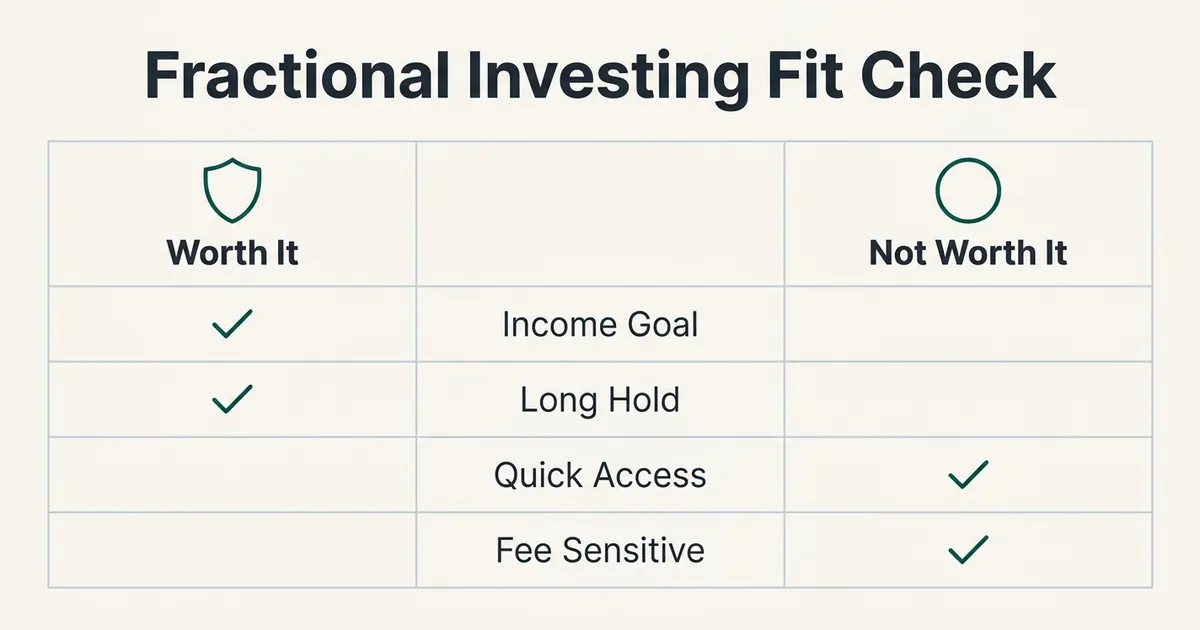
Fractional real estate investing is worth it if you want rental-style income from $100–$5,000 checks and can accept illiquidity of three to seven years; it's not worth it if you need your cash back on short notice or can't absorb sponsor and platform fees eating 1%–3% of returns annually.
Fractional real estate investing means buying a small ownership slice — often through an LLC or trust that holds one property or a pooled fund — instead of buying a whole rental yourself. Platforms built under SEC Regulation A and Regulation Crowdfunding exemptions made this possible for non-accredited investors beginning with the Regulation A+ rollout (SEC, 2015), and the rules governing how much they can raise have changed since then. According to the U.S. Securities and Exchange Commission (March 2021), the agency raised the annual fundraising cap for Regulation A Tier 2 offerings from $50 million to $75 million, which let more of these platforms scale beyond a handful of properties.
For a working parent with $10,000–$50,000 in savings and zero appetite for a 2 a.m. call about a burst water heater, fractional shares sit between a public REIT and buying a turnkey rental outright. The trade you're making is liquidity and control for a lower entry price and someone else running the property day to day — if hands-off income rather than ownership is the real goal, Airbnb management for parents is a comparable low-involvement alternative worth weighing against fractional shares.
What Is Fractional Real Estate Investing, and How Does It Work?
Fractional real estate investing lets you buy a percentage stake in a specific property or a pooled real estate fund through an online platform, rather than purchasing the whole asset with a mortgage. A sponsor — the company that finds, buys, and manages the property — forms a legal entity, usually an LLC, and sells membership interests to investors in amounts as low as $100 on some platforms and up to $5,000–$25,000 per share on others.
Your return comes from two sources: quarterly or monthly rental-income distributions, and your share of the sale price if the sponsor sells the property. According to the SEC Office of Investor Education and Advocacy (2024), securities sold under Regulation A and Regulation Crowdfunding carry limited resale markets, and investors should expect to hold them for the length of the sponsor's stated investment period — typically three to seven years — because no public exchange exists to sell shares on demand. That single mechanism, the absence of a secondary market, is why fractional real estate behaves nothing like a stock or a public REIT even though the purchase process looks similar.
Most platforms also charge two layers of fees: an annual asset management fee (commonly 1%–2% of assets, disclosed in each deal's own offering circular rather than capped by any regulator) and a sponsor promote or "carried interest" — a cut of profits above a set return threshold, often 15%–20% — taken only when the property sells at a gain.
Is Fractional Real Estate Investing Worth It for a $10k–$50k Investor?
It's worth it if three conditions hold: you want real-estate exposure without landlord duties, you can lock up part of the money for three-plus years, and you're diversifying across several properties rather than concentrating in one. It's not worth it if that $10k–$50k is your emergency fund or a house down payment you'll need within two years.
Run the numbers concretely. Put $5,000 into a fractional single-family rental share paying a projected 5% annual cash distribution. That's $250 a year before fees. Strip out a 1% annual management fee ($50) and you're at roughly $200, or 4% net cash yield — comparable to a high-yield savings account in 2026 but with principal at risk and no FDIC protection. That $200 figure only nets out the management fee; for the full list of costs — taxes, insurance, vacancy, and repairs — that erode a landlord's return, see what a rental property actually nets after every expense, and for what that insurance line item actually costs, see Landlord Insurance: 2026 Costs, Coverage & Quotes. According to the FDIC (2025), deposit insurance covers bank and credit union deposit accounts only; it does not extend to securities, LLC membership interests, or any real estate investment product, fractional or otherwise. The upside case — and the reason people accept the illiquidity — is potential appreciation on sale, which a savings account can never deliver.
The math changes if you spread that same $5,000 across three or four properties on one platform instead of one property. A single-property fractional deal concentrates you in one roof, one tenant base, one local job market; a $10,000–$20,000 investor who splits capital across multiple properties or a pooled fund reduces the odds that one vacancy or one bad market wipes out the year's return.
How Do Fractional Real Estate Platforms Compare to REITs, Turnkey Rentals, and Syndications?
| Option | Typical minimum check | Annual fees | Liquidity | Weekly time commitment |
|---|---|---|---|---|
| Fractional shares (Arrived, Ark7, Lofty-style platforms) | $100–$5,000 per property | ~1% management fee + sale-profit promote (15%–20%) | Low — 3–7 year hold, thin or no secondary market | Under 15 minutes/month |
| Public equity REITs (bought via brokerage) | Cost of 1 share, often under $100 | Expense ratio 0.1%–0.5% if via ETF | High — trade daily on an exchange | Under 15 minutes/month |
| Non-traded REIT crowdfunding funds (Fundrise-style) | $10–$1,000 | ~0.85%–1.85% combined advisory/management | Low-medium — quarterly redemption windows, often gated | Under 15 minutes/month |
| Turnkey rental (property manager-run) | $30,000–$80,000+ down payment | 8%–10% of rent to property manager, plus repairs | Low — sell like any house, weeks to months | 1–3 hours/month |
| Real estate syndication (direct sponsor deal) | $25,000–$100,000, often accredited-investor only | 1%–2% asset management fee + 20% promote | Very low — 5–10 year hold, no exit until sale/refinance | Under 30 minutes/month |
According to the U.S. Securities and Exchange Commission (August 2020), the agency expanded the accredited-investor definition to include people who hold certain professional securities licenses, but the traditional bar — income over $200,000 individually ($300,000 with a spouse) for the past two years, or net worth over $1 million excluding a primary residence — still locks most syndications out of reach for a saver with $10k–$50k. Read this table by check size first: if you have under $5,000 to deploy, public REITs and low-minimum fractional or crowdfunding platforms are your only realistic entries; syndications and turnkey rentals require capital most readers in this range don't have yet — see Turnkey Real Estate Investing: Worth It in 2026? for the minimum down payment a fully-managed, sight-unseen rental typically requires before it becomes a realistic alternative, or see How to Finance an Investment Property: Down Payment, Rates, and DSCR Loans for how mortgage financing on that down payment actually works if you eventually buy one outright. If liquidity matters more than yield, public REITs win outright because you can sell in seconds during market hours; every other row on this table locks your money up for years.
What Are the Downsides of Fractional Ownership?
The biggest downside is illiquidity: your money is stuck until the sponsor sells the property or a redemption window opens, and neither is guaranteed on your timeline. A second downside is fee drag that compounds against you in flat or down years — a 1% management fee on a 3% net-yield year cuts your return by a third, not a rounding error. Upfront costs can bite harder than the annual ones: according to the SEC Office of Investor Education and Advocacy (August 2015), non-traded REIT offerings have carried upfront fees of up to 15% of the offering price — money that never reaches the property.
A third downside is sponsor and platform risk. You're relying on a management company you don't control to maintain the property, find tenants, and report honestly; if the sponsor mismanages the asset or the platform itself fails, your recourse is limited to whatever the offering documents (Form 1-K annual reports and Form 1-SA semiannual reports under Regulation A) disclose. According to the SEC (March 2021), Regulation A issuers must file these ongoing reports, but the SEC does not vet the accuracy of a sponsor's financial projections before the offering goes live — due diligence is on you.
A fourth downside is tax complexity that most REIT buyers never encounter. LLC-based fractional ownership typically passes rental income and depreciation through to you on a Schedule K-1, reported on IRS Schedule E, rather than the simple 1099-DIV a REIT sends. According to the IRS (2025), any payer must issue Form 1099-DIV once your dividends reach $10 in a tax year, but K-1 fractional structures instead require you to report your allocated share of income, deductions, and depreciation directly. The timing is the practical problem: according to the IRS Instructions for Form 1065 (2025), a calendar-year partnership must furnish each partner's Schedule K-1 by March 15, and a partnership that files for an extension can push that to September 15 — which is why fractional-real-estate K-1s routinely land after the date many households would otherwise have filed. A related nuance: according to IRS Revenue Ruling 2004-86 (2004), only Delaware Statutory Trust structures — not typical single-member LLC fractional shares — qualify for 1031 exchange tax deferral, so most fractional platforms can't offer the tax-deferred rollover that direct rental owners use.
California residents get one more wrinkle. Per the California Franchise Tax Board (2025), any LLC doing business in California owes an $800 minimum annual franchise tax, and some fractional-ownership LLCs structured with California-resident members have triggered this fee at the entity level, a cost that can get passed through to investors in the offering's fine print — check the operating agreement before you fund a deal.
Which Fractional Real Estate Investing Platforms Should You Consider?
No single platform fits every reader; match the platform's structure to your check size and hold-time tolerance. Choose a low-minimum single-property platform (roughly $100–$1,000 per share) if you want to pick specific properties and hold cash on the sidelines to diversify across several deals over a year. Choose a pooled, diversified fund platform (roughly $10–$1,000 minimums) if you'd rather own a slice of dozens of properties in one purchase and don't want to research individual addresses.
Before funding any platform, confirm three things in its offering circular: the redemption or resale policy, the all-in fee stack (management fee plus promote), and whether it files under Regulation A or Regulation Crowdfunding — Reg CF issuers cap annual raises lower than Reg A issuers. According to the SEC (March 2021), Regulation Crowdfunding issuers may raise up to $5 million in a 12-month period, versus $75 million for Regulation A Tier 2, a gap that affects how many properties a smaller platform can realistically hold and diversify across.
One more constraint applies before you pick a platform: the exemption a deal is sold under also caps how much you are allowed to put in. Under the Regulation A rules the SEC adopted in 2015 and still applies today, a non-accredited individual buying into a Tier 2 offering may invest no more than 10% of the greater of their annual income or net worth in that offering (SEC, 2015). Regulation Crowdfunding is tighter and tiered — according to the SEC Office of Investor Education and Advocacy (October 2022), if either your annual income or your net worth is below $124,000, you may invest only the greater of $2,500 or 5% of the greater of those two figures across all Reg CF deals in a rolling 12-month period; if both figures are at or above $124,000, the ceiling rises to 10%, capped at $124,000. Those thresholds are inflation-adjusted periodically, so confirm the current numbers before planning around them. For a household with $10k–$50k of investable savings, the Reg A cap rarely binds, but the Reg CF 5% tier often does.
What Is the 3-3-3 Rule in Real Estate, and Does It Apply to Fractional Deals?
The 3-3-3 rule is a home-buying budgeting guideline: keep your total housing payment under 3 times your gross income, put down at least 3% (or ideally more), and hold 3 months of expenses in reserve before you buy. It's a rule for financing a primary residence with a mortgage, not for allocating money to an investment platform.
It doesn't map onto fractional real estate investing directly because you're not taking on mortgage debt or a monthly payment obligation — you're buying a security. The useful parallel is the reserve piece: don't put fractional-share money to work that you'd need as your 3-month emergency cushion, because unlike a savings account, you can't withdraw a fractional investment on short notice if a real emergency hits.
Who Should Avoid Fractional Real Estate Investing?
Avoid it if you have less than three months of expenses saved outside your investment accounts — illiquid fractional shares are the wrong place for money you might need in the next 12–36 months. Avoid it if you're chasing a specific dollar target for a near-term goal like a home down payment or a K-8 tuition deposit, since projected distributions in offering materials aren't guaranteed and can be cut if a tenant vacates or rents soften.
Also avoid concentrating more than a small slice of your $10k–$50k in a single fractional property. According to the SEC Office of Investor Education and Advocacy (August 2015), non-traded real estate offerings cannot be readily sold, and the redemption programs that do exist carry significant limitations — so unlike a public REIT, you can't quickly rebalance out of one bad asset. Spreading money across issuers and property types is the practical risk-reduction lever left to you. A reasonable ceiling for most readers in this income range is 10%–15% of investable savings in illiquid fractional or crowdfunded real estate combined, leaving the rest in liquid accounts and retirement plans.
If you want real-estate-style yield with same-day liquidity instead, compare public REITs vs. rental properties before committing to a multi-year lockup — that breakdown covers the mechanics of publicly traded REIT dividends versus direct property ownership, and the liquidity trade-offs specific to fund structures if you're weighing a non-traded REIT fund against a single-property fractional deal. Once you've decided fractional is worth it, our comparison of the best fractional real estate platforms covers minimums, fees, and redemption windows platform by platform. If you'd rather own a whole property outright and hand the day-to-day work to someone else, see outsourcing rental property management instead. For the full menu of hands-off real estate income options this pillar covers, start at low-maintenance real estate investing to see how fractional shares stack up against turnkey rentals and syndications side by side.
Disclaimer: This article is for informational purposes only and does not constitute personalized financial, tax, or legal advice. Fractional real estate offerings involve risk, including loss of principal and illiquidity; consult the specific offering's disclosure documents and a qualified advisor before investing.
Frequently asked questions
Is fractional real estate investing worth it?
Fractional real estate investing is worth it for investors who want rental-style yield without landlord duties and can tolerate a three-to-seven-year lockup on part of their money. According to the SEC Office of Investor Education and Advocacy (2024), Regulation A and Regulation Crowdfunding securities have limited resale markets, so a $5,000 fractional stake paying a projected 4%-5% cash yield after fees only makes sense as money you won't need before the sponsor's planned sale date.
What is the 3-3-3 rule in real estate?
The 3-3-3 rule is a home-buying guideline stating your housing payment should stay under 3 times gross income, your down payment should be at least 3%, and you should hold 3 months of expenses in reserve before purchasing. It applies to financing a primary residence with a mortgage and does not govern how much to allocate to fractional real estate securities, which involve no mortgage payment at all.
What are the downsides of fractional ownership?
The main downsides are illiquidity, layered fees, sponsor-management risk, and tax complexity. According to the SEC Office of Investor Education and Advocacy (August 2015), non-traded real estate offerings are illiquid and cannot be readily sold, and their fee loads can materially reduce what actually reaches the investor; combined annual management fees plus a sale-profit promote of 15%-20% can push net returns well below the sponsor's advertised projection in a slow-appreciation year.
Can I buy fractional shares of real estate?
Yes — U.S. investors can buy fractional shares of real estate through platforms operating under SEC Regulation A or Regulation Crowdfunding, typically with minimums between $100 and $5,000 per property. According to the SEC (March 2021), Regulation A Tier 2 issuers may raise up to $75 million annually from both accredited and non-accredited investors, which is the legal basis most retail fractional platforms rely on to sell shares to non-wealthy buyers.
What are the best fractional real estate investing platforms?
There's no single best platform; the right one depends on whether you want to pick individual properties or own a diversified pooled fund. Single-property platforms typically require $100-$1,000 minimums per deal and let you choose specific addresses, while pooled fund platforms with $10-$1,000 minimums spread your money across dozens of properties automatically — check each platform's Form 1-K annual report, filed under SEC Regulation A rules (SEC, March 2021), before funding a deal.
What does Reddit say about fractional real estate investing?
Investor discussions on forums like Reddit's r/realestateinvesting commonly flag two recurring complaints about fractional real estate platforms: distributions getting cut when a property underperforms projections, and difficulty exiting a position before the sponsor's planned sale date. These anecdotal reports track with the SEC's own guidance — according to the SEC Office of Investor Education and Advocacy (2024), Regulation A and Regulation Crowdfunding securities lack guaranteed resale markets — so treat forum complaints as confirmation of a disclosed structural risk rather than a platform-specific scandal.