Rental Property Income After Expenses: The Real Math (2026)

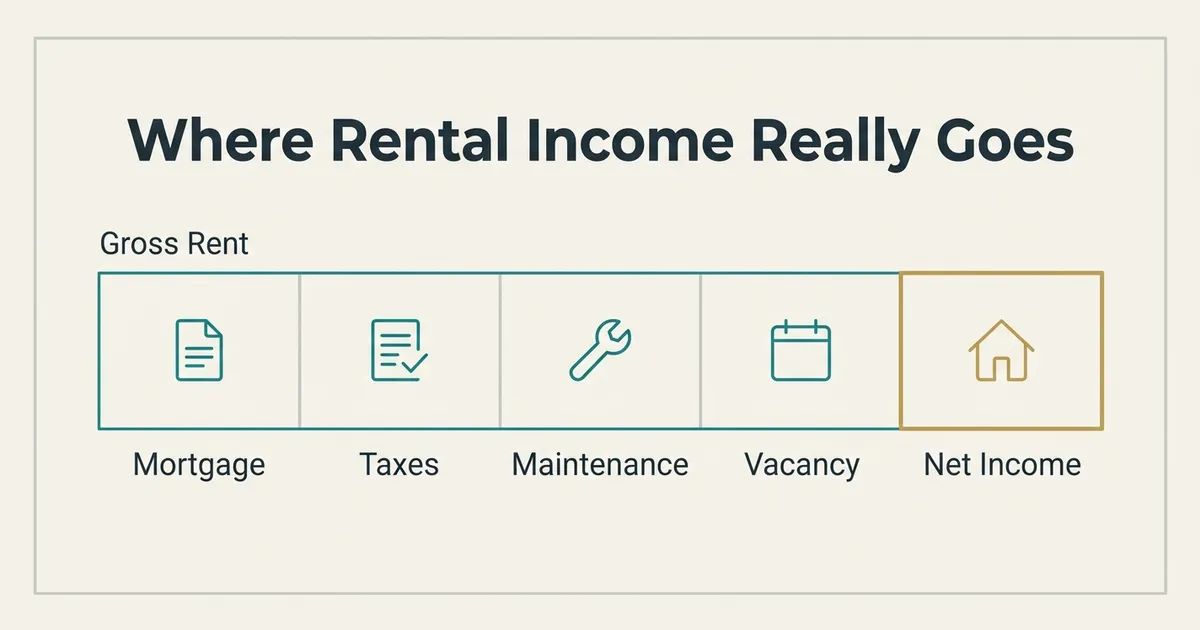
Rental property income after expenses typically leaves you with 40% to 60% of gross rent, not the full rent check. Mortgage principal and interest, property taxes, insurance, vacancy losses, maintenance reserves, and — if you hire out the landlording — an 8%-12% management fee all come out before you see net cash flow.
That gap between "rent collected" and "cash you keep" is the single most misunderstood number in real estate investing, and it's why a $2,400/month rental doesn't put $2,400 in your account. According to the National Apartment Association's Dollar of Rent analysis (September 2023), 93 cents of every rent dollar collected at professionally managed rental properties goes straight back out again — 46 cents to the mortgage and 47 cents to operating costs, property taxes, payroll, and capital reserves — leaving owners roughly 7 cents of profit. Run that arithmetic on a property generating $28,800 a year in rent carrying a $12,600 annual mortgage, and the owner nets somewhere between $1,800 and $6,100 depending on where its operating costs land in the usual 35%-50% band.
How much of your rental property income do you actually keep?
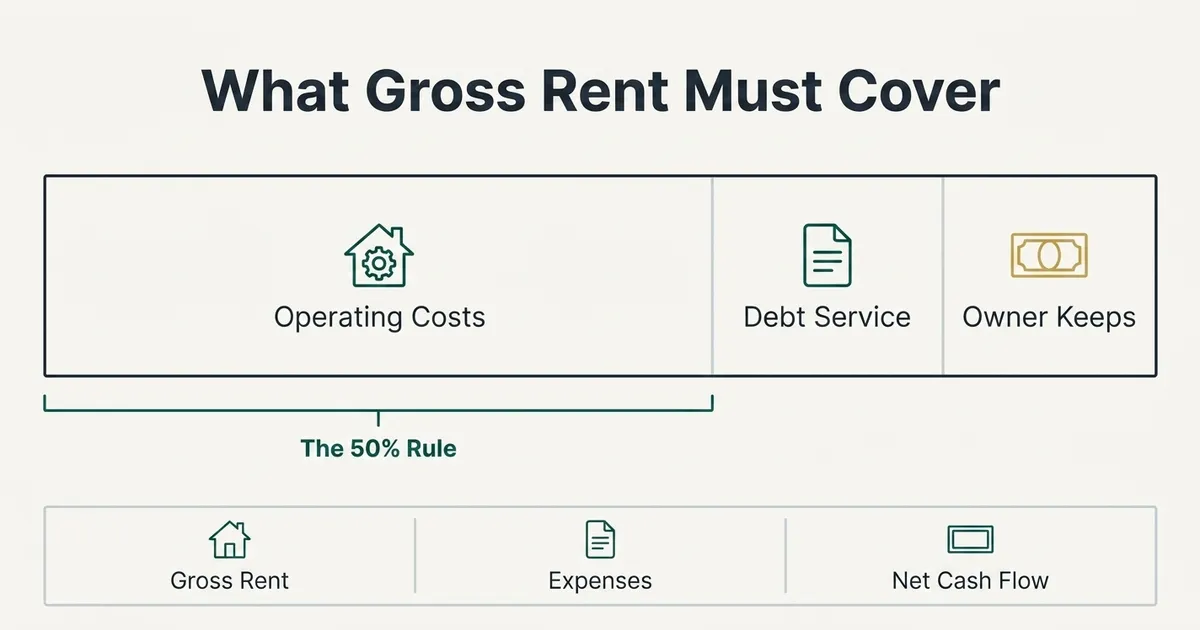
You keep gross rent minus operating expenses minus debt service, and the industry shorthand for estimating that first subtraction is the 50% rule: assume half of gross rent goes to non-mortgage operating costs. The National Apartment Association's Dollar of Rent analysis measured non-mortgage costs at 47 cents of every rent dollar nationally (NAA, September 2023), which lands just under the rule and makes 50% a conservative planning number, not a guarantee — well-run properties in low-tax states can beat it, and older properties in high-insurance states like California or Florida can blow past it.
Here's the mechanism with real numbers. A rental collecting $2,400/month ($28,800/year) that lands at the 50% mark spends about $14,400/year on property tax, insurance, maintenance, vacancy, and management, leaving $14,400 to cover the mortgage and produce profit. If that mortgage payment (principal, interest, and any PMI) is $1,050/month ($12,600/year), you clear about $1,800/year, or $150/month, in actual take-home cash flow — before income tax. That's the number a rent estimate never shows you, and it's why comparing rental property income to a REIT's stated dividend yield without netting out these costs overstates the rental by a wide margin, a comparison covered in more detail in our REITs vs. rental properties breakdown.
What expenses come out of rental property income before you see a dime?
Six categories eat into gross rent, in roughly this order of size: mortgage debt service, property tax, insurance, maintenance/capex reserve, vacancy loss, and management fees. Each has a distinct mechanism for why it's unavoidable, not just a line item you can trim to zero.
- Mortgage principal and interest: fixed by your loan terms; on a typical $260,000 investor loan at 7% over 30 years, that's roughly $1,730/month, the single largest deduction from rent.
- Property tax: assessed annually by the county, not the market rent; it rises with reassessment regardless of whether your tenant renews.
- Insurance: landlord policies run higher than owner-occupant homeowners insurance because the insurer is covering a non-owner-occupied liability risk; costs have risen sharply in wildfire- and hurricane-exposed states.
- Maintenance and capital-expenditure reserve: the National Apartment Association's Dollar of Rent analysis puts capital reserves at 2 cents of every rent dollar (NAA, September 2023), and the long-standing planning rule of thumb is to set aside roughly 1% of property value per year for roofs, HVAC, and appliance replacement — about $3,000/year on a $300,000 property.
- Vacancy loss: the U.S. Census Bureau's Housing Vacancy Survey (Q2 2026, released July 28, 2026) reported a national rental vacancy rate of 7.3% — unchanged from the first quarter — meaning even a well-managed property should budget close to four weeks of lost rent a year.
- Management fees: per fee benchmarks published by the National Association of Residential Property Managers (2025), third-party property managers typically charge 8%-12% of collected rent plus a leasing fee equal to half to a full month's rent when placing a new tenant.
Which low-maintenance option keeps the most rental property income after fees?
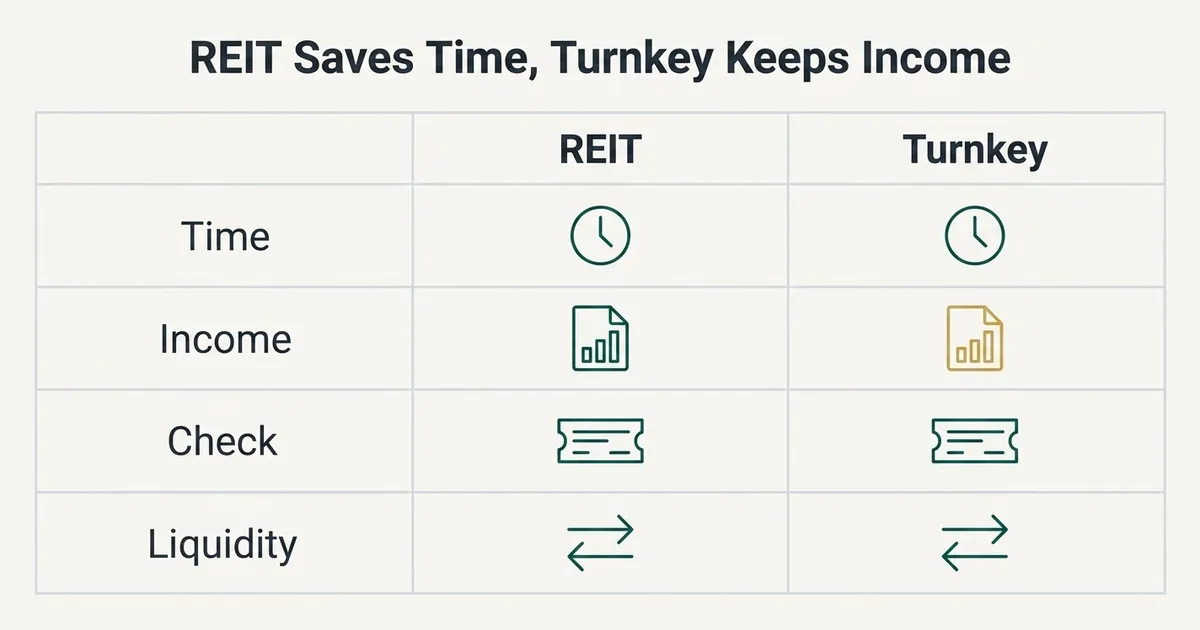
A publicly traded REIT keeps the most of your invested dollar working per hour of your time, while a turnkey rental with a property manager keeps the most of the property's income but demands the largest check and the least liquidity. The right choice depends on how much cash you have and how much illiquidity you can tolerate for years at a stretch.
| Option | Minimum check size | Typical fees | Liquidity | Weekly time commitment | Typical net yield after fees* |
|---|---|---|---|---|---|
| Publicly traded REIT | ~$1 (one share) | 0.5%-1% fund expense ratio | Sell any trading day | Under 15 minutes/month | 3.5%-4.5% dividend yield |
| Fractional/crowdfunded platform | $10-$500 | 1%-2% AUM plus sponsor promote | Locked 1-5 years, limited redemption windows | Under 1 hour/month | 4%-7% target distribution |
| Turnkey rental + property manager | $20,000-$40,000 down payment | 8%-12% of rent to manager, per NARPM (2025) | Illiquid; sale takes 30-90+ days | 1-3 hours/month | 4%-8% cash-on-cash |
| Private real estate syndication | $25,000-$50,000 | 1%-2% asset management fee plus 15%-20% promote above a hurdle | Locked 3-7 years | Under 1 hour/quarter | 6%-10% target IRR |
*Net yield ranges are illustrative planning estimates based on typical fee structures, not promised returns; actual results vary by property, market, and manager.
Read it this way: choose a REIT or a fractional platform if your check is under $25,000 and you need the option to exit within a year — you'll trade some yield for the ability to sell without a closing. Choose a turnkey rental or syndication only once you can write a $25,000+ check you won't need for three-plus years, because both trade liquidity for a shot at higher net income once fees are paid. If you already hold a rental and want the property-manager route without the sourcing headache, our guide on outsourcing rental property management walks through vetting and fee negotiation.
How does the IRS tax rental property income?
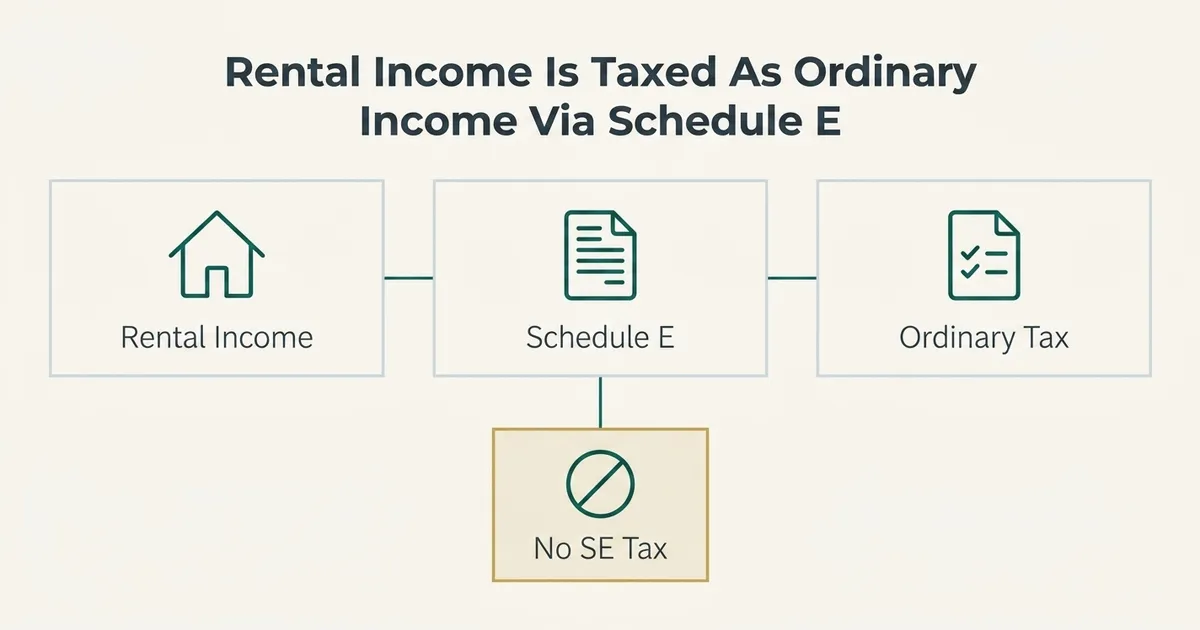
Rental property income is taxed as ordinary income, reported on Schedule E of Form 1040 (IRS Schedule E Instructions, 2025), and it is generally not subject to self-employment tax. That last point separates it from side-hustle income, which does owe self-employment tax and carries its own set of write-offs — home-office and side-hustle deductions covers that side of a family's return. §1402(a)(1) of the Internal Revenue Code (2025) expressly excludes “rentals from real estate” from net earnings from self-employment, so rental income avoids the 15.3% self-employment tax (IRS Schedule SE Instructions, 2025) that hits freelance or side-business income — unless you provide substantial hotel-like services (daily cleaning, concierge service) to tenants, which moves the activity onto Schedule C (IRS Topic No. 414, 2025).
Depreciation is the mechanism that often makes rental income look like a loss on paper even when cash flow is positive. The IRS requires residential rental property to be depreciated straight-line over 27.5 years (IRS Publication 527, 2025), so a $300,000 property (minus land value, say $250,000 depreciable basis) generates about $9,090/year in depreciation you can deduct against rental income with no cash outlay. That's why a property producing $1,800/year in real cash flow can still show a tax loss of several thousand dollars on Schedule E.
That paper loss isn't automatically usable, though. The IRS caps the “special allowance” for actively participating landlords at $25,000 of passive losses against other income (IRS Publication 925, 2025), and phases that allowance out entirely between $100,000 and $150,000 of modified adjusted gross income — a threshold that catches many dual-income working parents. Above $150,000 MAGI, the loss simply suspends and carries forward until you have passive income to offset or sell the property, per the same publication. Small repairs get a separate, immediate break: under the de minimis safe harbor of Treasury Regulation §1.263(a)-1(f) (Treasury, 2025), you can expense up to $2,500 per item or invoice — a ceiling IRS Notice 2015-82 (2015) raised from $500 for taxpayers without an applicable financial statement — a new water heater or a repaired fence — instead of depreciating it over years.
When you eventually sell, the depreciation you deducted doesn't disappear tax-free. The IRS taxes “unrecaptured Section 1250 gain” — the portion of your gain equal to depreciation taken — at a rate of up to 25% (IRS Publication 544, 2025), higher than the standard long-term capital gains rate for most sellers. That recapture is the trade-off for years of depreciation shelter, and it's a detail most first-time landlords don't budget for at closing.
How can you increase net rental property income without doing more landlord work?
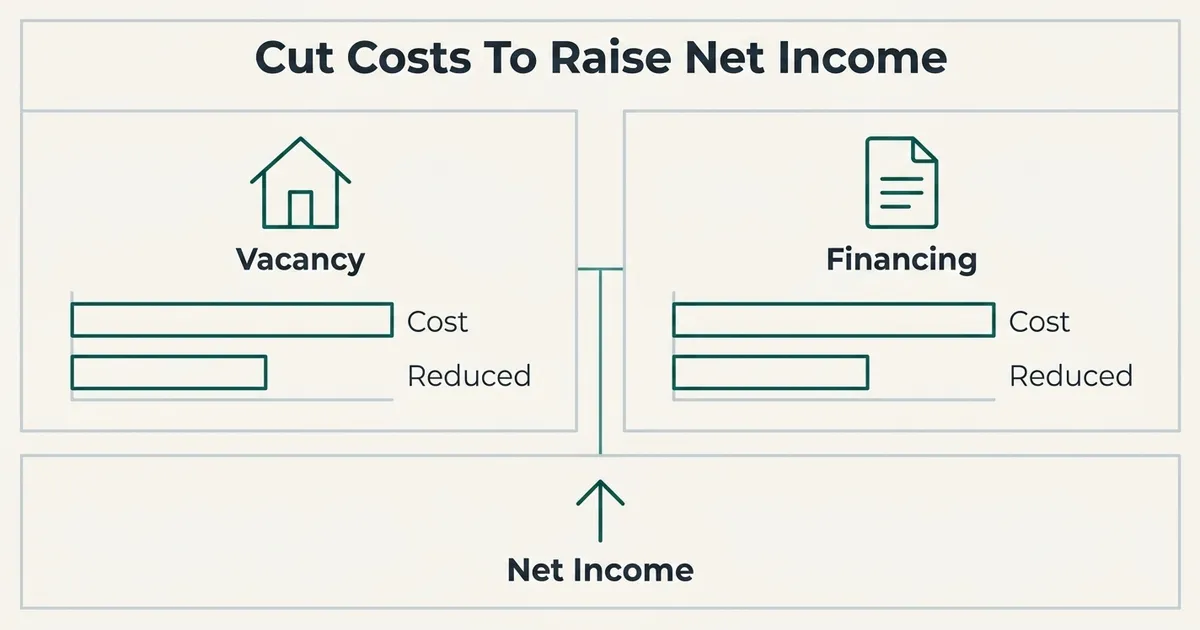
You raise net income by cutting the two largest controllable costs — vacancy and financing — not by doing more hands-on work yourself. A tenant retention program (fast repairs, on-time lease renewal offers) that cuts vacancy from the Census Bureau's national 7.3% average (Q2 2026) to 3% adds roughly two extra weeks of rent per year without adding a single task to your own calendar, because the fix is process, not personal labor.
Refinancing or paying down principal faster works the same way: on the earlier $260,000 loan example, cutting the rate from 7% to 6% drops the payment from about $1,730 to about $1,559 — a saving of roughly $171/month, or $2,050/year, which on its own exceeds the entire cash-flow profit in the worked example above. If you'd rather not manage even the manager, fractional platforms and syndications remove financing decisions from your plate entirely, at the cost of the fee layers shown in the comparison table above; our review of whether fractional real estate is worth it and our ranking of fractional real estate platforms both work through that fee-versus-control trade-off in detail.
When does the 50% rule fail as a planning shortcut?
The 50% rule breaks down on new construction, short-term rentals, and properties in high-insurance or high-regulation states, where actual expense ratios run well outside the 35%-50% band implied by the National Apartment Association's Dollar of Rent data (NAA, September 2023). A property built in the last five years often runs closer to 30%-35% because major systems don't need repair yet, while a 60-year-old property in a coastal insurance market can exceed 55%-60% once premiums and deferred maintenance are counted.
California adds a regulatory layer the rule doesn't capture. Under California Civil Code §1947.12 (the Tenant Protection Act, effective 2020), most existing rental units are capped at annual rent increases of 5% plus local CPI, up to a hard ceiling of 10% — a limit that can hold your revenue growth below rising expense growth in high-inflation years. Short-term rentals fail the rule in the opposite direction: turnover costs (cleaning, platform fees of 3%-15% per booking, and higher furnishing depreciation) replace the standard expense mix entirely, so applying the long-term-rental version of the 50% rule to a short-term listing will understate your true costs — our guide to Airbnb management for parents works through that fee stack separately.
Disclaimer: This article is for general educational purposes and is not individualized tax, legal, or investment advice. Rental income tax treatment, depreciation rules, and passive-loss thresholds are set by the IRS and adjust periodically — confirm current-year figures with the IRS or a licensed tax professional and check your state's landlord-tenant statute before acting. Explore the Low-Maintenance Real Estate hub for the full comparison of hands-off rental income vehicles.
Frequently asked questions
What is the 50% rule in rental property?
The 50% rule is a rule of thumb estimating that roughly half of a rental property's gross rent goes to non-mortgage operating expenses — property tax, insurance, maintenance, vacancy, and management — before debt service. According to the National Apartment Association's Dollar of Rent analysis (September 2023), non-mortgage costs at professionally managed properties actually absorb about 47 cents of every rent dollar, so the 50% figure is a conservative upper-bound estimate best used for quick screening, not a substitute for a line-item budget on a specific property.
Does rental property income count as taxable income?
Yes — rental property income is taxable and must be reported as ordinary income on Schedule E of Form 1040, per IRS guidance for the 2025 filing year. It is generally exempt from the 15.3% self-employment tax that applies to active business income because §1402(a)(1) of the Internal Revenue Code (2025) expressly excludes rentals from real estate from net earnings from self-employment — unless you provide substantial hotel-like services to tenants, which moves the activity onto Schedule C (IRS Topic No. 414, 2025).
What are the IRS rules for rental property income?
The core IRS rules require reporting all rent received on Schedule E, deducting ordinary and necessary expenses like mortgage interest, property tax, insurance, and management fees, and depreciating the building's value over 27.5 years under IRS Publication 527 (2025). Losses from passive rental activity are limited: IRS Publication 925 (2025) caps the special loss allowance at $25,000 for actively participating owners and phases it out completely once modified adjusted gross income exceeds $150,000, with unused losses carried forward to future years.
How to pay no taxes on rental income?
You cannot legally eliminate reporting rental income, but you can offset it to zero taxable income using depreciation and the passive-loss allowance described in IRS Publication 925 (2025), which permits up to $25,000 of passive losses against other income for owners under the $100,000-$150,000 MAGI phase-out band. Taxpayers who qualify as real estate professionals — working more than 750 hours and over half their total working hours in real property trades, per the same publication — can deduct rental losses without the passive-activity limit at all, though this status is difficult for a full-time W-2 employee to meet.
Is there a rental property income calculator I can use?
A reliable rental property income calculator needs five inputs: gross monthly rent, fixed costs (mortgage, property tax, insurance), variable costs (maintenance reserve, typically near the National Apartment Association's 2025 benchmark of about 1% of property value annually), a vacancy assumption (the U.S. Census Bureau's Housing Vacancy Survey reported a 7.3% national rate for the second quarter of 2026), and any management fee, commonly 8%-12% of collected rent per the National Association of Residential Property Managers' 2025 survey. Plugging real numbers into gross rent minus each category, rather than relying on a single "50%" shortcut, is what separates an accurate estimate from a rough guess.
How is rental property income taxed differently from a job?
Rental property income is taxed at your ordinary marginal income tax rate on Schedule E, the same rate schedule that applies to wages, but it is not subject to the 15.3% self-employment or payroll tax that applies to wage and 1099 business income, because §1402(a)(1) of the Internal Revenue Code (2025) excludes rentals from real estate from net earnings from self-employment. It also benefits from depreciation deductions unavailable to wage income — IRS Publication 527 (2025) allows roughly $9,090 a year in non-cash depreciation on a $250,000 depreciable basis — which can shelter real cash flow from tax in the early years of ownership, though IRS Publication 544 (2025) recaptures that benefit at sale through a depreciation-recapture tax of up to 25%.