1031 Exchange Rules 2026: Deadlines, Costs, Exceptions

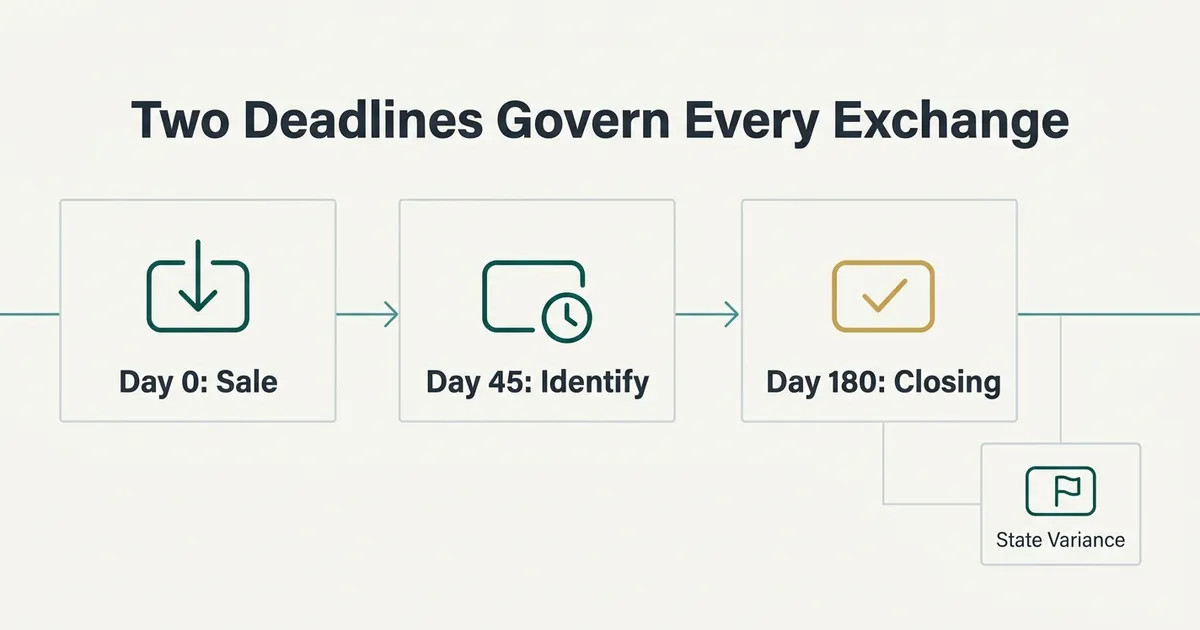
A 1031 exchange defers federal capital gains tax when you sell an investment property and reinvest the proceeds into a like-kind replacement property. IRC Section 1031 requires you to identify a replacement property within 45 days of closing and finish the purchase within 180 days.
The strategy only works if you already own investment real estate with built-in gains — it is not a way to turn $10,000 to $50,000 in savings into a rental property. If you're starting from cash instead of equity, a Delaware Statutory Trust (DST) bought as 1031 replacement property, a REIT, or a fractional platform gets you real-estate exposure without any of the exchange mechanics below, a distinction covered in our comparison of REITs vs rental properties.
What Is a 1031 Exchange and How Does the Tax Deferral Actually Work?
A 1031 exchange does not erase your tax bill — it postpones it by carrying your original cost basis forward onto the replacement property instead of resetting it. According to the IRS (2026), this basis carryover under IRC Section 1031(d) is why no gain is "recognized" in the year of the swap: the IRS treats the transaction as a continuation of the same investment, not a sale and a new purchase.
That deferral has a limit built into it. According to the IRS (2026), depreciation you've claimed on a rental property is recaptured as "unrecaptured Section 1250 gain" and taxed at a maximum federal rate of 25% if you ever sell without exchanging, on top of ordinary long-term capital gains rates on the rest of the profit. According to the IRS (2026), the 3.8% net investment income tax under IRC Section 1411 can also apply to rental gains above certain income thresholds, regardless of whether you exchange or sell outright.
Here's a worked example. You bought a rental duplex for $250,000 eight years ago and have claimed $60,000 in depreciation, leaving an adjusted basis of $190,000. You sell it today for $400,000, for a total gain of $210,000. Sold outright, you'd owe roughly $15,000 on the $60,000 of recaptured depreciation (at the 25% cap) plus roughly $22,500 on the remaining $150,000 gain (illustrative 15% long-term rate), for about $37,500 in combined federal tax before state tax and any net investment income tax — figures that shift with your bracket and state. Through a 1031 exchange, none of that $210,000 is taxed this year; it carries forward as a reduced basis on the replacement property, due only when you eventually sell without exchanging again.
What Are the 1031 Exchange Rules and Deadlines You Must Hit?
Missing any one of these deadlines makes the entire deferred gain taxable in the year of sale, so treat them as hard stops, not guidelines.
- Close the sale, then start the clock. The identification and exchange periods both begin on the day title transfers on your relinquished property — not the day you decide to sell, according to the IRS (2026) instructions for Form 8824.
- Identify replacement property within 45 calendar days. According to the IRS (2026), IRC Section 1031(a)(3)(A) gives you 45 days, with no extension for weekends or holidays, to deliver a written, signed identification to your qualified intermediary.
- Stay inside the identification limits. According to the IRS (2026), Treasury Regulation §1.1031(k)-1(c)(4) lets you identify up to three properties of any value (the three-property rule), or more than three if their combined fair market value doesn't exceed 200% of what you sold (the 200% rule), or an unlimited number if you end up acquiring at least 95% of the total value identified (the 95% rule).
- Close on the replacement property within 180 days. According to the IRS (2026), IRC Section 1031(a)(3)(B) sets the outer deadline at 180 days after your sale closes, or the due date of your tax return (with extensions) for that year if that date comes first.
- Never touch the cash. According to the IRS (2026), Treasury Regulation §1.1031(k)-1(g)(4) requires a qualified intermediary to hold your sale proceeds in escrow; taking actual or constructive receipt of the funds — even briefly — disqualifies the entire exchange.
- Match or exceed value and debt. According to the IRS (2026), IRC Section 1031(b) taxes any "boot" — cash or non-like-kind property you receive — so full deferral requires your replacement property's price and mortgage debt to equal or exceed what you sold.
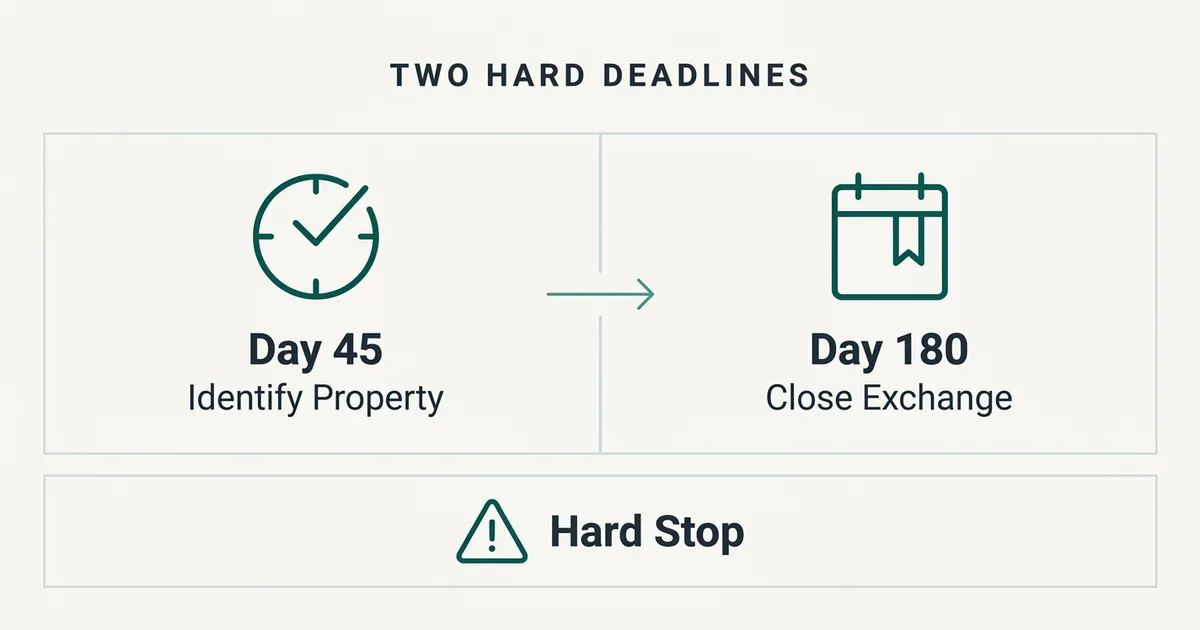
Put dates on it: if you close the sale of your relinquished property on October 1, 2026, your identification deadline is November 15, 2026 (45 days later), and your closing deadline on the replacement property is March 30, 2027 (180 days later). Both deadlines run in calendar days, so a deal that stalls in underwriting for three weeks eats directly into your remaining runway.
Which Properties Qualify — and What Disqualifies a 1031 Exchange?
Only real property held for investment or business use qualifies — rental homes, apartment buildings, commercial buildings, raw land held for investment, and fractional interests in a Delaware Statutory Trust. According to the IRS (2026), Revenue Ruling 2004-86 confirms that a DST beneficial interest counts as direct real property ownership for 1031 purposes, which is why DSTs function as passive, fractional replacement property for exchangers who no longer want to self-manage.
Since the Tax Cuts and Jobs Act of 2017 (Pub. L. 115-97), personal property no longer qualifies at all. According to the IRS (2026), equipment, vehicles, artwork, and franchise licenses that used to be eligible before 2018 are now excluded — only real property counts.
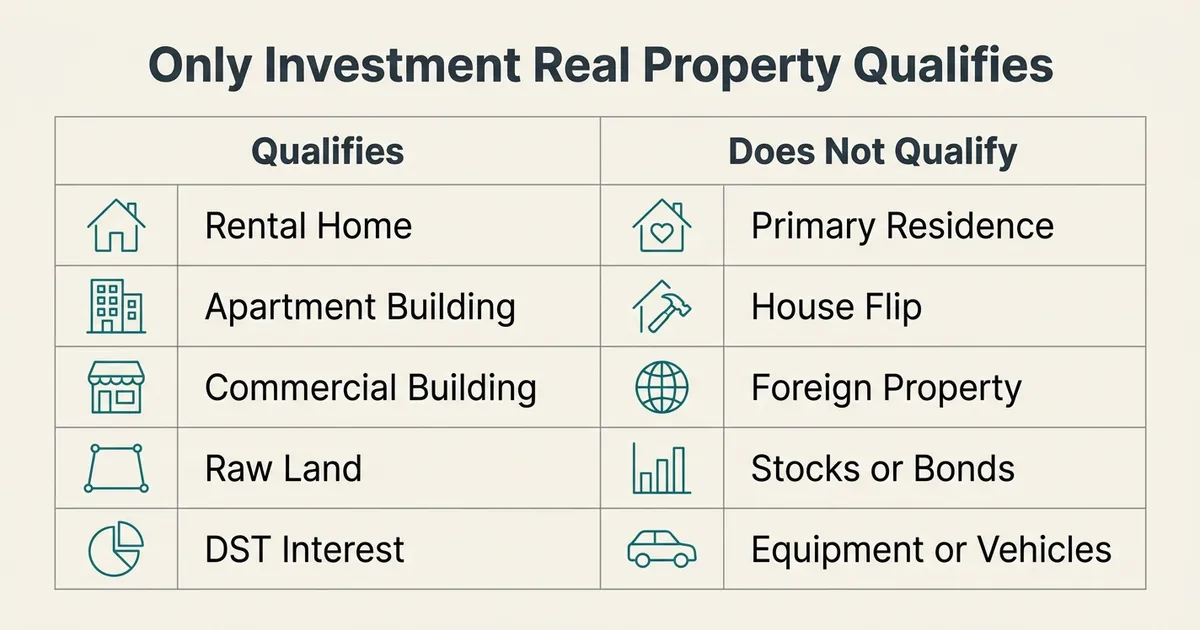
Several property types get disqualified outright:
- Your primary residence. It's covered by the separate Section 121 home-sale exclusion, not Section 1031 (see the FAQ below).
- Dealer property. According to the IRS (2026), Publication 544 excludes property "held primarily for sale," which covers house-flips and spec-built homes — the IRS looks at your sale frequency and intent, not just your paperwork.
- Foreign real estate. According to the IRS (2026), IRC Section 1031(h) states that foreign real property is never like-kind to U.S. real property, and the reverse is also true.
- Related-party exchanges that unwind early. According to the IRS (2026), IRC Section 1031(f) requires both you and a related party (a sibling, parent, or an entity you control) to hold your respective properties for at least 24 months after the exchange, or the deferred gain becomes taxable retroactively.
- Former vacation homes that fail the safe harbor. According to the IRS (2026), Revenue Procedure 2008-16 requires 24 months of ownership before and after the exchange, at least 14 days of fair-market-rent rental each 12-month period, and personal use capped at the greater of 14 days or 10% of the days it was rented.
1031 Exchange vs Other Low-Maintenance Real Estate Options: Which Wins for You?
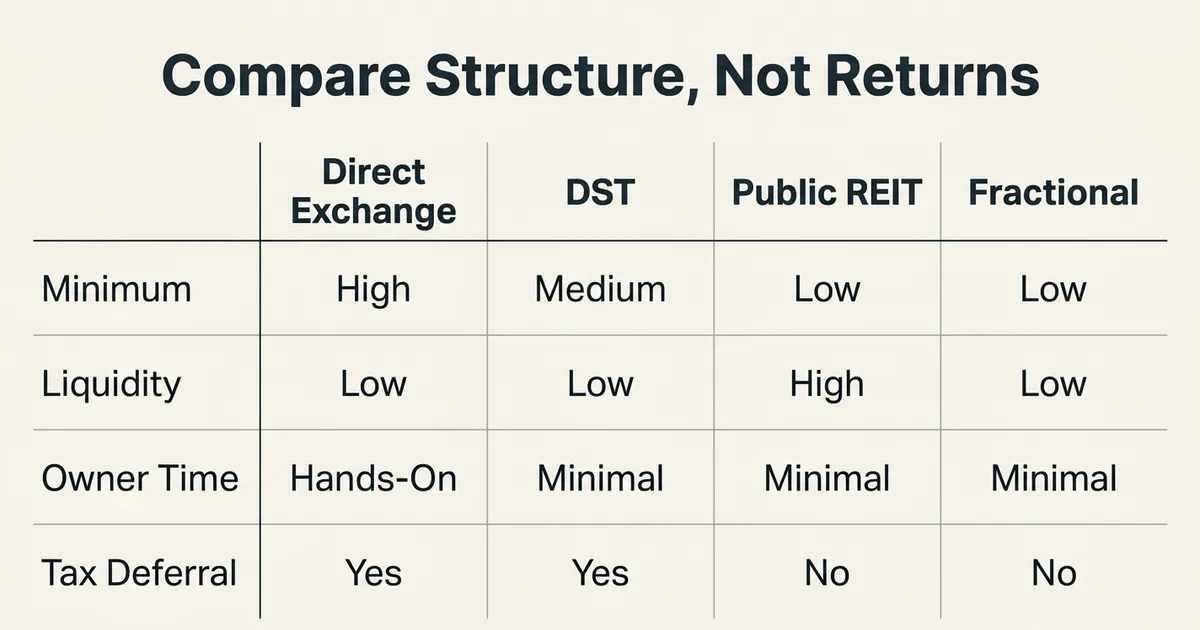
| Option | Typical minimum | Fees/costs | Liquidity | Weekly time commitment | Tax treatment |
|---|---|---|---|---|---|
| Direct 1031 exchange (whole property) | Equity from an existing property, commonly $150,000+ | QI fee $600–$1,500; closing costs 2%–5% of price | Illiquid; multi-year hold, sale takes 60–120+ days | 1–3 hrs/month self-managed; under 1 hr/month with a property manager | Gain deferred, not eliminated, under IRC Section 1031 |
| DST as 1031 replacement | $25,000–$100,000 | Sponsor/organizational load ~8%–12% built into the offering price | Illiquid; typical 5–10 year hold, no early redemption | Under 15 min/month; sponsor manages the asset | Gain deferred via 1031, per Revenue Ruling 2004-86 |
| Public REIT | $1–$500 via a brokerage account | Brokerage commission only for a single REIT share; REIT index funds from about 0.1%/year | Daily liquidity on a public exchange | Under 15 min/month | Dividends taxed as ordinary income; no 1031 deferral |
| Fractional/crowdfunded platform | $500–$5,000 typical minimum | Platform + asset management fees ~1%–2% of assets/year | Illiquid; 1–7 year lockups, thin secondary market | Under 30 min/month | K-1 passive income; typically not 1031-eligible directly |
| Turnkey rental with a property manager | Full purchase price, commonly $150,000+ | Property manager fee 8%–10% of monthly rent | Illiquid; months to sell | 1–2 hrs/month | Standard rental rules; can seed a future 1031 exchange |
Qualified intermediaries' published fee schedules for a standard exchange typically run about $600 to $1,500, rising for reverse or improvement exchanges. DST minimums commonly start around $25,000 — the typical minimum at Kay Properties & Investments, a DST marketplace — with sponsor costs built into the offering price and disclosed deal by deal in each private placement memorandum, commonly in the high single digits to low double digits as a percentage of equity raised. If you already own an appreciated rental and want to stop landlording without a tax bill, a DST wins. If you're building from cash with $10,000 to $50,000, a REIT or a fractional platform wins on cost and liquidity — see our breakdown of whether fractional real estate is worth it and our list of the best fractional real estate platforms before committing capital either way.
What Does a 1031 Exchange Actually Cost, and Who Should Skip It?
Beyond the QI fee and closing costs, three costs get underweighted. First, California-specific clawback paperwork: according to the California Franchise Tax Board (2025), the state requires Form FTB 3840 to be filed every year after you exchange California property for an out-of-state replacement, until the deferred gain is recognized, so the state can collect its share later even though the federal deferral continues. Second, opportunity cost — your equity is locked into the 45/180-day window and can't be redeployed if a better deal appears mid-search. Third, a lower basis means a bigger taxable gain whenever you finally do sell outright instead of exchanging again, since the deferred gain never disappears, per IRC Section 1031(d).
Skip a 1031 exchange if your taxable gain is under roughly $20,000 — transaction costs of $1,000 to $3,000-plus can eat a large share of the benefit. Skip it if you need the cash within 12 months, since the mechanics assume a multi-year real-estate hold, not a bridge to liquidity. Skip it if you're trying to exit real estate altogether, since every dollar you defer has to stay in real property (or a DST) to keep the deferral — a public REIT or fractional platform lets you exit real estate entirely without that constraint.
Do a 1031 exchange if you have $50,000 or more of taxable gain at stake, want to remain real-estate-exposed, and can tie up equity for years. Combine it with a DST if your actual goal is to stop being a landlord: you keep the deferral and hand day-to-day management to the sponsor instead of doing it yourself, a step further than simply outsourcing rental property management on a property you keep titled in your own name.
How Does a 1031 Exchange Fit a Parent With $10k–$50k to Invest?
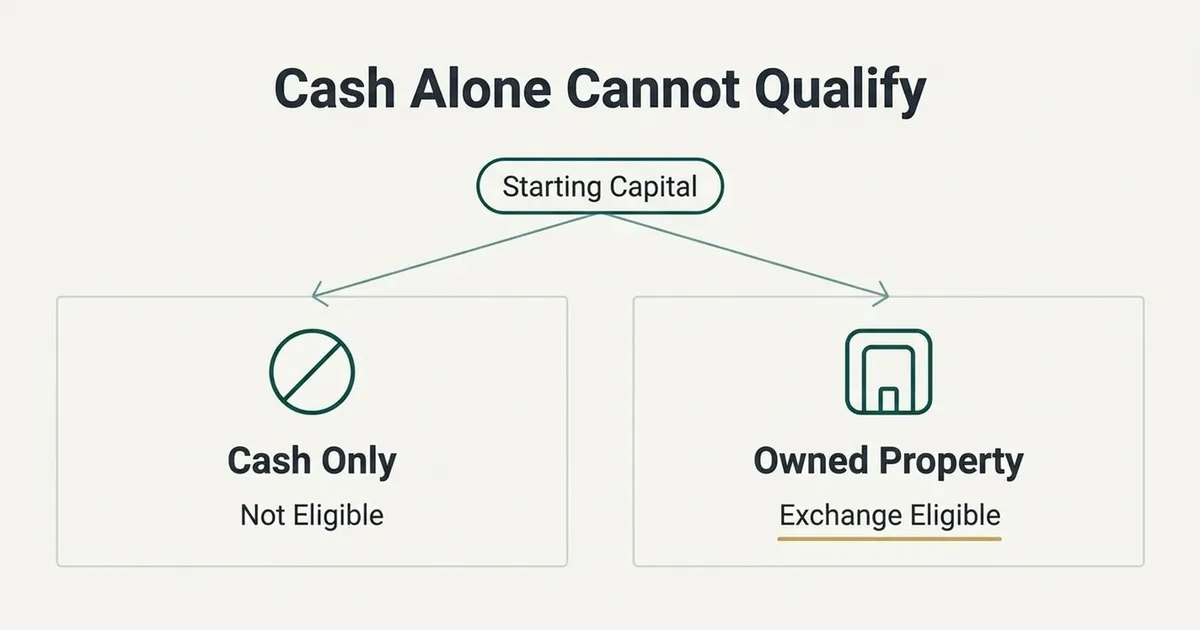
Most readers in this savings range don't own an existing rental to exchange, and a 1031 exchange cannot convert cash into a qualifying transaction — you need appreciated real property first. The scenario where it applies to you: you bought a starter condo or small rental before your kids were school-age, it's appreciated by $50,000 or more, and you're now working full-time with no time for a midnight maintenance call. In that case, exchanging into a DST lets you keep the tax deferral while trading hands-on ownership for quarterly, professionally managed distributions — no tenant calls, no lease renewals.
If you don't yet own that starter property, the 1031 exchange isn't your near-term tool; building toward it with a low-minimum REIT or fractional platform position, as laid out in our low-maintenance real estate guide, is. Revisit a 1031 exchange only once you hold appreciated investment real estate directly — the rules above apply the same way whether your gain is $50,000 or $500,000.
Disclaimer: This article is educational and not individualized tax, legal, or investment advice. Federal 1031 exchange rules and state add-on requirements change and carry real deadlines and penalties for missteps — confirm current figures with a qualified intermediary, CPA, or the IRS before acting.
Frequently asked questions
What is the 2-year rule for 1031?
The 2-year rule under IRC Section 1031(f) applies to exchanges between related parties — a sibling, parent, or an entity you control — and requires both parties to hold their respective properties for at least 24 months after the exchange. According to the IRS (2026), Form 8824 instructions state that if either party disposes of their property before that 24-month window closes, the deferred gain becomes taxable retroactively in the year of the early disposition, unless a specific exception (like death, involuntary conversion, or a transaction proven not to be tax-avoidance-motivated) applies. This rule targets exchanges designed to shift basis within a family, not ordinary exchanges between unrelated buyers and sellers.
What is the downside of a 1031 exchange?
The main downside is that a 1031 exchange defers tax rather than eliminating it, so the deferred gain plus any depreciation recapture still comes due whenever you eventually sell without exchanging again. According to the IRS (2026), IRC Section 1031(a)(3) imposes rigid 45-day identification and 180-day closing deadlines with no extensions for financing delays, and missing either one makes the full gain taxable in the year of sale. Additional downsides include qualified-intermediary and closing costs, with qualified-intermediary fees alone commonly running about $600 to $1,500, equity locked into real estate for years, and a reduced cost basis on the replacement property that produces a larger taxable gain later if you don't keep exchanging.
What is a poor man's 1031 exchange?
A "poor man's 1031 exchange" is an informal term for using the IRC Section 121 primary-residence exclusion instead of a real 1031 exchange. According to the IRS (2026), Publication 523 lets you exclude up to $250,000 of gain ($500,000 for married couples filing jointly) on a home you've owned and lived in for at least two of the five years before selling — with no qualified intermediary, no identification deadline, and no replacement property required. It only applies to a primary residence, not a straight rental or commercial property, so it can't substitute for a real 1031 exchange when the property you're selling was never your home.
What would disqualify a property from being used in a 1031 exchange?
A property is disqualified if it's your primary residence, a former vacation home that fails the safe harbor, or "dealer property" held primarily for resale, such as a house you flipped. According to the IRS (2026), Revenue Procedure 2008-16 requires 24 months of ownership with at least 14 days of fair-market rental each year and personal use capped at the greater of 14 days or 10% of rental days for a former vacation home to qualify at all. Foreign real property is also disqualified because, per the IRS (2026) and IRC Section 1031(h), it is never like-kind to U.S. real property, and related-party exchanges lose their deferral retroactively if either party sells within 24 months under IRC Section 1031(f).
What are the core 1031 exchange rules?
The core rules require that both properties be real property held for investment or business use, that you identify replacement property in writing within 45 days of closing the sale, and that you close on the replacement property within 180 days. According to the IRS (2026), IRC Section 1031(a)(3) sets both deadlines, Treasury Regulation §1.1031(k)-1(g)(4) requires a qualified intermediary to hold your proceeds so you never touch the cash, and IRC Section 1031(b) requires your replacement property's price and debt to equal or exceed what you sold to defer 100% of the gain. You report the completed exchange on IRS Form 8824 for the tax year of the sale.
Does a 1031 exchange work for all types of real estate?
No — a 1031 exchange only works for real property held for investment or business use, covering rental homes, apartment buildings, commercial buildings, raw land held for investment, and fractional Delaware Statutory Trust interests. According to the IRS (2026), Revenue Ruling 2004-86 confirmed DST interests qualify, while IRC Section 1031(h) excludes foreign real estate because it's never like-kind to U.S. property. Since the Tax Cuts and Jobs Act of 2017 (Pub. L. 115-97), the exchange also no longer applies to personal property such as equipment or vehicles — under current law, real property is the only eligible asset class.