Cash Out Refinance vs HELOC for a Rental in 2026

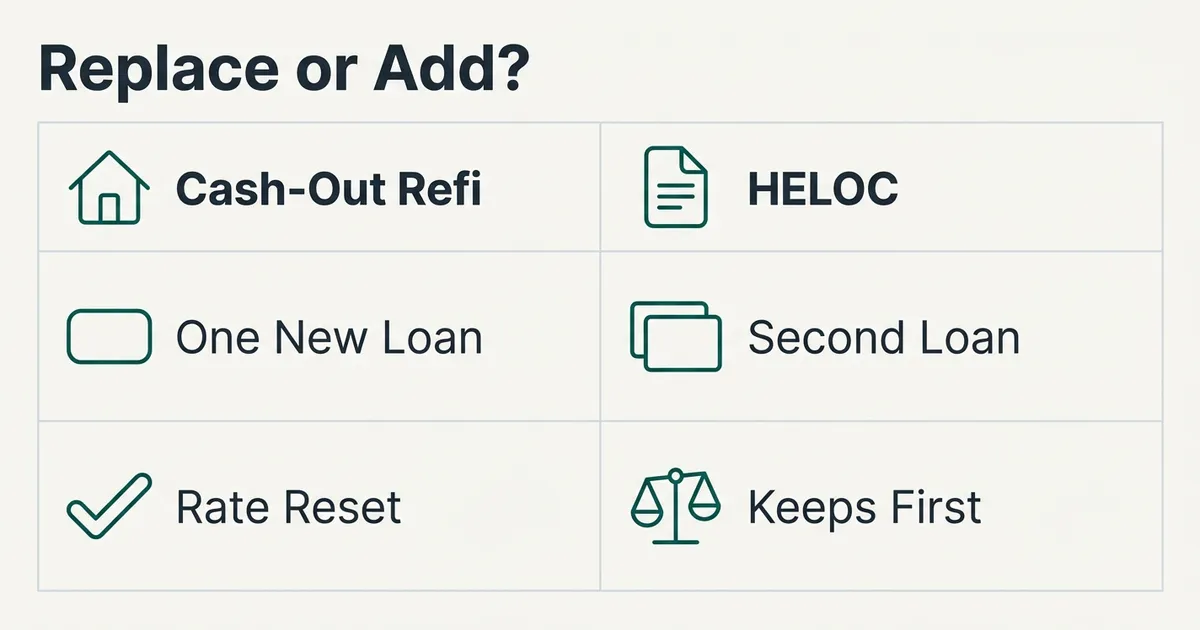
Choose a cash out refinance if your current mortgage rate is above today's rates; choose a HELOC if your first mortgage is low-rate and you need less cash. Skip both if the new payment depends on rent arriving on time. A cash out refinance replaces your whole loan; a HELOC adds a second, variable-rate loan beside it.
The reason is mechanical, and it matters most if you hold a mortgage from the 2020-2021 low-rate era. A cash out refinance reprices every dollar you already owe at today's rate. A HELOC (home equity line of credit) leaves your first mortgage untouched and reprices only the new money. This guide is for working parents with $10,000-$50,000 saved who want rental-style income without a midnight maintenance call, so it also covers when borrowing is the wrong move entirely.
What is a cash out refinance, and how does a HELOC differ?
A cash out refinance is a new first mortgage, larger than your current balance, that pays off the old loan and sends you the difference at closing. If you owe $300,000 and the new loan is $340,000, you receive about $40,000 minus closing costs. Your entire balance then carries the new rate and a fresh 30-year clock.
A HELOC works the other way. It is a revolving credit line secured by the property and sits behind your first mortgage as a second lien. You borrow only what you draw, and the rate is usually variable, so your payment moves with the market. According to Regulation Z, 12 CFR §1026.30 (2026), a variable-rate HELOC must carry a disclosed lifetime maximum rate, which caps the damage but does not remove it.
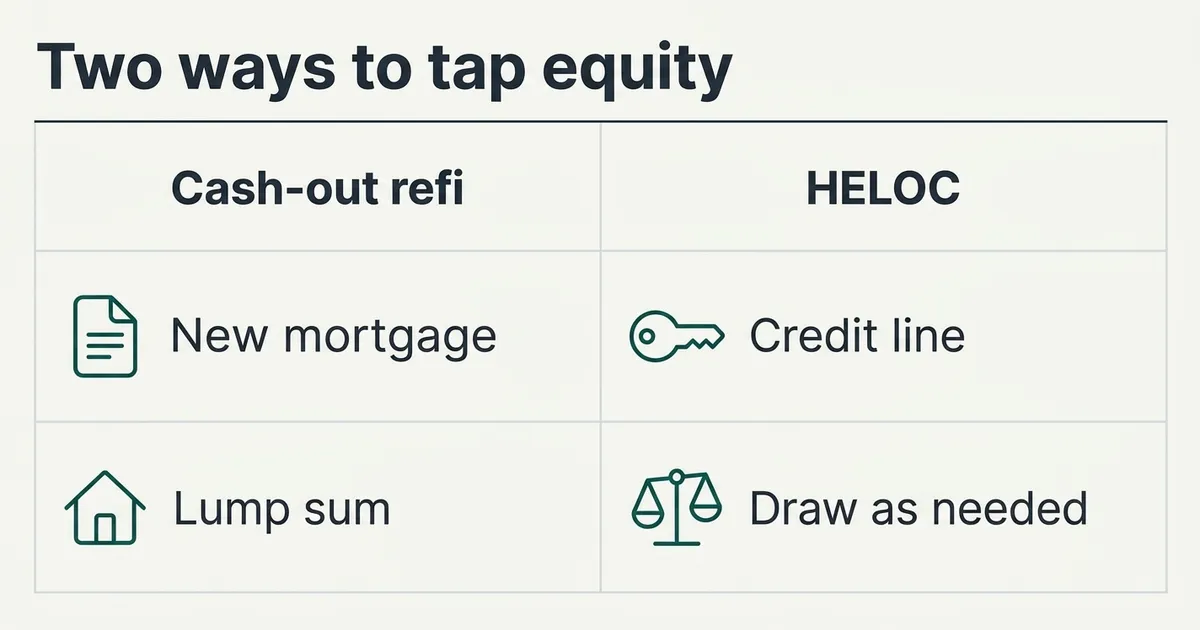
The practical difference is which dollars reprice. A cash out refinance touches your whole balance. A HELOC touches only the draw. That single fact decides most cases, as the worked example below shows.
How much can you pull out of a home or a rental?
Lenders size the loan to the property's appraised value, not to your need. According to the Fannie Mae Selling Guide (2026), the maximum loan-to-value ratio (LTV, the loan divided by appraised value) on a cash out refinance is 80% for a one-unit primary residence and 75% for a one-unit investment property. A $500,000 home with $300,000 owed caps at a $400,000 loan, leaving $100,000 of gross room. A $400,000 rental with $200,000 owed caps at $300,000, which is also $100,000 of room.
Rental refinances add conditions. According to the Fannie Mae Selling Guide (2026), at least one borrower must have been on title for six months before a cash out refinance, with narrow exceptions, so you cannot buy a rental and immediately pull equity out of it. According to the Fannie Mae Selling Guide, section B3-3.8-02 (September 2026), a lender counts 75% of gross monthly rent for a purchase or for a refinance of a rental not yet on Schedule E, and uses the Schedule E cash flow for one that is. Under the 75% rule, a $2,800 rent counts as $2,100.
Loan-size ceilings matter in expensive markets. According to the Federal Housing Finance Agency (November 2025), the 2026 baseline conforming loan limit is $832,750 for one-unit properties, and high-cost counties, including many in California, reach $1,249,125. Loans above the local limit move to jumbo programs, where each lender sets its own rules. For the investor-loan side of the picture, including down payments, rates and reserves, see Investment Property Loan Requirements, Explained (2026).
No Fannie Mae cap applies to a HELOC. Each lender sets its own combined LTV and decides whether it lends against a non-owner-occupied rental at all. Some lenders offer HELOCs only on owner-occupied homes, so ask before you pay for an appraisal.
Which costs less for a rental down payment: a cash out refinance or a HELOC?
For most homeowners with a low-rate first mortgage, the HELOC costs far less, because the cash out refinance reprices your entire balance. Rates explain why. According to Freddie Mac's Primary Mortgage Market Survey (January 2021), the 30-year fixed average hit a record low of 2.65%. According to the same survey (October 2023), it reached 7.79%, its highest level in more than two decades. A mortgage from the low end carries a rate you cannot replace, and a cash out refinance throws it away.
Here is an illustrative case, not a quote. You own a $500,000 home with a $300,000 mortgage at 3.0% fixed. You need $40,000. To keep the comparison clean, treat the $300,000 as a fresh 30-year loan.
| Option | New debt | Monthly payment | Rate type | What reprices | Assumed closing cost |
|---|---|---|---|---|---|
| Cash out refinance on your home | $340,000 at 6.5% | $2,149 | Fixed | All $340,000 | $10,200 (3%) |
| HELOC, interest-only draw period | $40,000 at 8.5% | $1,265 + $283 = $1,548 | Variable | Only the $40,000 | $500 |
| HELOC, 20-year repayment phase | $40,000 at 8.5% | $1,265 + $347 = $1,612 | Variable | Only the $40,000 | $500 |
| HELOC if rates rise 2 points (interest-only) | $40,000 at 10.5% | $1,265 + $350 = $1,615 | Variable | Only the $40,000 | $500 |
The HELOC saves about $600 a month during the draw period. The cause is the blended rate. Keeping the 3.0% mortgage and adding $40,000 at 8.5% gives (300,000 × 3.0% + 40,000 × 8.5%) ÷ 340,000, about 3.65%. The refinance charges 6.5% on everything.
Measure the real price of the cash by comparing yearly interest. With no new borrowing you pay about $9,000 on $300,000 at 3.0%. The refinance costs about $22,100 on $340,000 at 6.5%, an extra $13,100 for $40,000 of cash, an effective cost near 33%. The HELOC adds $3,400, an effective 8.5%. A rental would have to out-earn the cost of the cash, which almost none do at the 33% figure.
The result flips when your existing rate is high. Suppose the $300,000 mortgage carries 7.25% and a refinance would be 6.5%. Keeping it and adding the HELOC blends to (300,000 × 7.25% + 40,000 × 8.5%) ÷ 340,000, about 7.4%. The refinance then saves roughly 0.9 point, about $3,050 a year on $340,000. Against $10,200 in closing costs, break-even lands near 3.3 years. If you may move or refinance again sooner, the refinance loses.
The HELOC has its own failure modes. According to Regulation Z, 12 CFR §1026.40(f)(3)(vi) (2026), a lender may freeze or reduce a HELOC after a significant decline in the home's value. Undrawn money you were counting on can vanish when prices fall. The payment also steps up when the draw period ends, so plan to repay the draw within a few years.
Choose the cash out refinance if your current rate is above the new rate, you need a large sum, and you want a fixed payment you can budget around. Choose the HELOC if your first mortgage is well below market rates, you need a modest amount, and you can repay it in two to three years.
How do you run a cash out refinance calculator yourself?
You need five steps and a basic spreadsheet. Any online cash out refinance calculator runs the same math, and doing it by hand shows you which input drives the result.
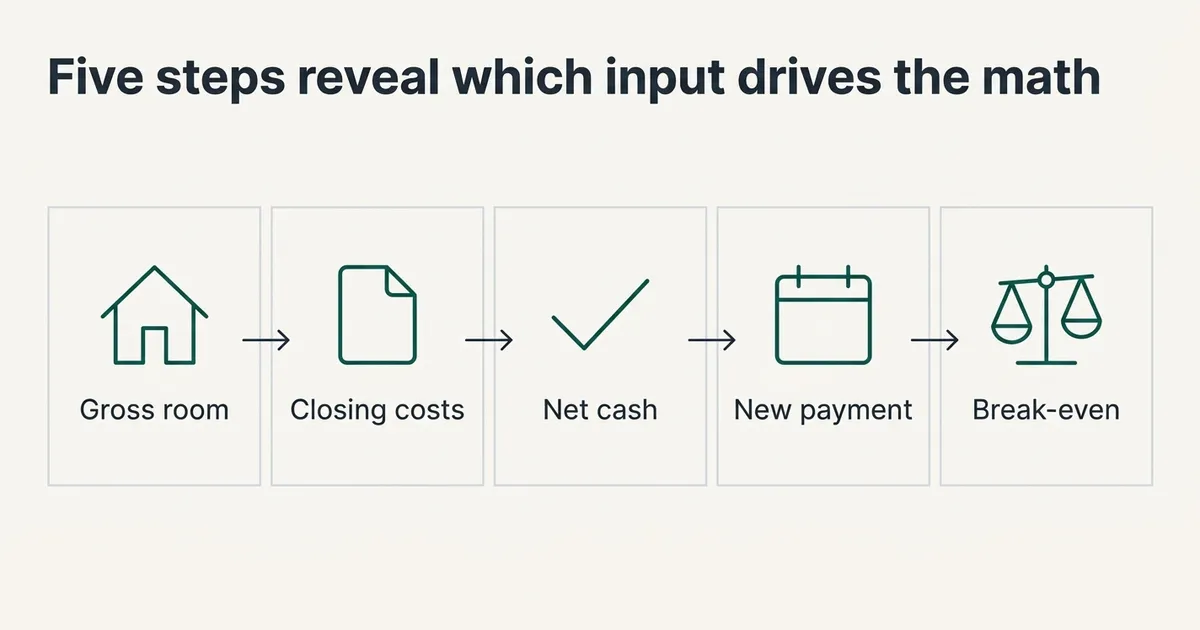
- Find gross room. Multiply appraised value by the LTV cap, then subtract your payoff. For the $500,000 home at 80%: $400,000 − $300,000 = $100,000.
- Subtract closing costs. Get a Loan Estimate from two or three lenders on the same day. According to Regulation Z, 12 CFR §1026.19(e) (2026), a lender must deliver the Loan Estimate within three business days of your application, so shopping costs you nothing but time.
- Compute the new payment. Use P = L × r ÷ (1 − (1 + r)^−n), where L is the loan, r is the monthly rate and n is the number of months. For $340,000 at 6.5% over 360 months, the payment is about $2,149.
- Compare blended rates. Use (balance × old rate + draw × HELOC rate) ÷ total debt, as in the example above. The lower number wins on interest.
- Stress-test the rental. Count only 75% of rent, as lenders do for a purchase. Then subtract the rental's own mortgage, taxes, insurance and a property manager fee. Confirm you can carry every payment for three months with zero rent. If a manager runs the unit, get a written fee quote rather than assuming one.
Run step 5 before you apply. The most common mistake is sizing the loan to the equity available rather than to the payment your paycheck can survive. Budget for insurance on the rental too; Landlord Insurance: 2026 Costs, Coverage & Quotes covers what a rental policy costs and what a homeowner policy leaves out. For the full expense-by-expense math on what a rental nets, see Rental Property Income After Expenses: The Real Math (2026), where the extra debt service this article creates is the line that decides whether the rental still nets anything.
What do cash out refinance rates today depend on?
Today's rate is not printed here because mortgage rates reprice daily, and any figure would be stale within days. You can find the benchmark and your own quote in two steps. According to Freddie Mac (2026), its Primary Mortgage Market Survey publishes national average rates weekly on Thursdays. Treat that as a floor for a primary-residence loan, then request same-day quotes for your actual numbers.
Your rate sits above the survey average for specific reasons. According to Fannie Mae's Loan-Level Price Adjustment matrix (2026), cash out refinances carry one price adjustment and investment properties carry another, each tiered by LTV and credit score. A rental cash out refinance stacks both, so expect it to price higher than a refinance on your own home.
Those tiers step at LTV breakpoints. Ask each lender to quote at 70% and 75% LTV as well as the maximum. Borrowing $10,000-$20,000 less can drop you into a cheaper tier and change the effective cost of the cash.
Can you get a cash out refinance with bad credit?
Sometimes, but the options narrow as the score falls, and the FHA route never covers a rental. According to the Fannie Mae Selling Guide, section B3-5.1-01 (April 2026), loans run through Desktop Underwriter have no fixed minimum credit score, while manually underwritten fixed-rate loans require 620 and adjustable-rate loans 640. A lender may still set a higher minimum of its own, so ask for it in writing before you pay for an appraisal. According to HUD Handbook 4000.1 (2026), an FHA cash out refinance is capped at 80% LTV and is limited to owner-occupied principal residences.
That means a lower score may still be able to cash out your own home through FHA, but never a rental. If your score sits below 620 and the money is meant for a rental, wait. Weak credit raises the price adjustments above, and borrowing at a high rate to buy a rental that must cover it leaves no margin for a vacancy.
Use the waiting time to pay down card balances, since utilization moves scores fastest. Meanwhile, fractional real estate platforms accept small checks without a mortgage or a credit-based loan, which suits a $10,000-$25,000 budget better than debt does.
What changes on tax and legal when the money funds a rental?
Neither product wins on tax; what you spend the money on controls the treatment. According to IRS Publication 936 (2025), interest on home equity debt qualifies as deductible home mortgage interest only when the money buys, builds or substantially improves the home that secures the loan. Cash used to buy a rental does not meet that test.
Interest follows the use of the proceeds instead. According to Treasury Regulation §1.163-8T (1987), interest is allocated by how borrowed money is spent, so interest on cash spent on rental property is rental interest. On a cash out refinance, only the new cash portion gets this treatment; the old balance stays home mortgage debt. Keep the proceeds in a separate account and pay rental costs directly from it so the trail stays clean. Borrowing against equity is generally not a taxable event, unlike a sale; if you would rather reach equity by selling, a 1031 exchange defers the tax on the gain instead.
Legal protections also differ by property. According to Regulation Z, 12 CFR §1026.23 for refinances and §1026.15 for HELOCs (2026), borrowers get a three-business-day right to cancel a consumer-purpose loan secured by their principal dwelling. A loan secured by a rental has no such right. The commentary also deems credit to acquire non-owner-occupied rental property to be for business purposes (12 CFR Part 1026, Supplement I, comment 3(a)-4 (2026)), and Regulation Z does not cover business-purpose credit under 12 CFR §1026.3(a), so ask your lender in writing which protections apply to your loan, and confirm every number before you sign.
California adds a rent-side constraint. According to California Civil Code §1947.12 (2026), annual rent increases on covered units are capped at 5% plus the local CPI change, with a 10% ceiling. A variable-rate HELOC can rise faster than your allowed rent, so confirm whether your unit is covered or exempt before you rely on rent increases to offset it.
Should you borrow against your home for a low-maintenance rental at all?
For most readers with $10,000-$50,000 of savings, no: borrowing against the house where your kids sleep to fund a rental puts your primary residence behind a tenant's rent check. The leverage works both ways. A vacancy or a $9,000 roof comes out of your paycheck, not the property's income.
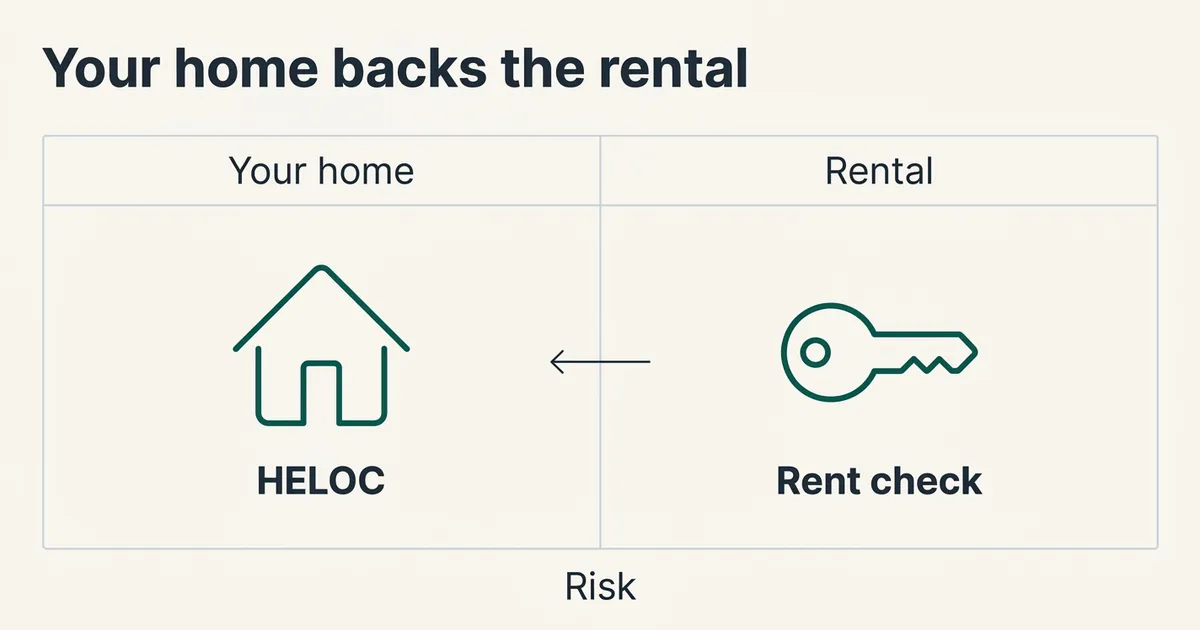
Use these rules:
- Choose a cash out refinance if your first mortgage rate is above current rates, the rental's counted income covers its own debt, and you can pay the full new payment with zero rent for three months.
- Choose a HELOC if your first mortgage is low-rate, you need under roughly one year's household savings, and you can repay the draw within a few years.
- Choose neither if your emergency fund is thin, the rental's net income after a manager fee would not cover the new debt's interest, or your credit score is under 620.
Weigh the unlevered alternatives before you borrow. REITs versus rental properties compares the two on check size, fees and liquidity, and whether fractional real estate is worth it covers the platform route. If you still want a direct rental, outsourcing rental property management shows what a manager costs and handles, which determines whether you can ever skip the midnight call. For the full range of options, start from the low-maintenance real estate hub.
Disclaimer: This article is general education, not personalized financial, tax, or legal advice. Figures in worked examples are illustrative assumptions, not quotes or promised outcomes, and rates, limits and rules change. Borrowing against your home puts it at risk of foreclosure if you cannot repay. Confirm current terms with lenders and a qualified tax or legal professional before you borrow.
Frequently asked questions
What is a cash out refinance calculator?
A cash out refinance calculator estimates how much cash you can take by multiplying your home's value by the lender's maximum LTV and subtracting your current mortgage payoff and closing costs. For a $500,000 home with $300,000 owed, an 80% cap leaves $100,000 before costs. According to the Fannie Mae Selling Guide (2026), the cap is 80% for a one-unit primary residence and 75% for a one-unit investment property, so a rental yields less cash from the same value.
What are cash out refinance rates?
Cash out refinance rates are the interest rates lenders charge on a new, larger first mortgage and they typically price above a plain rate-and-term refinance. According to Fannie Mae's Loan-Level Price Adjustment matrix (2026), cash out transactions and investment properties each carry price adjustments that vary by credit score and LTV. A rental cash out refinance therefore costs more than one on your own home, and dropping to a lower LTV tier can reduce the rate.
Is a cash out refinance better than a HELOC?
A cash out refinance is better only when your existing mortgage rate is higher than the new rate. A HELOC is better when your first mortgage is low-rate. In an illustrative $40,000 example, keeping a 3.0% mortgage and adding an 8.5% HELOC blends to about 3.65%, while a 6.5% refinance charges 6.5% on all $340,000. According to Freddie Mac (January 2021), the 30-year fixed average reached 2.65%, a rate worth keeping.
What does cash out refinance mean?
A cash out refinance means replacing your current mortgage with a larger one and receiving the difference as cash at closing. If you owe $300,000 and take a $340,000 loan, you receive about $40,000 less closing costs, and your whole balance takes the new rate and term. According to the Fannie Mae Selling Guide (2026), at least one borrower must have been on title for six months before a cash out refinance.
Can you get a cash out refinance with bad credit?
You can get a cash out refinance with bad credit only if your score clears the minimum of the program and the lender you use. According to HUD Handbook 4000.1 (2026), an FHA cash out refinance is limited to owner-occupied principal residences at 80% LTV, so it never covers a rental. According to the Fannie Mae Selling Guide (April 2026), loans run through Desktop Underwriter have no fixed minimum credit score, while manually underwritten fixed-rate loans require 620, and a lender may set a higher minimum of its own.
What are cash out refinance rates today?
Today's cash out refinance rate depends on your credit score, LTV and property type, so it is best found by requesting same-day Loan Estimates from several lenders. According to Freddie Mac (2026), its Primary Mortgage Market Survey publishes national averages every Thursday, and the 30-year fixed average ranged from 2.65% in January 2021 to 7.79% in October 2023. Use the weekly survey as a benchmark, then add the premium for cash out or investment-property pricing.