Cost Segregation: Worth It for Passive Investors in 2026?

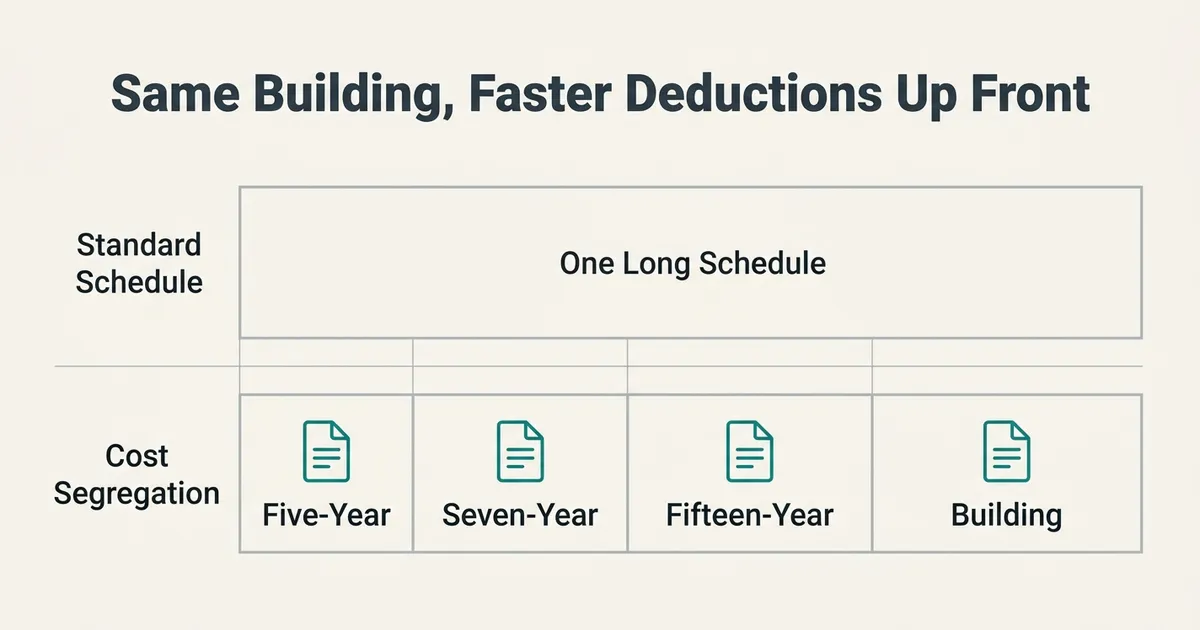
Cost segregation is a tax strategy that reclassifies parts of a rental building into shorter-life assets — 5, 7, or 15 years instead of 27.5 or 39 — to front-load depreciation deductions. For passive owners without real estate professional status, those accelerated losses usually just pile up instead of cutting this year's tax bill.
That distinction matters more than the strategy itself if you're a working parent with $10,000 to $50,000 to deploy and no appetite for midnight maintenance calls. Cost segregation doesn't behave the same way across every low-maintenance real estate vehicle — it reaches you very differently depending on whether you own a rental directly, hold a stake in a syndication, or buy shares of a low-maintenance real estate fund like a REIT.
What Is Cost Segregation, and How Does It Work?
Cost segregation works by splitting a building's purchase price into IRS-recognized components with different depreciation lives, instead of depreciating the whole structure on one schedule. According to the Internal Revenue Service's Publication 946 (2025), residential rental buildings normally depreciate straight-line over 27.5 years and commercial buildings over 39 years, with land excluded entirely because land doesn't wear out.
An engineering-based cost segregation study inspects the property and reassigns pieces of it — carpeting, cabinetry, decorative lighting, parking pads, landscaping — into 5-, 7-, or 15-year MACRS classes. Per IRS Publication 5653, the Cost Segregation Audit Techniques Guide (2025), a defensible study documents the cost and classification of each component well enough to survive an IRS examination, which is why firms use licensed engineers rather than a bookkeeper's estimate.
Here's the math on a typical deal. You buy a $400,000 single-family rental with $80,000 allocated to land, leaving a $320,000 building basis. Without a study, that basis depreciates at a flat $11,636 a year for 27.5 years. A study might reclassify 25% of the basis ($80,000) as 5-year personal property and 10% ($32,000) as 15-year land improvements, leaving $208,000 on the 27.5-year schedule. If the shorter-life $112,000 qualifies for 100% bonus depreciation, you could deduct roughly $119,500 in year one — about ten times the deduction you'd get without the study. That gap is the entire appeal, and it's also exactly why the IRS scrutinizes passive-loss limits so closely.
Why Can't Most Passive Investors Use Cost Segregation Losses?
Most W-2 employees can't deduct rental losses against their paycheck because of the passive activity loss rules, even after a cost segregation study manufactures a large loss. Rental real estate is "per se passive" under federal tax law regardless of how the loss was generated.
The mechanism is IRC Section 469. Per IRC Section 469(c)(7), added by the Omnibus Budget Reconciliation Act (1993), qualifying as a real estate professional requires more than 750 hours of service in real property trades during the year and more than half of your total personal-service hours across all jobs. A parent working a full-time W-2 job already fails the second test by definition — you can't spend more than half your working hours in real estate while also holding down a 40-hour job elsewhere. According to IRS Publication 925 (2025), there's a narrower $25,000 special allowance for active participation in a rental, but it phases out completely once modified adjusted gross income reaches $150,000, which rules it out for many dual-income households before cost segregation even enters the picture.
Short-term rentals carry a popular workaround that most articles gloss over. Per Treasury Regulation 1.469-1T(e)(3)(ii)(A) (1988), a rental with an average guest stay of seven days or less isn't a "rental activity" for passive-loss purposes at all — it's tested under the material participation rules instead, which don't require real estate professional status. The catch: you still have to materially participate, commonly through the "100 hours and no less than anyone else" test under Treasury Regulation 1.469-5T (1988). Hand the turnovers, guest messaging, and maintenance coordination to a co-host or property manager, and that manager likely logs more hours than you do — which fails the test and pushes the activity back into passive-loss purgatory. You cannot outsource the work and keep the deduction; the loophole and the hands-off lifestyle are mutually exclusive for most parents in this budget range.
How Do Syndications Make Cost Segregation Work for Hands-Off Investors?
Syndications let a sponsor run the cost segregation study at the property level and pass your share of the resulting loss to you on a Schedule K-1, without requiring you to log a single hour of material participation. As a limited partner, you're presumed a non-material participant under the same Treasury Regulation 1.469-5T framework described above, so the loss arrives as passive to you no matter how large it is.
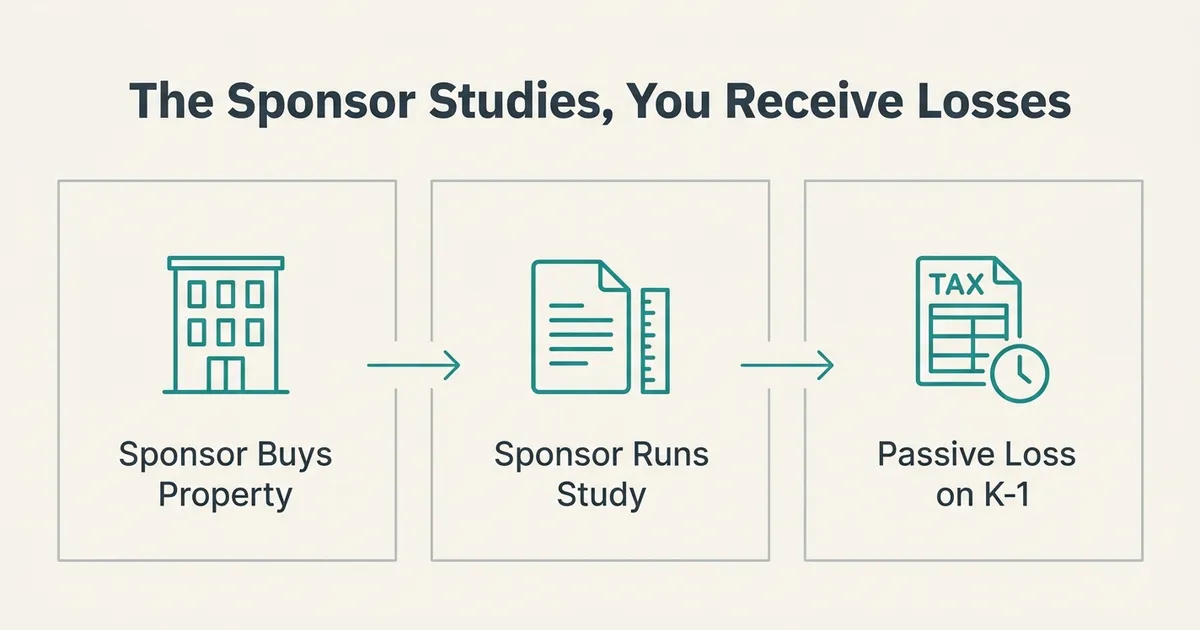
That passive characterization is fine if you already have other passive income to absorb it — gains from another syndication, a rental sold at a profit, or dividends from a passive real estate fund. If you don't, the loss suspends on IRS Form 8582 and carries forward, per IRS Publication 925 (2025), until you generate passive income or dispose of your stake, often when the sponsor sells the property five to seven years later. Many syndications sold under Regulation D Rule 506(c) also require accredited investor status; per the SEC's accredited-investor definition in 17 CFR 230.501, last amended by the SEC (2020), that generally means a net worth above $1 million excluding your primary residence, or income above $200,000 ($300,000 joint) in each of the last two years — a real gate for some readers in this budget range, since 506(b) offerings without that requirement exist but are marketed more quietly.
| Vehicle | Typical check size | Does cost segregation reach you? | Can you deduct losses vs. W-2 income? | Liquidity |
|---|---|---|---|---|
| Direct rental, self-managed | $150,000+ (down payment + closing) | Yes, you commission the study | Only with REPS status or STR material participation | Illiquid; sale takes months |
| Syndication (limited partner) | $25,000–$50,000 | Yes, passed through via K-1 | Rarely — LPs are presumed passive | Illiquid; 5–7 year typical hold |
| Turnkey rental with property manager | $150,000–$300,000+ | Yes, you own it directly | Same REPS/STR rules as any direct rental | Illiquid, but sellable anytime |
| Fractional real estate platform | $100–$5,000 | Sometimes, depends on the platform's tax structure | Rarely — small passive share | Limited secondary market |
| REIT shares (brokerage) | $1–$500 per share | No — depreciation stays inside the REIT | No — you only see dividend characterization | High; trades daily |
Syndications and turnkey rentals are the only two rows where cost segregation changes your personal tax return in a meaningful way; REITs absorb the benefit internally and pass you a dividend already characterized as ordinary income, capital gain, or return of capital. If your goal is passive exposure with occasional tax benefit, a syndication fits the $25,000–$50,000 budget this reader typically has; compare it against REITs vs. rental properties before committing capital for five-plus years. Readers testing the waters with smaller checks should also weigh whether fractional real estate is worth it and review the best fractional real estate platforms for how each one actually structures ownership.
What Does a Cost Segregation Study Cost, and Who Should Pay for One?
An engineering-based cost segregation study typically runs $5,000 to $15,000 for a single property under $1 million, scaling with square footage and the complexity of the build-out. That fee is why the strategy rarely pencils out for a $150,000 starter rental — the study cost can eat a large share of the first-year tax benefit before you've recovered anything.
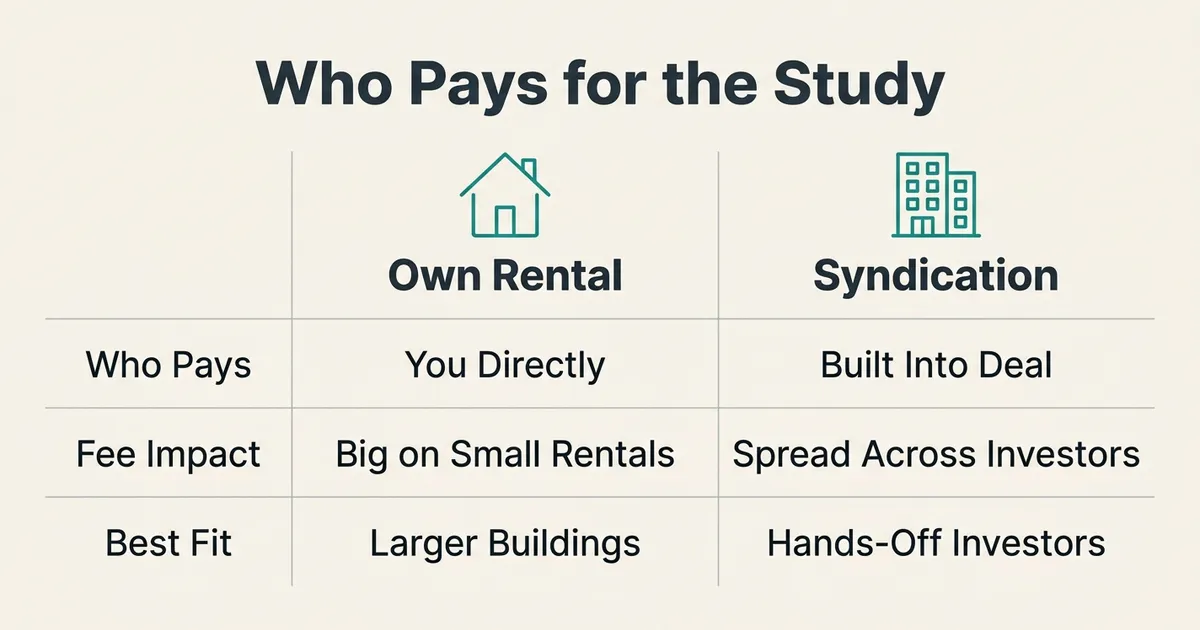
You don't need to buy a property this year to benefit. According to the IRS Instructions for Form 3115 (2022), owners of property already in service can commission a "look-back" study and claim missed depreciation through a single Section 481(a) accounting-method change, without amending any prior tax returns. In a syndication, this cost is irrelevant to you directly — the sponsor builds the study fee into the deal's acquisition budget, which is one more reason the structure suits an investor writing a $25,000–$50,000 check rather than commissioning a study on a single rental they own outright.
How Did Bonus Depreciation Rules Change the Math in 2026?
Bonus depreciation determines how much of the shorter-life property a cost segregation study identifies you can expense immediately, versus depreciating it over its normal 5-, 7-, or 15-year schedule. The percentage is locked in by the property's placed-in-service date, not the year you run the study or file the return.
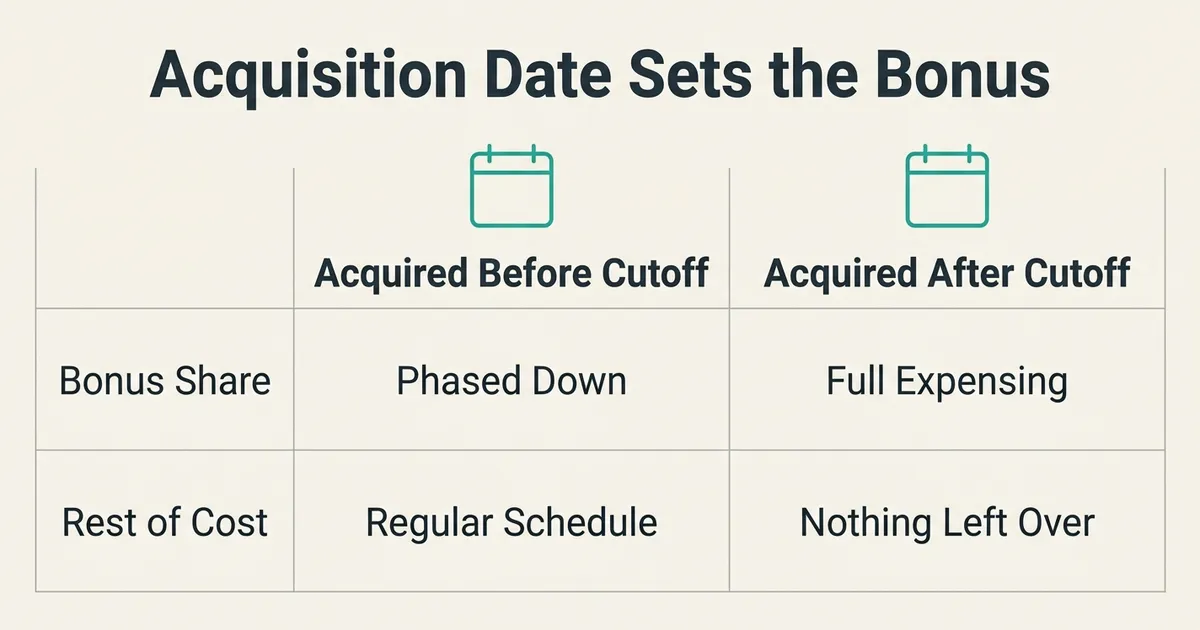
Per the Tax Cuts and Jobs Act (December 2017), bonus depreciation allowed 100% first-year expensing of qualifying short-life property through 2022, then was scheduled to phase down 20 percentage points a year — 80% in 2023, 60% in 2024, and 40% for property placed in service in 2025 under the original statute. That schedule changed mid-course: per the One Big Beautiful Bill Act (2025), signed into law on July 4, 2025, Congress restored 100% bonus depreciation permanently for qualifying property acquired after January 19, 2025 — and "acquired" means the date of the binding purchase contract. Practically, this means a syndication that signed its contract after that date and closed in March 2025 gets full first-year expensing on the reclassified components, while one that closed in 2024 is locked at the 60% rate for that vintage even if the cost segregation study itself happens in 2026 — always check the sponsor's acquisition date before assuming current-year bonus rates apply.
Do You Have to Pay Back Cost Segregation When You Sell?
You don't repay the deduction directly, but depreciation recapture taxes back a meaningful share of the benefit when you sell, which functions like deferred payment rather than a free deduction. Cost segregation moves the write-off earlier; it doesn't make it disappear.
The mechanism splits into two parts. Per IRS Publication 544 (2025), gain attributable to straight-line real property depreciation is taxed as unrecaptured Section 1250 gain at a maximum federal rate of 25%, higher than the 15% or 20% long-term capital gains rate most asset sales enjoy. Gain tied to the 5- and 7-year personal-property components a cost segregation study identified is recaptured as ordinary income under Section 1245, at your regular marginal rate — which can reach 37% federally, meaning the portion you accelerated hardest comes back at the highest possible tax cost. On the earlier $400,000 example, if you sell after fully writing off the $112,000 in reclassified property, the $80,000 of 5-year personal property can come back as Section 1245 ordinary-income recapture in the year of sale — the $32,000 of land improvements is Section 1250 property with its own recapture rules — on top of 25% recapture on the accumulated straight-line depreciation.
Two mechanisms can change this outcome. A like-kind exchange under IRC Section 1031, limited to real property since the Tax Cuts and Jobs Act (2017), defers both types of recapture by rolling your basis into a replacement property instead of triggering tax at sale. A stepped-up basis at death under IRC Section 1014 erases the recapture liability entirely for heirs, since their basis resets to fair market value — the one scenario where the deferred tax bill never actually arrives.
Who Should Skip Cost Segregation Entirely?
Skip it if you and your spouse both hold full-time W-2 jobs with no plan to personally manage a short-term rental past the material participation threshold — the losses will suspend on Form 8582 rather than cut this year's tax bill, as detailed above. Skip it if the building basis is under roughly $150,000, since a $5,000-plus study fee consumes too large a share of a modest depreciation acceleration to be worth the cost or the audit-risk exposure of an aggressive classification.
Use it if you're investing through a syndication or fund that bundles the study cost into the deal and you already hold other passive real estate income — a prior syndication's gain, a rental sold at a profit — to absorb the loss as it's generated. Use it if one spouse qualifies as a real estate professional under IRC Section 469(c)(7), or if you personally run a short-term rental above the material participation threshold rather than outsourcing it. For most readers who want genuinely hands-off exposure, pairing a syndication's passed-through cost segregation with other passive income sources beats trying to qualify for real estate professional status around a day job — and if direct ownership still appeals to you, review outsourcing rental property management before assuming you'll have the hours to spare for material participation.
Frequently asked questions
What is the meaning of cost segregation?
Cost segregation means splitting a building's purchase price into separate IRS depreciation categories — typically 5-, 7-, 15-, and 27.5- or 39-year classes — instead of depreciating the entire structure on one schedule. According to IRS Publications 527 and 946 (2025), components like carpeting in a residential rental and parking lots qualify for the shorter classes, which lets an owner deduct a much larger share of the building's cost in the first few years of ownership rather than spreading it evenly over nearly three decades.
What is the 2% rule for rental property?
The 2% rule is a quick screening heuristic, not a tax rule: multiply the purchase price by 2% and check whether expected monthly rent meets or beats that figure. According to BiggerPockets (2024), a $200,000 property clearing the 2% rule should rent for at least $4,000 a month to likely cash-flow after a mortgage, taxes, insurance, and property management; most markets in 2026 fall well short of that threshold, so investors use it as a fast initial filter rather than a purchase requirement.
What are the disadvantages of cost segregation?
The main disadvantages are the study cost, the passive-loss trap, and recapture at sale. A study typically runs $5,000 to $15,000 for a single property, the passive activity rules under IRC Section 469 block most W-2 employees from deducting the resulting losses in the year they're generated, and according to IRS Publication 544 (2025), selling later triggers depreciation recapture taxed at up to 25% on the real-property portion and ordinary income rates up to 37% on the personal-property components — meaning the benefit is often tax deferral rather than tax elimination.
Do you have to pay back cost segregation?
You don't repay the deduction itself, but depreciation recapture claws back part of the tax benefit when you sell the property. According to IRS Publication 544 (2025), gain attributable to straight-line building depreciation is taxed as unrecaptured Section 1250 gain at up to 25%, while gain tied to the 5- and 7-year personal-property components a cost segregation study identified is recaptured as ordinary income under Section 1245; a 1031 exchange can defer both, and a stepped-up basis at death under IRC Section 1014 can eliminate them for your heirs.
What is a cost segregation study?
A cost segregation study is an engineering-based analysis that inspects a property and reassigns portions of its cost from the standard 27.5- or 39-year depreciation schedule into 5-, 7-, or 15-year classes. Per IRS Publication 5653, the Cost Segregation Audit Techniques Guide (2025), a defensible study documents each component's cost and recovery-period classification so it can withstand an IRS examination, and owners can commission one years after purchase using a Section 481(a) look-back adjustment on IRS Form 3115 (2022) rather than amending prior returns.
How does cost segregation work in real estate investing?
In real estate investing, cost segregation works by front-loading depreciation deductions so an owner or syndication can show a large paper loss in the early years of holding a property, even while the property produces positive cash flow. According to IRS Publication 925 (2025), those losses only offset passive income unless the taxpayer qualifies as a real estate professional under IRC Section 469(c)(7) or materially participates in a short-term rental under Treasury Regulation 1.469-1T(e)(3)(ii), which is why the strategy benefits active landlords and syndication sponsors more directly than hands-off, passive investors.