Index Funds vs. Dividend Stocks for Kids (2026)

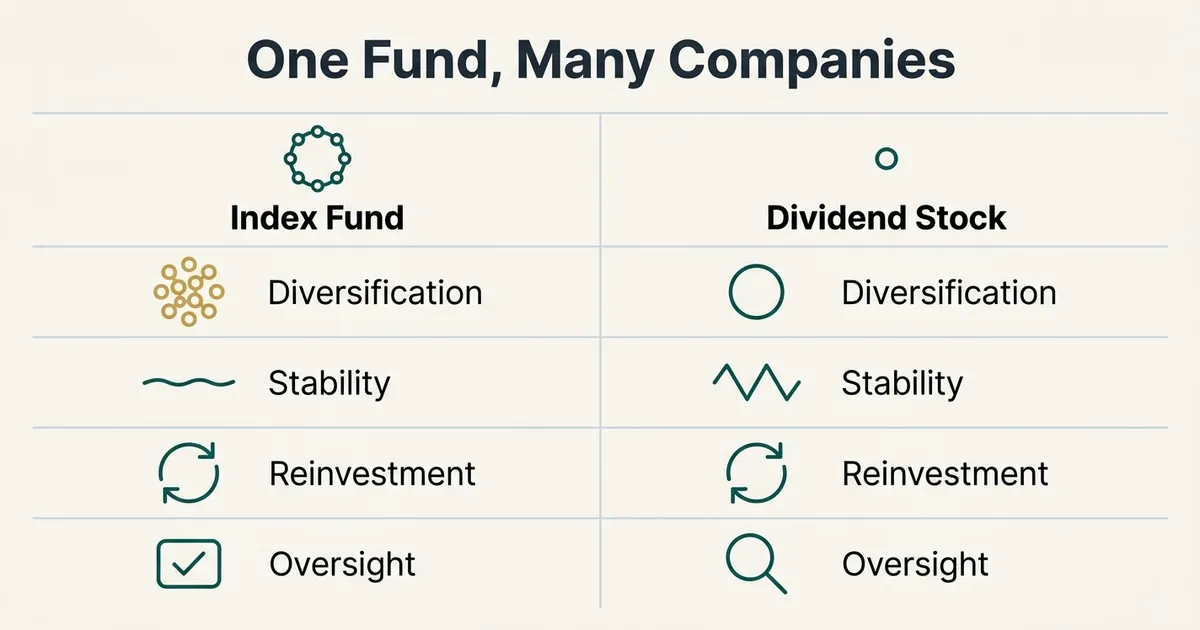
Index funds beat individual dividend stocks for most custodial accounts because one fund share spreads risk across hundreds of companies instead of a handful. For parents investing $50–$500 a month, that built-in diversification and lower cost compound into meaningfully more spendable income by the time a California UTMA transfers at 18 or 21.
That doesn't mean dividend stocks have no place in a child's portfolio — picking a handful of individual names can work as a learning tool or a small satellite position once the index-fund core is established. The decision below walks through the mechanism behind each choice, a worked $200-a-month example, and the exact tax forms a parent files when a custodial account earns its first dividend.
What's the Difference Between Index Funds and Dividend Stocks for a Child's Account?
An index fund buys every company in a target benchmark at once; a dividend stock is a single company's shares bought for its payout. According to the SEC's Office of Investor Education and Advocacy (2024), an index fund is a type of mutual fund or ETF built to track a specified market index rather than to beat it through stock-picking. A total-market or S&P 500 index fund held in a custodial account therefore pays a blended dividend from roughly 500 underlying companies, while one dividend stock pays only what that single board of directors declares.
The mechanism that matters for a child's account is concentration risk: according to S&P Dow Jones Indices (2026), the S&P 500 tracks 500 of the largest US publicly traded companies weighted by market capitalization, so even its largest holding, Nvidia, made up only about 8% of the index in late September 2026. A custodial account holding five individual dividend stocks instead puts 20% of the portfolio behind each company's board decision to keep paying — a dividend cut at one holding removes a fifth of that account's income in a single announcement. Parents comparing the mechanics of dividend ETFs against single stocks in more depth can see the full trade-off breakdown in dividend ETFs vs. individual stocks.
Which Wins for Custodial Account Income: Index Funds or Dividend Stocks?
Index funds win on cost, diversification, and automation; individual dividend stocks win only on raw current yield for a reader willing to accept single-company risk. The table below compares the two on the factors that actually change a custodial account's outcome.
| Factor | Total-Market / S&P 500 Index Fund | Individual Dividend Stocks |
|---|---|---|
| Typical annual cost | 0.00%–0.04% expense ratio (Vanguard, 2025; Fidelity, 2025) | $0 expense ratio, but no diversification cushion |
| Companies owned per share | ~500 (S&P Dow Jones Indices, 2026) | 1 per stock purchased |
| Typical dividend yield | ~1.0%–1.1% for the S&P 500, a record low (Motley Fool, September 2026) | ~2.5% for the S&P 500 Dividend Aristocrats index (S&P Dow Jones Indices, June 2026); individual high-yield names run higher |
| Minimum to start | $1 for fractional ETF shares at Fidelity; no minimum on Schwab's own index mutual funds (Fidelity, 2026; Charles Schwab, 2026) | $1 at Fidelity; $5 via Schwab Stock Slices, which cover S&P 500 stocks only |
| Single-company risk | One bankruptcy has minimal portfolio impact | A dividend cut at one holding can remove 20%+ of account income |
| Monthly automation | One recurring order covers full diversification | Needs separate recurring orders across multiple tickers |
| Tax paperwork | 1 Form 1099-DIV per fund | 1 Form 1099-DIV per holding |
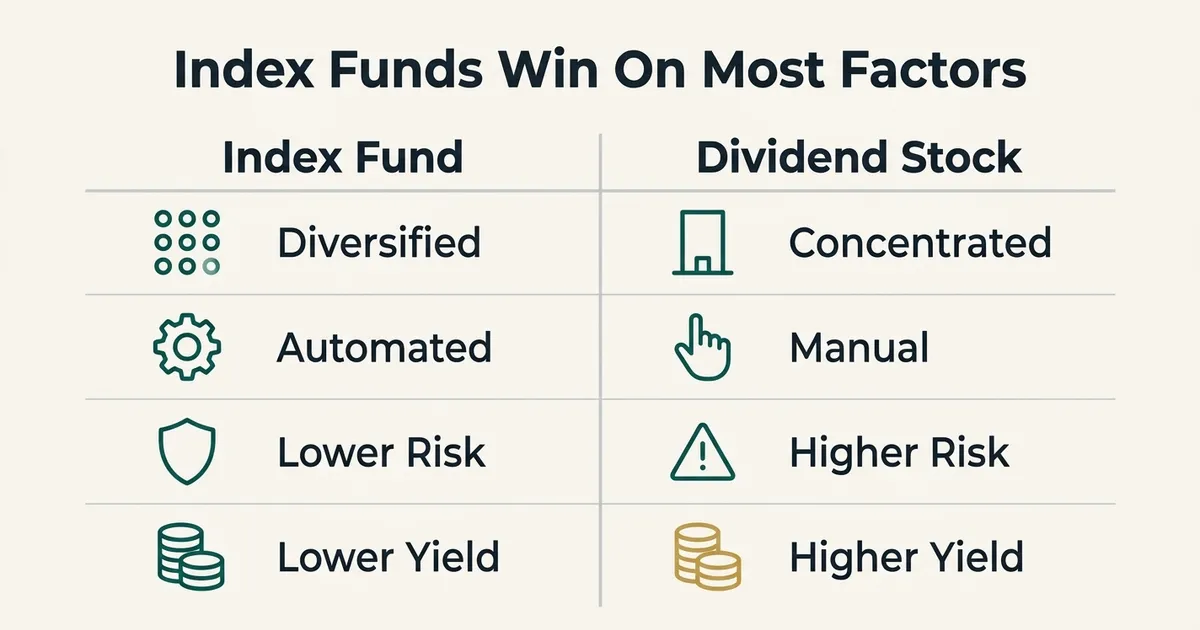
Read this table as a trade-off between yield and durability. Dividend-focused individual stocks post a higher headline yield — roughly 2.5% for the Dividend Aristocrats as a group, and more for individual high-yield names, versus about 1% for a broad S&P 500 index fund — but that extra yield is concentrated in a handful of boards whose payout decisions a parent cannot control. For a $50–$500-a-month custodial account where the goal is reliable compounding over 8–18 years rather than maximum current income, the lower, diversified yield from an index fund is the one that's less likely to get cut mid-decade.
How Does a Custodial Account Tax Index Fund Dividends?
A custodial account's dividends are taxed to the child under the federal "kiddie tax," which shifts a portion of unearned income to the parent's tax rate above a set threshold. Per IRS Revenue Procedure 2025-32 (2025) and the Instructions for Form 8615, for the 2026 tax year the first $1,350 of a child's unearned income — dividends, interest, and capital gains combined — is tax-free, the next $1,350 is taxed at the child's own rate, and anything above $2,700 is taxed at the parent's marginal rate using Form 8615. Both thresholds are indexed for inflation, but the 2026 adjustment left them unchanged from 2025, so confirm each new year's figures in that year's IRS revenue procedure rather than reusing a prior year's numbers.
Because an index fund distributes one blended 1099-DIV instead of five or ten separate ones, it also simplifies the figures a parent carries onto the child's return and Form 8615 each spring. In California, the custodial account itself is governed by the Uniform Transfers to Minors Act: per California Probate Code Section 3920.5, the default transfer age is 18, but the person funding the account can elect an extension to 21 at the time the account is opened. Other states set their own UTMA/UGMA transfer ages and some allow an extension to 25 — verify the exact statute in your state before assuming California's 18/21 split applies. FINRA (2024) confirms custodial accounts are irrevocable: once a parent deposits money as custodian, it legally belongs to the child and must be managed solely for the child's benefit, which is a separate structural question from whether to use a brokerage account or a 529 plan — compared directly in custodial account vs. 529 plan.
What Does $200 a Month Look Like in Index Funds vs. Dividend Stocks?
A $200 monthly contribution into a diversified index fund has historically compounded faster than the same amount spread across a handful of high-yield dividend stocks, mainly because lower fees and reinvested dividends both compound without interruption. Illustratively, using the S&P 500's commonly cited long-run average annual total return of roughly 10% (dividends reinvested) since its 1957 launch, $200 invested monthly for 10 years grows to approximately $41,000 before any taxes, assuming returns match that long-run historical average — a hypothetical, not a guarantee, since actual 10-year windows vary widely.
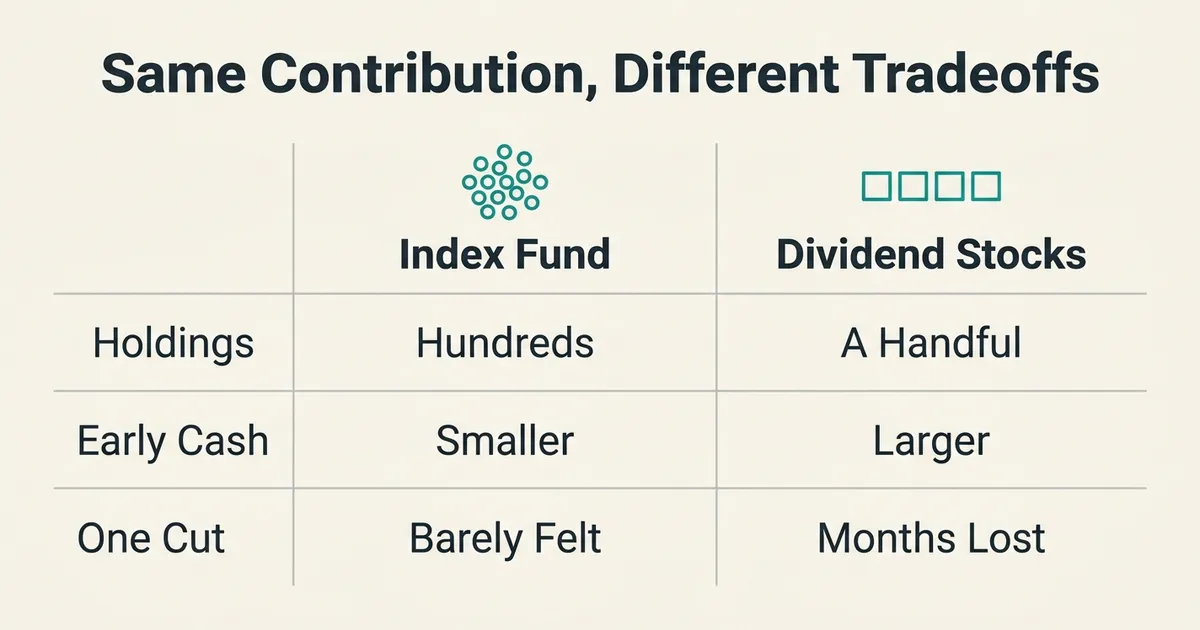
Running the same $200 a month through five individual dividend stocks yielding a combined average of 3% adds more current cash to reinvest early on, but a single dividend cut at any one holding — common during sector-specific downturns — can reduce the reinvested amount for months at a time. According to Hartford Funds (2026), dividend income contributed an average of 33% of the S&P 500's total return from 1940 through 2025, which means an index fund investor still captures most of that dividend effect without betting on which five companies keep raising their payout.
When Should You Pick Dividend Stocks Over Index Funds for Your Kid's Portfolio?
Choose individual dividend stocks only as a small satellite position once a low-cost index fund already anchors most of the custodial account — not as the sole holding. Pick dividend stocks if your goal is teaching a child to read an annual report and track a specific company's payout history over years; pick an index fund if the goal is maximizing risk-adjusted growth on $50–$500 a month with minimal ongoing attention.
Do not build a custodial account around five or fewer dividend stocks if the account is meant to fund extracurriculars or college costs on a fixed timeline, because a payout cut at one holding directly reduces the cash available on that timeline. Parents who do want direct stock exposure alongside an index-fund core can screen candidates using the criteria in best dividend stocks for a custodial account, which covers payout-history length and dividend-coverage ratios rather than yield alone.
How Do You Automate Index Fund Investing in a Custodial Brokerage Account?
Set a recurring automatic investment on the custodial account's chosen index fund, dated to land a day or two after each paycheck or child-benefit deposit clears, so the purchase never competes with available cash. Most major brokers support fractional-share recurring buys: per Fidelity (2026), fractional investing in stocks and ETFs starts at $1, and per Charles Schwab (2026), its own index mutual funds carry no investment minimum — either is low enough to automate a $50 monthly contribution without leaving cash uninvested.
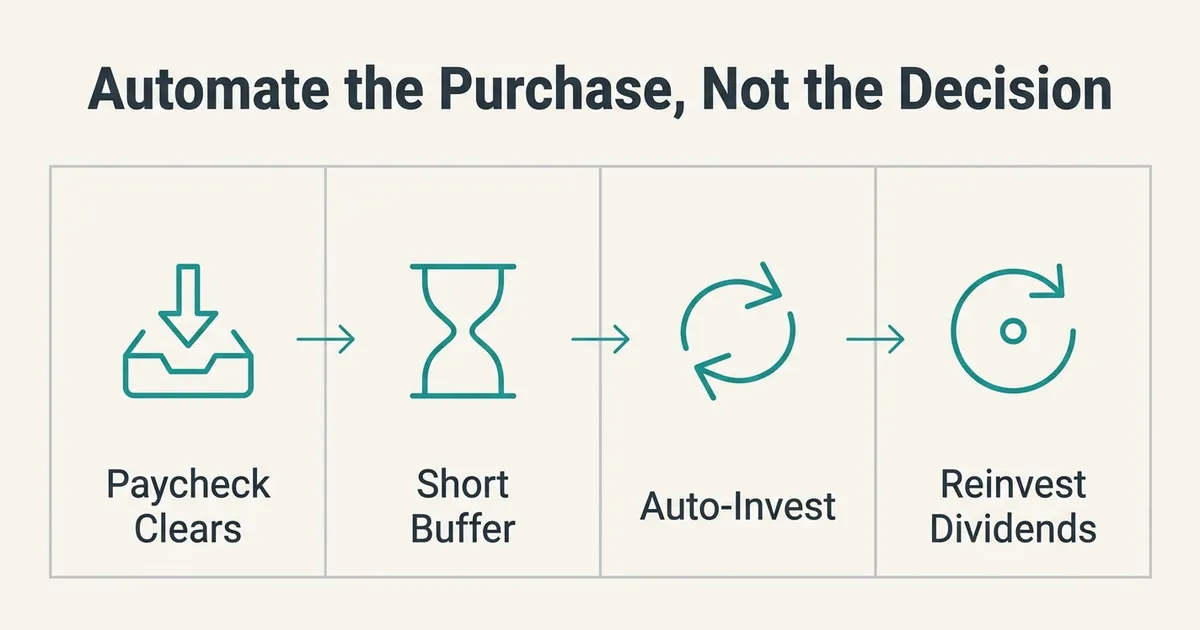
Reinvest every dividend automatically through the broker's dividend reinvestment program (DRIP) rather than letting cash sit in the settlement fund, because uninvested dividend cash earns nothing while the market continues compounding around it. The full mechanics of setting up and auditing a DRIP schedule inside a custodial account are covered in DRIP auto-compounding setup. For the broader framework of building a custodial dividend-income strategy from account selection through tax filing, start at the family dividend investing pillar.
Disclaimer: This article is for general educational purposes and is not individualized tax, legal, or investment advice. Tax thresholds adjust annually — confirm current-year figures with the IRS and your state's UTMA/UGMA statute before acting.
Frequently asked questions
What are the top 5 index funds?
There is no single official "top 5," but among the largest US index funds by net assets, per Morningstar (2025), are the Vanguard 500 Index Fund (VFIAX/VOO), Fidelity 500 Index Fund (FXAIX), SPDR S&P 500 ETF Trust (SPY), Vanguard Morningstar Total Stock Market Index Fund (VTSAX/VTI, renamed from Vanguard Total Stock Market in July 2026), and iShares Core S&P 500 ETF (IVV). All five track a broad US market benchmark; four charge between 0.015% and 0.04%, per Vanguard (2026) and Fidelity (2026), while SPY charges about 0.09%, making the ranking among them less important for a custodial account than confirming the fund tracks a diversified index rather than a narrow sector.
What if I invested $1,000 in S&P 500 10 years ago?
Using the S&P 500's long-run average annual total return of roughly 10% (dividends reinvested) since its 1957 launch as an illustrative baseline, $1,000 compounding at that average rate for 10 years would grow to approximately $2,590. This is a hypothetical projection based on a multi-decade average, not an actual quoted 10-year return — real 10-year periods have ranged from negative to over 15% annualized, so treat this as an illustration of compounding, not a forecast.
Are index funds a good investment?
Index funds are a good core investment for most long-term goals, including custodial accounts, because they combine low cost with broad diversification and have historically outperformed most actively managed alternatives after fees. Per the S&P Dow Jones Indices SPIVA U.S. Scorecard (Year-End 2025), 79% of active large-cap US equity funds underperformed the S&P 500 in 2025 alone, and fees are a large part of the long-run gap: Morningstar's Annual US Fund Fee Study (2026) put the 2025 asset-weighted average expense ratio at 0.57% for actively managed funds versus 0.10% for passive funds.
Which are the best index funds?
The best index fund for a custodial account is the lowest-cost fund tracking the broadest benchmark available at your broker, rather than one chasing a specific sector or theme. Fidelity's FXAIX charges 0.015% and Vanguard's VTI charges 0.03%, per Fidelity (2025) and Vanguard (2025) respectively, and both track hundreds of US companies — for a child's account with an 8-to-18-year horizon, that broad, cheap exposure typically outperforms narrower or more expensive alternatives after fees compound over time.
Index funds vs ETF: what's the difference for a custodial account?
An index fund is a strategy — tracking a benchmark — while an ETF (exchange-traded fund) is one of two structures that strategy can take, the other being a traditional index mutual fund; the two trade differently but can track the identical index. Per Vanguard (2025), ETFs use an in-kind creation and redemption mechanism that typically generates fewer taxable capital gains distributions than an equivalent mutual fund, which matters less for kiddie-tax purposes since dividends are taxed either way, but ETFs also trade all day at market prices while mutual funds settle once daily at net asset value.
Index funds vs mutual funds: which is better for a child's account?
An index fund can be built as either an index mutual fund or an index ETF, so the real comparison is index strategy versus active-management strategy, not index versus mutual fund as separate categories. Per Morningstar's Annual US Fund Fee Study (2026), actively managed funds charged an asset-weighted average of 0.57% in 2025 versus 0.10% for passive funds — on a $10,000 custodial balance, that 0.47-point gap is about $47 a year, or roughly $470 over 10 years before counting the growth those fees would have earned, making low-cost index mutual funds or ETFs the more efficient choice for most custodial accounts.