Onchain Source: USDC Terms (updated Oct 15, 2026) 6 min read
Your stablecoin dollars earn interest. Who gets it?

Contents
Digby's Field Note
Once the GENIUS Act takes effect (by Jan 18, 2027 at the latest), a permitted stablecoin issuer will have to publish what backs its coins every month and have a registered public accounting firm examine that report. That's the report I'll read before I look at the price.
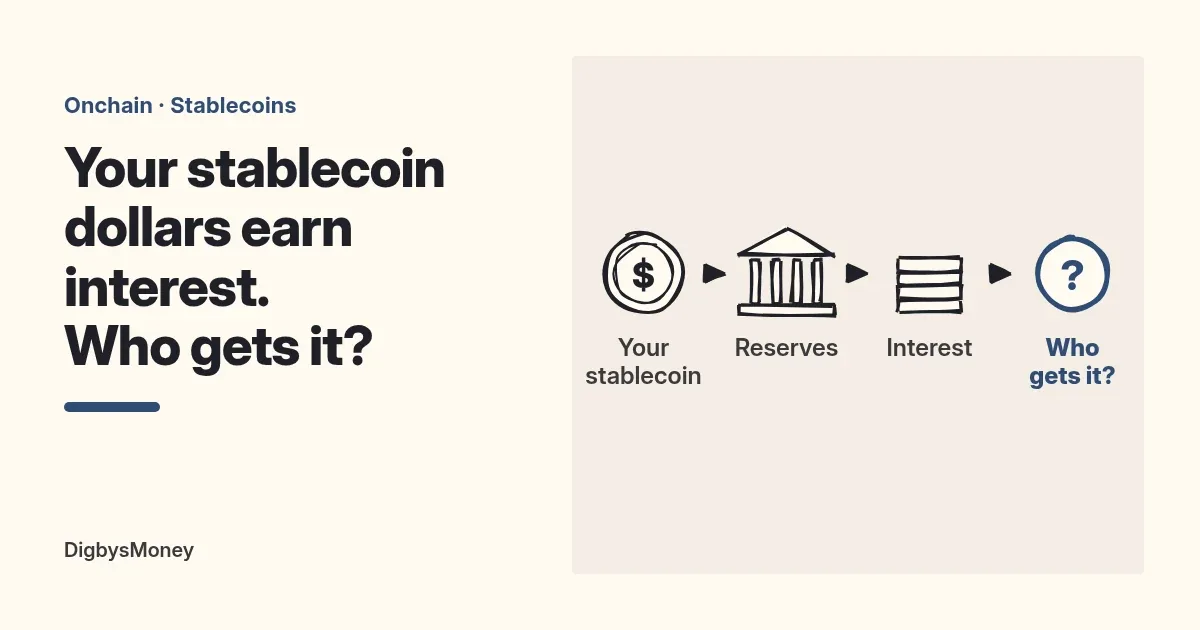
Who receives the interest on stablecoin reserves?
The dollars behind USDC sit in reserves that can earn interest. Under Circle's USDC Terms, that reserve income belongs to Circle, the issuer, not to the people holding the coin. Part of Circle's revenue then goes out as distribution and transaction costs. Digby dug into Circle's third-quarter results to follow that money.
Where does a stablecoin dollar go?
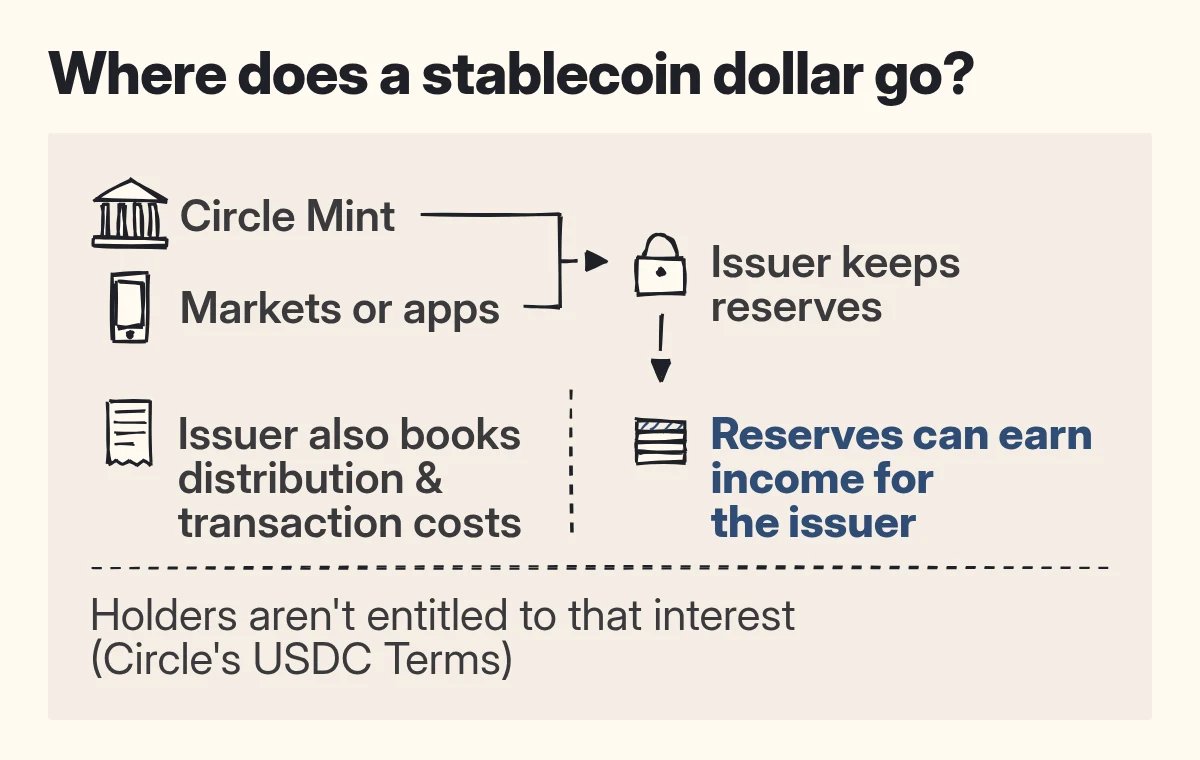
A rough path, using Circle's own labels and USDC Terms:
- How someone gets USDC. Eligible Circle Mint customers can have USDC issued for USD (and redeem USDC for USD) with Circle. Holders can instead buy or receive USDC in secondary markets or apps without being Circle Mint customers. Circle's terms say each USDC is intended to maintain a value of 1 USD and that Circle commits to redeem 1 USDC for 1 USD for eligible Mint users, subject to the Terms, law, and fees — that is not the same as a guarantee that every secondary purchase happens at exactly $1.1
- Issuer (here, Circle) keeps reserves behind the coin.
- Those reserves can earn reserve income (interest and similar return on the reserve assets). That income shows up on the issuer's income statement.
- The issuer also books distribution and transaction costs — a cost line that includes payments meant to get distributors to use and spread the coin, plus transaction costs. Digby treats that line as a mixed cost bucket, not as a partner-by-partner payout schedule.
Circle's USDC Terms state that while reserves may sit in interest-bearing or other yield-generating instruments, holders are not entitled to that interest, and that USDC does not itself generate interest or return for holders.1 Digby is not saying USDC is a bank deposit or a savings product — only that reserve interest is the issuer's under those Terms.
What Circle's Q3 filing shows (as of Nov 4, 2026)
Primary source: Circle Internet Group 8-K filed Nov 4, 2026, Exhibit 99.1, Circle Reports Third Quarter 2026 Results (printed page numbers below).2 The Q3 10-Q was not relied on for this note.
| Figure | Q3 2026 | What the release says |
|---|---|---|
| Reserve income | $658M ($657,624K) | Down 8% year over year, "primarily from a 61 bps decline in the Reserve Return Rate" (p.4; p.9)2 |
| Reserve return rate | 3.5% | Down 61 bps year over year (Key Operating Indicators, p.3)2 |
| Total revenue and reserve income | $865M ($864,888K) | Up 17% year over year (p.1, p.3, p.9)2 |
| Of that total: ARC token presale | $182M | Inside Other Revenue of $207M, which "increased 627% year-over-year from the ARC token presale ($182 million)" (p.4; p.9)2 |
| Distribution and transaction costs | $409.2M ($409,169K) | Statements of Operations (p.9).2 Separate from the broader "Total Distribution, Transaction and Other Costs" headline of $412M (p.4; p.9 $411,634K)2 |
| USDC in circulation, end of period | $73.9B | 0% year over year / flat (p.3).2 Digby does not compare this to any Q2 end-of-period figure here.2 |
Digby's math on the cost share
Using the release's own $182M attribution to the ARC token presale:2
- $409.169M ÷ $864.888M ≈ 47.3% of the $865M headline total.2
- $409.169M ÷ ($864.888M − $182M) ≈ 59.9% after subtracting the $182M the release attributes to the ARC token presale.2
Digby labels both as writer math, not Circle's stated percentages. Digby also does not call the ARC token presale "one-time": the release does not use that word; FY26 guidance still counts "recognized ARC token presale revenue" (p.5 fn 3), and the forward-looking section mentions possible repayment obligations tied to launch milestones (p.6–7).2
What the cost line is — and is not
From Circle's earlier Q2 2026 10-Q (filed Aug 5, 2026; used only for the cost-line description, not for Q3 dollars): Circle says it incurs distribution costs "to incentivize distributors to use and distribute our stablecoins, for example, Coinbase, Binance, and others," and that under its Collaboration Agreement Coinbase's allocations depend in part on USDC held on Coinbase's platform.3 That explains why a distribution line exists. It does not let Digby turn Q3's $409.2M distribution and transaction costs into a named partner's check.2 The Q3 release does not split that line by partner.2
Why the interest usually does not land with the holder
Today (as of these facts): under Circle's USDC Terms, holders are not entitled to interest or other returns earned on the reserves.1 Reserve income is recorded by the issuer. Separate apps or platforms may run their own rewards programs; those are not the same as the issuer paying yield on the coin, and this note is not a survey of every third-party program.
Looking ahead: a federal payment-stablecoin rule set often called the GENIUS Act will bar permitted and foreign payment stablecoin issuers from paying holders interest or yield solely for holding, using, or keeping the coin. Digby quotes the ban narrowly:
"No permitted payment stablecoin issuer or foreign payment stablecoin issuer shall pay the holder of any payment stablecoin any form of interest or yield (whether in cash, tokens, or other consideration) solely in connection with the holding, use, or retention of such payment stablecoin."
The Act was approved July 18, 2025. By §20 it takes effect on the earlier of 18 months after enactment or 120 days after the primary federal payment stablecoin regulators issue final implementing regulations.4 The OCC states that the final rule and the GENIUS Act take effect on January 18, 2027.5 Digby is not treating that future ban as the reason USDC holders do not receive reserve interest today.
The OCC's final GENIUS implementing rule (FR Doc. 2026-21706, published Oct 23, 2026) discusses that same yield prohibition.6 In the preamble the OCC says it determined to eliminate the rebuttable presumption that had been in the proposal, and that it retains authority to address evasion of section 4 of the Act, including the yield prohibition (91 FR 67026–67027).6 Digby is not restating the whole rulebook here.
Digby leaves application-window status and other deadlines out of this note; those need a fresh check on publish day.
What Digby is still watching
- Whether Circle's Q3 10-Q restates the $182M ARC token presale or splits distribution and transaction costs more finely.2
- How the Jan 18, 2027 effective date shows up in issuer disclosures once applications and compliance language firm up.5
Related reading
No credentials
The person behind DigbysMoney holds no financial credentials, so please check anything that matters to you with a qualified professional.
Sources
- Circle. USDC Terms (updated Oct 15, 2026) Data as of . Accessed .
- Circle Internet Group. Circle Reports Third Quarter 2026 Results (Exhibit 99.1 to Form 8-K) Data as of . Accessed .
- Circle Internet Group. Circle Q2 2026 Form 10-Q Data as of . Accessed .
- U.S. Government Publishing Office (govinfo). GENIUS Act, Public Law 119-27, §4(a)(11) and §20 Data as of . Accessed .
- Office of the Comptroller of the Currency. OCC News Release NR 2026-92 Data as of . Accessed .
- Office of the Comptroller of the Currency (Federal Register). OCC final rule implementing the GENIUS Act, FR Doc. 2026-21706, 91 FR 67000 Data as of . Accessed .
- Circle Internet Group (SEC EDGAR). Form 8-K filing index, filed Nov 4, 2026 Data as of . Accessed .